South Korea Tunnel Boring Machine Market Size Growth Rate
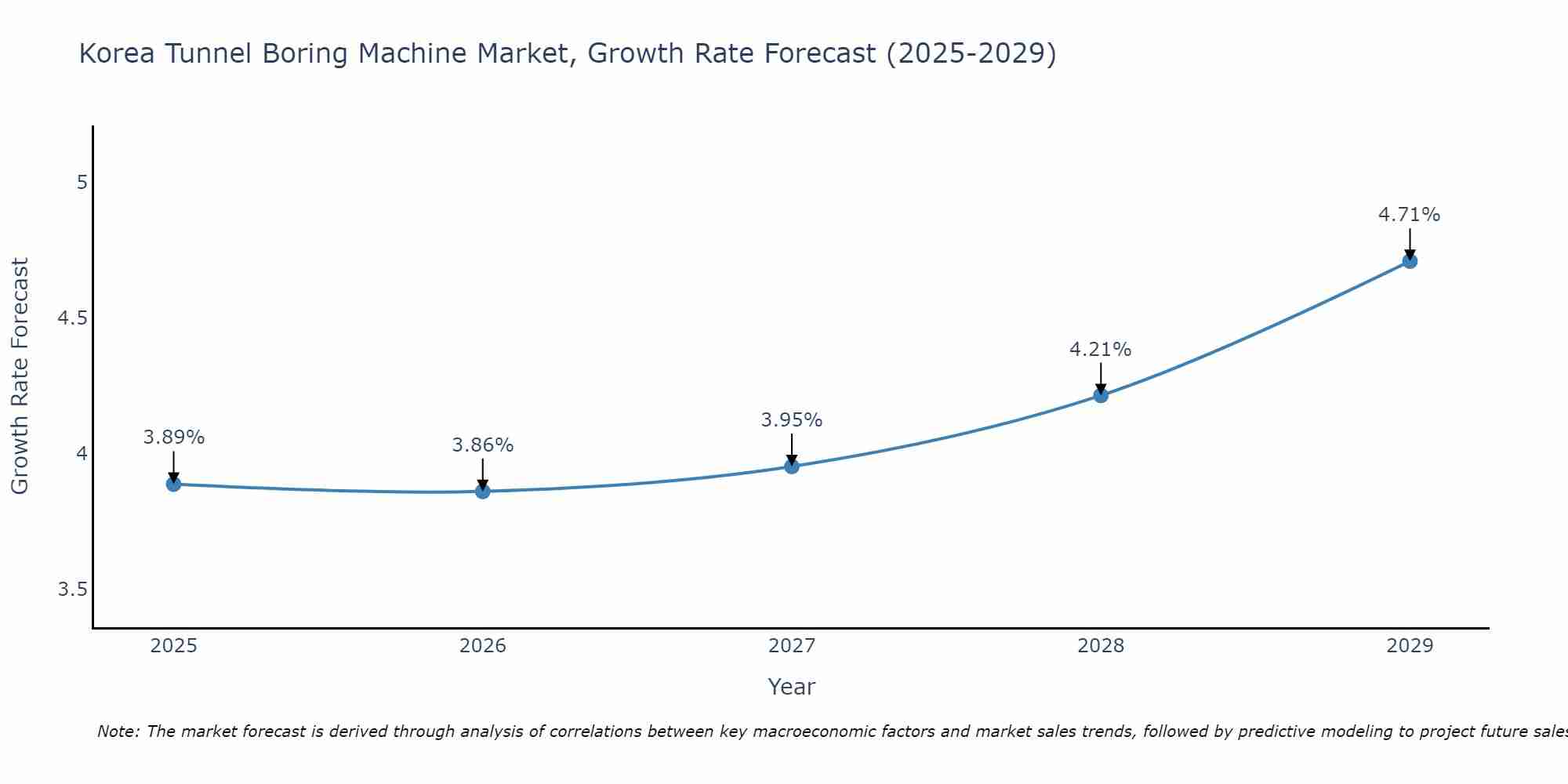
The South Korea Tunnel Boring Machine Market is projected to witness mixed growth rate patterns during 2025 to 2029. Commencing at 3.89% in 2025, growth builds up to 4.71% by 2029.
South Korea Tunnel Boring Machine Market Overview
The tunnel boring machine market in South Korea includes machines used for excavating tunnels through soil and rock. This market supports large-scale infrastructure projects such as subways, highways, and water tunnels, facilitating efficient and safe underground construction.
Drivers of the market
The South Korea Tunnel Boring Machine market is experiencing growth due to increased investments in infrastructure projects such as subway expansions, underground utilities, and tunnel construction for transportation networks. Tunnel boring machines offer efficiency and precision in excavating tunnels through various geological conditions, reducing project timelines and costs. Government initiatives to improve urban mobility and connectivity drive market expansion.
Challenges of the market
The tunnel boring machine (TBM) market in South Korea faces challenges such as project delays, cost overruns, and technical complexities. TBMs, used in various infrastructure projects such as tunnels, subways, and underground utilities, face challenges related to ground conditions, geological uncertainties, and construction risks. Moreover, ensuring TBM reliability, performance, and safety in challenging underground environments poses challenges for TBM manufacturers and operators. Additionally, regulatory compliance and permitting processes impact project timelines and investment decisions, requiring collaboration between government agencies, contractors, and technology suppliers to address market challenges.
Government Policy of the market
Government policies in South Korea regarding the tunnel boring machine market may aim to support infrastructure development, technological innovation, and safety standards. These policies may include funding for tunneling projects, regulatory frameworks for machine safety and performance, and support for research and development in tunneling technology. Additionally, the government may implement measures to promote local manufacturing capabilities and facilitate international collaboration to address technical challenges in tunnel construction.
Key Highlights of the Report:
- South Korea Tunnel Boring Machine Market Outlook
- Market Size of South Korea Tunnel Boring Machine Market, 2021
- Forecast of South Korea Tunnel Boring Machine Market, 2028
- Historical Data and Forecast of South Korea Tunnel Boring Machine Revenues & Volume for the Period 2018 - 2028
- South Korea Tunnel Boring Machine Market Trend Evolution
- South Korea Tunnel Boring Machine Market Drivers and Challenges
- South Korea Tunnel Boring Machine Price Trends
- South Korea Tunnel Boring Machine Porter's Five Forces
- South Korea Tunnel Boring Machine Industry Life Cycle
- Historical Data and Forecast of South Korea Tunnel Boring Machine Market Revenues & Volume By Machine Type for the Period 2018 - 2028
- Historical Data and Forecast of South Korea Tunnel Boring Machine Market Revenues & Volume By Slurry TBM for the Period 2018 - 2028
- Historical Data and Forecast of South Korea Tunnel Boring Machine Market Revenues & Volume By Earth Pressure Balance Shield TBM for the Period 2018 - 2028
- Historical Data and Forecast of South Korea Tunnel Boring Machine Market Revenues & Volume By Shielded TBM for the Period 2018 - 2028
- Historical Data and Forecast of South Korea Tunnel Boring Machine Market Revenues & Volume By Multi-Mode TBM for the Period 2018 - 2028
- Historical Data and Forecast of South Korea Tunnel Boring Machine Market Revenues & Volume By Others for the Period 2018 - 2028
- Historical Data and Forecast of South Korea Tunnel Boring Machine Market Revenues & Volume By Geology Type for the Period 2018 - 2028
- Historical Data and Forecast of South Korea Tunnel Boring Machine Market Revenues & Volume By Soft Ground for the Period 2018 - 2028
- Historical Data and Forecast of South Korea Tunnel Boring Machine Market Revenues & Volume By Hard Rock Ground for the Period 2018 - 2028
- Historical Data and Forecast of South Korea Tunnel Boring Machine Market Revenues & Volume By Heterogenous Ground for the Period 2018 - 2028
- Historical Data and Forecast of South Korea Tunnel Boring Machine Market Revenues & Volume By Variable Ground for the Period 2018 - 2028
- Historical Data and Forecast of South Korea Tunnel Boring Machine Market Revenues & Volume By End-users for the Period 2018 - 2028
- Historical Data and Forecast of South Korea Tunnel Boring Machine Market Revenues & Volume By Road Transport for the Period 2018 - 2028
- Historical Data and Forecast of South Korea Tunnel Boring Machine Market Revenues & Volume By Railway Transport for the Period 2018 - 2028
- Historical Data and Forecast of South Korea Tunnel Boring Machine Market Revenues & Volume By Metro & Transit for the Period 2018 - 2028
- Historical Data and Forecast of South Korea Tunnel Boring Machine Market Revenues & Volume By Utilities for the Period 2018 - 2028
- Historical Data and Forecast of South Korea Tunnel Boring Machine Market Revenues & Volume By Mining for the Period 2018 - 2028
- Historical Data and Forecast of South Korea Tunnel Boring Machine Market Revenues & Volume By Oil & Gas for the Period 2018 - 2028
- Historical Data and Forecast of South Korea Tunnel Boring Machine Market Revenues & Volume By Others for the Period 2018 - 2028
- South Korea Tunnel Boring Machine Import Export Trade Statistics
- Market Opportunity Assessment By Machine Type
- Market Opportunity Assessment By Geology Type
- Market Opportunity Assessment By End-users
- South Korea Tunnel Boring Machine Top Companies Market Share
- South Korea Tunnel Boring Machine Competitive Benchmarking By Technical and Operational Parameters
- South Korea Tunnel Boring Machine Company Profiles
- South Korea Tunnel Boring Machine Key Strategic Recommendations






































