South Korea Underground Mining Equipment Market Size, Share & Growth Rate
The South Korea Underground Mining Equipment Market was estimated at USD 468 Million in 2025 and is projected to reach USD 656 Million by 2032, growing at a CAGR of 4.9% from 2026 to 2032. This growth trajectory is primarily driven by the expansion of mining operations throughout the country, alongside a rising demand for advanced equipment that enhances both productivity and safety within underground environments. As South Korea diversifies its resource extraction strategies, the focus on innovative mining technologies will play a pivotal role in shaping the market's evolution.
South Korea Underground Mining Equipment Market Year-wise Growth Rate and Key Drivers
This graph highlights how the South Korea Underground Mining Equipment Market has steadily grown over the years, supported by major growth factors.
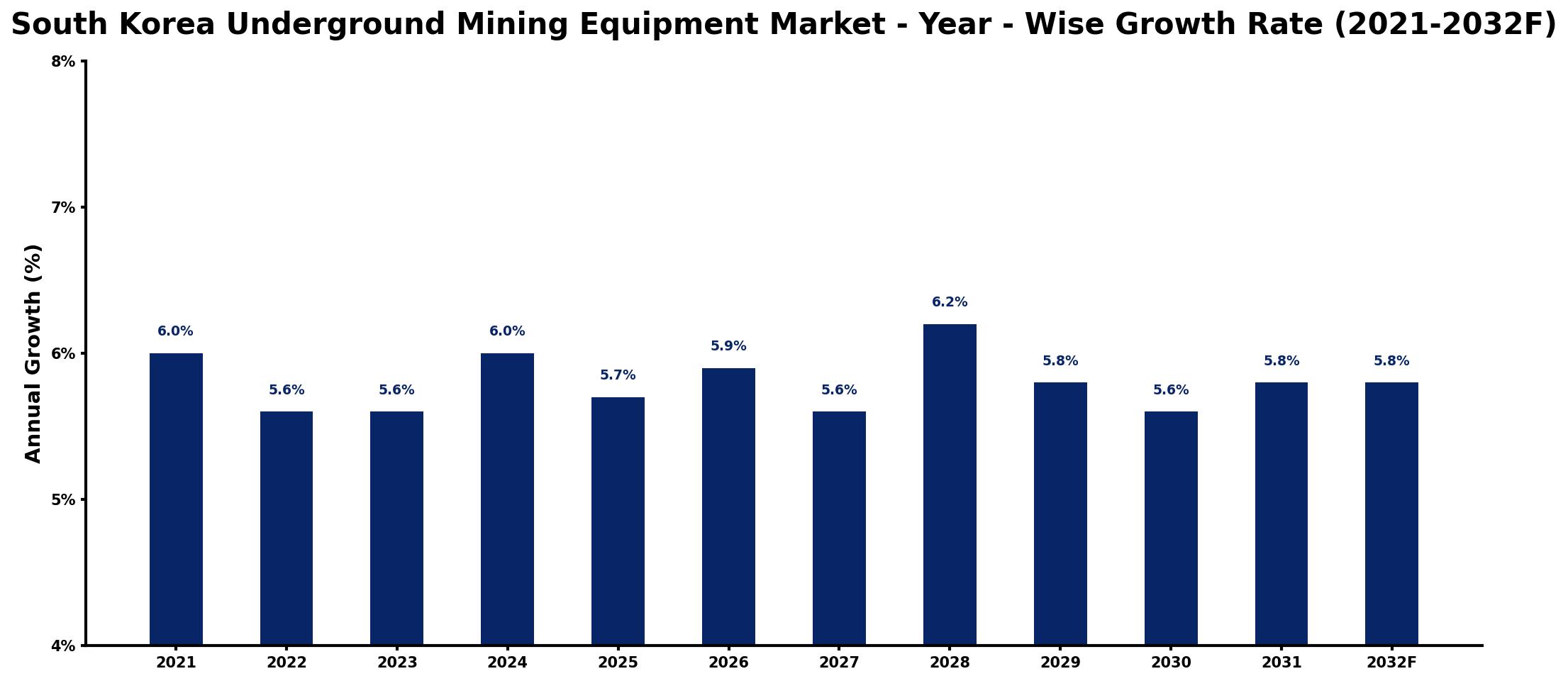
The table below presents the year‑wise growth rates along with the key drivers influencing the market
| Year | Growth Rate | Major Drivers |
| 2021 | 6.0% | Rising demand for natural resources |
| 2022 | 5.6% | Increased investments in infrastructure |
| 2023 | 5.6% | Adoption of automation technologies |
| 2024 | 6.0% | Expansion of renewable energy projects |
| 2025 | 5.7% | Growing focus on sustainability practices |
| 2026 | 5.9% | Surge in global mineral consumption |
| 2027 | 5.6% | Enhanced safety regulations implementation |
| 2028 | 6.2% | Technological advancements driving efficiency |
| 2029 | 5.8% | strengthening underlying market demand |
| 2030 | 5.6% | Strengthened international trade agreements |
| 2031 | 5.8% | Diversification of resource supply chains |
| 2032 | 5.8% | Growing urbanization driving resource needs |
Note: Market size estimations and growth projections presented in this report are based on 6Wresearch's proprietary forecasting methodology, utilizing the latest available industry data, government publications, and primary research inputs.
South Korea Underground Mining Equipment Market Synopsis
In South Korea, the demand for underground mining equipment is witnessing significant upsurge due to increased investment in mineral exploration and resource diversification initiatives. The adoption of advanced machinery such as automated loaders and state-of-the-art drills is critical in addressing the challenges of ore extraction efficiently.
The market's dynamics are also influenced by safety regulations that compel operators to utilize cutting-edge technologies to ensure compliant and secure mining practices. This requirement creates an inherent need for innovative equipment that can meet stringent industry standards while maintaining operational effectiveness.
South Korea Underground Mining Equipment Market Key Takeaways
- The market is driven by ongoing mining activities and the need for modern equipment.
- Government initiatives are supporting advancements in mining technology.
- Safety and environmental regulations are shaping equipment development priorities.
- Market competition is fostering innovation in product offerings.
- Strategic partnerships are essential for addressing technological challenges.
Evaluation of Restraints in South Korea Underground Mining Equipment Market
Despite its growth potential, the South Korea Underground Mining Equipment Market faces notable restraints. Chief among these are rapid technological advancements, which require manufacturers to continuously invest in research and development to stay competitive. Additionally, stringent safety regulations impose high standards on equipment design and functionality. These factors, combined with fluctuating market conditions and economic uncertainties, can hinder investment and slow market penetration for new innovations.
South Korea Underground Mining Equipment Market Trends
Emerging trends indicate a significant shift toward automation and smart mining technologies in the South Korean market. The integration of IoT and AI into mining equipment is enhancing operational efficiency and safety, allowing for remote monitoring and predictive maintenance. Furthermore, there is an increasing focus on sustainable mining practices, with companies investing in eco-friendly equipment that minimizes environmental impact while maximizing resource recovery.
South Korea Underground Mining Equipment Market Opportunities
The South Korea Underground Mining Equipment Market presents substantial growth opportunities, particularly for companies that innovate in automation and sustainable practices. The country's push for advanced mineral exploration opens new avenues for equipment manufacturers who can provide cutting-edge solutions. Additionally, as mining operations expand, the demand for robust and reliable machinery that enhances productivity will continue to rise, creating fertile ground for new entrants and established players alike.
Government Initiatives in the South Korea Underground Mining Equipment Market
The South Korean government plays a crucial role in shaping the underground mining equipment landscape through stringent safety regulations and support for technological advancements. Initiatives aimed at enhancing industry competitiveness include funding for research and development, along with incentives for companies that invest in innovative mining solutions. The governments focus on establishing safety standards further drives the demand for state-of-the-art equipment designed to meet these requirements.
Future Insights of the South Korea Underground Mining Equipment Market
Looking ahead, the South Korea Underground Mining Equipment Market is poised for notable transformation from 2026 to 2032. The anticipated growth in resource extraction and mineral exploration activities will drive demand for advanced mining equipment. With a clear emphasis on innovation, sustainability, and safety, the market will likely witness an influx of new technologies that not only enhance productivity but also ensure compliance with evolving regulatory standards.
South Korea Underground Mining Equipment Market Latest Developments (2025 - 2026)
Recent developments within the South Korea Underground Mining Equipment Market highlight a robust focus on technological enhancements and strategic partnerships among industry stakeholders. Companies are increasingly embracing automation and smart technologies to improve efficiency and reduce operational risks. Collaboration between equipment manufacturers and mining operators is becoming more common as both sectors aim to tackle technical challenges and embrace innovative solutions that align with safety and environmental standards.
South Korea Underground Mining Equipment Market - Key Attractiveness of the Report
- 10 Years of Market Numbers
- Historical Data Starting from 2022 to 2025
- Base Year: 2025
- Forecast Data until 2032
- Key Performance Indicators Impacting the Market
- Major Upcoming Developments and Projects
Key Highlights of the Report:
- South Korea Underground Mining Equipment Market Outlook
- Market Size of South Korea Underground Mining Equipment Market, 2025
- Forecast of South Korea Underground Mining Equipment Market, 2032
- Historical Data and Forecast of South Korea Underground Mining Equipment Revenues & Volume for the Period 2022-2032F
- South Korea Underground Mining Equipment Market Trend Evolution
- South Korea Underground Mining Equipment Market Drivers and Challenges
- South Korea Underground Mining Equipment Price Trends
- South Korea Underground Mining Equipment Porter's Five Forces
- South Korea Underground Mining Equipment Industry Life Cycle
- Historical Data and Forecast of South Korea Underground Mining Equipment Market Revenues & Volume By Product Type for the Period 2022-2032F
- Historical Data and Forecast of South Korea Underground Mining Equipment Market Revenues & Volume By Mining Loaders for the Period 2022-2032F
- Historical Data and Forecast of South Korea Underground Mining Equipment Market Revenues & Volume By Mining Trucks for the Period 2022-2032F
- Historical Data and Forecast of South Korea Underground Mining Equipment Market Revenues & Volume By Mining Drills for the Period 2022-2032F
- Historical Data and Forecast of South Korea Underground Mining Equipment Market Revenues & Volume By Mining Bolters for the Period 2022-2032F
- Historical Data and Forecast of South Korea Underground Mining Equipment Market Revenues & Volume By Mining Shearer for the Period 2022-2032F
- Historical Data and Forecast of South Korea Underground Mining Equipment Market Revenues & Volume By Continuous Miners for the Period 2022-2032F
- Historical Data and Forecast of South Korea Underground Mining Equipment Market Revenues & Volume By Mining Excavators & Shovels for the Period 2022-2032F
- Historical Data and Forecast of South Korea Mining Loaders Underground Mining Equipment Market Revenues & Volume By Mining Scalers for the Period 2022-2032F
- Historical Data and Forecast of South Korea Underground Mining Equipment Market Revenues & Volume By Mining Technique for the Period 2022-2032F
- Historical Data and Forecast of South Korea Underground Mining Equipment Market Revenues & Volume By Soft Rock Mining for the Period 2022-2032F
- Historical Data and Forecast of South Korea Underground Mining Equipment Market Revenues & Volume By Hard Rock Mining for the Period 2022-2032F
- Historical Data and Forecast of South Korea Underground Mining Equipment Market Revenues & Volume By End Users for the Period 2022-2032F
- Historical Data and Forecast of South Korea Underground Mining Equipment Market Revenues & Volume By Mining Operators for the Period 2022-2032F
- Historical Data and Forecast of South Korea Underground Mining Equipment Market Revenues & Volume By Rental Service Provider for the Period 2022-2032F
- South Korea Underground Mining Equipment Import Export Trade Statistics
- Market Opportunity Assessment By Product Type
- Market Opportunity Assessment By Mining Technique
- Market Opportunity Assessment By End Users
- South Korea Underground Mining Equipment Top Companies Market Share
- South Korea Underground Mining Equipment Competitive Benchmarking By Technical and Operational Parameters
- South Korea Underground Mining Equipment Company Profiles
- South Korea Underground Mining Equipment Key Strategic Recommendations






































