South Korea Underground Utility Mapping Market Size & Growth Rate (2026-2032)
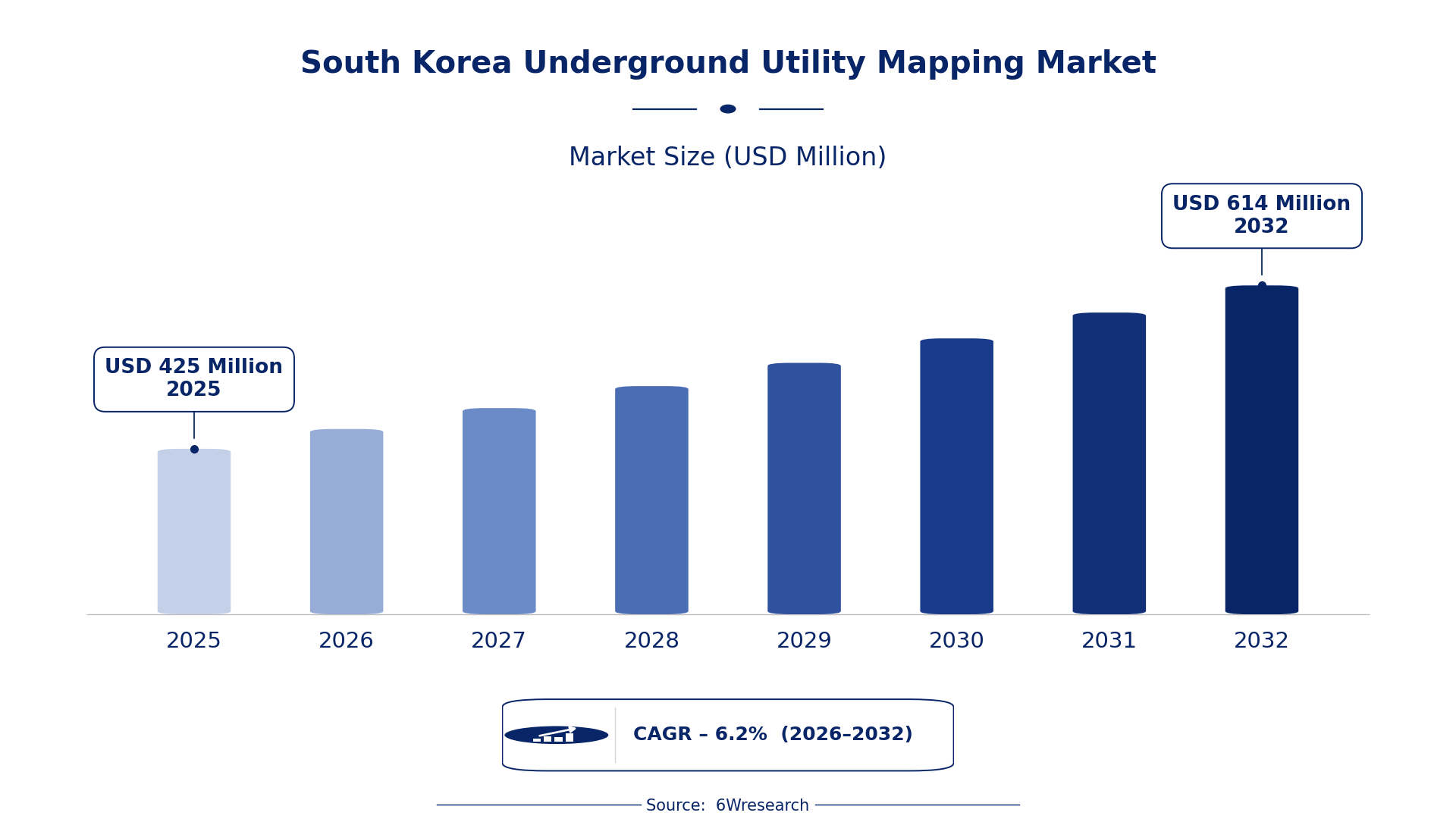
The South Korea Underground Utility Mapping Market was estimated at USD 425 Million in 2025 and is projected to reach USD 614 Million by 2032, growing at a CAGR of 6.2% from 2026 to 2032.
South Korea Underground Utility Mapping Market Synopsis
The South Korea Underground Utility Mapping Market is witnessing a surge, driven by the urgent need for precise mapping amid rapid urbanization and extensive infrastructure projects. As cities expand and evolve, the demand for accurate underground utility data becomes critical, pushing the market towards innovative mapping technologies.
Looking ahead, the market is set to grow as regulatory pressures increase for safety standards and data accuracy. The advent of advanced technologies such as ground penetrating radar and electromagnetic induction will further enhance mapping capabilities, ensuring that infrastructure remains intact during construction and renovation.
South Korea Underground Utility Mapping Market Year-wise Growth Rate and Key Drivers
This graph illustrates the annual growth rates of the South Korea Underground Utility Mapping Market from 2021 to 2032, highlighting a steady upward trajectory and projected expansion over the forecast period.
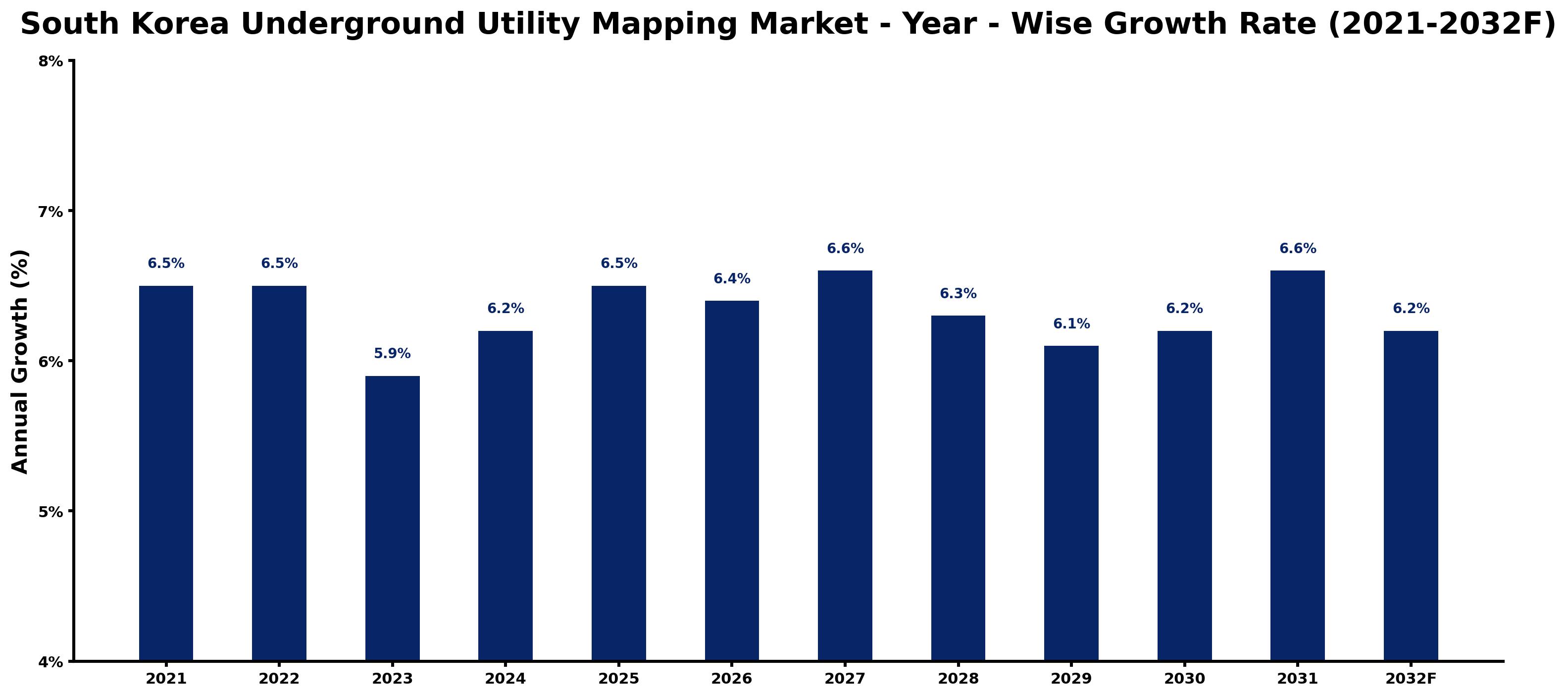
The table below presents the year‑wise growth rates along with the key drivers influencing the market
| Year | Growth Rate | Major Drivers |
| 2021 | 6.5% | Government's Smart City project enhancing utility mapping efforts. |
| 2022 | 6.5% | Increased construction activity demands accurate underground asset location. |
| 2023 | 5.9% | New regulations by KICT demanding better mapping technologies. |
| 2024 | 6.2% | Growing awareness of disaster management in urban areas. |
| 2025 | 6.5% | Investment in AI tools for predictive utility management. |
| 2026 | 6.4% | Rise in urban renovation projects requiring detailed utility surveys. |
| 2027 | 6.6% | Local government grants promote advanced mapping technologies adoption. |
| 2028 | 6.3% | Technological collaborations improving accuracy in utility mapping services. |
| 2029 | 6.1% | Increased focus on infrastructure resilience post natural disasters. |
| 2030 | 6.2% | Regulatory push for real-time utility tracking in cities. |
| 2031 | 6.6% | Surge in public-private partnerships for urban planning initiatives. |
| 2032 | 6.2% | Increased data privacy concerns drive demand for mapping accuracy. |
Note: Market size estimations and growth projections presented in this report are based on 6Wresearch's proprietary forecasting methodology, utilizing the latest available industry data, government publications, and primary research inputs.
South Korea Underground Utility Mapping Market Key Takeaways
Below are some of the specific key takeaways from the market, including:
- Infrastructure development projects are the primary growth driver for underground utility mapping services.
- Technological advancements are improving the accuracy and efficiency of utility mapping operations.
- Data integration and visualization remain significant challenges for service providers in this sector.
- Regulatory compliance is increasingly shaping the operational landscape for mapping companies.
- Collaboration with technology providers is essential for meeting evolving customer demands.
Evaluation of Restraints in South Korea Underground Utility Mapping Market
Despite the growth potential, several constraints hinder the South Korea Underground Utility Mapping Market. High accuracy requirements for data collection and interpretation create pressure on service providers. Additionally, the challenge of integrating various data types hampers effective visualization and decision-making. The competitive environment also intensifies these issues, as companies grapple with market saturation and pricing pressures, necessitating innovative strategies to remain viable.
South Korea Underground Utility Mapping Market Trends
Several trends are currently influencing the South Korea Underground Utility Mapping Market. The push towards smart cities is leading to increased investments in advanced mapping technologies. on top of that, the rise of digital twin technology is enabling better planning and maintenance of underground utilities. Data-driven decision-making is becoming a norm, with companies increasingly relying on analytics to enhance operational efficiency and reduce risks associated with underground construction.
South Korea Underground Utility Mapping Market Opportunities
As urban infrastructure continues to expand, significant opportunities exist for mapping service providers. The growing emphasis on sustainability and safety in construction provides a fertile ground for innovative mapping solutions. Additionally, advancements in technology open doors for new applications in various sectors, including transportation, utilities, and urban planning, allowing companies to diversify their service offerings and tap into emerging markets.
Government Initiatives in the South Korea Underground Utility Mapping Market
Government policy is playing a crucial role in shaping the South Korea Underground Utility Mapping Market. With a focus on enhancing infrastructure planning and safety standards, regulatory frameworks are evolving to ensure accurate utility mapping and data sharing. These initiatives are designed to support the integration of advanced technologies in utility management, driving growth in the sector.
- A regulatory framework introduced in 2025 mandates enhanced accuracy and transparency in utility mapping.
- Current initiatives include a national infrastructure safety program aimed at improving underground utility detection and marking.
- Ongoing research and development grants are available for companies innovating in utility mapping technologies.
- Upcoming plans for a public-private partnership focused on urban renewal projects to ensure compliance with safety standards.
Future Insights of the South Korea Underground Utility Mapping Market
From 2026 to 2032, the South Korea Underground Utility Mapping Market is expected to evolve rapidly. With urbanization driving demand, mapping technologies will likely advance to meet the growing complexity of underground utility networks. Increased collaboration between government, industry, and technology providers will further enhance the market’s capabilities, fostering a safer and more efficient infrastructure environment.
South Korea Underground Utility Mapping Market Latest Developments
Recent activity in the South Korea Underground Utility Mapping Market reflects a dynamic shift towards innovation and collaboration. Companies are increasingly adopting advanced technologies to enhance mapping accuracy and efficiency. This trend is expected to continue as the market responds to evolving regulatory standards and growing infrastructure needs.
- An initiative launched in early 2025 focuses on integrating AI into utility mapping services to improve data analysis capabilities.
- A partnership between a major technology vendor and a regional operator began in mid-2025, aimed at developing advanced mapping tools.
- A comprehensive training program for utility mapping professionals was completed in late 2025 to elevate industry standards.
- Plans for a technology rollout expected to begin in Q3 2026 will introduce new tools for real-time utility mapping and monitoring.
South Korea Underground Utility Mapping Market - Key Attractiveness of the Report
- 10 Years of Market Numbers
- Historical Data Starting from 2022 to 2025
- Base Year: 2025
- Forecast Data until 2032
- Key Performance Indicators Impacting the Market
- Major Upcoming Developments and Projects
Key Highlights of the Report:
- South Korea Underground Utility Mapping Market Outlook
- Market Size of South Korea Underground Utility Mapping Market, 2025
- Forecast of South Korea Underground Utility Mapping Market, 2032
- Historical Data and Forecast of South Korea Underground Utility Mapping Revenues & Volume for the Period 2022-2032F
- South Korea Underground Utility Mapping Market Trend Evolution
- South Korea Underground Utility Mapping Market Drivers and Challenges
- South Korea Underground Utility Mapping Price Trends
- South Korea Underground Utility Mapping Porter's Five Forces
- South Korea Underground Utility Mapping Industry Life Cycle
- Historical Data and Forecast of South Korea Underground Utility Mapping Market Revenues & Volume By Component for the Period 2022-2032F
- Historical Data and Forecast of South Korea Underground Utility Mapping Market Revenues & Volume By Technological Solutions for the Period 2022-2032F
- Historical Data and Forecast of South Korea Underground Utility Mapping Market Revenues & Volume By Services for the Period 2022-2032F
- Historical Data and Forecast of South Korea Underground Utility Mapping Market Revenues & Volume By Vertical for the Period 2022-2032F
- Historical Data and Forecast of South Korea Underground Utility Mapping Market Revenues & Volume By Oil & Gas for the Period 2022-2032F
- Historical Data and Forecast of South Korea Underground Utility Mapping Market Revenues & Volume By Electricity for the Period 2022-2032F
- Historical Data and Forecast of South Korea Underground Utility Mapping Market Revenues & Volume By Government & Public Safety for the Period 2022-2032F
- Historical Data and Forecast of South Korea Underground Utility Mapping Market Revenues & Volume By Construction for the Period 2022-2032F
- Historical Data and Forecast of South Korea Underground Utility Mapping Market Revenues & Volume By Telecommunication for the Period 2022-2032F
- Historical Data and Forecast of South Korea Underground Utility Mapping Market Revenues & Volume By Others for the Period 2022-2032F
- South Korea Underground Utility Mapping Import Export Trade Statistics
- Market Opportunity Assessment By Component
- Market Opportunity Assessment By Vertical
- South Korea Underground Utility Mapping Top Companies Market Share
- South Korea Underground Utility Mapping Competitive Benchmarking By Technical and Operational Parameters
- South Korea Underground Utility Mapping Company Profiles
- South Korea Underground Utility Mapping Key Strategic Recommendations






































