South Korea Unified Network Management Market Size & Growth Rate (2026-2032)
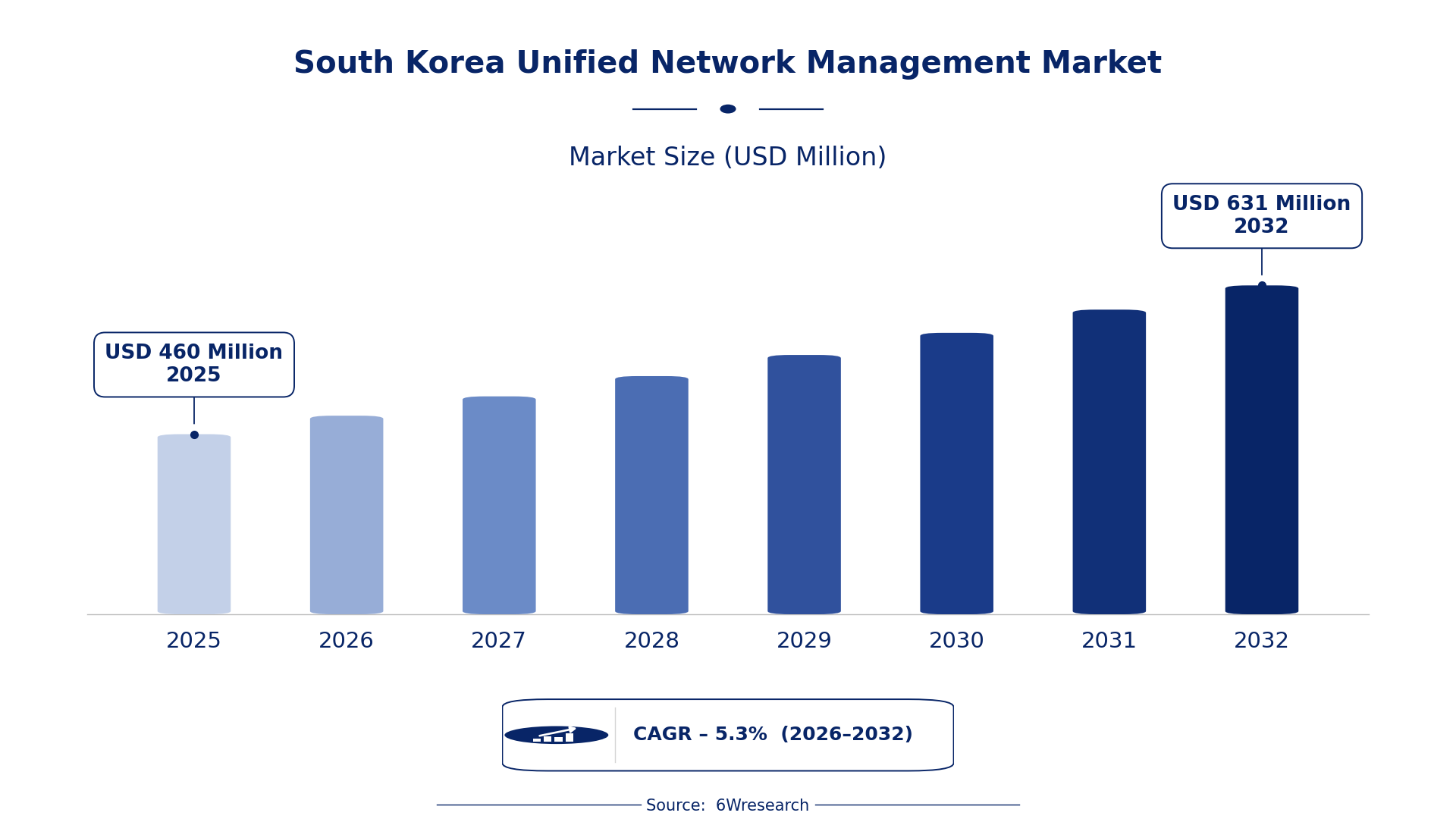
The South Korea Unified Network Management Market was estimated at USD 460 Million in 2025 and is projected to reach USD 631 Million by 2032, growing at a CAGR of 5.3% from 2026 to 2032.
South Korea Unified Network Management Market Synopsis
Recent momentum in South Korea's Unified Network Management Market reflects a clear shift towards integrated solutions that enhance network performance. As businesses increasingly rely on sophisticated network configurations, the demand for centralized management tools is becoming more pronounced.
Looking ahead, the market is set to evolve further, driven by the proliferation of connected devices and data traffic. Companies are seeking solutions that not only optimize performance but also ensure robust security and compliance, presenting both challenges and opportunities for providers in this sector.
South Korea Unified Network Management Market Year-wise Growth Rate and Key Drivers
This graph illustrates the annual growth rates of the South Korea Unified Network Management Market from 2021 to 2032, highlighting a steady upward trajectory and projected expansion over the forecast period.
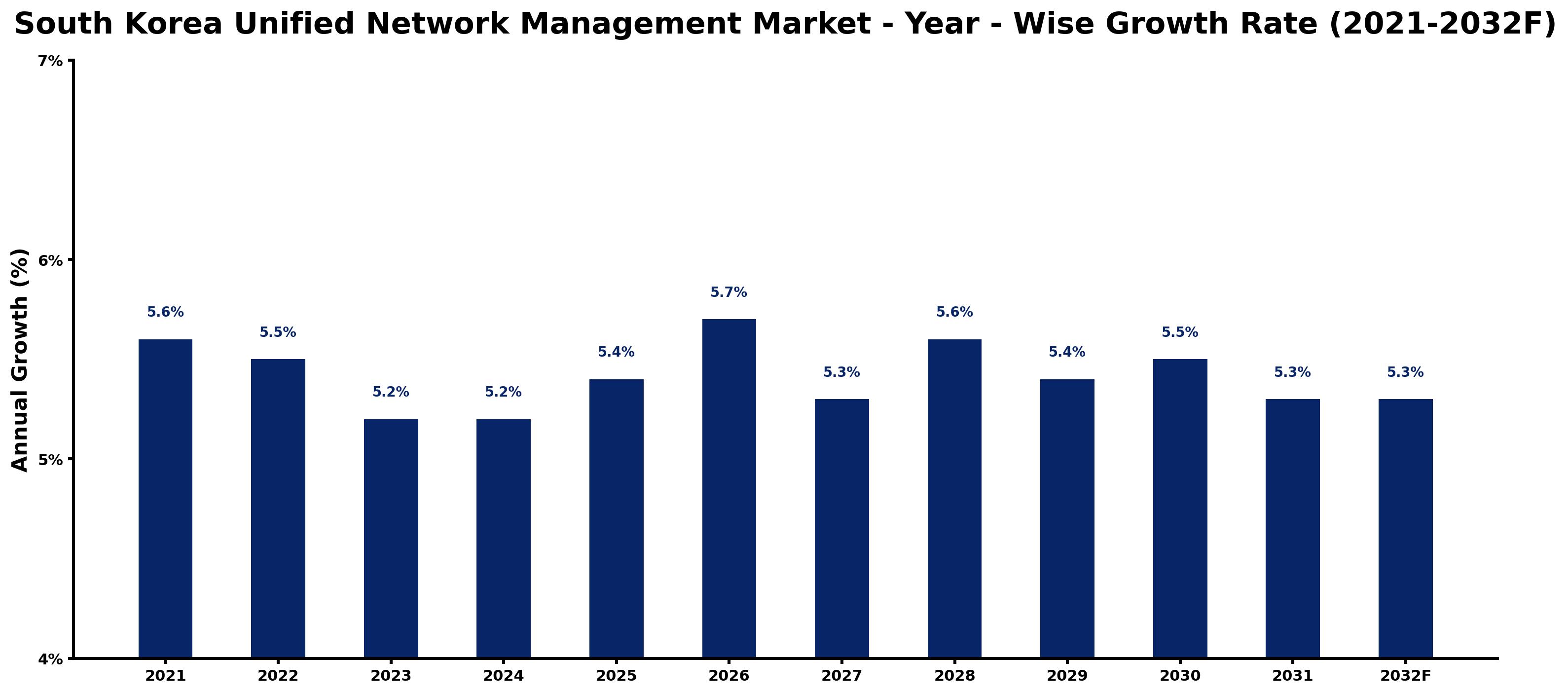
The table below presents the year‑wise growth rates along with the key drivers influencing the market
| Year | Growth Rate | Major Drivers |
| 2021 | 5.6% | Increased government support for smart factory initiatives. |
| 2022 | 5.5% | Growing adoption of 5G technology enhances connectivity strategies. |
| 2023 | 5.2% | Implementation of K-ICT Strategy promotes tech-integrative networks. |
| 2024 | 5.2% | Local enterprises pursue digital transformation for operational efficiency. |
| 2025 | 5.4% | Rising cyber threats drive demand for advanced security solutions. |
| 2026 | 5.7% | Government-led initiatives to enhance cybersecurity regulations. |
| 2027 | 5.3% | Demand for SD-WAN solutions increases among businesses. |
| 2028 | 5.6% | Emergence of AI-powered network management solutions. |
| 2029 | 5.4% | Rising competition among telecom operators fosters innovation. |
| 2030 | 5.5% | Focus on reducing operational costs boosts network optimization. |
| 2031 | 5.3% | Increasing investment in cloud computing infrastructures accelerates growth. |
| 2032 | 5.3% | Growth of remote work culture necessitates robust network management. |
Note: Market size estimations and growth projections presented in this report are based on 6Wresearch's proprietary forecasting methodology, utilizing the latest available industry data, government publications, and primary research inputs.
South Korea Unified Network Management Market Key Takeaways
Below are some of the specific key takeaways from the market, including:
- The demand for unified network management solutions is escalating due to increasing network complexity.
- Centralized control and automation features are key selling points for enterprises and service providers.
- Security concerns and regulatory compliance are top priorities influencing market dynamics.
- Innovation and customization are essential for differentiation in a competitive landscape.
- Government initiatives are increasingly shaping the regulatory framework for network management solutions.
Evaluation of Restraints in South Korea Unified Network Management Market
Several restraints are affecting the South Korea Unified Network Management Market. Network complexity continues to be a significant hurdle, complicating visibility and performance monitoring for providers. Additionally, security threats require constant vigilance and adaptability, adding pressure on service differentiation. Regulatory compliance poses its own challenges, as businesses must align with an evolving set of standards while managing cost constraints. This environment necessitates innovative solutions tailored to meet diverse customer needs while ensuring operational efficiency.
South Korea Unified Network Management Market Trends
Emerging trends are defining the South Korea Unified Network Management Market. The surge in IoT devices is pushing companies to adopt more integrated management systems that can handle vast amounts of data. Cloud-based solutions are gaining traction, offering flexibility and scalability, which are critical for modern enterprises. on top of that, artificial intelligence and machine learning are being incorporated into network management tools, enabling proactive monitoring and predictive analytics. These trends indicate a clear shift towards more intelligent, automated systems that enhance overall network reliability.
South Korea Unified Network Management Market Opportunities
Genuine growth opportunities are emerging in the South Korea Unified Network Management Market. The increasing digitization across sectors presents a ripe environment for providers to offer tailored solutions. Companies focusing on cybersecurity and compliance management are well-positioned to capture market share, given the heightened regulatory scrutiny. Additionally, partnerships with technology firms to enhance service offerings or expand into new verticals could lead to significant competitive advantages. As enterprises seek to modernize their infrastructure, investing in innovative network management tools is a priority.
Government Initiatives in the South Korea Unified Network Management Market
Government policies are increasingly influencing the South Korea Unified Network Management Market, focusing on enhancing network optimization, interoperability, and cybersecurity. As South Korea aims to strengthen its digital economy, regulatory frameworks are being established to promote standards in network management. These initiatives are crucial for ensuring that businesses can operate effectively while meeting compliance requirements.
- A regulatory framework introduced in 2025 mandates compliance with updated network management standards.
- Ongoing initiatives are focused on incentivizing companies to invest in advanced network management technologies.
- Support for research and development in network management solutions is currently underway to foster innovation.
- Planned public-private initiatives aim to enhance collaboration in addressing interoperability challenges by 2028.
Future Insights of the South Korea Unified Network Management Market
Looking ahead to 2026-2032, the South Korea Unified Network Management Market is set for substantial growth. As organizations increasingly adopt digital transformation strategies, the need for integrated management tools will only intensify. The convergence of AI and network management solutions will drive operational efficiencies and enhance security protocols. As businesses face mounting pressure to optimize performance and comply with regulations, the demand for innovative and adaptable solutions will be at the forefront of market development.
South Korea Unified Network Management Market Latest Developments
Recent activity in the South Korea Unified Network Management Market illustrates a dynamic environment marked by innovation and strategic partnerships. Companies are focusing on enhancing their offerings to meet the evolving demands of enterprises in a digitally-driven economy.
- A major technology vendor launched a new cloud-based unified network management solution in early 2025, aimed at improving scalability for businesses.
- An initiative that began in mid-2025 is currently underway to develop AI-powered analytics tools for real-time network performance monitoring.
- A partnership between service providers is expected to enhance cybersecurity measures, slated to begin rollout by Q3 2026.
- A national digital infrastructure upgrade program, now in its rollout phase, focuses on improving network reliability across various sectors.
South Korea Unified Network Management Market - Key Attractiveness of the Report
- 10 Years of Market Numbers
- Historical Data Starting from 2022 to 2025
- Base Year: 2025
- Forecast Data until 2032
- Key Performance Indicators Impacting the Market
- Major Upcoming Developments and Projects
Key Highlights of the Report:
- South Korea Unified Network Management Market Outlook
- Market Size of South Korea Unified Network Management Market, 2025
- Forecast of South Korea Unified Network Management Market, 2032
- Historical Data and Forecast of South Korea Unified Network Management Revenues & Volume for the Period 2022-2032F
- South Korea Unified Network Management Market Trend Evolution
- South Korea Unified Network Management Market Drivers and Challenges
- South Korea Unified Network Management Price Trends
- South Korea Unified Network Management Porter's Five Forces
- South Korea Unified Network Management Industry Life Cycle
- Historical Data and Forecast of South Korea Unified Network Management Market Revenues & Volume By Networking Type for the Period 2022-2032F
- Historical Data and Forecast of South Korea Unified Network Management Market Revenues & Volume By Wireline Network Management for the Period 2022-2032F
- Historical Data and Forecast of South Korea Unified Network Management Market Revenues & Volume By Wireless Network Management for the Period 2022-2032F
- Historical Data and Forecast of South Korea Unified Network Management Market Revenues & Volume By Solution for the Period 2022-2032F
- Historical Data and Forecast of South Korea Unified Network Management Market Revenues & Volume By Network Traffic Management for the Period 2022-2032F
- Historical Data and Forecast of South Korea Unified Network Management Market Revenues & Volume By Network Monitoring Management for the Period 2022-2032F
- Historical Data and Forecast of South Korea Unified Network Management Market Revenues & Volume By Network Security Management for the Period 2022-2032F
- Historical Data and Forecast of South Korea Unified Network Management Market Revenues & Volume By Network Application Management for the Period 2022-2032F
- Historical Data and Forecast of South Korea Unified Network Management Market Revenues & Volume By Configuration and Server Management for the Period 2022-2032F
- Historical Data and Forecast of South Korea Unified Network Management Market Revenues & Volume By Others (IP Address Management and Network Device Management) for the Period 2022-2032F
- Historical Data and Forecast of South Korea Unified Network Management Market Revenues & Volume By Service for the Period 2022-2032F
- Historical Data and Forecast of South Korea Unified Network Management Market Revenues & Volume By Training and Support for the Period 2022-2032F
- Historical Data and Forecast of South Korea Unified Network Management Market Revenues & Volume By Consulting for the Period 2022-2032F
- Historical Data and Forecast of South Korea Unified Network Management Market Revenues & Volume By Managed and Integration service for the Period 2022-2032F
- Historical Data and Forecast of South Korea Unified Network Management Market Revenues & Volume By Deployment Type for the Period 2022-2032F
- Historical Data and Forecast of South Korea Unified Network Management Market Revenues & Volume By On-Cloud for the Period 2022-2032F
- Historical Data and Forecast of South Korea Unified Network Management Market Revenues & Volume By On-Premises for the Period 2022-2032F
- Historical Data and Forecast of South Korea Unified Network Management Market Revenues & Volume By User Type for the Period 2022-2032F
- Historical Data and Forecast of South Korea Unified Network Management Market Revenues & Volume By Large Enterprises for the Period 2022-2032F
- Historical Data and Forecast of South Korea Unified Network Management Market Revenues & Volume By Small and Medium Enterprises for the Period 2022-2032F
- Historical Data and Forecast of South Korea Unified Network Management Market Revenues & Volume By Industry Vertical for the Period 2022-2032F
- Historical Data and Forecast of South Korea Unified Network Management Market Revenues & Volume By BFSI for the Period 2022-2032F
- Historical Data and Forecast of South Korea Unified Network Management Market Revenues & Volume By High-Tech and Telecom for the Period 2022-2032F
- Historical Data and Forecast of South Korea Unified Network Management Market Revenues & Volume By Retail and Consumer Goods for the Period 2022-2032F
- Historical Data and Forecast of South Korea Unified Network Management Market Revenues & Volume By Travel and Hospitality for the Period 2022-2032F
- Historical Data and Forecast of South Korea Unified Network Management Market Revenues & Volume By Government for the Period 2022-2032F
- Historical Data and Forecast of South Korea Unified Network Management Market Revenues & Volume By Media and Entertainment for the Period 2022-2032F
- Historical Data and Forecast of South Korea Unified Network Management Market Revenues & Volume By Healthcare for the Period 2022-2032F
- Historical Data and Forecast of South Korea Unified Network Management Market Revenues & Volume By Education for the Period 2022-2032F
- South Korea Unified Network Management Import Export Trade Statistics
- Market Opportunity Assessment By Networking Type
- Market Opportunity Assessment By Solution
- Market Opportunity Assessment By Service
- Market Opportunity Assessment By Deployment Type
- Market Opportunity Assessment By User Type
- Market Opportunity Assessment By Industry Vertical
- South Korea Unified Network Management Top Companies Market Share
- South Korea Unified Network Management Competitive Benchmarking By Technical and Operational Parameters
- South Korea Unified Network Management Company Profiles
- South Korea Unified Network Management Key Strategic Recommendations






































