South Korea Urodynamic Equipment Market Size, Share & Growth Rate
The South Korea Urodynamic Equipment Market was estimated at USD 451 Million in 2025 and is projected to reach USD 622 Million by 2032, growing at a CAGR of 4.7% from 2026 to 2032. This growth is predominantly fueled by the rising prevalence of urological disorders, particularly among the aging population, alongside advancements in technology that enhance diagnostic capabilities. As awareness surrounding urological health escalates, healthcare providers are increasingly integrating urodynamic testing into their practice, contributing to the market's robust trajectory.
South Korea Urodynamic Equipment Market Year-wise Growth Rate and Key Drivers
This graph highlights how the South Korea Urodynamic Equipment Market has steadily grown over the years, supported by major growth factors.
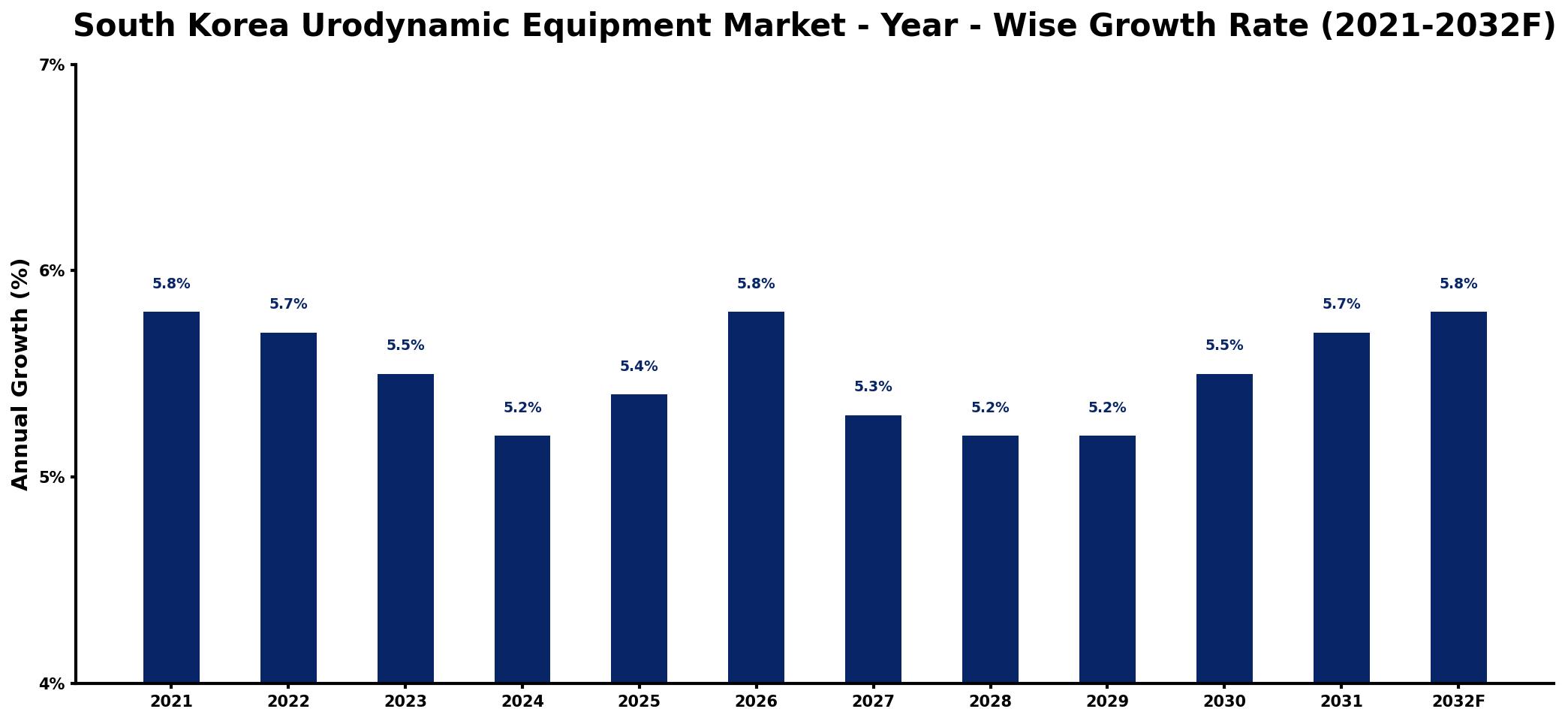
The table below presents the year‑wise growth rates along with the key drivers influencing the market
| Year | Growth Rate | Major Drivers |
| 2021 | 5.8% | Rising prevalence of urinary disorders |
| 2022 | 5.7% | Increased healthcare expenditure growth |
| 2023 | 5.5% | Expansion of outpatient treatment facilities |
| 2024 | 5.2% | Emerging telehealth service adoption |
| 2025 | 5.4% | Advancements in diagnostic technologies |
| 2026 | 5.8% | Growing awareness of pelvic health |
| 2027 | 5.3% | Surge in aging population demand |
| 2028 | 5.2% | Innovations in minimally invasive procedures |
| 2029 | 5.2% | Strengthened healthcare policy initiatives |
| 2030 | 5.5% | Enhanced patient education programs |
| 2031 | 5.7% | Investment in research and development |
| 2032 | 5.8% | Collaboration between healthcare sectors |
Note: Market size estimations and growth projections presented in this report are based on 6Wresearch's proprietary forecasting methodology, utilizing the latest available industry data, government publications, and primary research inputs.
South Korea Urodynamic Equipment Market Synopsis
The South Korea Urodynamic Equipment Market has experienced significant momentum in recent years due to an uptick in urological disorders, sparking a greater demand for effective diagnostic tools. Moving forward, the market is set to expand further as innovations continue to emerge, focusing on patient comfort and enhanced diagnostic accuracy.
Notably, the increasing inclination towards outpatient settings for urodynamic testing reflects a shift in patient care dynamics. As healthcare systems adapt to this trend, the market is well-positioned for sustained growth, encouraging further investment in advanced technologies and services aimed at improving overall patient outcomes.
South Korea Urodynamic Equipment Market Key Takeaways
- The market is driven by a growing aging population and a rising prevalence of urological disorders.
- Technological advancements are paving the way for innovative diagnostic tools and minimally invasive procedures.
- Increased awareness of urological health is encouraging healthcare professionals to adopt urodynamic testing.
- Outpatient testing is becoming more common, reflecting a shift towards cost-effective healthcare solutions.
- Investment in advanced urodynamic equipment is anticipated to yield significant returns in the long term.
Evaluation of Restraints in South Korea Urodynamic Equipment Market
Despite the positive outlook, the South Korea Urodynamic Equipment Market faces certain restraints. Increasing competition from domestic and international manufacturers poses a challenge for market players aiming to differentiate their offerings. Furthermore, regulatory hurdles regarding product approvals can slow the introduction of innovative solutions. Another significant barrier is the limited awareness among some healthcare professionals regarding the benefits and capabilities of urodynamic testing, which can impede market penetration efforts.
In a market characterized by conservatism in medical practices, fostering acceptance for new diagnostic technologies will necessitate targeted marketing strategies and collaborations with thought leaders. Understanding the intricacies of local market dynamics will be essential to overcoming resistance and positioning urodynamic equipment effectively.
South Korea Urodynamic Equipment Market Trends
Current trends indicate a marked shift towards the adoption of advanced urodynamic technologies, including wireless systems that enhance testing flexibility and patient comfort. The integration of artificial intelligence and data analytics is also reshaping the landscape, allowing for improved diagnostic accuracy and efficiency. As healthcare practices evolve, there is an increasing preference for outpatient settings to conduct urodynamic testing, aligning with broader trends towards convenient and accessible healthcare solutions.
South Korea Urodynamic Equipment Market Opportunities
The South Korea Urodynamic Equipment Market is ripe with investment opportunities, driven by a rise in urological disorders such as urinary incontinence. A growing awareness of these conditions among the population complements the demand for advanced diagnostic tools. Companies that invest in innovative technologies are likely to find substantial growth potential, especially in developing user-friendly and effective urodynamic solutions. Collaborations with healthcare providers will enhance market access and can significantly improve profitability in this sector.
Government Initiatives in the South Korea Urodynamic Equipment Market
The South Korean government has implemented several initiatives to bolster the Urodynamic Equipment Market. Regulatory oversight by the Ministry of Food and Drug Safety (MFDS) ensures that medical devices, including urodynamic equipment, meet safety and efficacy standards. Additionally, subsidies and incentives have been established for healthcare facilities to encourage the integration of advanced medical technologies into patient care practices, thereby enhancing overall healthcare outcomes.
Future Insights of the South Korea Urodynamic Equipment Market
Looking ahead to 2026-2032, the South Korea Urodynamic Equipment Market is poised for steady growth, fueled by the increasing prevalence of urological conditions and heightened awareness about urodynamic testing. Technological advancements will likely yield more efficient and user-friendly diagnostic tools, making it easier for healthcare providers to manage and treat urological disorders effectively. Furthermore, the ongoing investment in healthcare infrastructure is expected to enhance the demand for urodynamic equipment, solidifying its critical role in urological health management.
South Korea Urodynamic Equipment Market Latest Developments (2025 - 2026)
Recent developments within the South Korea Urodynamic Equipment Market indicate a surge in innovations aimed at improving diagnostic capabilities and patient comfort. Companies are increasingly focusing on wireless systems and AI integration to streamline testing procedures and enhance accuracy. Additionally, there has been a concerted effort to raise awareness among healthcare professionals regarding the importance of urodynamic testing, which is expected to drive market growth further.
South Korea Urodynamic Equipment Market - Key Attractiveness of the Report
- 10 Years of Market Numbers
- Historical Data Starting from 2022 to 2025
- Base Year: 2025
- Forecast Data until 2032
- Key Performance Indicators Impacting the Market
- Major Upcoming Developments and Projects
Key Highlights of the Report:
- South Korea Urodynamic Equipment Market Outlook
- Market Size of South Korea Urodynamic Equipment Market, 2025
- Forecast of South Korea Urodynamic Equipment Market, 2032
- Historical Data and Forecast of South Korea Urodynamic Equipment Revenues & Volume for the Period 2022-2032F
- South Korea Urodynamic Equipment Market Trend Evolution
- South Korea Urodynamic Equipment Market Drivers and Challenges
- South Korea Urodynamic Equipment Price Trends
- South Korea Urodynamic Equipment Porter's Five Forces
- South Korea Urodynamic Equipment Industry Life Cycle
- Historical Data and Forecast of South Korea Urodynamic Equipment Market Revenues & Volume By Product Type for the Period 2022-2032F
- Historical Data and Forecast of South Korea Urodynamic Equipment Market Revenues & Volume By Urodynamic Equipment for the Period 2022-2032F
- Historical Data and Forecast of South Korea Urodynamic Equipment Market Revenues & Volume By Urodynamic Consumables for the Period 2022-2032F
- Historical Data and Forecast of South Korea Urodynamic Equipment Market Revenues & Volume By End User for the Period 2022-2032F
- Historical Data and Forecast of South Korea Urodynamic Equipment Market Revenues & Volume By Hospitals for the Period 2022-2032F
- Historical Data and Forecast of South Korea Urodynamic Equipment Market Revenues & Volume By Ambulatory Centers for the Period 2022-2032F
- Historical Data and Forecast of South Korea Urodynamic Equipment Market Revenues & Volume By Diagnostic Centers for the Period 2022-2032F
- Historical Data and Forecast of South Korea Urodynamic Equipment Market Revenues & Volume By Others for the Period 2022-2032F
- South Korea Urodynamic Equipment Import Export Trade Statistics
- Market Opportunity Assessment By Product Type
- Market Opportunity Assessment By End User
- South Korea Urodynamic Equipment Top Companies Market Share
- South Korea Urodynamic Equipment Competitive Benchmarking By Technical and Operational Parameters
- South Korea Urodynamic Equipment Company Profiles
- South Korea Urodynamic Equipment Key Strategic Recommendations






































