South Korea Vending machines Market Summary
The south korea vending machines market was estimated at USD 261 Million in 2025 and is projected to reach USD 366 Million by 2032, growing at a CAGR of 5.6% from 2026 to 2032.
South Korea Vending machines Market Year-wise Growth Rate and Key Drivers
This graph highlights how the South Korea Vending machines Market has steadily grown over the past five years, supported by major growth factors.
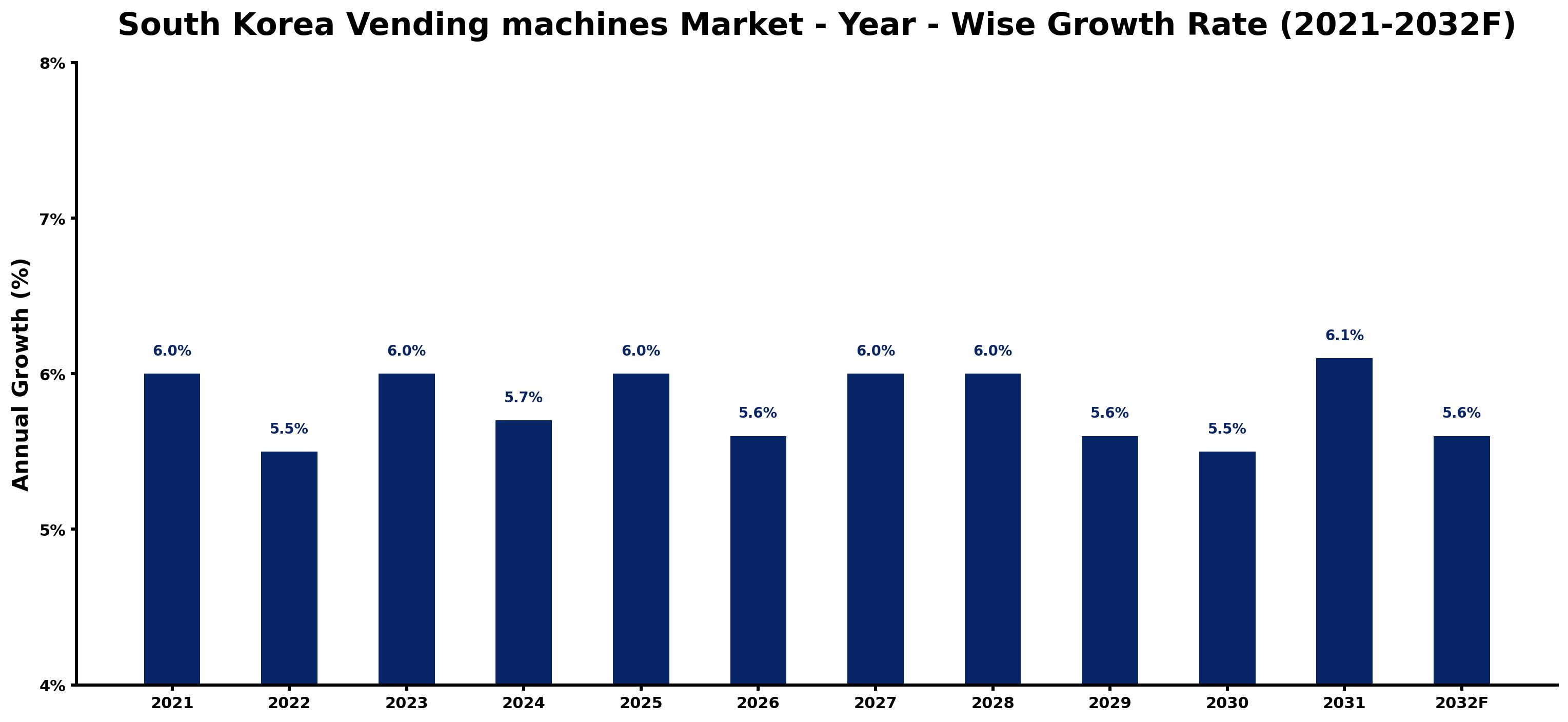
The table below presents the year wise growth rates along with the key drivers influencing the market
| Year | Growth Rate | Major Drivers |
| 2021 | 6.0% | Post-lockdown retail projects initiated a shift towards automated shopping solutions. |
| 2022 | 5.5% | Consumer preferences leaned towards contactless and convenient purchasing experiences. |
| 2023 | 6.0% | Technological upgrades in vending machine interfaces attracted younger demographics eager for innovation. |
| 2024 | 5.7% | Urbanization trends increased foot traffic, enhancing machine placements in metropolitan areas. |
| 2025 | 6.0% | Health-conscious offerings in machines aligned with wellness trends for diverse consumer bases. |
| 2026 | 5.6% | Integration of mobile payment systems significantly streamlined the purchasing process. |
| 2027 | 6.0% | Small business collaborations introduced localized products, improving regional market penetration. |
| 2028 | 6.0% | Sustainability initiatives led to eco-friendly machine designs, appealing to environmentally conscious consumers. |
| 2029 | 5.6% | Data analytics provided insights into consumer preferences, optimizing stock management and offerings. |
| 2030 | 5.5% | Enhanced machine capabilities included fresh food options, catering to on-the-go lifestyles. |
| 2031 | 6.1% | E-commerce partnerships expanded product ranges, integrating online shopping dynamics into vending. |
| 2032 | 5.6% | Advanced AI technologies personalized user experiences, revolutionizing customer interactions with machines. |
Note - Market size estimations and growth projections presented in this report are based on 6Wresearch's advanced forecasting approach, validated with industry datasets as of June 2026.
South Korea Vending machines Market Synopsis
The South Korea Vending machines Market is projected to reach 5.6% and witness significant growth during the forecast period (2026-2032). The market is experiencing a transformative phase characterized by technological advancements and shifting consumer behaviors. Urbanization and convenience-seeking lifestyles are pivotal in shaping the vending machine landscape, with increasing adoption of smart technologies and cashless payment systems reinforcing the sector's expansion.
South Korea Vending machines Market Growth Drivers
Several factors are propelling the South Korea Vending machines Market forward. Firstly, the country's fast-paced urban lifestyle drives demand for convenient purchasing options. Vending machines are strategically located in densely populated areas such as public transportation hubs, office buildings, and educational institutions, enabling easy access to a variety of products.
- The increasing preference for on-the-go purchasing among consumers is reshaping retail dynamics, making vending machines an attractive option.
- Technological innovations, such as cashless payment systems and smart vending solutions, enhance user experience and operational efficiency.
- Urbanization leads to higher foot traffic in cities, creating opportunities for vending machine operators to reach a larger audience.
- Changing dietary habits are also influencing product offerings in vending machines, with a growing demand for healthier snack and beverage options.
- Moreover, the COVID-19 pandemic highlighted the need for contactless purchasing solutions, further accelerating the shift towards technologically advanced vending machines.
South Korea Vending machines Market Challenges and Restraints
Despite its growth potential, the South Korea Vending machines Market faces several challenges that could hinder its progress. One significant obstacle is the need for product diversification. With consumers increasingly prioritizing health and wellness, vending machine operators must adapt their offerings to include healthier choices, thereby complicating inventory management.
- Another challenge is the need for widespread adoption of cashless payment systems, which may require substantial investment in technology and infrastructure.
- Market saturation in certain urban areas raises concerns regarding profitability and return on investment for new vending machine operators.
- Additionally, the maintenance and security of machines present ongoing challenges for operators, who must ensure consistent functionality and safety.
- Consumer preferences are continually evolving, necessitating ongoing market research and flexibility in product offerings to meet changing demands.
- Lastly, regulatory restrictions related to food safety and operational standards can pose hurdles, requiring companies to remain compliant while innovating.
South Korea Vending machines Market Government Investment and Initiatives
The South Korean government plays a crucial role in shaping the vending machine landscape through various policies and initiatives aimed at enhancing food safety and industry standards. Government regulations ensure that vending machines meet hygiene and maintenance standards, fostering consumer trust in these automated retail solutions.
- Regulatory frameworks are being established to promote transparency in product labeling and pricing, helping consumers make informed choices.
- Investment in research and development within the vending technology sector is encouraged to fuel innovation and competitiveness.
- Collaboration between industry stakeholders is promoted to share best practices and improve operational efficiencies.
- Support is provided for initiatives that enhance machine security and operational reliability, ensuring a safe consumer experience.
- Additionally, the government offers incentives for companies to invest in smart vending technologies that align with sustainability and energy efficiency goals.
South Korea Vending machines Market Latest Developments (May 2025 - June 2026)
In the period from May 2025 to June 2026, the South Korea Vending machines Market underwent substantial changes as operators increasingly embraced technological advancements. The integration of artificial intelligence and IoT-enabled systems became prevalent, allowing for real-time inventory tracking and dynamic pricing strategies.
- Moreover, a growing focus on sustainability in vending machine operations became evident, with companies exploring eco-friendly packaging and energy-efficient machines.
- Cashless payment methods continued to gain traction, with consumers favoring mobile payment options for convenience and security.
- Industry collaboration led to the development of standardized practices for hygiene and machine management, improving overall service quality.
- Research initiatives aimed at understanding consumer preferences yielded insights that prompted the introduction of health-focused product lines.
- Finally, competitive pressures encouraged operators to enhance user experience, leading to the introduction of personalized marketing strategies based on consumer behavior data.
South Korea Vending machines Market - Key Attractiveness of the Report
- 10 Years of Market Numbers
- Historical Data Starting from 2022 to 2025
- Base Year: 2025
- Forecast Data until 2032
- Key Performance Indicators Impacting the Market
- Major Upcoming Developments and Projects
Key Highlights of the Report:
- South Korea Vending machines Market Outlook
- Market Size of South Korea Vending machines Market, 2025
- Forecast of South Korea Vending machines Market, 2032
- Historical Data and Forecast of South Korea Vending machines Revenues & Volume for the Period 2022-2032F
- South Korea Vending machines Market Trend Evolution
- South Korea Vending machines Market Drivers and Challenges
- South Korea Vending machines Price Trends
- South Korea Vending machines Porter's Five Forces
- South Korea Vending machines Industry Life Cycle
- Historical Data and Forecast of South Korea Vending machines Market Revenues & Volume By Applications for the Period 2022-2032F
- Historical Data and Forecast of South Korea Vending machines Market Revenues & Volume By Commercial Places for the Period 2022-2032F
- Historical Data and Forecast of South Korea Vending machines Market Revenues & Volume By Offices for the Period 2022-2032F
- Historical Data and Forecast of South Korea Vending machines Market Revenues & Volume By Public Places for the Period 2022-2032F
- Historical Data and Forecast of South Korea Vending machines Market Revenues & Volume By Others for the Period 2022-2032F
- Historical Data and Forecast of South Korea Vending machines Market Revenues & Volume By Payment Mode for the Period 2022-2032F
- Historical Data and Forecast of South Korea Vending machines Market Revenues & Volume By Cash for the Period 2022-2032F
- Historical Data and Forecast of South Korea Vending machines Market Revenues & Volume By Cashless for the Period 2022-2032F
- South Korea Vending machines Import Export Trade Statistics
- Market Opportunity Assessment By Applications
- Market Opportunity Assessment By Payment Mode
- South Korea Vending machines Top Companies Market Share
- South Korea Vending machines Competitive Benchmarking By Technical and Operational Parameters
- South Korea Vending machines Company Profiles
- South Korea Vending machines Key Strategic Recommendations






































