South Korea Water & Wastewater Treatment Market Summary
The south korea water & wastewater treatment market was estimated at USD 1485 Million in 2025 and is projected to reach USD 2121 Million by 2032, growing at a CAGR of 6.2% from 2026 to 2032.
South Korea Water & Wastewater Treatment Market Year-wise Growth Rate and Key Drivers
This graph highlights how the South Korea Water & Wastewater Treatment Market has steadily grown over the past five years, supported by major growth factors.
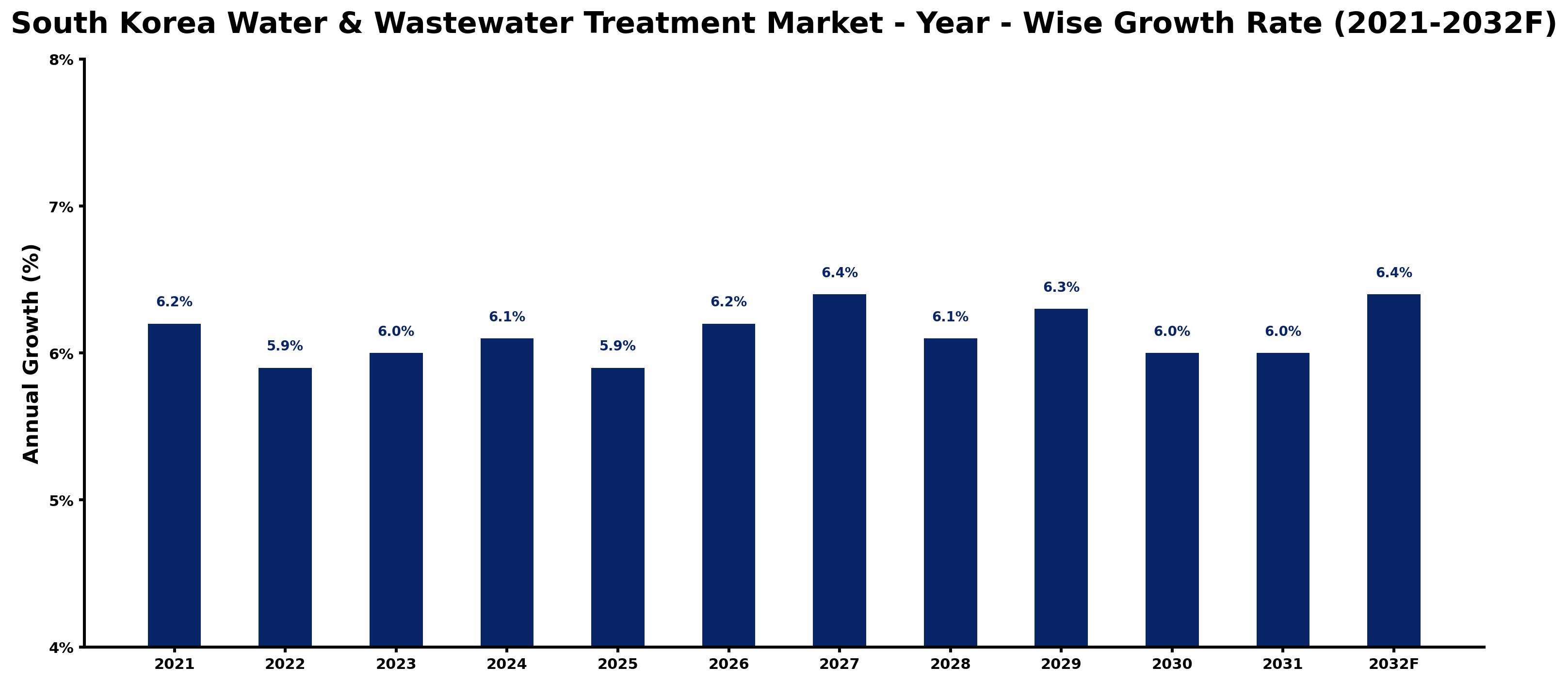
The table below presents the year wise growth rates along with the key drivers influencing the market
| Year | Growth Rate | Major Drivers |
| 2021 | 6.2% | COVID-19 emphasized the need for resilient water treatment infrastructure in urban areas. |
| 2022 | 5.9% | Investment in smart city projects led to innovative wastewater management solutions gaining traction. |
| 2023 | 6.0% | Water scarcity issues prompted a shift towards advanced filtration technologies in urban settings. |
| 2024 | 6.1% | Public awareness around sustainability influenced consumer preferences for eco-friendly water solutions. |
| 2025 | 5.9% | Emerging technologies like IoT enhanced operational efficiencies in water treatment facilities nationwide. |
| 2026 | 6.2% | Corporate social responsibility initiatives prioritized sustainable water practices across major industries. |
| 2027 | 6.4% | Deteriorating water quality reports drove demand for effective treatment methodologies and solutions. |
| 2028 | 6.1% | Government policies began incentivizing private sector investments in water and wastewater sectors. |
| 2029 | 6.3% | Collaboration among industries fostered innovative approaches to water reuse and recycling efforts. |
| 2030 | 6.0% | Focus on climate resilience highlighted the importance of adaptable water management systems. |
| 2031 | 6.0% | Urbanization trends necessitated comprehensive upgrades to existing water infrastructure and technology. |
| 2032 | 6.4% | Integration of AI into operations streamlined processes, reducing costs and enhancing service delivery. |
Note - Market size estimations and growth projections presented in this report are based on 6Wresearch's advanced forecasting approach, validated with industry datasets as of June 2026.
South Korea Water & Wastewater Treatment Market Synopsis
The South Korea Water Wastewater Treatment Market is projected to reach 6.2% and witness significant growth during the forecast period (2026-2032). This market is becoming increasingly important as South Korea faces challenges related to water scarcity, the need for safe drinking water, and stringent environmental regulations. Innovative treatment methods and sustainable practices are crucial as the country strives to manage its water resources effectively.
South Korea Water & Wastewater Treatment Market Growth Drivers
Several factors are driving the South Korea Water & Wastewater Treatment Market's growth. A critical driver is the rising demand for clean and safe water across various sectors, including residential, industrial, and municipal. As urbanization expands, the need for efficient water treatment solutions becomes more pronounced. Furthermore, stringent environmental regulations are pushing industries to adopt advanced treatment technologies that ensure compliance while promoting sustainability.
- The demand for potable water is escalating due to population growth and urban expansion, requiring improved treatment facilities.
- Increased awareness of environmental sustainability is driving investment in technologies that reduce water pollution and ensure safe water discharge.
- Chemical and biological treatment advancements are providing more effective solutions for contaminant removal, thus enhancing water quality.
- The integration of IoT and automation in water management systems is improving operational efficiency and decision-making processes in treatment plants.
- Public health concerns surrounding waterborne diseases underscore the necessity for stringent treatment methods, compelling both public and private investment in water infrastructure.
South Korea Water & Wastewater Treatment Market Challenges and Restraints
Despite the promising growth prospects in the South Korea Water & Wastewater Treatment Market, several challenges must be addressed. Regulatory compliance presents a significant hurdle, as treatment facilities must continually adapt to tightening standards on water quality and wastewater discharge.
- Operating costs remain high, particularly with the need for advanced technological solutions that ensure effective treatment and compliance.
- Technological advancement requires a skilled workforce, which can be a limitation in certain regions dependent on outdated systems.
- Limited public awareness about water reuse and recycling can hinder the implementation of innovative treatment solutions.
- The capital-intensive nature of upgrading existing infrastructure may deter smaller municipalities from investing in necessary improvements.
- Environmental concerns about chemical usage in treatment processes present a barrier to the adoption of certain technologies.
South Korea Water & Wastewater Treatment Market Government Investment and Initiatives
The South Korean government has recognized the importance of efficient water and wastewater management and is committed to supporting the sector through various initiatives and investments. Policies are designed to ensure environmental sustainability while also safeguarding public health.
- The government has implemented strict regulations aimed at improving water quality standards that align with international benchmarks.
- Incentives for industries are provided to encourage the adoption of advanced treatment technologies and practices that facilitate water conservation.
- Research and development funding is prioritized to explore innovative methods for treating emerging contaminants and enhancing treatment efficiency.
- Programs promoting water reuse and recycling initiatives are backed by government initiatives to mitigate the effects of water scarcity.
- Public-private partnerships are encouraged to enhance investment in water infrastructure development projects, ensuring broader access to safe water.
South Korea Water & Wastewater Treatment Market Latest Developments (May 2025 - June 2026)
Recent developments in the South Korea Water & Wastewater Treatment Market highlight a shift towards enhanced sustainability and efficiency. The focus is on adopting advanced technologies, such as membrane filtration and biological treatments, to address water quality challenges effectively. Efforts are underway to increase the capacity for municipal treatment facilities while simultaneously upgrading aging infrastructure.
- Collaboration among public agencies and private sectors has intensified to foster innovative wastewater treatment solutions.
- New policies have been introduced encouraging communities to adopt water conservation practices, resulting in an increased emphasis on water recycling.
- Technological advancements in automation and data analytics are revolutionizing the monitoring and operation of treatment processes, leading to cost savings and improved efficiency.
- Public education campaigns are being launched to raise awareness about the importance of water reuse and responsible consumption.
- The government continues to enhance funding for research initiatives aimed at developing cutting-edge wastewater treatment technologies.
South Korea Water & Wastewater Treatment Market - Key Attractiveness of the Report
- 10 Years of Market Numbers
- Historical Data Starting from 2022 to 2025
- Base Year: 2025
- Forecast Data until 2032
- Key Performance Indicators Impacting the Market
- Major Upcoming Developments and Projects
Key Highlights of the Report:
- South Korea Water & Wastewater Treatment Market Outlook
- Market Size of South Korea Water & Wastewater Treatment Market, 2025
- Forecast of South Korea Water & Wastewater Treatment Market, 2032
- Historical Data and Forecast of South Korea Water & Wastewater Treatment Revenues & Volume for the Period 2022-2032F
- South Korea Water & Wastewater Treatment Market Trend Evolution
- South Korea Water & Wastewater Treatment Market Drivers and Challenges
- South Korea Water & Wastewater Treatment Price Trends
- South Korea Water & Wastewater Treatment Porter's Five Forces
- South Korea Water & Wastewater Treatment Industry Life Cycle
- Historical Data and Forecast of South Korea Water & Wastewater Treatment Market Revenues & Volume By Product Category????????????? for the Period 2022-2032F
- Historical Data and Forecast of South Korea Water & Wastewater Treatment Market Revenues & Volume By Treatment Technologies for the Period 2022-2032F
- Historical Data and Forecast of South Korea Water & Wastewater Treatment Market Revenues & Volume By Delivery Equipment for the Period 2022-2032F
- Historical Data and Forecast of South Korea Water & Wastewater Treatment Market Revenues & Volume By Treatment Chemicals for the Period 2022-2032F
- Historical Data and Forecast of South Korea Water & Wastewater Treatment Market Revenues & Volume By Instrumentation for the Period 2022-2032F
- Historical Data and Forecast of South Korea Water & Wastewater Treatment Market Revenues & Volume By Applications for the Period 2022-2032F
- Historical Data and Forecast of South Korea Water & Wastewater Treatment Market Revenues & Volume By Municipal for the Period 2022-2032F
- Historical Data and Forecast of South Korea Water & Wastewater Treatment Market Revenues & Volume By Industrial for the Period 2022-2032F
- South Korea Water & Wastewater Treatment Import Export Trade Statistics
- Market Opportunity Assessment By Product Category?????????????
- Market Opportunity Assessment By Applications
- South Korea Water & Wastewater Treatment Top Companies Market Share
- South Korea Water & Wastewater Treatment Competitive Benchmarking By Technical and Operational Parameters
- South Korea Water & Wastewater Treatment Company Profiles
- South Korea Water & Wastewater Treatment Key Strategic Recommendations






































