South Korea Winding Wire Market Size Growth Rate
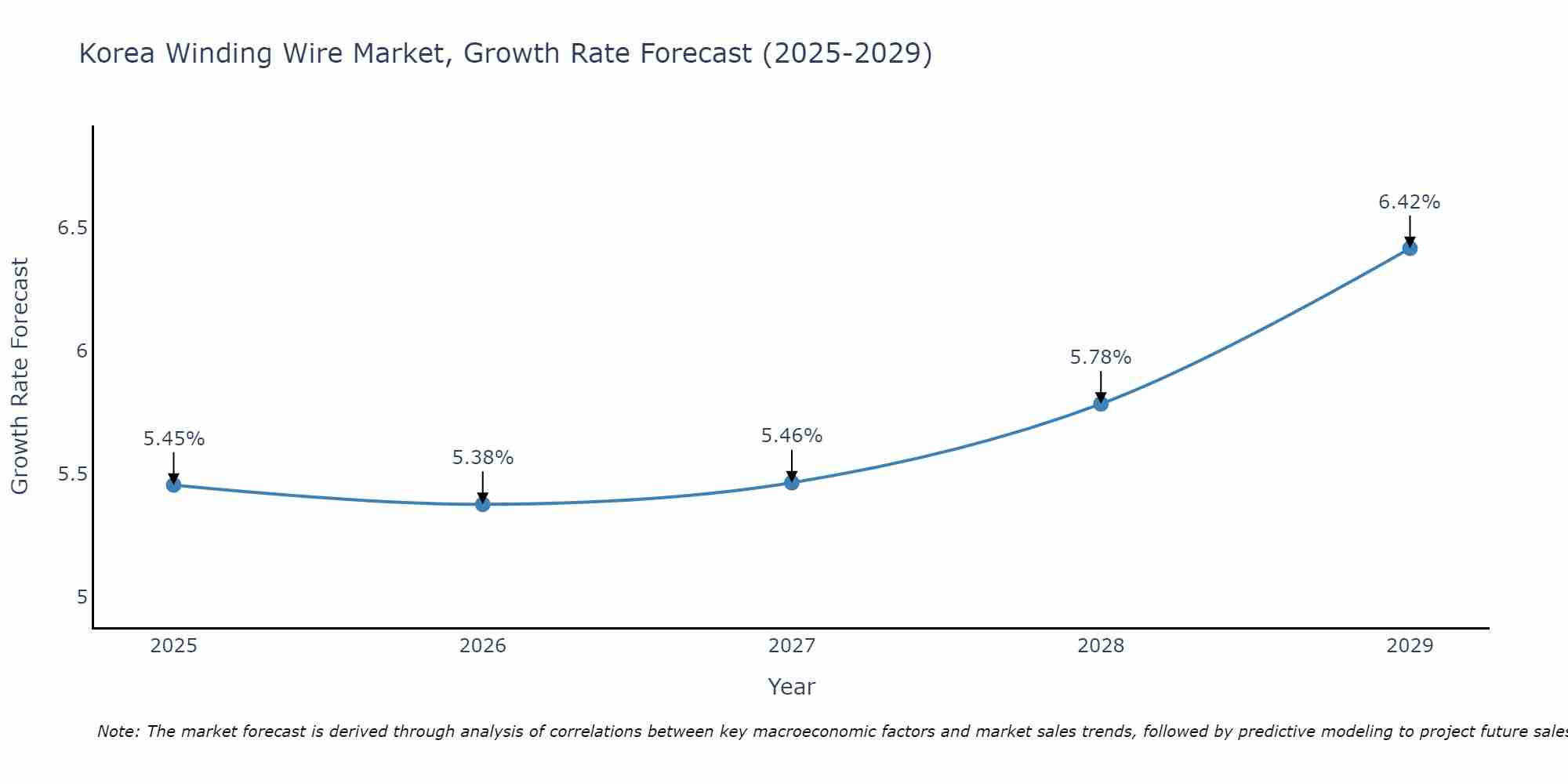
The South Korea Winding Wire Market is projected to witness mixed growth rate patterns during 2025 to 2029. The growth rate starts at 5.45% in 2025 and reaches 6.42% by 2029.
South Korea Winding Wire Market Overview
The South Korea Winding Wire Market is experiencing steady growth driven by the expanding electronics and automotive industries in the country. Winding wires are essential components in the manufacturing of electrical motors, transformers, and other electrical equipment, and their demand is directly influenced by the growth of these industries. The market is characterized by the presence of both domestic manufacturers and international players providing a wide range of winding wire products. Factors such as technological advancements, increasing investments in infrastructure, and the growing emphasis on renewable energy sources are also contributing to the market`s growth. Additionally, government initiatives to promote industrial development and innovation are further bolstering the demand for winding wires in South Korea.
South Korea Winding Wire Market Trends
The South Korea winding wire market is experiencing growth driven by factors such as increasing demand for consumer electronics, automotive components, and industrial machinery. The market is seeing a shift towards high-performance and energy-efficient winding wires to meet the requirements of advanced technologies such as electric vehicles and renewable energy systems. Key trends include the adoption of copper-clad aluminum wires for cost savings and lightweight applications, as well as the development of specialty winding wires with enhanced thermal and electrical properties. Manufacturers in South Korea are focusing on innovation to cater to the evolving needs of industries, while also emphasizing sustainability and compliance with environmental regulations. Overall, the South Korea winding wire market is poised for further expansion in line with the country`s technological advancements and industrial development.
South Korea Winding Wire Market Challenges
In the South Korea winding wire market, some challenges faced include intense competition among manufacturers leading to pricing pressures, fluctuating raw material costs, and rapid technological advancements requiring constant innovation to stay competitive. Additionally, stringent government regulations on environmental sustainability and safety standards can pose challenges for companies operating in the market. Furthermore, the market is highly sensitive to global economic conditions, making it vulnerable to external factors such as trade tensions and currency fluctuations. Adapting to these challenges requires companies to invest in research and development, establish strong supply chain networks, and build strong relationships with customers to differentiate themselves in a crowded market landscape.
South Korea Winding Wire Market Investment Opportunities
The South Korea winding wire market offers various investment opportunities driven by the country`s strong industrial base and technological advancements. The growing demand for winding wires in sectors such as electrical, automotive, and electronics presents lucrative prospects for investors looking to capitalize on the market. Additionally, the government`s focus on renewable energy sources like wind and solar power is expected to drive further growth in the winding wire market. Investing in manufacturers of high-quality winding wires, innovative technologies for wire production, and companies catering to the renewable energy sector within South Korea can be advantageous. Furthermore, strategic partnerships with local businesses and understanding the regulatory landscape will be crucial for success in this market.
South Korea Winding Wire Market Government Policy
Government policies in South Korea related to the winding wire market focus on promoting sustainable growth and innovation in the industry. The government provides support for research and development activities, aiming to enhance the competitiveness of domestic manufacturers and encourage the adoption of advanced technologies in the production of winding wires. Additionally, there are regulations in place to ensure the quality and safety of winding wires, with standards set by government agencies to maintain product integrity and protect consumers. The government also offers incentives and subsidies to companies investing in environmentally friendly practices and energy-efficient technologies, aligning with South Korea`s commitment to sustainability and green initiatives in the manufacturing sector. Overall, the government`s policies aim to drive growth, innovation, and sustainability in the winding wire market.
South Korea Winding Wire Market Future Outlook
The South Korea winding wire market is expected to exhibit steady growth in the coming years, driven by increasing demand from various industries such as automotive, electronics, and renewable energy. The government`s focus on promoting renewable energy sources like wind and solar power is likely to drive the demand for winding wires used in transformers and generators. Additionally, the growing adoption of electric vehicles in South Korea is expected to further boost the demand for winding wires in the automotive sector. Technological advancements leading to the development of high-performance and energy-efficient winding wires are also anticipated to drive market growth. Overall, the South Korea winding wire market is poised for expansion, with opportunities for manufacturers to innovate and cater to the evolving needs of different industries.
Key Highlights of the Report:
- South Korea Winding Wire Market Outlook
- Market Size of South Korea Winding Wire Market, 2021
- Forecast of South Korea Winding Wire Market, 2031
- Historical Data and Forecast of South Korea Winding Wire Revenues & Volume for the Period 2018 - 2031
- South Korea Winding Wire Market Trend Evolution
- South Korea Winding Wire Market Drivers and Challenges
- South Korea Winding Wire Price Trends
- South Korea Winding Wire Porter's Five Forces
- South Korea Winding Wire Industry Life Cycle
- Historical Data and Forecast of South Korea Winding Wire Market Revenues & Volume By Product for the Period 2018 - 2031
- Historical Data and Forecast of South Korea Winding Wire Market Revenues & Volume By Copper Winding Wire for the Period 2018 - 2031
- Historical Data and Forecast of South Korea Winding Wire Market Revenues & Volume By Aluminum Winding Wire for the Period 2018 - 2031
- South Korea Winding Wire Import Export Trade Statistics
- Market Opportunity Assessment By Product
- South Korea Winding Wire Top Companies Market Share
- South Korea Winding Wire Competitive Benchmarking By Technical and Operational Parameters
- South Korea Winding Wire Company Profiles
- South Korea Winding Wire Key Strategic Recommendations






































