South Korea Wireless Mesh Network Market Size & Growth Rate (2026-2032)
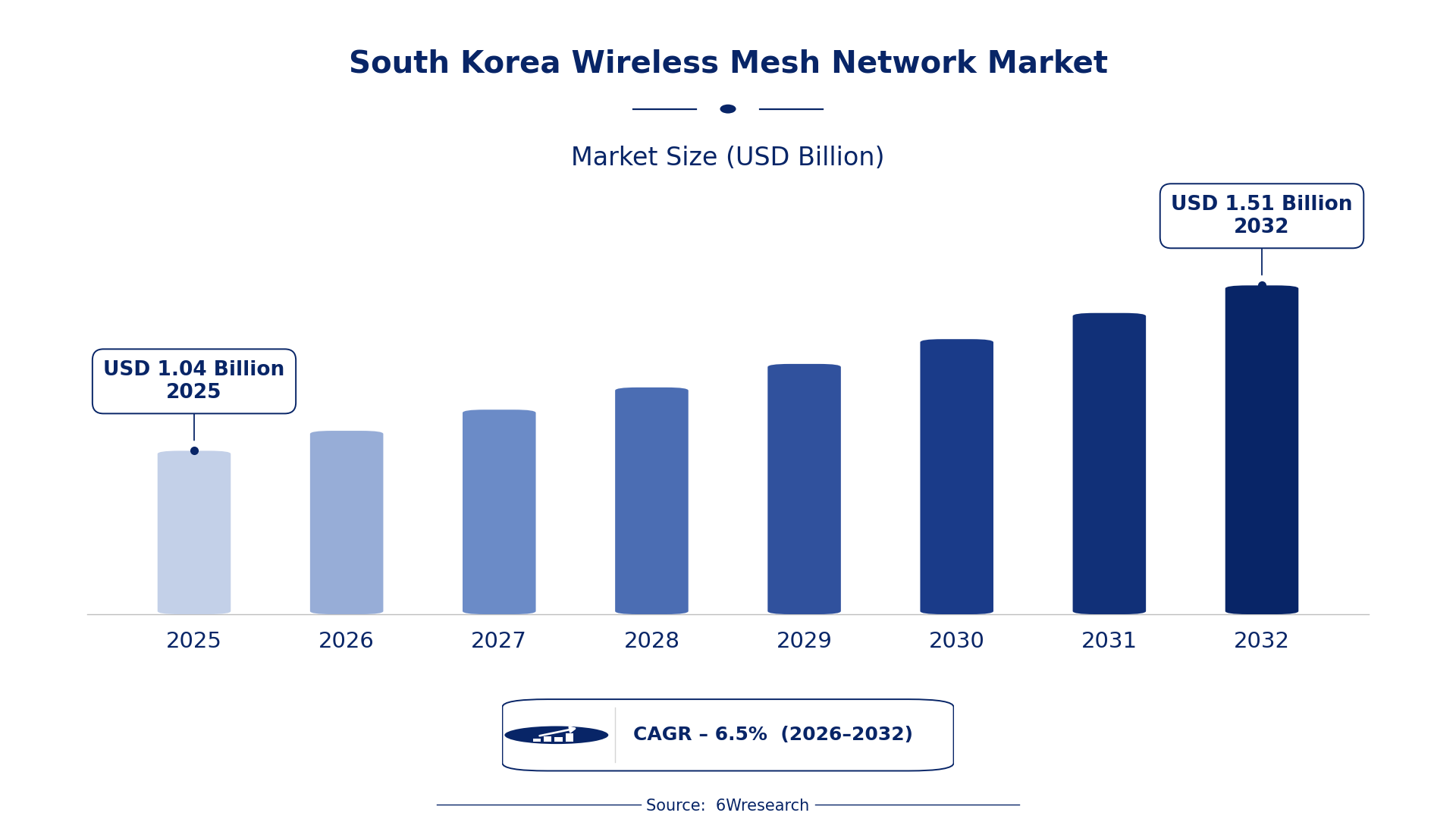
The South Korea Wireless Mesh Network Market was estimated at USD 1039 Million in 2025 and is projected to reach USD 1512 Million by 2032, growing at a CAGR of 6.5% from 2026 to 2032.
South Korea Wireless Mesh Network Market Synopsis
The South Korea Wireless Mesh Network Market has recently gained traction, reflecting a robust demand for reliable wireless connectivity solutions. As industries pivot towards advanced technologies and smart city initiatives, the market is set to witness considerable expansion, driven by evolving infrastructure and technology needs.
Looking ahead, the market's trajectory is encouraging, spurred by increased Internet of Things (IoT) device deployment and the need for self-healing networks. Stakeholders are strategically positioning themselves to harness this growth, emphasizing the significance of decentralized networks in urban planning and industrial automation.
South Korea Wireless Mesh Network Market Year-wise Growth Rate and Key Drivers
This graph illustrates the annual growth rates of the South Korea Wireless Mesh Network Market from 2021 to 2032, highlighting a steady upward trajectory and projected expansion over the forecast period.
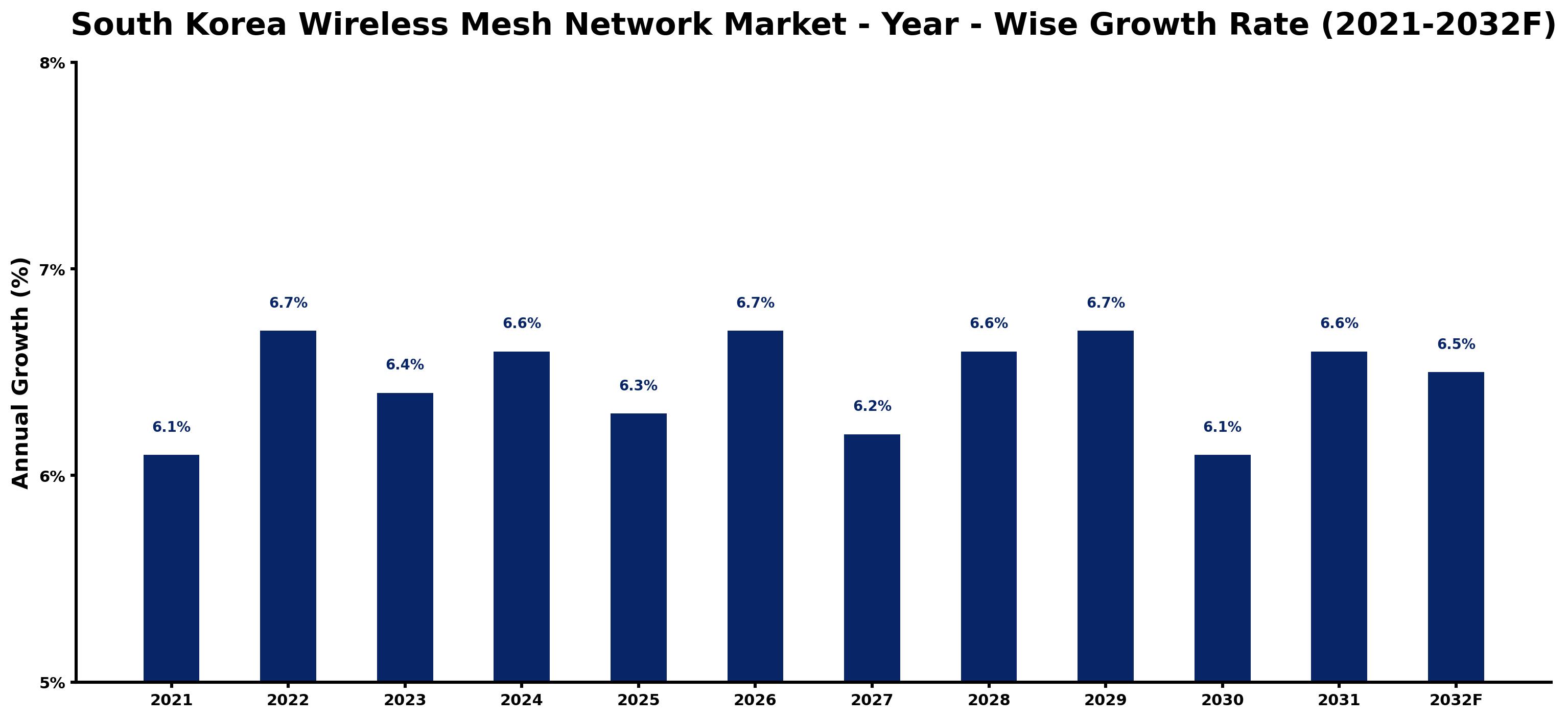
The table below presents the year‑wise growth rates along with the key drivers influencing the market
| Year | Growth Rate | Major Drivers |
| 2021 | 6.1% | Government 5G rollout spurring wireless infrastructure investments. |
| 2022 | 6.7% | Increase in IoT devices enhancing mesh network requirements. |
| 2023 | 6.4% | Smart city initiatives driving demand for robust connectivity. |
| 2024 | 6.6% | Educational institutions enhancing online learning through mesh networks. |
| 2025 | 6.3% | Urban population growth leading to denser network demands. |
| 2026 | 6.7% | Cybersecurity regulations boosting secure wireless communication needs. |
| 2027 | 6.2% | Rising wireless user density necessitating improved network solutions. |
| 2028 | 6.6% | Telecom partnerships expanding mesh technology offerings. |
| 2029 | 6.7% | Seoul's urban planning encouraging decentralized network implementations. |
| 2030 | 6.1% | Increased collaboration tools fostering remote connectivity expansions. |
| 2031 | 6.6% | Regulatory support for mesh network growth and innovation. |
| 2032 | 6.5% | High demand for seamless mobile experiences in urban areas. |
Note: Market size estimations and growth projections presented in this report are based on 6Wresearch's proprietary forecasting methodology, utilizing the latest available industry data, government publications, and primary research inputs.
South Korea Wireless Mesh Network Market Key Takeaways
Below are some of the specific key takeaways from the market, including:
- The rise of smart cities is significantly boosting the adoption of wireless mesh networks.
- Advancements in technologies like Zigbee and Thread are enhancing network capabilities.
- Demand for IoT applications is shaping the deployment strategies of mesh networks.
- Decentralized networks facilitate improved communication in complex environments.
- Government policies are fostering an environment conducive to mesh network growth.
Evaluation of Restraints in South Korea Wireless Mesh Network Market
Despite the promising growth, several restraints hinder the South Korea Wireless Mesh Network Market. Key challenges include concerns regarding network reliability and security, which can affect user confidence and adoption rates. Providers are also grappling with scalability issues, as ensuring adequate performance across a vast number of nodes presents significant technical hurdles. Furthermore, interoperability issues among various standards can complicate deployment, leading to increased costs and extended timelines for implementation.
South Korea Wireless Mesh Network Market Trends
The market is experiencing a shift towards decentralized and self-organizing networking solutions. This trend is largely driven by the growing necessity for reliable connectivity across urban landscapes. In tandem, the increasing integration of AI and machine learning technologies is optimizing network management, allowing for predictive maintenance and improved performance metrics. The evolution of standards and protocols within the mesh networking space, particularly in IoT contexts, is another key trend reshaping market dynamics.
South Korea Wireless Mesh Network Market Opportunities
Opportunities abound in sectors like public infrastructure and industrial automation, where the need for extensive coverage and resilience in connectivity is paramount. The ongoing digital transformation in South Korea is facilitating investments into wireless mesh networks to enhance operational efficiency. Additionally, as businesses embrace digital solutions, there is considerable potential for partnerships that can provide integrated connectivity solutions tailored to specific industry needs.
Government Initiatives in the South Korea Wireless Mesh Network Market
The South Korean government plays a crucial role in advancing the wireless mesh network market by implementing strategic policies aimed at enhancing telecommunications infrastructure. These initiatives prioritize innovation and seek to alleviate regulatory challenges that may impede market growth. Ongoing government support is critical in aligning private sector efforts with national objectives, ensuring that mesh networks are effectively integrated into urban and industrial frameworks.
- A national digital infrastructure upgrade programme that was launched in early 2023 aims to enhance connectivity in underserved areas.
- Currently, there is an initiative underway to standardize mesh network protocols, which is expected to facilitate interoperability among devices.
- In 2025, regulations on radio frequency spectrum allocation are set to be reviewed, promoting optimal usage for mesh networks.
- The government is currently incentivizing telecommunications companies to invest in mesh networking technologies through grants and subsidies.
- Future plans include a public-private partnership expected to foster innovation in urban connectivity solutions by 2027.
Future Insights of the South Korea Wireless Mesh Network Market
From 2026 to 2032, the South Korea Wireless Mesh Network Market is anticipated to evolve significantly as urban areas increasingly adopt smart technologies. The integration of mesh networks in public infrastructure projects is set to become a norm, creating an environment where connectivity is not just an expectation but a necessity. With ongoing technological advancements and supportive government policies, the future looks bright for stakeholders who are ready to adapt and innovate in this rapidly changing space.
South Korea Wireless Mesh Network Market Latest Developments
In the past year, the South Korea Wireless Mesh Network Market has witnessed a flurry of activity, reflecting a concerted effort to strengthen connectivity frameworks across various sectors. As businesses and governmental bodies push for greater digital integration, advancements in mesh technologies have gained momentum, bringing new solutions to the forefront.
- A major technology vendor launched a new mesh networking product in Q1 2023, aimed at enhancing connectivity in smart city applications.
- An initiative that began in mid-2023 is currently underway, focusing on deploying mesh networks in public transportation systems.
- In early 2023, a pilot project was completed, showcasing the benefits of mesh networks in industrial automation settings.
- Plans for a rollout of mesh networking capabilities in rural areas are set to begin by late 2024, aiming to address connectivity gaps.
- Q3 2023 saw the completion of a collaboration between multiple stakeholders to promote interoperability in wireless mesh technologies.
South Korea Wireless Mesh Network Market - Key Attractiveness of the Report
- 10 Years of Market Numbers
- Historical Data Starting from 2022 to 2025
- Base Year: 2025
- Forecast Data until 2032
- Key Performance Indicators Impacting the Market
- Major Upcoming Developments and Projects
Key Highlights of the Report:
- South Korea Wireless Mesh Network Market Outlook
- Market Size of South Korea Wireless Mesh Network Market, 2025
- Forecast of South Korea Wireless Mesh Network Market, 2032
- Historical Data and Forecast of South Korea Wireless Mesh Network Revenues & Volume for the Period 2022-2032F
- South Korea Wireless Mesh Network Market Trend Evolution
- South Korea Wireless Mesh Network Market Drivers and Challenges
- South Korea Wireless Mesh Network Price Trends
- South Korea Wireless Mesh Network Porter's Five Forces
- South Korea Wireless Mesh Network Industry Life Cycle
- Historical Data and Forecast of South Korea Wireless Mesh Network Market Revenues & Volume By Component for the Period 2022-2032F
- Historical Data and Forecast of South Korea Wireless Mesh Network Market Revenues & Volume By Physical Appliances for the Period 2022-2032F
- Historical Data and Forecast of South Korea Wireless Mesh Network Market Revenues & Volume By Mesh Platform for the Period 2022-2032F
- Historical Data and Forecast of South Korea Wireless Mesh Network Market Revenues & Volume By Services for the Period 2022-2032F
- Historical Data and Forecast of South Korea Wireless Mesh Network Market Revenues & Volume By Mesh Design for the Period 2022-2032F
- Historical Data and Forecast of South Korea Wireless Mesh Network Market Revenues & Volume By Infrastructure Wireless Mesh for the Period 2022-2032F
- Historical Data and Forecast of South Korea Wireless Mesh Network Market Revenues & Volume By Ad-Hoc Mesh for the Period 2022-2032F
- Historical Data and Forecast of South Korea Wireless Mesh Network Market Revenues & Volume By Applications for the Period 2022-2032F
- Historical Data and Forecast of South Korea Wireless Mesh Network Market Revenues & Volume By Video Streaming and Surveillance for the Period 2022-2032F
- Historical Data and Forecast of South Korea Wireless Mesh Network Market Revenues & Volume By Telecommunication for the Period 2022-2032F
- Historical Data and Forecast of South Korea Wireless Mesh Network Market Revenues & Volume By Disaster Management and Public Safety for the Period 2022-2032F
- Historical Data and Forecast of South Korea Wireless Mesh Network Market Revenues & Volume By Smart Mobility for the Period 2022-2032F
- Historical Data and Forecast of South Korea Wireless Mesh Network Market Revenues & Volume By Border Security (GPS Tracking) for the Period 2022-2032F
- Historical Data and Forecast of South Korea Wireless Mesh Network Market Revenues & Volume By Smart Manufacturing for the Period 2022-2032F
- Historical Data and Forecast of South Korea Wireless Mesh Network Market Revenues & Volume By Smart Building and Home Automation for the Period 2022-2032F
- Historical Data and Forecast of South Korea Wireless Mesh Network Market Revenues & Volume By Others (Environment Monitoring, and Smart Grids and Meters) for the Period 2022-2032F
- Historical Data and Forecast of South Korea Wireless Mesh Network Market Revenues & Volume By Radio Frequency for the Period 2022-2032F
- Historical Data and Forecast of South Korea Wireless Mesh Network Market Revenues & Volume By Sub 1 GHz Band for the Period 2022-2032F
- Historical Data and Forecast of South Korea Wireless Mesh Network Market Revenues & Volume By 2.4 GHz Band for the Period 2022-2032F
- Historical Data and Forecast of South Korea Wireless Mesh Network Market Revenues & Volume By 4.9 GHz Band for the Period 2022-2032F
- Historical Data and Forecast of South Korea Wireless Mesh Network Market Revenues & Volume By 5 GHz Band for the Period 2022-2032F
- South Korea Wireless Mesh Network Import Export Trade Statistics
- Market Opportunity Assessment By Component
- Market Opportunity Assessment By Mesh Design
- Market Opportunity Assessment By Applications
- Market Opportunity Assessment By Radio Frequency
- South Korea Wireless Mesh Network Top Companies Market Share
- South Korea Wireless Mesh Network Competitive Benchmarking By Technical and Operational Parameters
- South Korea Wireless Mesh Network Company Profiles
- South Korea Wireless Mesh Network Key Strategic Recommendations






































