South Korea Wooden Toys Market Size, Share & Growth Rate
The South Korea Wooden Toys Market was estimated at USD 153 Million in 2025 and is projected to reach USD 212 Million by 2032, growing at a CAGR of 4.8% from 2026 to 2032. This growth trajectory is significantly driven by a growing consumer preference for sustainable, non-toxic products and a rising awareness regarding the developmental benefits that wooden toys provide for children. Additionally, the emphasis on educational toys that stimulate cognitive and motor skills in a safe environment is propelling market growth.
South Korea Wooden Toys Market Year-wise Growth Rate and Key Drivers
This graph highlights how the South Korea Wooden Toys Market has steadily grown over the years, supported by major growth factors.
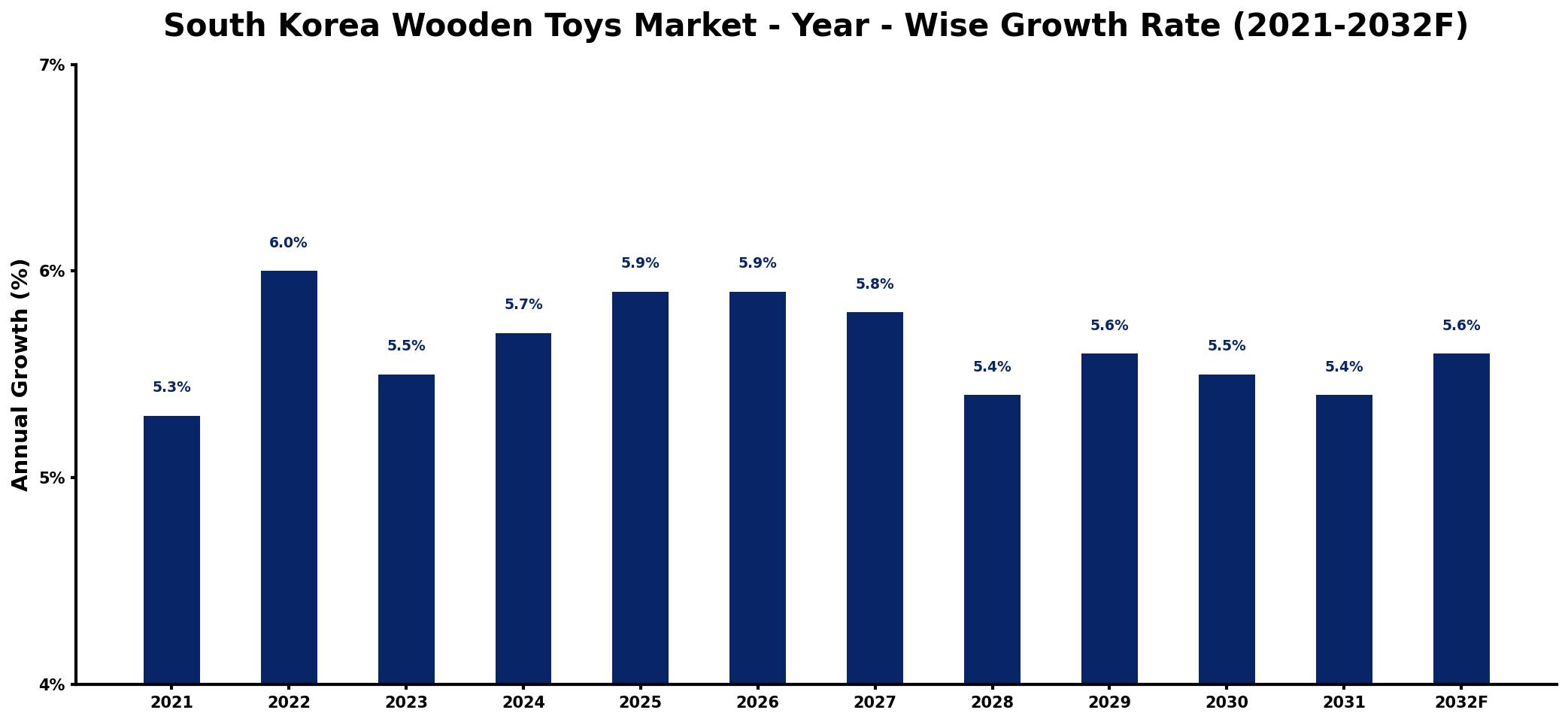
The table below presents the year‑wise growth rates along with the key drivers influencing the market
| Year | Growth Rate | Major Drivers |
| 2021 | 5.3% | Increased consumer interest in sustainability |
| 2022 | 6.0% | Rise in eco-friendly product investments |
| 2023 | 5.5% | Growing awareness of child development |
| 2024 | 5.7% | Expansion of online retail platforms |
| 2025 | 5.9% | Surge in educational product demand |
| 2026 | 5.9% | Strengthening of local manufacturing capabilities |
| 2027 | 5.8% | Enhancement of product safety regulations |
| 2028 | 5.4% | Growth in family-oriented leisure activities |
| 2029 | 5.6% | strengthening underlying market demand |
| 2030 | 5.5% | Development of innovative design trends |
| 2031 | 5.4% | rising export shipment volumes |
| 2032 | 5.6% | Boost in community-based initiatives |
Note: Market size estimations and growth projections presented in this report are based on 6Wresearch's proprietary forecasting methodology, utilizing the latest available industry data, government publications, and primary research inputs.
South Korea Wooden Toys Market Synopsis
In recent years, the South Korea wooden toys market has experienced noteworthy momentum, driven by an increased focus on environmental sustainability and educational play. However, as the market transitions forward, it faces competitive pressure from alternative play options such as plastic and electronic toys, which present both challenges and opportunities for adaptation.
As parents become more discerning in their purchasing decisions, the demand for high-quality, safe, and innovative wooden toys continues to rise. Market players are innovating product designs, incorporating cultural themes, and emphasizing the educational value of their offerings to maintain relevance in a fast-evolving landscape.
South Korea Wooden Toys Market Key Takeaways
- The wooden toys segment in South Korea is benefiting from increasing parental preference for safe, eco-friendly options.
- Demand for educational and developmental toys is on the rise, encouraging creativity and imaginative play.
- Local cultural elements are increasingly being incorporated into toy designs, enhancing consumer interest.
- Government policies favoring sustainability and product quality are bolstering market growth.
- Competition from plastic and electronic toys remains a challenge, necessitating innovation and adaptation.
Evaluation of Restraints in South Korea Wooden Toys Market
Despite the positive growth forecast, the South Korea wooden toys market grapples with significant restraints that could dampen its potential. One of the most formidable challenges comes from the fierce competition posed by plastic and electronic toys, which often dominate the market due to their lower price points and modern appeal. Additionally, safety regulations are increasingly stringent, requiring manufacturers to invest in compliance and quality assurance, which can raise operational costs. The shifting landscape of parental preferences, influenced by trends in technology and media, also necessitates constant innovation to retain customer loyalty.
South Korea Wooden Toys Market Trends
Emerging trends in the South Korea wooden toys market include a notable shift towards incorporating educational content in toy design. Manufacturers are increasingly focusing on products that promote not only play but also learning through interactive and sensory experiences. Another significant trend is the push for sustainable practices in sourcing materials, reflecting a broader societal demand for eco-conscious consumerism. Furthermore, the integration of traditional craftsmanship into modern designs is gaining traction, appealing to consumers who value cultural heritage in their purchasing choices.
South Korea Wooden Toys Market Opportunities
There lies substantial potential for growth in niche markets focused on specialty wooden toys that emphasize local culture or innovative educational concepts. Collaborations with early childhood education centers for customized toys could yield promising partnerships. Additionally, as online shopping continues to rise, companies that effectively leverage e-commerce platforms stand to enhance their market presence and accessibility. The increasing popularity of eco-friendly products presents a lucrative avenue for brands willing to invest in sustainable production methods.
Government Initiatives in the South Korea Wooden Toys Market
The South Korean government plays a crucial role in bolstering the wooden toys market through various supportive policies and initiatives. Regulatory frameworks focusing on safety standards ensure that products meet high-quality benchmarks, which fosters consumer trust. Additionally, incentives for manufacturers to adopt sustainable wood sourcing practices help align the industry with global sustainability goals. The government also collaborates with industry stakeholders to promote traditional craftsmanship and innovative designs, facilitating the growth of a vibrant and culturally rich wooden toy sector.
Future Insights of the South Korea Wooden Toys Market
Looking ahead to 2026-2032, the South Korea wooden toys market is poised for growth driven by a sustained consumer inclination towards eco-friendly and educational products. As parents and educators prioritize sustainability and child development, manufacturers who embrace innovation and cultural themes in their designs will likely lead the charge. The market will need to continually adapt to the evolving landscape, balancing traditional values with modern play needs to capture the attention of discerning consumers.
South Korea Wooden Toys Market Latest Developments (2025 - 2026)
Recent developments in the South Korea wooden toys market indicate a growing trend towards collaborations between manufacturers and educational institutions. Such partnerships aim to design toys that align closely with early childhood education curricula. Furthermore, there has been a noticeable increase in the launch of products that highlight local cultural heritage, reflecting a strategic effort to tap into the demand for unique and meaningful play experiences. Companies are also investing more in online marketing campaigns to reach a broader audience, enhancing their visibility in a competitive landscape.
South Korea Wooden Toys Market - Key Attractiveness of the Report
- 10 Years of Market Numbers
- Historical Data Starting from 2022 to 2025
- Base Year: 2025
- Forecast Data until 2032
- Key Performance Indicators Impacting the Market
- Major Upcoming Developments and Projects
Key Highlights of the Report:
- South Korea Wooden Toys Market Outlook
- Market Size of South Korea Wooden Toys Market, 2025
- Forecast of South Korea Wooden Toys Market, 2032
- Historical Data and Forecast of South Korea Wooden Toys Revenues & Volume for the Period 2022-2032F
- South Korea Wooden Toys Market Trend Evolution
- South Korea Wooden Toys Market Drivers and Challenges
- South Korea Wooden Toys Price Trends
- South Korea Wooden Toys Porter's Five Forces
- South Korea Wooden Toys Industry Life Cycle
- Historical Data and Forecast of South Korea Wooden Toys Market Revenues & Volume By Product Type for the Period 2022-2032F
- Historical Data and Forecast of South Korea Wooden Toys Market Revenues & Volume By Educational Toys for the Period 2022-2032F
- Historical Data and Forecast of South Korea Wooden Toys Market Revenues & Volume By Construction Toys for the Period 2022-2032F
- Historical Data and Forecast of South Korea Wooden Toys Market Revenues & Volume By Musical Toys for the Period 2022-2032F
- Historical Data and Forecast of South Korea Wooden Toys Market Revenues & Volume By Game Toys for the Period 2022-2032F
- Historical Data and Forecast of South Korea Wooden Toys Market Revenues & Volume By Dolls & Miniatures for the Period 2022-2032F
- Historical Data and Forecast of South Korea Wooden Toys Market Revenues & Volume By Automotive Toys for the Period 2022-2032F
- Historical Data and Forecast of South Korea Wooden Toys Market Revenues & Volume By Pretend Play Toys for the Period 2022-2032F
- Historical Data and Forecast of South Korea Wooden Toys Market Revenues & Volume By Wood Type for the Period 2022-2032F
- Historical Data and Forecast of South Korea Wooden Toys Market Revenues & Volume By Softwood for the Period 2022-2032F
- Historical Data and Forecast of South Korea Wooden Toys Market Revenues & Volume By Hardwood for the Period 2022-2032F
- Historical Data and Forecast of South Korea Wooden Toys Market Revenues & Volume By Age Group for the Period 2022-2032F
- Historical Data and Forecast of South Korea Wooden Toys Market Revenues & Volume By Below 1 Year for the Period 2022-2032F
- Historical Data and Forecast of South Korea Wooden Toys Market Revenues & Volume By Age 1-3 for the Period 2022-2032F
- Historical Data and Forecast of South Korea Wooden Toys Market Revenues & Volume By Age 3-5 for the Period 2022-2032F
- Historical Data and Forecast of South Korea Wooden Toys Market Revenues & Volume By Age 5-12 for the Period 2022-2032F
- Historical Data and Forecast of South Korea Wooden Toys Market Revenues & Volume By Age 12+ for the Period 2022-2032F
- Historical Data and Forecast of South Korea Wooden Toys Market Revenues & Volume By Distribution Channel for the Period 2022-2032F
- Historical Data and Forecast of South Korea Wooden Toys Market Revenues & Volume By Online for the Period 2022-2032F
- Historical Data and Forecast of South Korea Wooden Toys Market Revenues & Volume By Offline for the Period 2022-2032F
- South Korea Wooden Toys Import Export Trade Statistics
- Market Opportunity Assessment By Product Type
- Market Opportunity Assessment By Wood Type
- Market Opportunity Assessment By Age Group
- Market Opportunity Assessment By Distribution Channel
- South Korea Wooden Toys Top Companies Market Share
- South Korea Wooden Toys Competitive Benchmarking By Technical and Operational Parameters
- South Korea Wooden Toys Company Profiles
- South Korea Wooden Toys Key Strategic Recommendations






































