South Korea Workspace as a Service Market Size & Growth Rate (2026-2032)
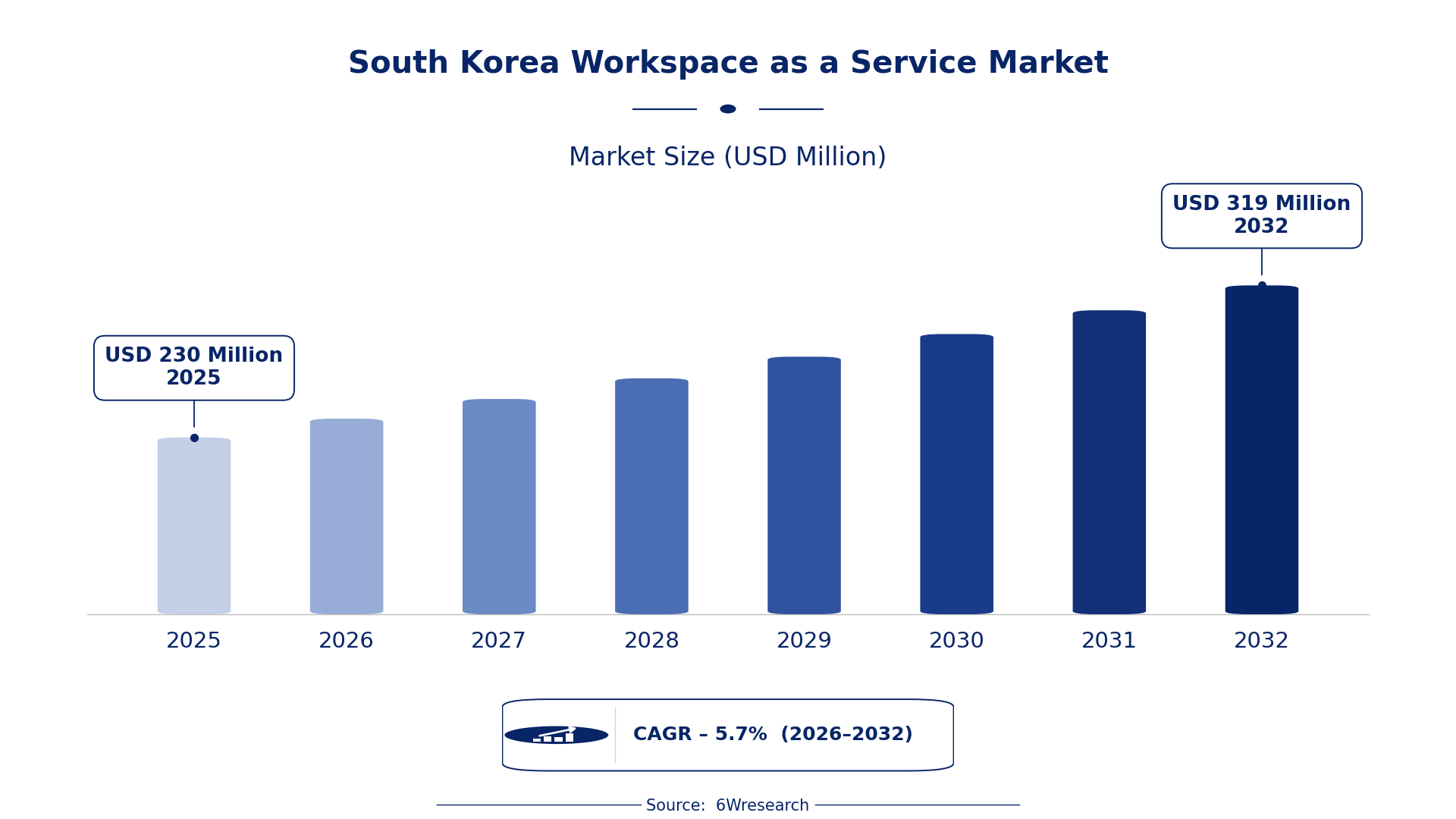
The South Korea Workspace as a Service Market was estimated at USD 230 Million in 2025 and is projected to reach USD 319 Million by 2032, growing at a CAGR of 5.7% from 2026 to 2032.
South Korea Workspace as a Service Market Synopsis
The escalating trend of remote work is the primary driver propelling the South Korea Workspace as a Service market forward. As businesses embrace the flexibility of remote operations, WaaS solutions are becoming essential for maintaining productivity and operational efficiency.
Alongside remote work, the adoption of cloud computing technologies is reshaping how organizations approach workspace management. Businesses are increasingly seeking scalable solutions that not only enhance user experience but also integrate robust security measures to protect sensitive data.
South Korea Workspace as a Service Market Year-wise Growth Rate and Key Drivers
This graph illustrates the annual growth rates of the South Korea Workspace as a Service Market from 2021 to 2032, highlighting a steady upward trajectory and projected expansion over the forecast period.
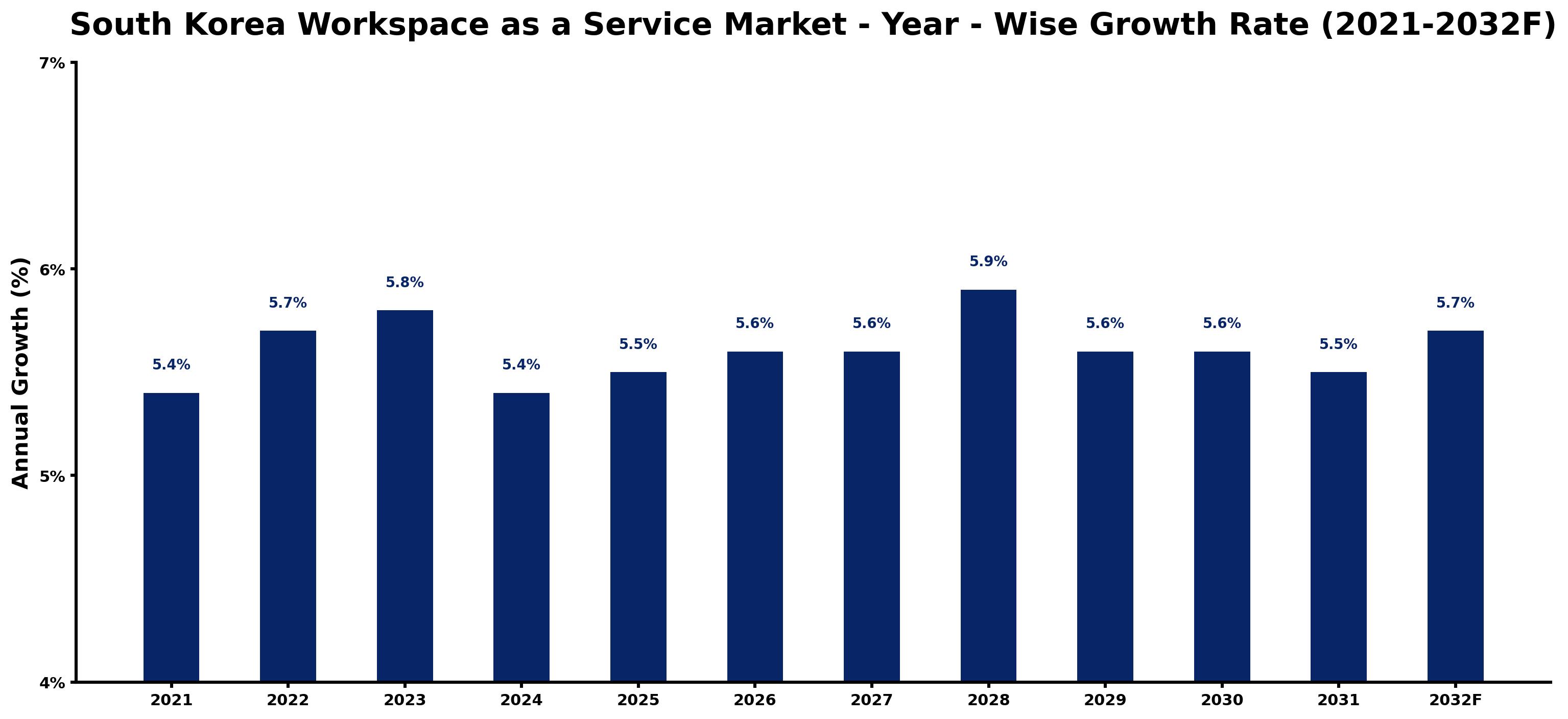
The table below presents the year‑wise growth rates along with the key drivers influencing the market
| Year | Growth Rate | Major Drivers |
| 2021 | 5.4% | Corporate adoption of flexible work policies increases demand. |
| 2022 | 5.7% | Government support for remote work technology initiatives. |
| 2023 | 5.8% | Rise in startups focusing on collaborative workspace solutions. |
| 2024 | 5.4% | Increased investment in digital workspace technologies and tools. |
| 2025 | 5.5% | Growing urbanization leading to smaller office spaces. |
| 2026 | 5.6% | Enhanced cybersecurity regulations promoting secure virtual workspaces. |
| 2027 | 5.6% | Booming freelance economy driving demand for flexible workplaces. |
| 2028 | 5.9% | Expanding 5G infrastructure boosting remote work capabilities. |
| 2029 | 5.6% | Sustainable workspace designs gaining popularity among companies. |
| 2030 | 5.6% | Increased focus on employee wellness in workspace designs. |
| 2031 | 5.5% | Corporate sustainability initiatives influencing workspace choices. |
| 2032 | 5.7% | Investment in AI tools for workspace efficiency enhancements. |
Note: Market size estimations and growth projections presented in this report are based on 6Wresearch's proprietary forecasting methodology, utilizing the latest available industry data, government publications, and primary research inputs.
South Korea Workspace as a Service Market Key Takeaways
Below are some of the specific key takeaways from the market, including:
- Remote work has become a fundamental aspect of corporate strategy, driving WaaS demand.
- Cloud computing advancements are enabling more organizations to adopt virtual desktop solutions.
- Security and compliance are critical concerns influencing WaaS adoption strategies.
- Flexible workspace solutions are essential for catering to diverse employee needs in hybrid environments.
- The South Korean government actively supports initiatives aimed at advancing WaaS technology.
Evaluation of Restraints in South Korea Workspace as a Service Market
Despite the upward trajectory of the South Korea Workspace as a Service market, several restraints hinder growth. Data security remains a pressing concern as organizations grapple with the risk of cyber threats. Additionally, regulatory compliance presents challenges, with businesses needing to adhere to stringent data privacy standards. Integration complexities can also stifle the adoption of WaaS solutions, as companies often struggle to align these services with their existing IT infrastructure.
South Korea Workspace as a Service Market Trends
Several trends are currently shaping the South Korea Workspace as a Service market. The integration of advanced security features has become paramount, as companies prioritize data protection. User experience continues to evolve, with service providers focusing on delivering intuitive interfaces and seamless access across devices. on top of that, the rise of AI and machine learning is beginning to influence WaaS solutions, offering enhanced automation and efficiency in workspace management.
South Korea Workspace as a Service Market Opportunities
The future of the South Korea Workspace as a Service market is rife with opportunities. With the increasing demand for hybrid work models, businesses are looking for solutions that offer flexibility and scalability. Investment in AI-driven WaaS technologies presents a significant opportunity for providers to differentiate their offerings. Additionally, the push for digital transformation across industries is expected to drive further investment in cloud-based solutions.
Government Initiatives in the South Korea Workspace as a Service Market
The South Korean government is actively involved in shaping the Workspace as a Service market through a variety of supportive policies. These initiatives aim to enhance productivity, foster innovation, and promote flexible work arrangements. The government recognizes the importance of WaaS solutions in driving economic growth and is committed to providing the necessary regulatory framework to facilitate their adoption.
- A national program launched in early 2023 incentivizes companies to invest in WaaS technologies to modernize their operations.
- Current initiatives include a collaboration with technology providers to improve digital infrastructure for remote work, which is ongoing.
- Upcoming regulatory frameworks are expected to enhance data security and privacy standards for cloud-based platforms by 2025.
- Ongoing training programs are being implemented to equip employees with skills necessary for effective use of WaaS solutions.
- Planned public-private partnerships aim to expand access to digital workspace solutions in underserved regions by 2027.
Future Insights of the South Korea Workspace as a Service Market
Looking ahead to 2026-2032, the South Korea Workspace as a Service market is set to experience significant evolution. As remote work solidifies its place in corporate culture, demand for flexible and user-centric WaaS solutions will only increase. Organizations will prioritize investments in technologies that enhance collaboration and productivity while maintaining stringent security protocols. The market's trajectory suggests a future where WaaS becomes integral to business strategy across sectors.
South Korea Workspace as a Service Market Latest Developments
In the last 12-14 months, the South Korea Workspace as a Service market has seen dynamic activity as companies adapt to changing work environments. The emphasis on cloud-based solutions has led to increased partnerships among technology firms and service providers, aiming to enhance service delivery and user experience.
- A leading regional operator announced the rollout of a new WaaS platform in early 2023, enhancing virtual collaboration tools.
- Currently ongoing is a major upgrade of existing WaaS services by a prominent vendor, focusing on improved security features.
- In Q4 2023, a collaboration between government and tech companies was established to boost digital literacy in remote work environments.
- A major technology vendor plans to introduce an innovative WaaS solution in mid-2024, aimed at small to medium-sized enterprises.
- Recent reports highlight ongoing investments in infrastructure aimed at expanding broadband access for remote work capabilities, expected to be completed by late 2025.
South Korea Workspace as a Service Market - Key Attractiveness of the Report
- 10 Years of Market Numbers
- Historical Data Starting from 2022 to 2025
- Base Year: 2025
- Forecast Data until 2032
- Key Performance Indicators Impacting the Market
- Major Upcoming Developments and Projects
Key Highlights of the Report:
- South Korea Workspace as a Service Market Outlook
- Market Size of South Korea Workspace as a Service Market, 2025
- Forecast of South Korea Workspace as a Service Market, 2032
- Historical Data and Forecast of South Korea Workspace as a Service Revenues & Volume for the Period 2022-2032F
- South Korea Workspace as a Service Market Trend Evolution
- South Korea Workspace as a Service Market Drivers and Challenges
- South Korea Workspace as a Service Price Trends
- South Korea Workspace as a Service Porter's Five Forces
- South Korea Workspace as a Service Industry Life Cycle
- Historical Data and Forecast of South Korea Workspace as a Service Market Revenues & Volume By Solutions for the Period 2022-2032F
- Historical Data and Forecast of South Korea Workspace as a Service Market Revenues & Volume By VDI and Applications for the Period 2022-2032F
- Historical Data and Forecast of South Korea Workspace as a Service Market Revenues & Volume By Desktop as a Service for the Period 2022-2032F
- Historical Data and Forecast of South Korea Workspace as a Service Market Revenues & Volume By Hosted Applications (Unified Communication Applications) for the Period 2022-2032F
- Historical Data and Forecast of South Korea Workspace as a Service Market Revenues & Volume By Security Solutions for the Period 2022-2032F
- Historical Data and Forecast of South Korea Workspace as a Service Market Revenues & Volume By Others (Browser-based WaaS solutions) for the Period 2022-2032F
- Historical Data and Forecast of South Korea Workspace as a Service Market Revenues & Volume By Services for the Period 2022-2032F
- Historical Data and Forecast of South Korea Workspace as a Service Market Revenues & Volume By System Integration for the Period 2022-2032F
- Historical Data and Forecast of South Korea Workspace as a Service Market Revenues & Volume By Consulting services for the Period 2022-2032F
- Historical Data and Forecast of South Korea Workspace as a Service Market Revenues & Volume By Managed services for the Period 2022-2032F
- Historical Data and Forecast of South Korea Workspace as a Service Market Revenues & Volume By Deployment Type for the Period 2022-2032F
- Historical Data and Forecast of South Korea Workspace as a Service Market Revenues & Volume By Public for the Period 2022-2032F
- Historical Data and Forecast of South Korea Workspace as a Service Market Revenues & Volume By Private for the Period 2022-2032F
- Historical Data and Forecast of South Korea Workspace as a Service Market Revenues & Volume By Hybrid for the Period 2022-2032F
- Historical Data and Forecast of South Korea Workspace as a Service Market Revenues & Volume By End-Users for the Period 2022-2032F
- Historical Data and Forecast of South Korea Workspace as a Service Market Revenues & Volume By Enterprises for the Period 2022-2032F
- Historical Data and Forecast of South Korea Workspace as a Service Market Revenues & Volume By Small and medium businesses(SMB) for the Period 2022-2032F
- Historical Data and Forecast of South Korea Workspace as a Service Market Revenues & Volume By Verticals for the Period 2022-2032F
- Historical Data and Forecast of South Korea Workspace as a Service Market Revenues & Volume By Banking, Financial Services and Insurance (BFSI) for the Period 2022-2032F
- Historical Data and Forecast of South Korea Workspace as a Service Market Revenues & Volume By Retail for the Period 2022-2032F
- Historical Data and Forecast of South Korea Workspace as a Service Market Revenues & Volume By Government for the Period 2022-2032F
- Historical Data and Forecast of South Korea Workspace as a Service Market Revenues & Volume By Healthcare for the Period 2022-2032F
- Historical Data and Forecast of South Korea Workspace as a Service Market Revenues & Volume By Manufacturing for the Period 2022-2032F
- Historical Data and Forecast of South Korea Workspace as a Service Market Revenues & Volume By Telecom and IT for the Period 2022-2032F
- Historical Data and Forecast of South Korea Workspace as a Service Market Revenues & Volume By Utilities for the Period 2022-2032F
- Historical Data and Forecast of South Korea Workspace as a Service Market Revenues & Volume By Travel and Hospitality for the Period 2022-2032F
- South Korea Workspace as a Service Import Export Trade Statistics
- Market Opportunity Assessment By Solutions
- Market Opportunity Assessment By Services
- Market Opportunity Assessment By Deployment Type
- Market Opportunity Assessment By End-Users
- Market Opportunity Assessment By Verticals
- South Korea Workspace as a Service Top Companies Market Share
- South Korea Workspace as a Service Competitive Benchmarking By Technical and Operational Parameters
- South Korea Workspace as a Service Company Profiles
- South Korea Workspace as a Service Key Strategic Recommendations






































