South Korea Zinc Sulphate Market Size, Share & Growth Rate
The South Korea Zinc Sulphate Market was estimated at USD 448 Million in 2025 and is projected to reach USD 613 Million by 2032, growing at a CAGR of 4.6% from 2026 to 2032. This growth trajectory is primarily fueled by a heightened demand for zinc sulphate in agriculture, particularly in fertilizers, where it enhances soil health and crop yield. Additionally, the rising awareness around animal nutrition and its role in livestock productivity further supports the upward trend in this market.
South Korea Zinc Sulphate Market Year-wise Growth Rate and Key Drivers
This graph highlights how the South Korea Zinc Sulphate Market has steadily grown over the years, supported by major growth factors.
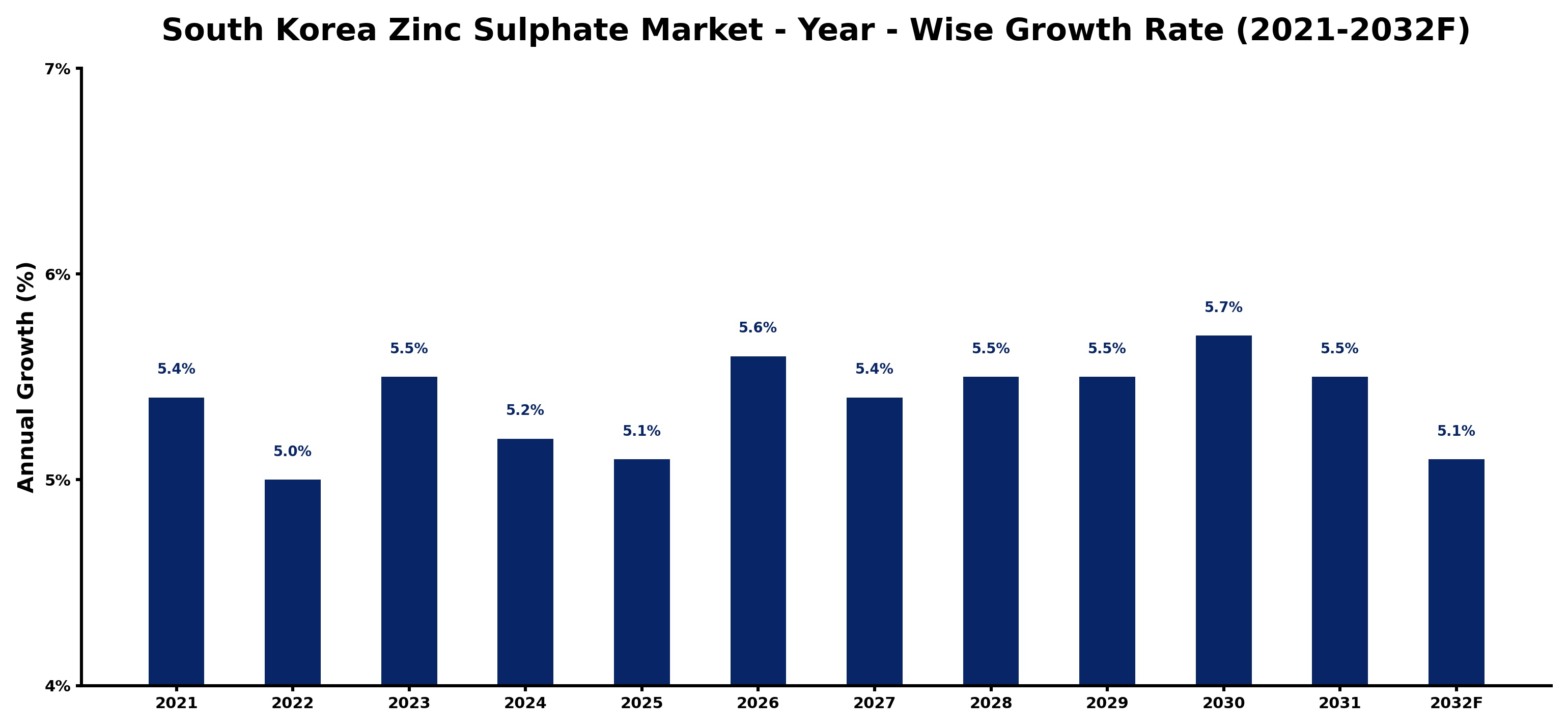
The table below presents the year‑wise growth rates along with the key drivers influencing the market
| Year | Growth Rate | Major Drivers |
| 2021 | 5.4% | Agricultural sector demand increased |
| 2022 | 5.0% | Fertilizer usage expanded significantly |
| 2023 | 5.5% | Animal feed formulations improved quality |
| 2024 | 5.2% | Industrial applications drove consumption |
| 2025 | 5.1% | Health supplements market growth accelerated |
| 2026 | 5.6% | Export opportunities expanded rapidly |
| 2027 | 5.4% | Research and development investments increased |
| 2028 | 5.5% | Sustainable farming practices gained traction |
| 2029 | 5.5% | Technological advancements enhanced production |
| 2030 | 5.7% | Consumer awareness of benefits rose |
| 2031 | 5.5% | Regulatory support for agriculture strengthened |
| 2032 | 5.1% | Market diversification strategies expanded |
Note - Market size estimations and growth projections presented in this report are based on 6Wresearch's advanced forecasting approach, validated with industry datasets as of June 2026.
South Korea Zinc Sulphate Market Synopsis
In recent years, the South Korea Zinc Sulphate Market has witnessed significant momentum, driven by the agricultural sector's increasing focus on micronutrient fortification. However, as the market matures, future growth hinges on innovating production techniques and addressing environmental concerns related to chemical usage. The emphasis on sustainable agricultural practices will continue to shape market dynamics, propelling zinc sulphate's adoption.
As we move toward 2032, the market is expected to evolve, embracing more eco-friendly practices and technologies. The interaction between government policies aimed at enhancing agricultural productivity and the growing focus on health and wellness will likely define the strategic landscape of the South Korea Zinc Sulphate Market.
South Korea Zinc Sulphate Market Key Takeaways
- The market is anticipated to grow significantly, with a forecasted value of USD 613 Million by 2032.
- High demand in agriculture and animal nutrition is a core driver of market expansion.
- Innovations in production processes are critical to maintaining competitive advantages.
- Government policies are increasingly supportive of sustainable agricultural practices.
- Market players are focused on developing value-added products to cater to diverse industry needs.
Evaluation of Restraints in South Korea Zinc Sulphate Market
Despite the growth opportunities, the South Korea Zinc Sulphate Market faces several constraints. Market saturation is a notable challenge, as many providers compete for the same customer base, leading to price pressures that can hinder profitability. Additionally, disruptions in the supply chain, particularly in raw material sourcing and logistics, pose risks to consistent product availability. Providers must continuously innovate to differentiate their offerings, addressing specific industry needs such as advanced micronutrient formulations and environmentally-friendly water treatment solutions.
South Korea Zinc Sulphate Market Trends
The market is increasingly influenced by trends centered around sustainability and eco-consciousness. Innovations in production methods are focusing on reducing environmental impacts while improving efficiency. There's a clear move toward water-soluble formulations that enhance the bioavailability of zinc in agricultural applications. Furthermore, the rise in organic farming practices is fostering a demand for high-quality zinc sulphate as a micronutrient supplement.
South Korea Zinc Sulphate Market Opportunities
The South Korea Zinc Sulphate Market is ripe with opportunities, particularly in sectors such as organic agriculture and fortified animal feeds. Manufacturers can explore partnerships with agribusiness firms that focus on sustainable practices and innovation. Additionally, there is considerable potential in developing advanced formulations that address specific crop needs and are aligned with regulatory standards for organic farming, thereby tapping into the expanding market for organic products.
Government Initiatives in the South Korea Zinc Sulphate Market
The South Korean government plays a pivotal role in fostering a conducive environment for the zinc sulphate market through various initiatives. These include regulatory frameworks that ensure the quality of zinc sulphate products, along with incentives for research and development aimed at enhancing agricultural productivity. Furthermore, collaborations between government entities and industry stakeholders are aimed at addressing regulatory hurdles and promoting the efficient usage of zinc sulphate as a micronutrient in agriculture.
Future Insights of the South Korea Zinc Sulphate Market
Looking ahead to 2026-2032, the South Korea Zinc Sulphate Market is expected to witness robust growth driven by advancements in agricultural practices and a continual push for enhanced soil health. With rising consumer awareness about food quality and nutrition, products that incorporate zinc sulphate will become increasingly significant. The interaction between technological advancements in production and sustainable practices will likely create a dynamic environment that shapes market strategies moving forward.
South Korea Zinc Sulphate Market Latest Developments (May 2025 - June 2026)
In the period from May 2025 to June 2026, the South Korea Zinc Sulphate Market is poised for notable developments, driven by a surge in R&D activities focused on eco-friendly production methods. Stakeholders are increasingly investing in technologies that enhance product purity and effectiveness. Additionally, awareness campaigns geared towards promoting the benefits of zinc sulphate in agricultural applications are expected to gain momentum, further stimulating market interest.
South Korea Zinc Sulphate Market - Key Attractiveness of the Report
- 10 Years of Market Numbers
- Historical Data Starting from 2022 to 2025
- Base Year: 2025
- Forecast Data until 2032
- Key Performance Indicators Impacting the Market
- Major Upcoming Developments and Projects
Key Highlights of the Report:
- South Korea Zinc Sulphate Market Outlook
- Market Size of South Korea Zinc Sulphate Market, 2025
- Forecast of South Korea Zinc Sulphate Market, 2032
- Historical Data and Forecast of South Korea Zinc Sulphate Revenues & Volume for the Period 2022-2032F
- South Korea Zinc Sulphate Market Trend Evolution
- South Korea Zinc Sulphate Market Drivers and Challenges
- South Korea Zinc Sulphate Price Trends
- South Korea Zinc Sulphate Porter's Five Forces
- South Korea Zinc Sulphate Industry Life Cycle
- Historical Data and Forecast of South Korea Zinc Sulphate Market Revenues & Volume By Type for the Period 2022-2032F
- Historical Data and Forecast of South Korea Zinc Sulphate Market Revenues & Volume By Zinc Sulphate Anhydrous for the Period 2022-2032F
- Historical Data and Forecast of South Korea Zinc Sulphate Market Revenues & Volume By Zinc Sulphate Hexahydrate for the Period 2022-2032F
- Historical Data and Forecast of South Korea Zinc Sulphate Market Revenues & Volume By Zinc Sulphate Heptahydrate for the Period 2022-2032F
- Historical Data and Forecast of South Korea Zinc Sulphate Market Revenues & Volume By Zinc Sulphate Monohydrate for the Period 2022-2032F
- Historical Data and Forecast of South Korea Zinc Sulphate Market Revenues & Volume By Application for the Period 2022-2032F
- Historical Data and Forecast of South Korea Zinc Sulphate Market Revenues & Volume By Agrochemicals for the Period 2022-2032F
- Historical Data and Forecast of South Korea Zinc Sulphate Market Revenues & Volume By Chemicals for the Period 2022-2032F
- Historical Data and Forecast of South Korea Zinc Sulphate Market Revenues & Volume By Pharmaceuticals for the Period 2022-2032F
- Historical Data and Forecast of South Korea Zinc Sulphate Market Revenues & Volume By Synthetic Fibers for the Period 2022-2032F
- Historical Data and Forecast of South Korea Zinc Sulphate Market Revenues & Volume By Water Treatment for the Period 2022-2032F
- Historical Data and Forecast of South Korea Zinc Sulphate Market Revenues & Volume By Others for the Period 2022-2032F
- South Korea Zinc Sulphate Import Export Trade Statistics
- Market Opportunity Assessment By Type
- Market Opportunity Assessment By Application
- South Korea Zinc Sulphate Top Companies Market Share
- South Korea Zinc Sulphate Competitive Benchmarking By Technical and Operational Parameters
- South Korea Zinc Sulphate Company Profiles
- South Korea Zinc Sulphate Key Strategic Recommendations






































