Spain Aggregates Market: Import Trend Analysis
In 2024, Spain`s import trend for the aggregates market showed a steady increase, driven by infrastructure development projects. The demand for construction materials contributed to the rise in imports, reflecting the industry`s growth.
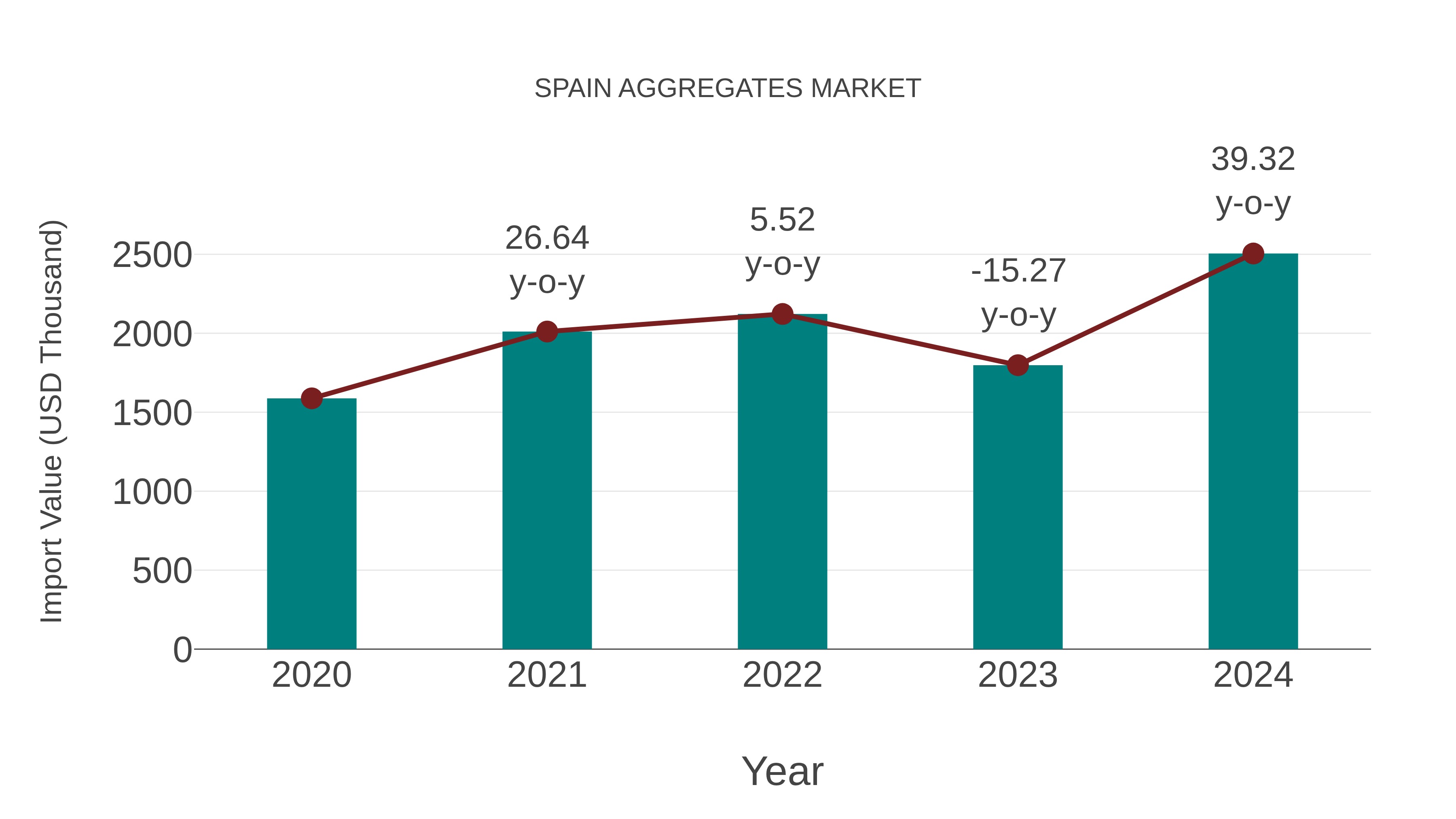
Spain Aggregates Market Overview
The Spain aggregates market is a crucial sector within the construction industry, encompassing a wide range of materials such as sand, gravel, crushed stone, and recycled concrete. These aggregates are primarily used in the production of concrete, asphalt, and other construction materials. The market is driven by infrastructure development, urbanization, and government investments in construction projects. Factors such as population growth, economic conditions, and environmental regulations also influence market trends. Major players in the Spain aggregates market include LafargeHolcim, HeidelbergCement, and Cemex, among others. Sustainability and innovation are increasingly important in the industry, with a focus on recycled aggregates and efficient production processes to meet the growing demand for construction materials in Spain.
Spain Aggregates Market Trends
The Spain aggregates market is experiencing steady growth driven by infrastructure development projects and increasing construction activities. Sustainable and eco-friendly practices are gaining traction in the market, with a growing emphasis on using recycled aggregates and reducing carbon footprint. Technological advancements, such as the use of advanced crushing and screening equipment, are improving efficiency and productivity in the production of aggregates. Market players are also focusing on innovations in product offerings to meet the evolving demands of customers, such as the development of specialized aggregates for specific applications. Additionally, there is a rising demand for high-quality aggregates for use in road construction, building foundations, and the manufacturing of concrete and asphalt, indicating a positive outlook for the Spain aggregates market in the coming years.
Spain Aggregates Market Challenges
In the Spain aggregates market, one of the key challenges faced is the increasing competition among suppliers, leading to pricing pressures and margin erosion. The market is also influenced by fluctuations in demand due to factors such as economic conditions and infrastructure development projects. Additionally, environmental concerns and regulations regarding sustainable sourcing and extraction of aggregates pose challenges for companies operating in the industry. Access to raw materials, transportation costs, and regulatory compliance further add complexity to the market landscape. To navigate these challenges successfully, companies need to focus on innovation, efficiency improvements, and strategic partnerships to remain competitive and sustainable in the Spain aggregates market.
Spain Aggregates Market Investment Opportunities
The Spain aggregates market presents promising investment opportunities due to the country`s robust construction sector and infrastructure development projects. With increasing investments in residential, commercial, and industrial construction, there is a growing demand for aggregates such as sand, gravel, and crushed stone. Investors can consider opportunities in aggregate mining and production companies, equipment suppliers, transportation and logistics firms, and recycling facilities. Furthermore, the emphasis on sustainable construction practices and environmental regulations in Spain creates avenues for investments in innovative technologies for efficient aggregate production and recycling processes. Overall, the Spain aggregates market offers diverse investment prospects driven by the construction industry`s growth and focus on sustainability.
Spain Aggregates Market Government Policy
Government policies related to the Spain aggregates market focus on sustainable extraction practices, environmental protection, and resource management. The Spanish government has implemented regulations to ensure responsible mining operations, including obtaining permits and conducting environmental impact assessments. There are also guidelines in place to promote the use of recycled aggregates and minimize the environmental impact of quarrying activities. Additionally, the government encourages innovation in the sector to improve efficiency and reduce carbon emissions. Overall, the policies aim to balance the need for construction materials with the protection of the environment and natural resources in Spain`s aggregates market.
Spain Aggregates Market Future Outlook
The Spain aggregates market is expected to experience moderate growth in the coming years, driven primarily by the increasing investments in infrastructure development and construction projects across the country. The demand for aggregates, including sand, gravel, and crushed stones, is likely to be sustained by the ongoing urbanization trends and government initiatives aimed at enhancing transportation networks and building sustainable cities. Additionally, the growing emphasis on sustainability and environmental regulations is anticipated to influence the market dynamics, leading to a shift towards the use of recycled aggregates and alternative materials. Overall, with the construction sector playing a pivotal role in the country`s economic recovery post-pandemic, the Spain aggregates market is poised for steady expansion in the foreseeable future.
Key Highlights of the Report:
- Spain Aggregates Market Outlook
- Market Size of Spain Aggregates Market, 2025
- Forecast of Spain Aggregates Market, 2032
- Historical Data and Forecast of Spain Aggregates Revenues & Volume for the Period 2022-2032F
- Spain Aggregates Market Trend Evolution
- Spain Aggregates Market Drivers and Challenges
- Spain Aggregates Price Trends
- Spain Aggregates Porter's Five Forces
- Spain Aggregates Industry Life Cycle
- Historical Data and Forecast of Spain Aggregates Market Revenues & Volume By Product Type for the Period 2022-2032F
- Historical Data and Forecast of Spain Aggregates Market Revenues & Volume By Crushed Stone for the Period 2022-2032F
- Historical Data and Forecast of Spain Aggregates Market Revenues & Volume By Sand for the Period 2022-2032F
- Historical Data and Forecast of Spain Aggregates Market Revenues & Volume By Gravel for the Period 2022-2032F
- Historical Data and Forecast of Spain Aggregates Market Revenues & Volume By Recycled Aggregates for the Period 2022-2032F
- Historical Data and Forecast of Spain Aggregates Market Revenues & Volume By Application for the Period 2022-2032F
- Historical Data and Forecast of Spain Aggregates Market Revenues & Volume By Construction Materials for the Period 2022-2032F
- Historical Data and Forecast of Spain Aggregates Market Revenues & Volume By Road Construction for the Period 2022-2032F
- Historical Data and Forecast of Spain Aggregates Market Revenues & Volume By Concrete Production for the Period 2022-2032F
- Historical Data and Forecast of Spain Aggregates Market Revenues & Volume By Landscaping for the Period 2022-2032F
- Historical Data and Forecast of Spain Aggregates Market Revenues & Volume By End User for the Period 2022-2032F
- Historical Data and Forecast of Spain Aggregates Market Revenues & Volume By Construction Industry for the Period 2022-2032F
- Historical Data and Forecast of Spain Aggregates Market Revenues & Volume By Residential for the Period 2022-2032F
- Historical Data and Forecast of Spain Aggregates Market Revenues & Volume By Commercial for the Period 2022-2032F
- Spain Aggregates Import Export Trade Statistics
- Market Opportunity Assessment By Product Type
- Market Opportunity Assessment By Application
- Market Opportunity Assessment By End User
- Spain Aggregates Top Companies Market Share
- Spain Aggregates Competitive Benchmarking By Technical and Operational Parameters
- Spain Aggregates Company Profiles
- Spain Aggregates Key Strategic Recommendations






































