Spain Automotive Aftermarket Market Size, Share & Growth Rate
The Spain Automotive Aftermarket Market was estimated at USD 150 Million in 2025 and is projected to reach USD 176 Million by 2032, growing at a CAGR of 2.3% from 2026 to 2032. This growth trajectory is underpinned by the increasing average age of vehicles on the road, which amplifies the demand for maintenance and repair services. Additionally, the rising trend of vehicle personalization and DIY maintenance among consumers is further stimulating market expansion.
Spain Automotive Aftermarket Market Year-wise Growth Rate and Key Drivers
This graph highlights how the Spain Automotive Aftermarket Market has steadily grown over the years, supported by major growth factors.
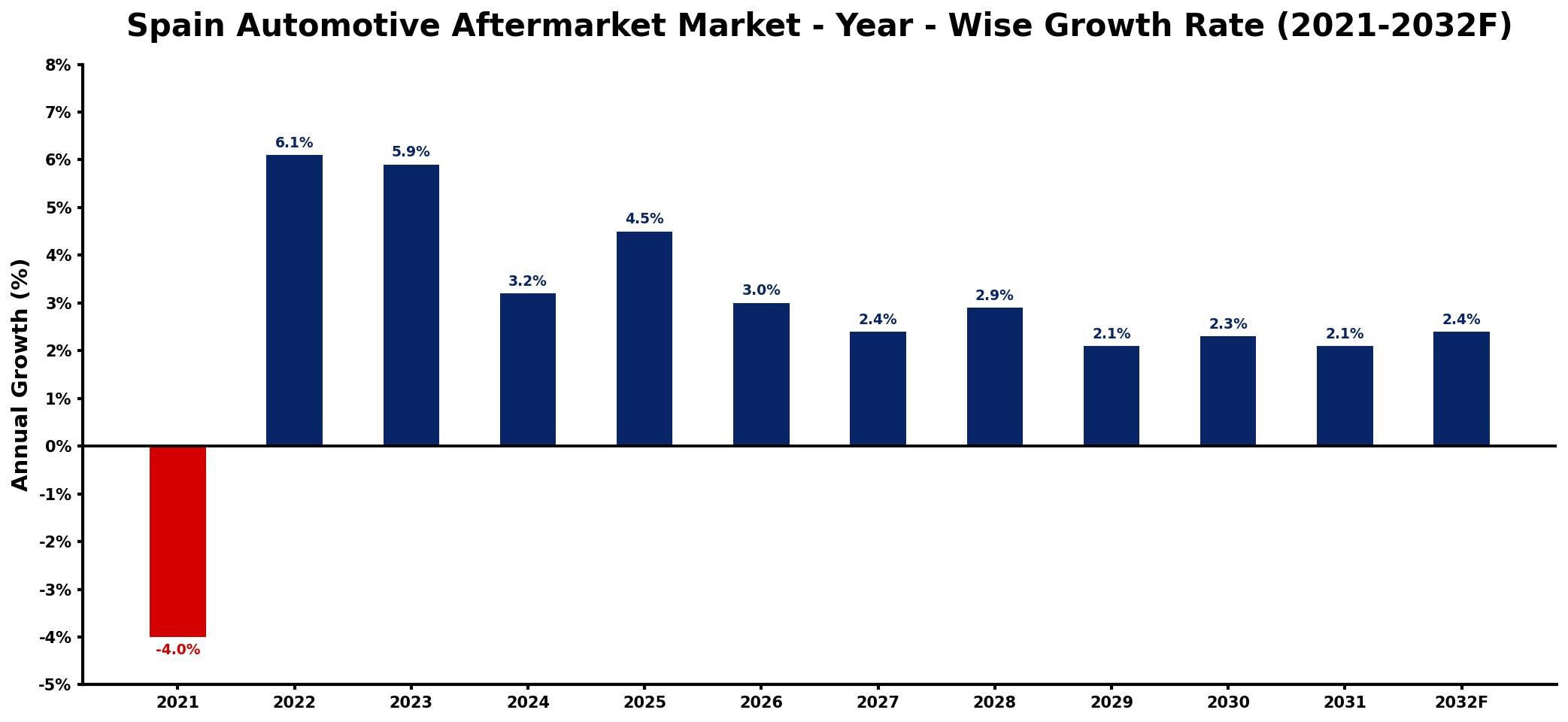
The table below presents the year‑wise growth rates along with the key drivers influencing the market
| Year | Growth Rate | Major Drivers |
| 2021 | -4.0% | decreased consumer spending on services |
| 2022 | 6.1% | rise in vehicle maintenance demand |
| 2023 | 5.9% | increased electric vehicle adoption |
| 2024 | 3.2% | growing online retail platforms |
| 2025 | 4.5% | expansion of service centers |
| 2026 | 3.0% | higher disposable income levels |
| 2027 | 2.4% | enhanced vehicle technology integration |
| 2028 | 2.9% | increased focus on sustainability |
| 2029 | 2.1% | growing interest in DIY repairs |
| 2030 | 2.3% | emphasis on preventive maintenance |
| 2031 | 2.1% | rising export shipment volumes |
| 2032 | 2.4% | rising end-use demand growth |
Note: Market size estimations and growth projections presented in this report are based on 6Wresearch's proprietary forecasting methodology, utilizing the latest available industry data, government publications, and primary research inputs.
Spain Automotive Aftermarket Market Synopsis
The Spain Automotive Aftermarket has witnessed significant momentum in recent years, fueled by a strong consumer base and diverse offerings. However, as the market evolves, the landscape is shifting towards more specialized services and eco-friendly products, indicating a transition that aligns with consumer preferences for sustainability and customization.
This market encompasses a broad array of sectors, including spare parts, accessories, maintenance services, and vehicle customization options. With a substantial vehicle population and a growing inclination towards upgrading vehicles, the Spanish aftermarket is poised for continued growth, presenting both challenges and opportunities for businesses within this space.
Spain Automotive Aftermarket Market Key Takeaways
- The market is characterized by a diverse range of products and services that cater to a variety of consumer needs.
- With a significant percentage of older vehicles on the road, demand for maintenance and repair services is on the rise.
- Shifts towards sustainability are influencing product offerings, with eco-friendly alternatives gaining traction.
- Digitalization and e-commerce are reshaping distribution channels, offering new avenues for consumer engagement.
- Investment in technology and innovative solutions presents lucrative opportunities within the aftermarket landscape.
Evaluation of Restraints in Spain Automotive Aftermarket Market
Despite its robust growth, the Spain Automotive Aftermarket faces several restraints that could hinder its momentum. Notably, the increasing competition among suppliers is creating pressure on margins, making it essential for businesses to differentiate themselves. Moreover, the rising costs of raw materials and the complex integration of new vehicle technologies add layers of difficulty for repair and maintenance services. These factors necessitate strategic investments in skills development and supply chain management to remain competitive. Additionally, the challenge of counterfeit products in the market raises concerns about quality assurance and consumer trust, requiring effective regulatory measures.
Spain Automotive Aftermarket Market Trends
Several noteworthy trends are shaping the Spain Automotive Aftermarket. A prominent trend is the increasing consumer appetite for vehicle customization, driving demand for aftermarket accessories and performance upgrades. Concurrently, there is a rising focus on environmentally friendly products, as consumers seek sustainable solutions for vehicle care and maintenance. The digital transformation of the industry is evident through the growing preference for online purchasing platforms, enabling consumers to easily access a wide range of automotive parts and services. This evolution is facilitating a shift in purchasing behavior, enhancing convenience and driving sales.
Spain Automotive Aftermarket Market Opportunities
The Spain Automotive Aftermarket presents numerous investment opportunities, particularly in the distribution of parts and accessories, as well as repair and maintenance services. The strong trend toward vehicle personalization and upgrades indicates a burgeoning market for aftermarket products. Furthermore, the increasing focus on sustainability offers avenues for investment in eco-friendly automotive solutions and services tailored to electric vehicles. By identifying these areas of growth, investors can capitalize on the evolving needs of consumers and the overall transformation of the automotive industry.
Government Initiatives in the Spain Automotive Aftermarket Market
Government policies in Spain are increasingly supportive of the automotive aftermarket sector, emphasizing innovation, competitiveness, and sustainability. Initiatives aimed at promoting eco-friendly technologies and research and development are pivotal to fostering a conducive environment for industry growth. Additionally, regulations are in place to ensure consumer protection and safety standards, enhancing market stability. The government is also providing incentives to bolster small and medium-sized enterprises, allowing them to improve their capabilities and respond effectively to market demands.
Future Insights of the Spain Automotive Aftermarket Market
Looking ahead to 2026-2032, the Spain Automotive Aftermarket is set to experience steady growth, fueled by several key drivers. The increasing average age of vehicles will likely necessitate more frequent repairs and maintenance, enhancing demand for aftermarket services. Moreover, the trend of vehicle customization is expected to persist, further driving accessory sales. The rise of electric vehicles will also create new opportunities for specialized aftermarket components and services. As online retail channels continue to expand, consumers will have greater access to products, contributing to sustained market growth.
Spain Automotive Aftermarket Market Latest Developments (2025 - 2026)
In the most recent developments within the Spain Automotive Aftermarket, there has been a marked increase in digital initiatives, including the expansion of e-commerce platforms tailored to automotive needs. Companies are exploring innovative partnerships to enhance service delivery and improve customer experience. Additionally, sustainability-focused products are becoming more prevalent, aligning with the growing consumer emphasis on eco-friendly practices. Efforts to combat counterfeit parts and ensure product quality are being ramped up, reflecting the industry's commitment to consumer protection and integrity.
Spain Automotive Aftermarket Market - Key Attractiveness of the Report
- 10 Years of Market Numbers
- Historical Data Starting from 2022 to 2025
- Base Year: 2025
- Forecast Data until 2032
- Key Performance Indicators Impacting the Market
- Major Upcoming Developments and Projects
Key Highlights of the Report:
- Spain Automotive Aftermarket Market Outlook
- Market Size of Spain Automotive Aftermarket Market, 2025
- Forecast of Spain Automotive Aftermarket Market, 2032
- Historical Data and Forecast of Spain Automotive Aftermarket Revenues & Volume for the Period 2022-2032F
- Spain Automotive Aftermarket Market Trend Evolution
- Spain Automotive Aftermarket Market Drivers and Challenges
- Spain Automotive Aftermarket Price Trends
- Spain Automotive Aftermarket Porter's Five Forces
- Spain Automotive Aftermarket Industry Life Cycle
- Historical Data and Forecast of Spain Automotive Aftermarket Market Revenues & Volume By Replacement Parts for the Period 2022-2032F
- Historical Data and Forecast of Spain Automotive Aftermarket Market Revenues & Volume By Tire for the Period 2022-2032F
- Historical Data and Forecast of Spain Automotive Aftermarket Market Revenues & Volume By Battery for the Period 2022-2032F
- Historical Data and Forecast of Spain Automotive Aftermarket Market Revenues & Volume By Brake Parts for the Period 2022-2032F
- Historical Data and Forecast of Spain Automotive Aftermarket Market Revenues & Volume By Filters for the Period 2022-2032F
- Historical Data and Forecast of Spain Automotive Aftermarket Market Revenues & Volume By Body parts for the Period 2022-2032F
- Historical Data and Forecast of Spain Automotive Aftermarket Market Revenues & Volume By Lighting & Electronic Components for the Period 2022-2032F
- Historical Data and Forecast of Spain Automotive Aftermarket Market Revenues & Volume By Wheels for the Period 2022-2032F
- Historical Data and Forecast of Spain Tire Automotive Aftermarket Market Revenues & Volume By Exhaust components for the Period 2022-2032F
- Historical Data and Forecast of Spain Automotive Aftermarket Market Revenues & Volume By Distribution Channel for the Period 2022-2032F
- Historical Data and Forecast of Spain Automotive Aftermarket Market Revenues & Volume By Retailers for the Period 2022-2032F
- Historical Data and Forecast of Spain Automotive Aftermarket Market Revenues & Volume By Wholesalers & Distributors for the Period 2022-2032F
- Historical Data and Forecast of Spain Automotive Aftermarket Market Revenues & Volume By Service Channel for the Period 2022-2032F
- Historical Data and Forecast of Spain Automotive Aftermarket Market Revenues & Volume By DIY (Do it Yourself) for the Period 2022-2032F
- Historical Data and Forecast of Spain Automotive Aftermarket Market Revenues & Volume By DIFM (Do it for Me) for the Period 2022-2032F
- Historical Data and Forecast of Spain Automotive Aftermarket Market Revenues & Volume By OE (Delegating to OEM??s) for the Period 2022-2032F
- Historical Data and Forecast of Spain Automotive Aftermarket Market Revenues & Volume By Certification for the Period 2022-2032F
- Historical Data and Forecast of Spain Automotive Aftermarket Market Revenues & Volume By Genuine Parts for the Period 2022-2032F
- Historical Data and Forecast of Spain Automotive Aftermarket Market Revenues & Volume By Certified Parts for the Period 2022-2032F
- Historical Data and Forecast of Spain Automotive Aftermarket Market Revenues & Volume By Uncertified Parts for the Period 2022-2032F
- Spain Automotive Aftermarket Import Export Trade Statistics
- Market Opportunity Assessment By Replacement Parts
- Market Opportunity Assessment By Distribution Channel
- Market Opportunity Assessment By Service Channel
- Market Opportunity Assessment By Certification
- Spain Automotive Aftermarket Top Companies Market Share
- Spain Automotive Aftermarket Competitive Benchmarking By Technical and Operational Parameters
- Spain Automotive Aftermarket Company Profiles
- Spain Automotive Aftermarket Key Strategic Recommendations






































