Spain Biomimetic Materials Market Size, Share & Growth Rate
The Spain Biomimetic Materials Market was estimated at USD 138 Million in 2025 and is projected to reach USD 162 Million by 2032, growing at a CAGR of 2.3% from 2026 to 2032. This growth trajectory is fueled by the escalating demand for sustainable materials across critical sectors such as healthcare, automotive, and construction. The innovative nature of biomimetic materials—replicating natural processes—positions them as a favorable alternative to traditional materials, aligning with Spain's commitment to sustainability and environmental consciousness.
Spain Biomimetic Materials Market Year-wise Growth Rate and Key Drivers
This graph highlights how the Spain Biomimetic Materials Market has steadily grown over the years, supported by major growth factors.
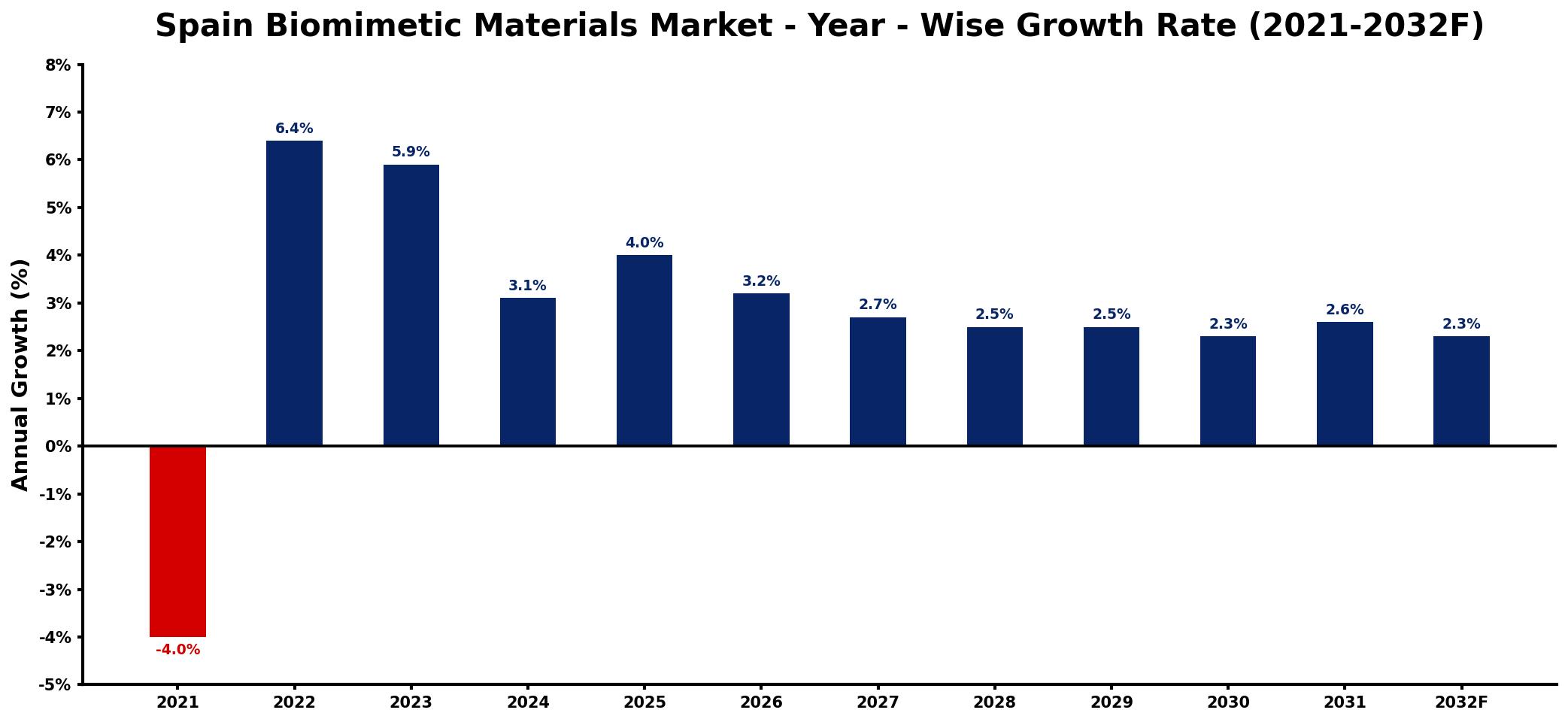
The table below presents the year‑wise growth rates along with the key drivers influencing the market
| Year | Growth Rate | Major Drivers |
| 2021 | -4.0% | decreased investment in sustainable technologies |
| 2022 | 6.4% | growing demand for eco-friendly solutions |
| 2023 | 5.9% | increased applications in construction industry |
| 2024 | 3.1% | expansion of renewable energy initiatives |
| 2025 | 4.0% | rising consumer interest in sustainability |
| 2026 | 3.2% | development of innovative manufacturing processes |
| 2027 | 2.7% | enhanced government funding for research |
| 2028 | 2.5% | growing collaborations with research institutions |
| 2029 | 2.5% | increased adoption in healthcare sector |
| 2030 | 2.3% | growing downstream application demand |
| 2031 | 2.6% | rising investments in circular economy |
| 2032 | 2.3% | expanding manufacturing base activity |
Note: Market size estimations and growth projections presented in this report are based on 6Wresearch's proprietary forecasting methodology, utilizing the latest available industry data, government publications, and primary research inputs.
Spain Biomimetic Materials Market Synopsis
In Spain, biomimetic materials are gaining traction due to the increasing integration of sustainability principles within industrial practices. These materials not only offer enhanced functionality but also contribute to reducing the ecological footprint of manufacturing and product development processes.
Particularly within the healthcare sector, biomimetic materials are revolutionizing applications such as tissue engineering and medical implants. This paradigm shift is largely attributed to their unique properties, including biocompatibility and self-healing abilities, which promise significant advancements in patient care and treatment outcomes.
Spain Biomimetic Materials Market Key Takeaways
- The market is driven by a strong demand for eco-friendly materials across various industries.
- Significant R&D investments are focused on advancing biomimetic material performance and applications.
- Healthcare remains the largest sector for biomimetic material applications, particularly in medical devices.
- Government policies actively promote sustainability and innovation, boosting market potential.
- Collaboration between academia and industry fosters a conducive environment for technological advancements.
Evaluation of Restraints in Spain Biomimetic Materials Market
Despite its growth potential, the Spain Biomimetic Materials Market faces several restraints. A lack of widespread awareness among potential end-users limits adoption rates. Additionally, the high costs associated with R&D for developing cutting-edge biomimetic solutions can hinder investment. Regulatory challenges around the commercialization of these advanced materials further complicate market dynamics. There's also the issue of standardization; without established benchmarks, ensuring quality across various products remains a significant hurdle. Addressing these barriers is crucial for facilitating broader market acceptance and driving growth.
Spain Biomimetic Materials Market Trends
The market is witnessing key trends centered around the development of innovative materials inspired by natural processes. Recent advancements include self-healing materials and bio-inspired adhesives, which cater to the growing need for sustainability. Moreover, there is a pronounced shift towards integrating circular economy principles, which encourages the use of materials that are not only functional but also capable of being recycled or reused. Collaborative efforts among academia, industry, and government are integral to enhancing innovation and accelerating the commercialization of these technologies.
Spain Biomimetic Materials Market Opportunities
Investment opportunities in the Spain Biomimetic Materials Market are abundant, particularly in healthcare applications such as drug delivery systems and tissue engineering. The construction sector also presents significant potential with a demand for sustainable building materials that emphasize both strength and environmental responsibility. Furthermore, the manufacturing industry is increasingly utilizing biomimetic materials for developing innovative products, particularly in self-healing technologies and coatings. As the momentum for research and development continues to build, stakeholders can expect substantial growth and returns on investment.
Government Initiatives in the Spain Biomimetic Materials Market
The Spanish government has implemented several initiatives to boost the development and adoption of biomimetic materials. Policies such as the National Strategy for Advanced Manufacturing and the Circular Economy Strategy emphasize the importance of sustainable materials. Funding programs, including the National Innovation and Technology Plan, are also available to support companies focused on research and development in biomimetic technologies. These initiatives reflect a broader commitment to fostering innovation that aligns with global sustainability goals.
Future Insights of the Spain Biomimetic Materials Market
Looking ahead to 2026-2032, the Spain Biomimetic Materials Market is set to experience notable growth, driven by the increasing need for environmentally friendly materials across key sectors. With advancements in research and significant government support, the introduction of advanced biomimetic materials is anticipated to flourish. As industries intensify their focus on innovative and sustainable solutions, the market landscape will transform, paving the way for lucrative opportunities for businesses operating in this space.
Spain Biomimetic Materials Market Latest Developments (2025 - 2026)
Recent developments in the Spain Biomimetic Materials Market highlight an increased focus on collaborative research initiatives aimed at accelerating innovation. Academic institutions are partnering with industry leaders to create advanced biomimetic solutions tailored for various applications, including healthcare and construction. Additionally, trade shows and conferences are fostering dialogue on best practices and emerging technologies in the biomimetic materials sector, providing stakeholders with insights into future market directions.
Spain Biomimetic Materials Market - Key Attractiveness of the Report
- 10 Years of Market Numbers
- Historical Data Starting from 2022 to 2025
- Base Year: 2025
- Forecast Data until 2032
- Key Performance Indicators Impacting the Market
- Major Upcoming Developments and Projects
Key Highlights of the Report:
- Spain Biomimetic Materials Market Outlook
- Market Size of Spain Biomimetic Materials Market, 2025
- Forecast of Spain Biomimetic Materials Market, 2032
- Historical Data and Forecast of Spain Biomimetic Materials Revenues & Volume for the Period 2022-2032F
- Spain Biomimetic Materials Market Trend Evolution
- Spain Biomimetic Materials Market Drivers and Challenges
- Spain Biomimetic Materials Price Trends
- Spain Biomimetic Materials Porter's Five Forces
- Spain Biomimetic Materials Industry Life Cycle
- Historical Data and Forecast of Spain Biomimetic Materials Market Revenues & Volume By Material for the Period 2022-2032F
- Historical Data and Forecast of Spain Biomimetic Materials Market Revenues & Volume By Biomimetic Polymers for the Period 2022-2032F
- Historical Data and Forecast of Spain Biomimetic Materials Market Revenues & Volume By Biomimetic Ceramics & Glass for the Period 2022-2032F
- Historical Data and Forecast of Spain Biomimetic Materials Market Revenues & Volume By Biomimetic Metals & Alloys for the Period 2022-2032F
- Historical Data and Forecast of Spain Biomimetic Materials Market Revenues & Volume By Others for the Period 2022-2032F
- Historical Data and Forecast of Spain Biomimetic Materials Market Revenues & Volume By Application for the Period 2022-2032F
- Historical Data and Forecast of Spain Biomimetic Materials Market Revenues & Volume By Medical for the Period 2022-2032F
- Historical Data and Forecast of Spain Biomimetic Materials Market Revenues & Volume By Automotive for the Period 2022-2032F
- Historical Data and Forecast of Spain Biomimetic Materials Market Revenues & Volume By Defense for the Period 2022-2032F
- Historical Data and Forecast of Spain Biomimetic Materials Market Revenues & Volume By Electronics for the Period 2022-2032F
- Historical Data and Forecast of Spain Biomimetic Materials Market Revenues & Volume By Others for the Period 2022-2032F
- Spain Biomimetic Materials Import Export Trade Statistics
- Market Opportunity Assessment By Material
- Market Opportunity Assessment By Application
- Spain Biomimetic Materials Top Companies Market Share
- Spain Biomimetic Materials Competitive Benchmarking By Technical and Operational Parameters
- Spain Biomimetic Materials Company Profiles
- Spain Biomimetic Materials Key Strategic Recommendations






































