Spain Breakfast Food Market: Import Trend Analysis
In 2024, Spain`s breakfast food market saw a notable increase in imports. This trend was driven by a growing consumer demand for diverse and convenient breakfast options, resulting in a higher volume of imported breakfast products entering the market.

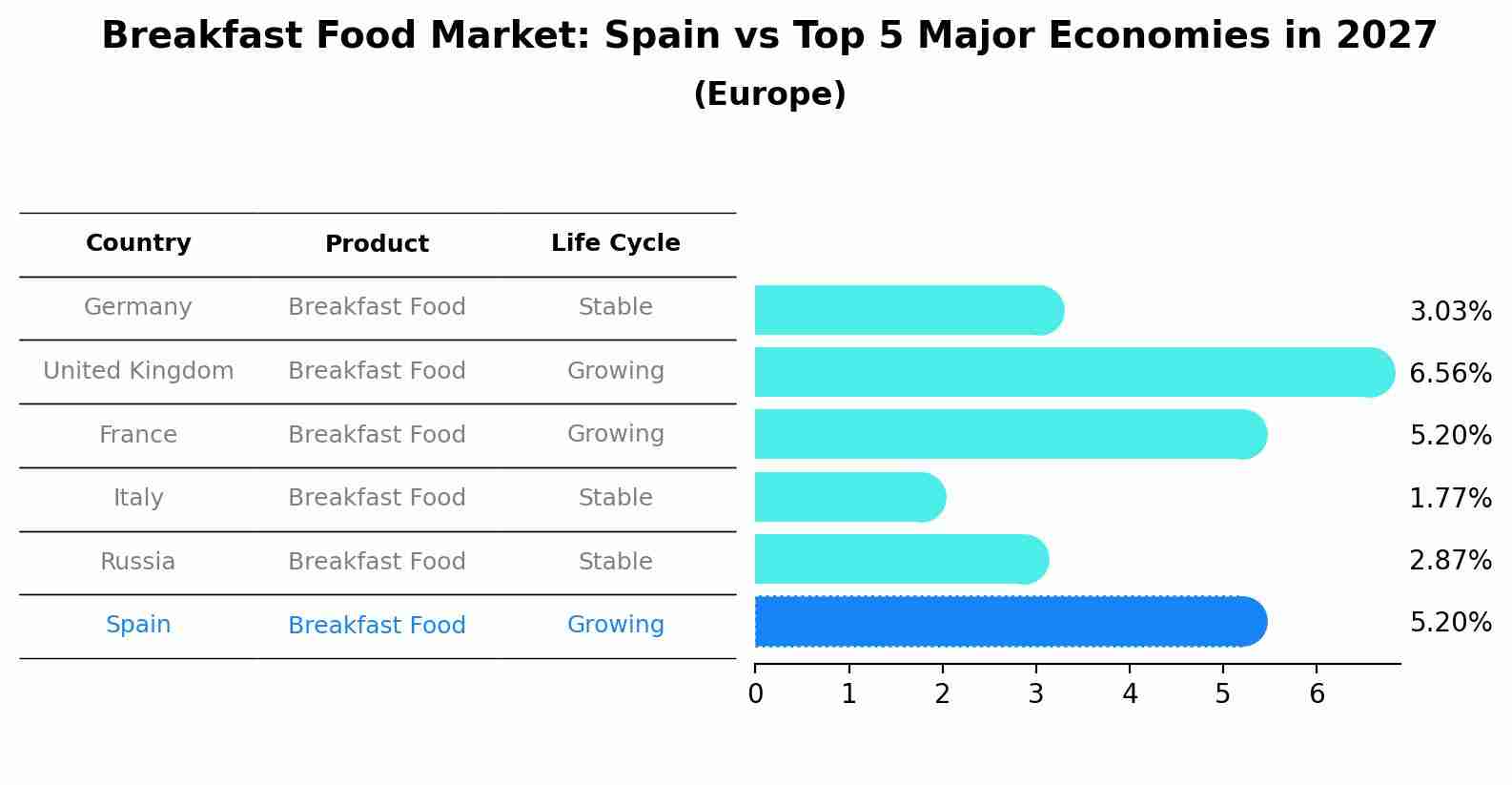
Breakfast Food Market: Spain vs Top 5 Major Economies in 2027 (Europe)
By 2027, the Breakfast Food market in Spain is anticipated to reach a growth rate of 5.20%, as part of an increasingly competitive Europe region, where Germany remains at the forefront, supported by United Kingdom, France, Italy and Russia, driving innovations and market adoption across sectors.
Spain Breakfast Food Market Highlights
| Report Name | Spain Breakfast Food Market |
| Forecast period | 2026-2032 |
| CAGR | 7.5% |
| Growing Sector | Convenient & healthy on-the-go breakfast foods |
Spain Breakfast Food Market Overview
The Spain Breakfast Food Market is experiencing growth driven by changing consumer preferences towards convenient and healthy breakfast options. Traditional breakfast items such as bread, pastries, and cured meats remain popular, but there is a rising demand for healthier alternatives like yogurt, muesli, and granola. The market is also witnessing a shift towards on-the-go breakfast solutions such as breakfast bars and smoothies to cater to busy lifestyles. Additionally, the trend of international influences in breakfast choices is leading to the adoption of dishes like avocado toast and chia pudding. Major players in the Spain Breakfast Food Market include Danone, Kellogg`s, and Granola Bites, who are focusing on product innovation and marketing strategies to capitalize on the growing consumer interest in diverse and nutritious breakfast options.
Spain Breakfast Food Market Synopsis
The Spain Breakfast Food Market continues to evolve as consumers increasingly prioritize convenience, nutrition, and diverse flavor profiles in their morning routines. Rising urbanization and busy work schedules are driving strong adoption of ready-to-eat cereals, muesli, oats, and fortified breakfast snacks. According to 6Wresearch internal database and industry insights, the Spain Breakfast Food Market is projected to grow at a compound annual growth rate (CAGR) of 7.5% during the forecast period (2026–2032),reflecting expanding demand across retail channels.
Growth in this market is further supported by shifting dietary preferences toward high-protein, low-sugar, and clean-label breakfast foods. Manufacturers are introducing innovative, premium, and organic product lines to attract health-conscious consumers. Additionally, rising influence of Western breakfast trends, increased café culture, and broader availability of on-the-go options are stimulating category expansion. Digital retail platforms and private-label offerings are also enhancing accessibility, boosting the overall competitiveness and sustainability of the Spain Breakfast Food Market.
Spain Breakfast Food Market Trends
In the Spain Breakfast Food Market, there is a growing demand for convenient and healthy options. Consumers are increasingly seeking out on-the-go breakfast products such as cereal bars, yogurt drinks, and smoothies that provide a quick and nutritious start to their day. There is also a trend towards traditional Spanish breakfast items like churros and Spanish omelettes being reinvented with a modern twist to appeal to a younger demographic. Additionally, there is a rising interest in plant-based and organic breakfast options, driven by concerns for health and sustainability. Manufacturers are responding to these trends by introducing innovative products that cater to these changing consumer preferences, creating a diverse and dynamic breakfast food market in Spain.
Spain Breakfast Food Market Challenges
In the Spain breakfast food market, one of the key challenges faced is changing consumer preferences and lifestyles. With busy schedules and a growing emphasis on health and wellness, consumers are seeking convenient, nutritious, and on-the-go breakfast options. This has led to a shift away from traditional breakfast items towards healthier alternatives such as yogurt, granola bars, and smoothies. Additionally, increased competition from international brands and the rise of online grocery shopping have made it challenging for local breakfast food manufacturers to differentiate themselves and attract consumers. Adapting to these changing trends, meeting consumer demand for healthier options, and effectively competing in a crowded market are some of the major challenges faced by players in the Spain breakfast food market.
Spain Breakfast Food Market Investment Opportunities
The Spain breakfast food market presents various investment opportunities for both established companies and new entrants. There is a growing trend towards healthier breakfast options, such as organic, gluten-free, and plant-based products, which presents opportunities for companies to innovate and cater to health-conscious consumers. Additionally, with the busy lifestyles of many Spaniards, convenient and on-the-go breakfast options are in demand. Investing in developing convenient, ready-to-eat breakfast products could be a lucrative opportunity. Furthermore, there is a rising interest in traditional Spanish breakfast items, such as churros, tortilla española, and pan con tomate, providing a niche market for specialty breakfast food producers. Overall, the Spain breakfast food market offers potential for growth and diversification through innovation, convenience, and catering to changing consumer preferences.
Spain Breakfast Food Market Government Policy
In Spain, the government has implemented various policies related to the breakfast food market to promote healthy eating habits and support local agriculture. These policies include regulations on food labeling to inform consumers about nutritional content, restrictions on advertising unhealthy foods to children, and subsidies for local farmers producing fresh fruits, vegetables, and dairy products. Additionally, the government has encouraged the consumption of traditional Spanish breakfast items like whole grain bread, olive oil, and fresh fruits through educational campaigns and public health initiatives. Overall, these policies aim to improve public health outcomes, support sustainable food production practices, and preserve the cultural heritage of Spanish cuisine in the breakfast food market.
Spain Breakfast Food Market Future Outlook
The Spain Breakfast Food Market is poised for steady growth in the coming years, fueled by changing consumer preferences, increasing health consciousness, and a growing demand for convenient and on-the-go breakfast options. The market is expected to see a rise in demand for healthier and more nutritious breakfast choices, including organic and plant-based options. Additionally, the trend towards snacking throughout the day is likely to drive innovation and product development in the breakfast food sector, leading to a wider variety of grab-and-go breakfast options. As consumers prioritize convenience and health in their food choices, we can anticipate a shift towards more innovative and functional breakfast products in the Spain market, creating opportunities for both traditional and new players in the industry to cater to evolving consumer needs.
Key Attractiveness of the Report
- 10 Years of Market Numbers.
- Historical Data Starting from 2022 to 2025.
- Base Year: 2025
- Forecast Data until 2032.
- Key Performance Indicators Impacting the market.
- Major Upcoming Developments and Projects.
Key Highlights of the Report:
- Spain Breakfast Food Market Outlook
- Market Size of Spain Breakfast Food Market, 2025
- Forecast of Spain Breakfast Food Market, 2032
- Historical Data and Forecast of Spain Breakfast Food Revenues & Volume for the Period 2022 - 2032
- Spain Breakfast Food Market Trend Evolution
- Spain Breakfast Food Market Drivers and Challenges
- Spain Breakfast Food Price Trends
- Spain Breakfast Food Porter's Five Forces
- Spain Breakfast Food Industry Life Cycle
- Historical Data and Forecast of Spain Breakfast Food Market Revenues & Volume By Product Type for the Period 2022 - 2032
- Historical Data and Forecast of Spain Breakfast Food Market Revenues & Volume By Cereals for the Period 2022 - 2032
- Historical Data and Forecast of Spain Breakfast Food Market Revenues & Volume By Beverages for the Period 2022 - 2032
- Historical Data and Forecast of Spain Breakfast Food Market Revenues & Volume By Snack Bars for the Period 2022 - 2032
- Historical Data and Forecast of Spain Breakfast Food Market Revenues & Volume By Ready meals for the Period 2022 - 2032
- Historical Data and Forecast of Spain Breakfast Food Market Revenues & Volume By Others for the Period 2022 - 2032
- Historical Data and Forecast of Spain Breakfast Food Market Revenues & Volume By Distribution Channel for the Period 2022 - 2032
- Historical Data and Forecast of Spain Breakfast Food Market Revenues & Volume By Hypermarkets and Supermarkets for the Period 2022 - 2032
- Historical Data and Forecast of Spain Breakfast Food Market Revenues & Volume By Independent Retailers for the Period 2022 - 2032
- Historical Data and Forecast of Spain Breakfast Food Market Revenues & Volume By Specialist Retailers for the Period 2022 - 2032
- Historical Data and Forecast of Spain Breakfast Food Market Revenues & Volume By Convenience Stores for the Period 2022 - 2032
- Historical Data and Forecast of Spain Breakfast Food Market Revenues & Volume By Others for the Period 2022 - 2032
- Spain Breakfast Food Import Export Trade Statistics
- Market Opportunity Assessment By Product Type
- Market Opportunity Assessment By Distribution Channel
- Spain Breakfast Food Top Companies Market Share
- Spain Breakfast Food Competitive Benchmarking By Technical and Operational Parameters
- Spain Breakfast Food Company Profiles
- Spain Breakfast Food Key Strategic Recommendations
Markets Covered
The Spain Breakfast Food Market report provides a detailed analysis of the following market segments:
By Product Type
- Cereals
- Beverages
- Snack Bars
- Ready meals
- Others
By Distribution Channel
- Hypermarkets and Supermarkets
- Independent Retailers
- Specialist Retailers
- Convenience Stores
- Others






































