Spain Confectionery Processing Equipment Market Size, Share & Growth Rate
The Spain Confectionery Processing Equipment Market was estimated at USD 207 Million in 2025 and is projected to reach USD 244 Million by 2032, growing at a CAGR of 2.4% from 2026 to 2032. This growth trajectory is primarily fueled by the expanding confectionery industry in Spain, where manufacturers increasingly seek automation and efficiency. With technological advancements improving production quality and speed, investments in state-of-the-art machinery are on the rise, further propelling market expansion.
Spain Confectionery Processing Equipment Market Year-wise Growth Rate and Key Drivers
This graph highlights how the Spain Confectionery Processing Equipment Market has steadily grown over the years, supported by major growth factors.
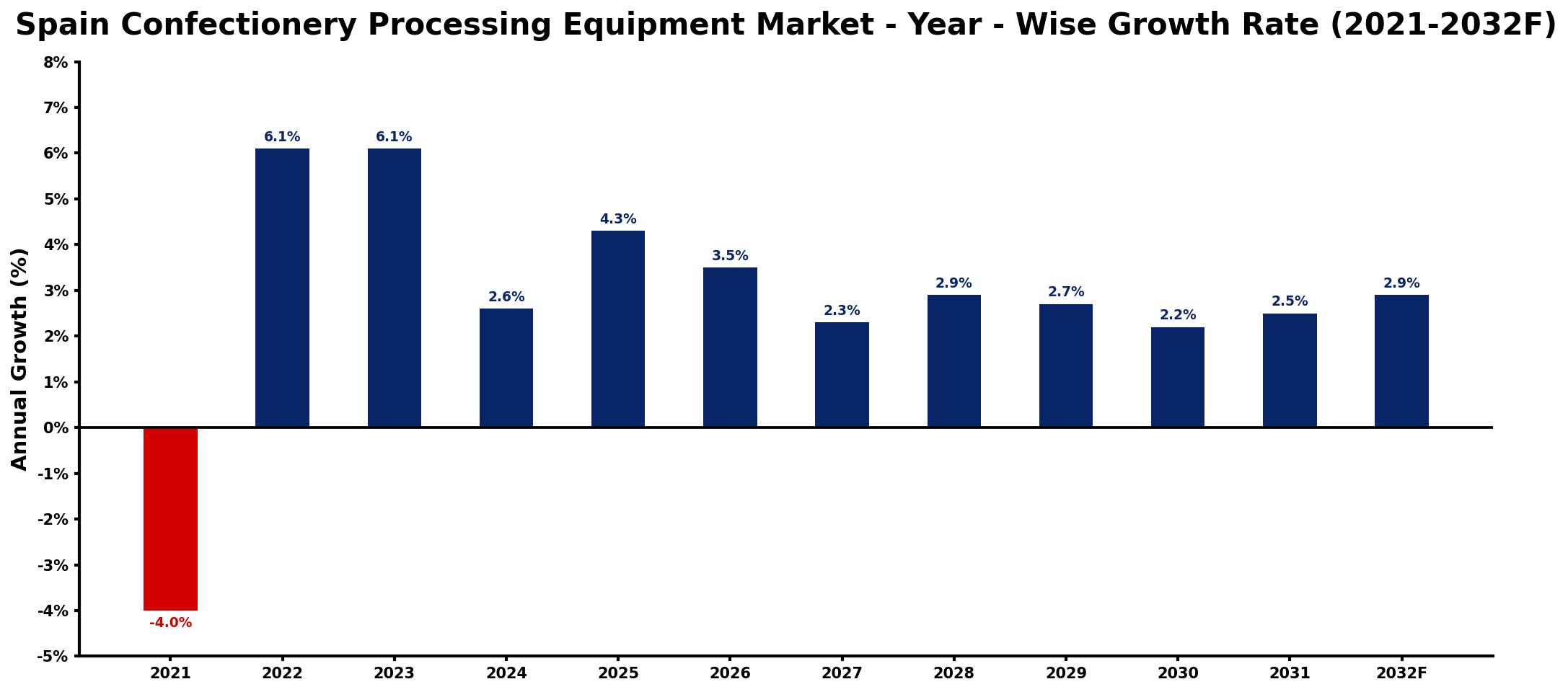
The table below presents the year‑wise growth rates along with the key drivers influencing the market
| Year | Growth Rate | Major Drivers |
| 2021 | -4.0% | decreased consumer spending on treats |
| 2022 | 6.1% | increased demand for healthier snacks |
| 2023 | 6.1% | expansion of retail distribution channels |
| 2024 | 2.6% | rise in automation technologies adoption |
| 2025 | 4.3% | growing preference for premium products |
| 2026 | 3.5% | surge in sustainable packaging solutions |
| 2027 | 2.3% | enhanced focus on R&D investments |
| 2028 | 2.9% | growth in e-commerce sales platforms |
| 2029 | 2.7% | increased popularity of gourmet options |
| 2030 | 2.2% | strengthening international trade flows |
| 2031 | 2.5% | growing regional consumption patterns |
| 2032 | 2.9% | growing demand for innovative flavors |
Note: Market size estimations and growth projections presented in this report are based on 6Wresearch's proprietary forecasting methodology, utilizing the latest available industry data, government publications, and primary research inputs.
Spain Confectionery Processing Equipment Market Synopsis
In Spain, the confectionery processing equipment landscape is witnessing a transformative phase driven by modern production needs. The demand for customized and artisanal products necessitates innovations in equipment design, ensuring that manufacturers can keep pace with consumer expectations while maintaining high efficiency.
Moreover, operators are increasingly investing in advanced machinery to enhance their production capabilities. This shift not only reflects a commitment to quality but also demonstrates a strategic response to the growing competition within the sector.
Spain Confectionery Processing Equipment Market Key Takeaways
- The market is expected to exhibit steady growth, with a focus on automation and technological advancement.
- Investment in modern machinery is critical for enhancing productivity and product quality.
- Government support and training initiatives are pivotal in promoting industry innovation.
- Challenges related to high initial costs and fluctuating demand persist, affecting smaller manufacturers.
- Supply chain disruptions may hinder procurement processes, impacting production schedules.
Evaluation of Restraints in Spain Confectionery Processing Equipment Market
Despite positive growth indicators, the Spain Confectionery Processing Equipment Market faces several notable restraints. Rapid technological advancements require manufacturers to make ongoing investments in new machinery, creating a financial burden. Smaller players may find the high initial costs of upgrading equipment prohibitive, which can limit their competitive edge. Additionally, the fluctuating demand in the confectionery sector leads to uncertainties in production schedules, making it challenging for manufacturers to optimize their operations. Supply chain disruptions further complicate the procurement of essential components, exacerbating the difficulties in maintaining a smooth production process.
Spain Confectionery Processing Equipment Market Trends
A significant trend influencing the Spain Confectionery Processing Equipment Market is the shift towards automation. As manufacturers strive for efficiency, automated systems are being integrated to reduce labor costs and minimize human error. Furthermore, there is an increasing focus on environmentally sustainable practices, prompting manufacturers to adopt energy-efficient machines that align with global sustainability goals.
Another trend is the rising consumer preference for personalized confectionery products, which is driving innovations in molding and packaging technologies. Equipment designed to facilitate customization is becoming crucial for manufacturers seeking to differentiate their offerings in a competitive market.
Spain Confectionery Processing Equipment Market Opportunities
The Spain Confectionery Processing Equipment Market presents numerous growth and investment opportunities, particularly for companies focusing on advanced automation technologies. The rising demand for specialty and artisanal confectionery products offers a unique niche for manufacturers willing to invest in tailored machinery. Additionally, companies that can leverage government initiatives and funding for technological innovation stand to gain a significant competitive advantage. As the market evolves, there is also potential for collaboration with tech firms to develop cutting-edge solutions that enhance production efficiency and product quality.
Government Initiatives in the Spain Confectionery Processing Equipment Market
The Spanish government is actively promoting initiatives aimed at bolstering the confectionery processing sector. Support for technological innovation in food processing equipment is crucial, as it encourages the adoption of advanced technologies that can significantly improve production capabilities. Furthermore, training programs for operators are being implemented to enhance safety and efficiency in manufacturing, ensuring that the workforce is equipped to handle new machinery and technologies. These initiatives not only aim to uplift manufacturing standards but also to stimulate investment in the sector.
Future Insights of the Spain Confectionery Processing Equipment Market
Looking ahead to 2026-2032, the Spain Confectionery Processing Equipment Market is positioned for steady growth, driven by technological advancements and rising consumer demands for customization. The ongoing shift towards automation and energy-efficient production processes will likely shape future investments. Moreover, as the industry adapts to changing consumer preferences, manufacturers will increasingly prioritize flexibility and innovation in their equipment offerings. This dynamic environment suggests that companies able to stay ahead of technological trends and consumer expectations will thrive in the coming years.
Spain Confectionery Processing Equipment Market Latest Developments (2025 - 2026)
Recent developments in the Spain Confectionery Processing Equipment Market indicate a strong push towards advanced technology adoption among manufacturers. The focus on enhancing production efficiency through automation is becoming more pronounced, with many companies actively exploring partnerships with tech firms. Additionally, there has been a notable increase in interest surrounding sustainability initiatives, with equipment manufacturers introducing energy-efficient solutions to meet evolving consumer and regulatory expectations. These trends highlight the industry's commitment to innovation and adaptability.
Spain Confectionery Processing Equipment Market - Key Attractiveness of the Report
- 10 Years of Market Numbers
- Historical Data Starting from 2022 to 2025
- Base Year: 2025
- Forecast Data until 2032
- Key Performance Indicators Impacting the Market
- Major Upcoming Developments and Projects
Key Highlights of the Report:
- Spain Confectionery Processing Equipment Market Outlook
- Market Size of Spain Confectionery Processing Equipment Market, 2025
- Forecast of Spain Confectionery Processing Equipment Market, 2032
- Historical Data and Forecast of Spain Confectionery Processing Equipment Revenues & Volume for the Period 2022-2032F
- Spain Confectionery Processing Equipment Market Trend Evolution
- Spain Confectionery Processing Equipment Market Drivers and Challenges
- Spain Confectionery Processing Equipment Price Trends
- Spain Confectionery Processing Equipment Porter's Five Forces
- Spain Confectionery Processing Equipment Industry Life Cycle
- Historical Data and Forecast of Spain Confectionery Processing Equipment Market Revenues & Volume By Product for the Period 2022-2032F
- Historical Data and Forecast of Spain Confectionery Processing Equipment Market Revenues & Volume By Soft Confectionery for the Period 2022-2032F
- Historical Data and Forecast of Spain Confectionery Processing Equipment Market Revenues & Volume By Hard Candies for the Period 2022-2032F
- Historical Data and Forecast of Spain Confectionery Processing Equipment Market Revenues & Volume By Chewing Gums for the Period 2022-2032F
- Historical Data and Forecast of Spain Confectionery Processing Equipment Market Revenues & Volume By Gummies & Jellies for the Period 2022-2032F
- Historical Data and Forecast of Spain Confectionery Processing Equipment Market Revenues & Volume By Others for the Period 2022-2032F
- Historical Data and Forecast of Spain Confectionery Processing Equipment Market Revenues & Volume By Type for the Period 2022-2032F
- Historical Data and Forecast of Spain Confectionery Processing Equipment Market Revenues & Volume By Thermal for the Period 2022-2032F
- Historical Data and Forecast of Spain Confectionery Processing Equipment Market Revenues & Volume By Mixers for the Period 2022-2032F
- Historical Data and Forecast of Spain Confectionery Processing Equipment Market Revenues & Volume By Blenders And Cutters for the Period 2022-2032F
- Historical Data and Forecast of Spain Confectionery Processing Equipment Market Revenues & Volume By Extrusion for the Period 2022-2032F
- Historical Data and Forecast of Spain Confectionery Processing Equipment Market Revenues & Volume By Cooling for the Period 2022-2032F
- Historical Data and Forecast of Spain Confectionery Processing Equipment Market Revenues & Volume By Coating for the Period 2022-2032F
- Historical Data and Forecast of Spain Confectionery Processing Equipment Market Revenues & Volume By Others for the Period 2022-2032F
- Historical Data and Forecast of Spain Confectionery Processing Equipment Market Revenues & Volume By Mode Of Operation for the Period 2022-2032F
- Historical Data and Forecast of Spain Confectionery Processing Equipment Market Revenues & Volume By Automatic for the Period 2022-2032F
- Historical Data and Forecast of Spain Confectionery Processing Equipment Market Revenues & Volume By Semi-automatic for the Period 2022-2032F
- Spain Confectionery Processing Equipment Import Export Trade Statistics
- Market Opportunity Assessment By Product
- Market Opportunity Assessment By Type
- Market Opportunity Assessment By Mode Of Operation
- Spain Confectionery Processing Equipment Top Companies Market Share
- Spain Confectionery Processing Equipment Competitive Benchmarking By Technical and Operational Parameters
- Spain Confectionery Processing Equipment Company Profiles
- Spain Confectionery Processing Equipment Key Strategic Recommendations






































