spain construction market
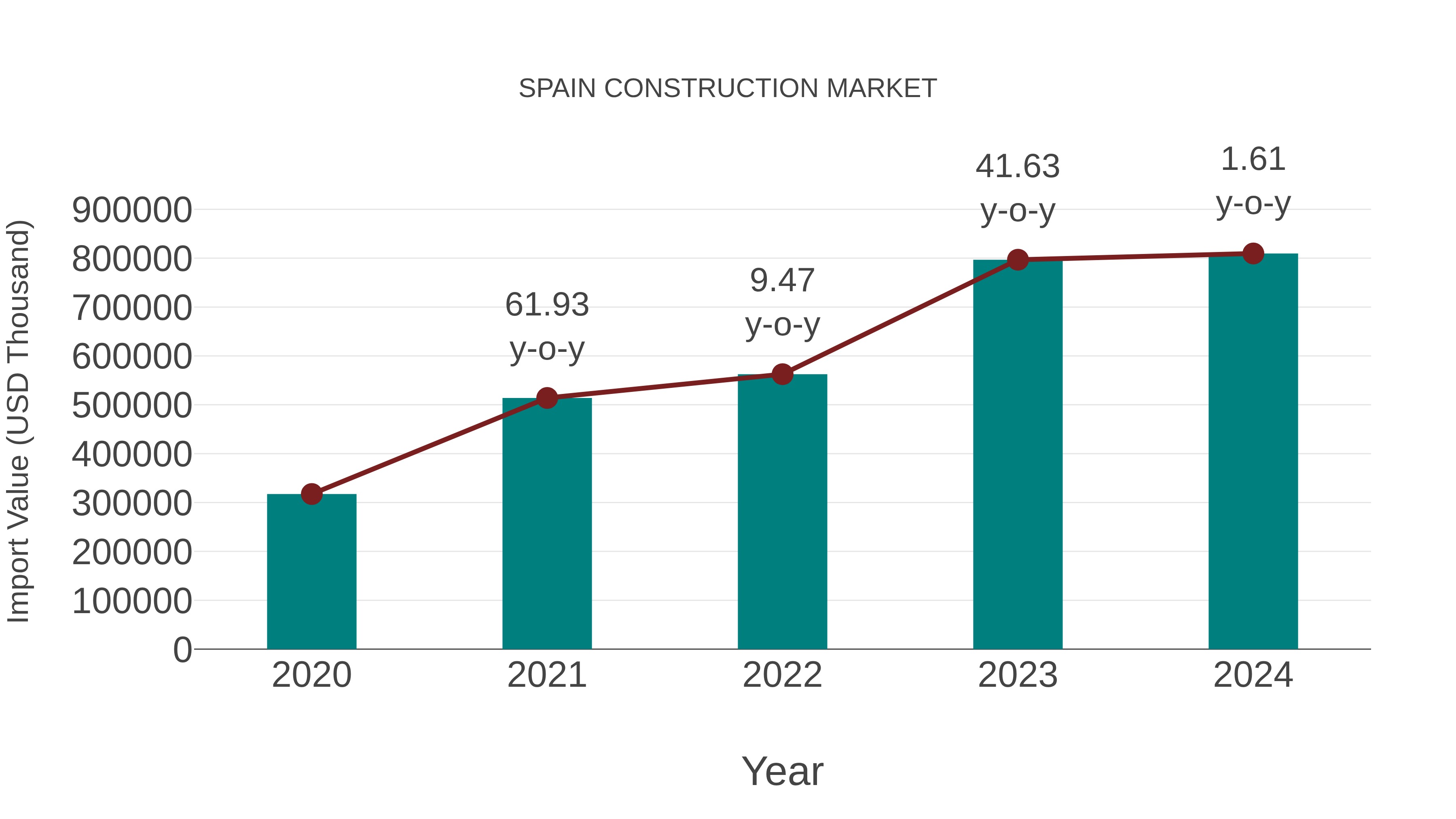
Spain Construction Market Growth Rate
According to 6Wresearch internal database and industry insights, the Spain Construction Market is projected to grow at a compound annual growth rate (CAGR) of 4.8% during the forecast period (2026–2032).
Five-Years Growth Trajectory of the Spain Construction Market with Core Drivers
Below is the evaluation of the year-wise growth rate along with key drivers:
| Years | Estimated Annual Growth (%) | Growth Drivers |
| 2021 | 4 | Increase in demand for residential housing and infrastructure development |
| 2022 | 4.2 | Rising investments in public infrastructure and government-led housing programs |
| 2023 | 4.4 | Growth in urbanization and rise in urban construction projects |
| 2024 | 4.6 | Expansion of green buildings and sustainable construction practices |
| 2025 | 4.8 | Increased foreign investments and technological advancements in construction |
Topics Covered in the Spain Construction Market Report
The Spain Construction Market report thoroughly covers the market by Product Types, Sector, and Category. The report provides a detailed analysis of ongoing market trends, opportunities/high-growth areas, and market drivers that will help stakeholders devise and align strategies according to current and future market dynamics.
Spain Construction Market Highlights
| Report Name | Spain Construction Market |
|---|---|
| Forecast period | 2026–2032 |
| CAGR | 4.8% |
| Growing Sector | Construction and Infrastructure |
Spain Construction Market Synopsis
The Spain Construction Industry is on a growth trajectory, fueled by increasing investments in residential, commercial, and public infrastructure projects. Measures taken by the government to address the housing gap and support sustainability are crucial contributors to this growth. The growing demand for eco-friendly materials and energy-efficient construction methods is driving strong market expansion. Furthermore, government policies promoting sustainable and green building practices are accelerating the sector's growth.
Evaluation of Growth Drivers in the Spain Construction Market
Below are some prominent drivers and their influence on the Spain Construction Market dynamics:
| Drivers | Primary Segments Affected | Why it Matters |
| Increasing Urbanization | By Sector (Urban) | Urban growth is pushing the demand for housing, commercial, and public infrastructure projects. |
| Government Investments in Housing | By Category (New) | Housing programs by the government stimulate demand for new residential and commercial building projects. |
| Technological Advancements in Construction | By Product (Heavy and Civil Engineering) | Technological advancements are improving construction efficiency and reducing project costs. |
| Focus on Sustainability | By Category (Renovation) | Green building trends and sustainable renovations are gaining popularity in residential and commercial spaces. |
The Spain Construction Market is projected to grow at a CAGR of 4.8% during the forecast period (2026–2032). The Spain Construction Market is experiencing growth, driven by increased government investment in the construction industry, urbanization and a high emphasis on sustainable development. As demand for smart, green buildings continues to rise due to this focus on sustainability, along with various government initiatives to encourage investment in housing and infrastructure projects (including government tax credits for those who invest), the overall growth pattern of the construction market will continue. Moreover, progress in construction techniques and materials is crucial in supporting the sustained expansion of the construction industry.
Evaluation of Restraints in the Spain Construction Market
Below are some prominent restraints and their influence on the Spain Construction Market dynamics:
| Restraints | Primary Segments Affected | What this Means |
| Rising Material Costs | By Product (General Construction) | Variations in the prices of raw materials like steel, cement, and wood can result in increased project costs. |
| Environmental Impact of Construction | By Product (Heavy and Civil Engineering) | Construction practices with high carbon footprints may face stricter environmental regulations. |
| Regulatory Challenges | By Sector (Rural) | Tightening building codes and compliance regulations may slow down development in rural areas. |
| Skilled Labor Shortage | By Product (General Construction) | A shortage of skilled workers may delay project timelines and increase labor costs. |
Spain Construction Market Challenges
The Spain Construction Market encounters challenges such as escalating raw material costs, environmental issues, and regulatory obstacles. A lack of skilled labor, especially in rural areas, may lead to delays and increased costs. Furthermore, stringent environmental regulations are pushing construction companies to implement sustainable practices, raising short-term expenses. These issues, coupled with volatile material prices and the need for green building compliance, present substantial obstacles to the market growth and profitability.
Spain Construction Market Trends
Several key trends are shaping the Spain Construction Market Growth:
- The rise of Sustainable Construction: The ever-stricter regulatory compliance is forcing the developers to adopt green materials and circular construction practices, thus the demand for sustainable projects is increasing.
- Increased activity in renovation projects: The adoption of energy efficiency standards is one of the main factors that lead to the upgrade of the older buildings through the increased renovation activity.
- Smart Infrastructure Development: Digital construction technology (e.g. building information modelling - BIM - and smart monitoring systems) will enhance the productivity of construction projects.
- Modular and Prefabricated Construction: Among the advantages of modular building techniques, faster construction time and less waste are the most important ones, resulting in gaining popularity in this method.
Investment Opportunities in the Spain Construction Market
Some notable investment opportunities include:
- Green Building Investments: As the demand for sustainable buildings rises, investment opportunities are emerging in green construction, energy-efficient materials, and eco-friendly solutions.
- Public Infrastructure Projects: Growth prospects for construction companies are driven by government efforts to improve public infrastructure, including roads, bridges, and transportation systems.
- Renovation and Retrofitting: Investment in the renovation of old buildings and the retrofitting of infrastructure to meet modern standards is an opportunity in both urban and rural areas.
- Modular and Prefabricated Solutions: Companies that invest in modular and prefabricated construction technologies stand to benefit from cost savings, quicker project completion times, and reduced environmental impact.
Top 5 Leading Players in the Spain Construction Market
Some leading players operating in the Spain Construction Market Share include:
1. Ferrovial
| Company Name | Ferrovial |
|---|---|
| Established Year | 1952 |
| Headquarters | Madrid, Spain |
| Official Website | Click Here |
A leading global infrastructure and construction company, Ferrovial specializes in large-scale projects, including highways, bridges, and public infrastructure, along with residential and commercial construction.
2. Sacyr
| Company Name | Sacyr |
|---|---|
| Established Year | 1986 |
| Headquarters | Madrid, Spain |
| Official Website | Click Here |
Sacyr is a multinational construction company involved in major projects such as highways, airports, and large residential and commercial buildings. They focus on both national and international markets.
3. Acciona
| Company Name | Acciona |
|---|---|
| Established Year | 1997 |
| Headquarters | Madrid, Spain |
| Official Website | Click Here |
Acciona operates in the renewable energy and infrastructure sectors, focusing on sustainable construction practices. The company is involved in civil engineering, water, and renewable energy projects.
4. Grupo ACS
| Company Name | Grupo ACS |
|---|---|
| Established Year | 1997 |
| Headquarters | Madrid, Spain |
| Official Website | Click Here |
Grupo ACS is one of the largest construction companies in Spain, known for its involvement in large infrastructure projects such as roads, airports, and high-speed rail systems.
5. FCC Construcción
| Company Name | FCC Construcción |
|---|---|
| Established Year | 1900 |
| Headquarters | Madrid, Spain |
| Official Website | Click Here |
FCC Construcción is a leader in civil engineering and construction, specializing in urban development, road building, and large-scale infrastructure projects.
Government Regulations Introduced in the Spain Construction Market
According to Spanish government data, initiatives like the Spanish Green Building Council (GBCe) and Sustainable Urban Development Plans are driving construction market growth. The government promotes the use of sustainable materials, energy-efficient designs, and carbon-reducing technologies. Examples, include incentives for energy-efficient buildings, tax breaks for renewable energy adoption, and regulations to cut carbon emissions in construction. These initiatives are driving supporting environmental objectives, more sustainable construction industry, and encouraging greener building practices throughout Spain.
Future Insights of the Spain Construction Market
The Spain Construction Market is influenced by key drivers such as urbanization, sustainable building practices, and technological advancements. Government measures aimed at energy-saving building and intelligent city project will be important for the market to evolve. Market will be regarded as active and being part of the sustainability and innovations' trends, these factors along with the continuing investments in both public and private sectors will support growth.
Market Segmentation Analysis
The report offers a comprehensive study of the following market segments and their leading categories:
By Product Type – General Construction to Lead the Market
According to Ritika Kalra, Senior Research Analyst at 6Wresearch, General construction leads the market, driven by increasing demand for residential buildings, commercial spaces, and large infrastructure projects.
By Sector – Urban to Lead the Market
Urban areas are dominating the construction market, supported by rapid urbanization and infrastructure development in metropolitan regions.
By Category – New Construction to Lead the Market
The market is expected to be led by new construction, supported by growth in infrastructure investment, housing projects, and large-scale developments nationwide.
Key Attractiveness of the Report
- 10 Years of Market Numbers
- Historical Data Starting from 2022 to 2025
- Base Year: 2025
- Forecast Data until 2032
- Key Performance Indicators Impacting the Market
- Major Upcoming Developments and Projects
Key Highlights of the Report:
- Spain Construction Market Outlook
- Market Size of Spain Construction Market, 2025
- Forecast of Spain Construction Market, 2032
- Historical Data and Forecast of Spain Construction Revenues & Volume for the Period 2022- 2032
- Spain Construction Market Trend Evolution
- Spain Construction Market Drivers and Challenges
- Spain Construction Price Trends
- Spain Construction Porter's Five Forces
- Spain Construction Industry Life Cycle
- Historical Data and Forecast of Spain Construction Market Revenues & Volume By Product for the Period 2022- 2032
- Historical Data and Forecast of Spain Construction Market Revenues & Volume By Heavy and Civil Engineering for the Period 2022- 2032
- Historical Data and Forecast of Spain Construction Market Revenues & Volume By General Construction for the Period 2022- 2032
- Historical Data and Forecast of Spain Construction Market Revenues & Volume By Sector for the Period 2022- 2032
- Historical Data and Forecast of Spain Construction Market Revenues & Volume By Urban for the Period 2022- 2032
- Historical Data and Forecast of Spain Construction Market Revenues & Volume By Rural for the Period 2022- 2032
- Historical Data and Forecast of Spain Construction Market Revenues & Volume By Category for the Period 2022- 2032
- Historical Data and Forecast of Spain Construction Market Revenues & Volume By New for the Period 2022- 2032
- Historical Data and Forecast of Spain Construction Market Revenues & Volume By Renovation for the Period 2022- 2032
- Spain Construction Import Export Trade Statistics
- Market Opportunity Assessment By Product
- Market Opportunity Assessment By Sector
- Market Opportunity Assessment By Category
- Spain Construction Top Companies Market Share
- Spain Construction Competitive Benchmarking By Technical and Operational Parameters
- Spain Construction Company Profiles
- Spain Construction Key Strategic Recommendations
Markets Covered
The report offers a comprehensive study of the following market segments:
By Product Type
- Heavy and Civil Engineering
- General Construction
By Sector
- Urban
- Rural
By Category
- New
- Renovation






































