Spain Cultured Meat Market Size, Share & Growth Rate
The Spain Cultured Meat Market was estimated at USD 202 Million in 2025 and is projected to reach USD 239 Million by 2032, growing at a CAGR of 2.4% from 2026 to 2032. This growth is fueled by a combination of rising consumer interest in sustainable food options and the increasing viability of cellular agriculture technologies. As biotechnology continues to advance and research investments surge, Spain is positioning itself as a key player in the cultured meat landscape.
Spain Cultured Meat Market Year-wise Growth Rate and Key Drivers
This graph highlights how the Spain Cultured Meat Market has steadily grown over the years, supported by major growth factors.
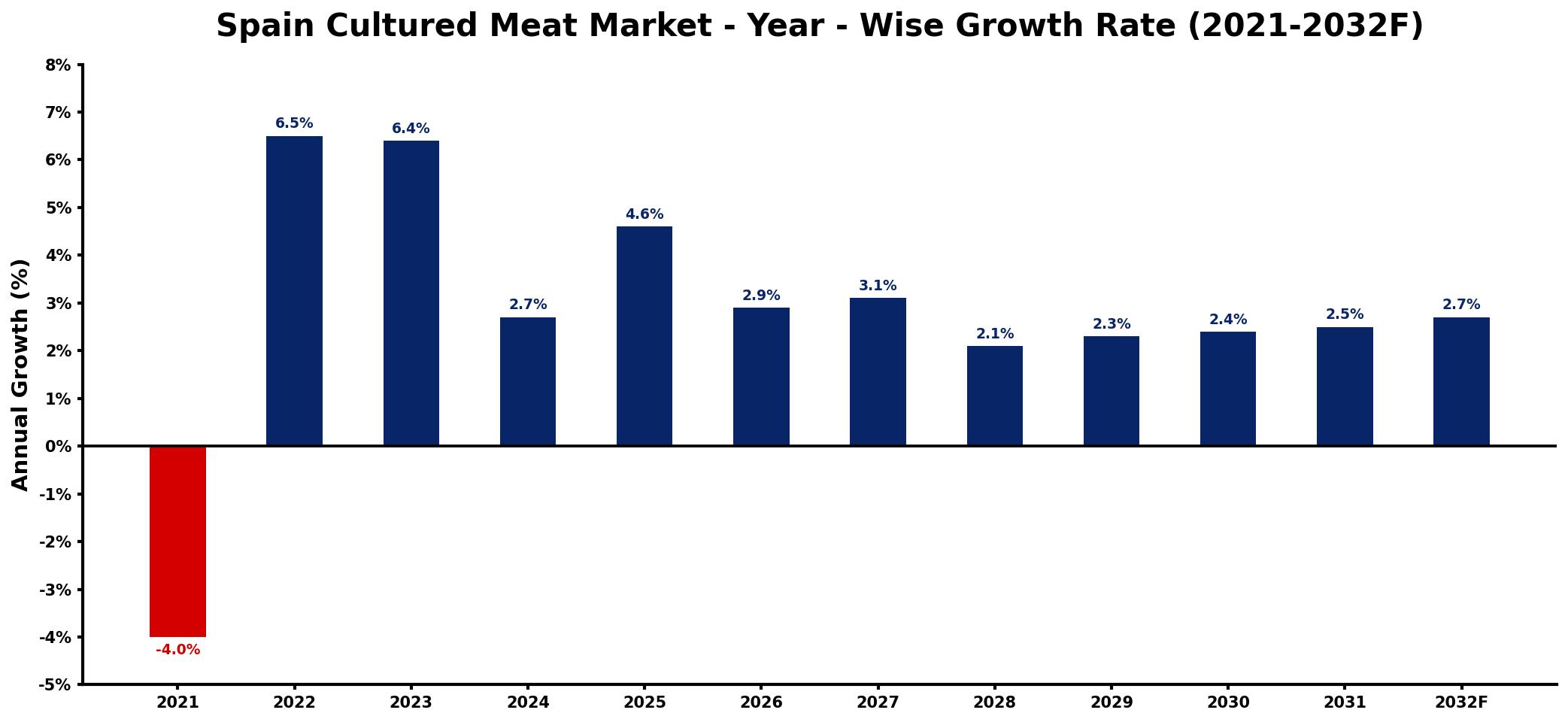
The table below presents the year‑wise growth rates along with the key drivers influencing the market
| Year | Growth Rate | Major Drivers |
| 2021 | -4.0% | consumer interest in alternatives wanes |
| 2022 | 6.5% | investments in sustainable alternatives rise |
| 2023 | 6.4% | public awareness of environmental impacts |
| 2024 | 2.7% | increased demand for ethical products |
| 2025 | 4.6% | expansion of production facilities planned |
| 2026 | 2.9% | research funding for innovative solutions |
| 2027 | 3.1% | collaboration among industry stakeholders grows |
| 2028 | 2.1% | new distribution channels established |
| 2029 | 2.3% | government support for sustainable initiatives |
| 2030 | 2.4% | emerging markets show increasing interest |
| 2031 | 2.5% | technology advancements enhance production efficiency |
| 2032 | 2.7% | consumer preferences shift towards sustainability |
Note: Market size estimations and growth projections presented in this report are based on 6Wresearch's proprietary forecasting methodology, utilizing the latest available industry data, government publications, and primary research inputs.
Spain Cultured Meat Market Synopsis
The cultured meat market in Spain is currently experiencing a surge in momentum, driven by heightened environmental awareness and shifting consumer preferences. This initial push, however, faces a challenging regulatory environment and the need for greater public education about the benefits of cultured meat. Looking ahead, the market is poised to grow as innovation takes center stage and regulatory pathways become clearer.
Despite the challenges, the Spanish cultured meat market is on a promising trajectory. The evolution of governmental policies favoring sustainable food production and the increasing backing from private investments signal an optimistic outlook. As more consumers become educated about the environmental and ethical advantages of cultured meat, its acceptance in mainstream food systems is expected to accelerate.
Spain Cultured Meat Market Key Takeaways
- Growing consumer demand for sustainable food solutions is a primary driver of market growth.
- Technological advancements in biotechnology are enhancing the production feasibility of cultured meat.
- Government support is crucial in developing regulatory frameworks that encourage market entry.
- Despite potential, challenges such as high production costs and consumer awareness remain significant hurdles.
- Investment from both startups and established companies is fostering innovation and market expansion.
Evaluation of Restraints in Spain Cultured Meat Market
The Spain Cultured Meat Market faces significant restraints, primarily stemming from regulatory complexities and a general lack of consumer understanding. The lengthy process to gain necessary certifications poses a barrier for new entrants, delaying product launches and hindering competitive positioning against traditional meat products. Additionally, public skepticism fueled by misconceptions surrounding lab-grown meats complicates acceptance, requiring focused educational initiatives to bridge the gap between innovation and consumer trust.
Spain Cultured Meat Market Trends
Several trends are shaping the cultured meat landscape in Spain. Firstly, increasing consumer emphasis on sustainability is driving demand for alternatives to conventional meat, particularly among environmentally conscious millennials. Furthermore, as technology advances, new cellular agriculture techniques are reducing production costs, making cultured meat more accessible. The rising prevalence of plant-based diets also complements the growth of cultured meat, as consumers explore a wider array of sustainable protein sources.
Spain Cultured Meat Market Opportunities
Significant opportunities lie within the Spanish cultured meat market for investment and innovation. As the regulatory landscape evolves, companies that can navigate these changes swiftly will capitalize on early market entry. Furthermore, collaboration between academia and industry could spur advancements in production efficiency and consumer awareness campaigns. Finally, as cultured meat products diversify to meet various culinary preferences, tapping into niche markets can present lucrative avenues for growth.
Government Initiatives in the Spain Cultured Meat Market
The Spanish government has taken a proactive stance in fostering the cultured meat market by implementing policies aimed at sustainable food production. These initiatives include funding for research and development, establishing regulatory frameworks to ensure food safety, and promoting public acceptance of lab-grown foods. Such supportive measures are essential for building consumer trust and paving the way for broader acceptance of cultured meat in the Spanish diet.
Future Insights of the Spain Cultured Meat Market
From 2026 to 2032, the Spain Cultured Meat Market is expected to undergo significant transformation driven by technological advancements and shifting consumer sentiments. As education efforts increase and production techniques become more refined, the acceptance of cultured meat is projected to rise. The interplay between government support, investment influx, and consumer awareness will play a pivotal role in shaping the future of this promising market.
Spain Cultured Meat Market Latest Developments (2025 - 2026)
Recent developments in the Spain Cultured Meat Market indicate a robust direction towards increased research collaboration and innovative production methodologies. Companies are focusing on streamlining the certification process to shorten timeframes for market entry. Additionally, public campaigns aimed at educating consumers about the benefits of cultured meat are gaining traction, enhancing the overall market landscape. Continued investment from both domestic and international players suggests a growing confidence in the viability of cultured meat.
Spain Cultured Meat Market - Key Attractiveness of the Report
- 10 Years of Market Numbers
- Historical Data Starting from 2022 to 2025
- Base Year: 2025
- Forecast Data until 2032
- Key Performance Indicators Impacting the Market
- Major Upcoming Developments and Projects
Key Highlights of the Report:
- Spain Cultured Meat Market Outlook
- Market Size of Spain Cultured Meat Market, 2025
- Forecast of Spain Cultured Meat Market, 2032
- Historical Data and Forecast of Spain Cultured Meat Revenues & Volume for the Period 2022-2032F
- Spain Cultured Meat Market Trend Evolution
- Spain Cultured Meat Market Drivers and Challenges
- Spain Cultured Meat Price Trends
- Spain Cultured Meat Porter's Five Forces
- Spain Cultured Meat Industry Life Cycle
- Historical Data and Forecast of Spain Cultured Meat Market Revenues & Volume By Product Type for the Period 2022-2032F
- Historical Data and Forecast of Spain Cultured Meat Market Revenues & Volume By Poultry for the Period 2022-2032F
- Historical Data and Forecast of Spain Cultured Meat Market Revenues & Volume By Beef for the Period 2022-2032F
- Historical Data and Forecast of Spain Cultured Meat Market Revenues & Volume By Seafood for the Period 2022-2032F
- Historical Data and Forecast of Spain Cultured Meat Market Revenues & Volume By Pork for the Period 2022-2032F
- Historical Data and Forecast of Spain Cultured Meat Market Revenues & Volume By Duck for the Period 2022-2032F
- Historical Data and Forecast of Spain Cultured Meat Market Revenues & Volume By End-Use for the Period 2022-2032F
- Historical Data and Forecast of Spain Cultured Meat Market Revenues & Volume By Nuggets for the Period 2022-2032F
- Historical Data and Forecast of Spain Cultured Meat Market Revenues & Volume By Burgers for the Period 2022-2032F
- Historical Data and Forecast of Spain Cultured Meat Market Revenues & Volume By Meatballs for the Period 2022-2032F
- Historical Data and Forecast of Spain Cultured Meat Market Revenues & Volume By Sausage for the Period 2022-2032F
- Historical Data and Forecast of Spain Cultured Meat Market Revenues & Volume By Hot dogs for the Period 2022-2032F
- Historical Data and Forecast of Spain Cultured Meat Market Revenues & Volume By Others for the Period 2022-2032F
- Spain Cultured Meat Import Export Trade Statistics
- Market Opportunity Assessment By Product Type
- Market Opportunity Assessment By End-Use
- Spain Cultured Meat Top Companies Market Share
- Spain Cultured Meat Competitive Benchmarking By Technical and Operational Parameters
- Spain Cultured Meat Company Profiles
- Spain Cultured Meat Key Strategic Recommendations






































