Spain Digital Lending Market Size & Growth Rate (2026-2032)
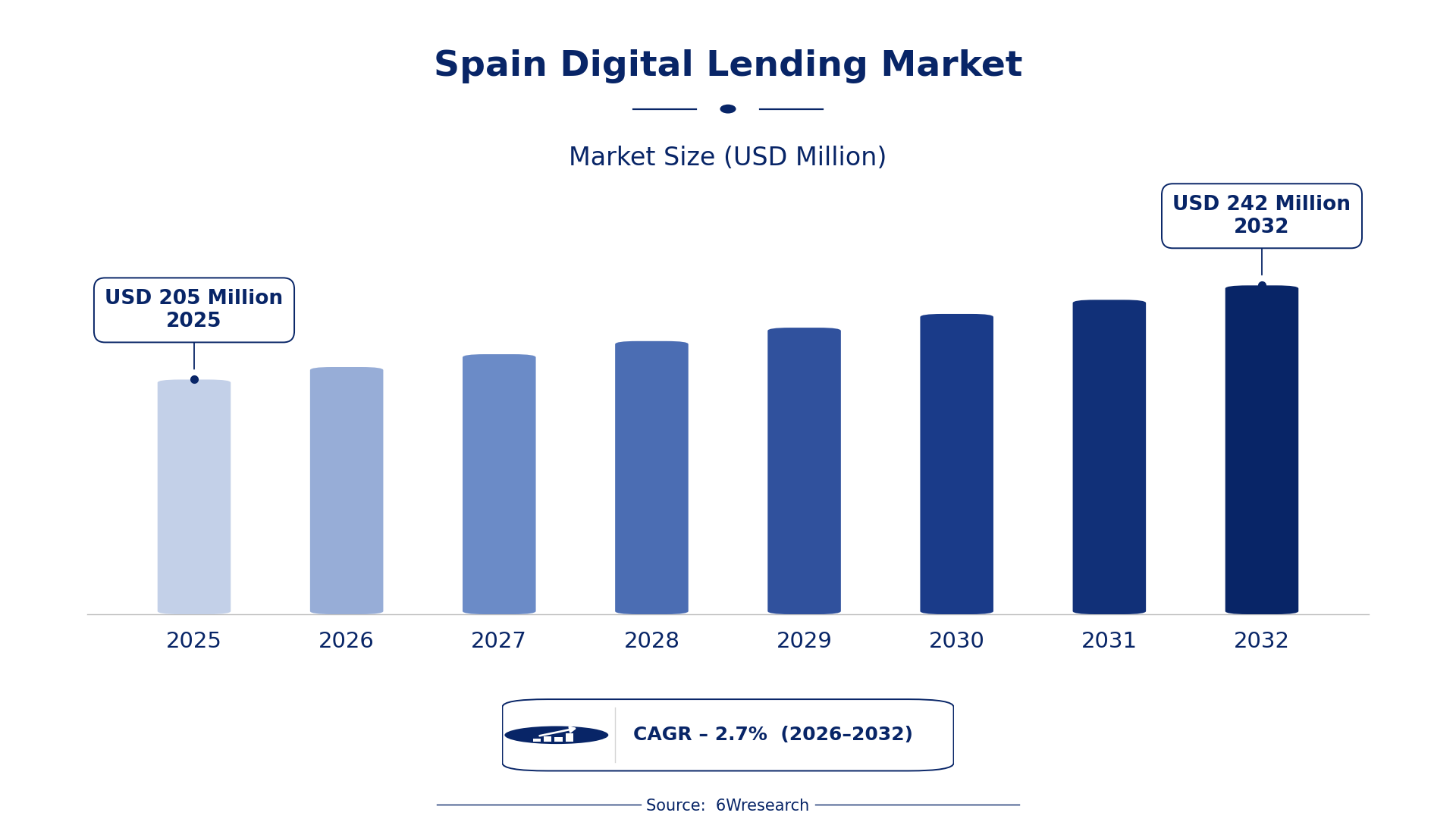
The Spain Digital Lending Market was estimated at USD 205 Million in 2025 and is projected to reach USD 242 Million by 2032, growing at a CAGR of 2.7% from 2026 to 2032.
Spain Digital Lending Market Synopsis
The Spain digital lending market is rapidly evolving, driven by the increasing demand for fast and accessible financing options. As internet penetration and smartphone usage soar, consumers are gravitating toward digital solutions that streamline the borrowing process and enhance user experience.
Fintech companies are at the forefront of this transformation, offering diverse lending products like peer-to-peer platforms and instant personal loans. With technology such as artificial intelligence being utilized for credit risk assessments, the market is poised for continuous growth and innovation.
Spain Digital Lending Market Year-wise Growth Rate and Key Drivers
This graph illustrates the annual growth rates of the Spain Digital Lending Market from 2021 to 2032, highlighting a steady upward trajectory and projected expansion over the forecast period.
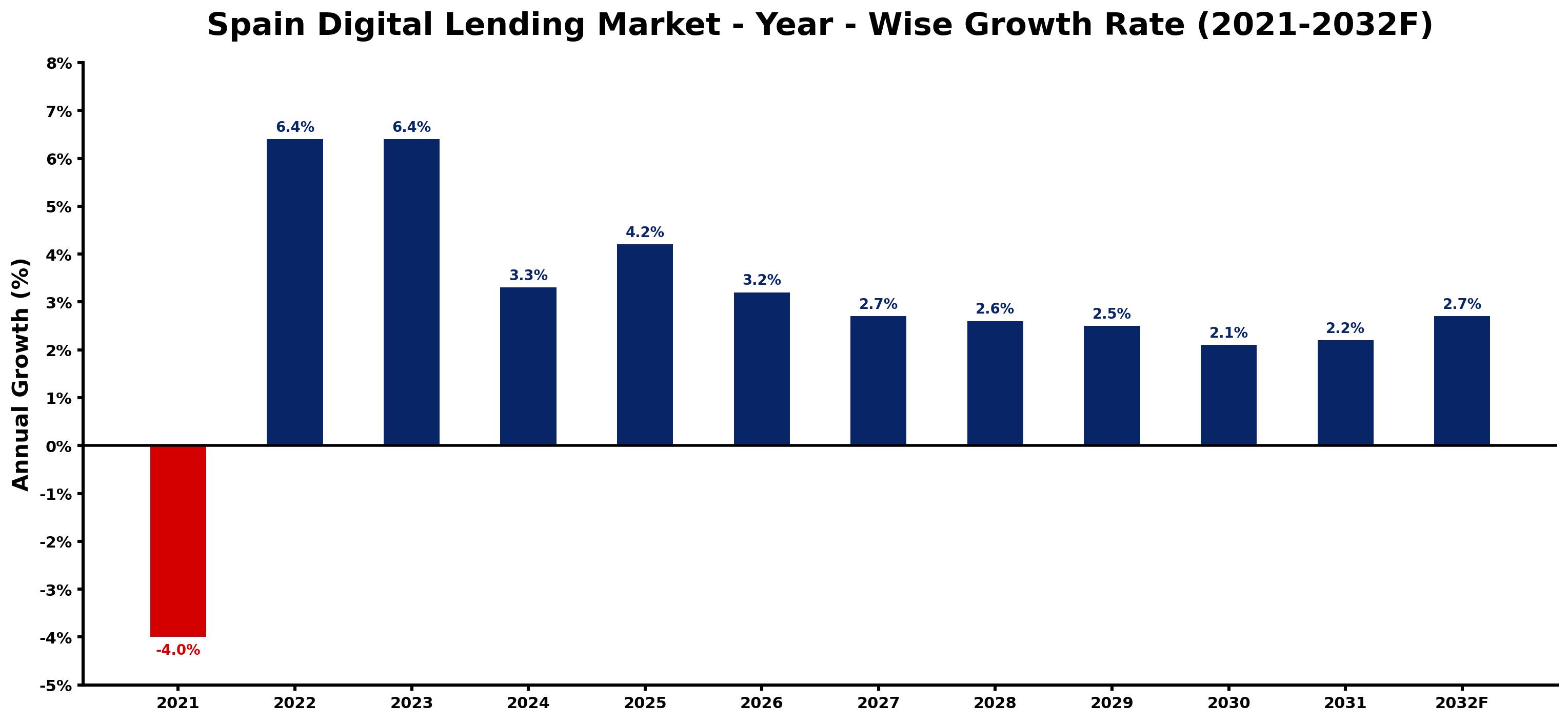
The table below presents the year‑wise growth rates along with the key drivers influencing the market
| Year | Growth Rate | Major Drivers |
| 2021 | -4.0% | Increased regulatory oversight by Bank of Spain |
| 2022 | 6.4% | Government push for digital financial services accessibility. |
| 2023 | 6.4% | Increased demand for online consumer loans post-pandemic. |
| 2024 | 3.3% | Launch of EU digital finance strategy promoting innovation. |
| 2025 | 4.2% | Growing popularity of fintech solutions among younger consumers. |
| 2026 | 3.2% | Enhanced digital identity verification regulations fostering trust. |
| 2027 | 2.7% | Rise in e-commerce driving personal financing needs. |
| 2028 | 2.6% | Growing acceptance of alternative credit scoring models. |
| 2029 | 2.5% | Partnerships between banks and fintechs for streamlined services. |
| 2030 | 2.1% | Focus on financial inclusion initiatives by local entities. |
| 2031 | 2.2% | Increased smartphone penetration enhancing access to lending. |
| 2032 | 2.7% | Evolving consumer preferences towards flexible repayment options. |
Note: Market size estimations and growth projections presented in this report are based on 6Wresearch's proprietary forecasting methodology, utilizing the latest available industry data, government publications, and primary research inputs.
Spain Digital Lending Market Key Takeaways
Below are some of the specific key takeaways from the market, including:
- Consumer preferences are shifting towards digital lending solutions for their convenience and speed.
- Technological advancements are enhancing the lending process, improving risk assessment and customer satisfaction.
- Regulatory support is fostering a competitive environment that benefits both borrowers and lenders.
- Emerging fintech companies are challenging traditional banks, creating a dynamic marketplace.
- Investment opportunities are abundant, particularly in peer-to-peer and online lending platforms.
Evaluation of Restraints in Spain Digital Lending Market
Despite the promising outlook, the Spain digital lending market faces considerable restraints. Regulatory compliance is a significant hurdle, as stringent financial regulations aim to protect consumers and ensure fair practices. This can create delays and additional costs for lenders trying to enter or expand in the market.
on top of that, competition is intensifying as traditional banks and new fintech entrants vie for market share, leading to pricing pressures that can erode margins. Cybersecurity remains a major concern, with the necessity for robust measures to protect sensitive borrower data and prevent fraud becoming ever more critical.
Spain Digital Lending Market Trends
A marked trend in the Spain digital lending market is the rise of peer-to-peer lending platforms, which provide borrowers with alternative funding options outside traditional banks. These platforms have gained traction, particularly among younger, tech-savvy consumers seeking quicker access to funds.
Fintech companies are increasingly leveraging advanced technologies like big data analytics to tailor loan options and expedite approval processes. As digital banking evolves, lenders are focusing on enhancing their digital capabilities, making the lending experience more user-friendly and efficient.
Spain Digital Lending Market Opportunities
There are substantial investment opportunities within the Spain digital lending market, particularly in peer-to-peer lending and consumer-focused online lending services. The growing demand for these alternatives is reshaping the financial landscape, allowing for more flexible borrowing solutions.
Investors should focus on established companies and startups that demonstrate a strong grasp of risk management and innovative technological applications. As the market continues to grow, the potential for high returns is significant, particularly in segments catering to underserved borrowers.
Government Initiatives in the Spain Digital Lending Market
The regulatory framework surrounding the Spain digital lending market is shaped by initiatives from the Bank of Spain and the National Securities Market Commission (CNMV). These entities are focused on fostering innovation while ensuring consumer protection and transparency in lending practices.
- A recently launched regulatory framework by the CNMV emphasizes investor protection in peer-to-peer lending platforms.
- Current initiatives from the Bank of Spain focus on enhancing compliance and risk management protocols across lending institutions.
- A planned public consultation aimed at revising lending regulations is expected to occur in late 2026, intending to adapt to the evolving digital landscape.
- The European Union’s Payment Services Directive (PSD2) continues to impact the market by promoting competition and innovation.
Future Insights of the Spain Digital Lending Market
Looking ahead to 2026-2032, the Spain digital lending market is set for significant expansion. The ongoing shift toward digital financial services is expected to attract both traditional banks and new fintech players, intensifying competition.
As more consumers embrace online lending, the demand for personalized and efficient services will drive innovation. Regulatory support aimed at fostering financial inclusion will further bolster market growth, creating a favorable environment for new entrants and established players alike.
Spain Digital Lending Market Latest Developments
Over the past year, the Spain digital lending market has seen several noteworthy developments. With fintech firms continually innovating, the competition is heating up, leading to enhanced offerings and improved customer experiences.
- A major fintech company launched a new mobile application in early 2025 that enables instant loan approvals, significantly reducing processing times.
- A partnership between two leading fintech firms was established in mid-2025 to integrate advanced AI technologies into their lending processes, currently underway.
- A new digital mortgage service is expected to launch in late 2026, targeting first-time homebuyers with competitive rates and simplified application processes.
- A digital security initiative aimed at enhancing cybersecurity protocols for online lending platforms is ongoing, expected to be completed by early 2026.
Spain Digital Lending Market - Key Attractiveness of the Report
- 10 Years of Market Numbers
- Historical Data Starting from 2022 to 2025
- Base Year: 2025
- Forecast Data until 2032
- Key Performance Indicators Impacting the Market
- Major Upcoming Developments and Projects
Key Highlights of the Report:
- Spain Digital Lending Market Outlook
- Market Size of Spain Digital Lending Market, 2025
- Forecast of Spain Digital Lending Market, 2032
- Historical Data and Forecast of Spain Digital Lending Revenues & Volume for the Period 2022-2032F
- Spain Digital Lending Market Trend Evolution
- Spain Digital Lending Market Drivers and Challenges
- Spain Digital Lending Price Trends
- Spain Digital Lending Porter's Five Forces
- Spain Digital Lending Industry Life Cycle
- Historical Data and Forecast of Spain Digital Lending Market Revenues & Volume By Offering for the Period 2022-2032F
- Historical Data and Forecast of Spain Digital Lending Market Revenues & Volume By Solutions for the Period 2022-2032F
- Historical Data and Forecast of Spain Digital Lending Market Revenues & Volume By Services for the Period 2022-2032F
- Historical Data and Forecast of Spain Digital Lending Market Revenues & Volume By Deployment Mode for the Period 2022-2032F
- Historical Data and Forecast of Spain Digital Lending Market Revenues & Volume By Cloud for the Period 2022-2032F
- Historical Data and Forecast of Spain Digital Lending Market Revenues & Volume By On-premises for the Period 2022-2032F
- Historical Data and Forecast of Spain Digital Lending Market Revenues & Volume By End User for the Period 2022-2032F
- Historical Data and Forecast of Spain Digital Lending Market Revenues & Volume By Banks for the Period 2022-2032F
- Historical Data and Forecast of Spain Digital Lending Market Revenues & Volume By Credit Unions for the Period 2022-2032F
- Historical Data and Forecast of Spain Digital Lending Market Revenues & Volume By NBFCs for the Period 2022-2032F
- Spain Digital Lending Import Export Trade Statistics
- Market Opportunity Assessment By Offering
- Market Opportunity Assessment By Deployment Mode
- Market Opportunity Assessment By End User
- Spain Digital Lending Top Companies Market Share
- Spain Digital Lending Competitive Benchmarking By Technical and Operational Parameters
- Spain Digital Lending Company Profiles
- Spain Digital Lending Key Strategic Recommendations






































