Spain Digital Signature Market Size & Growth Rate (2026-2032)
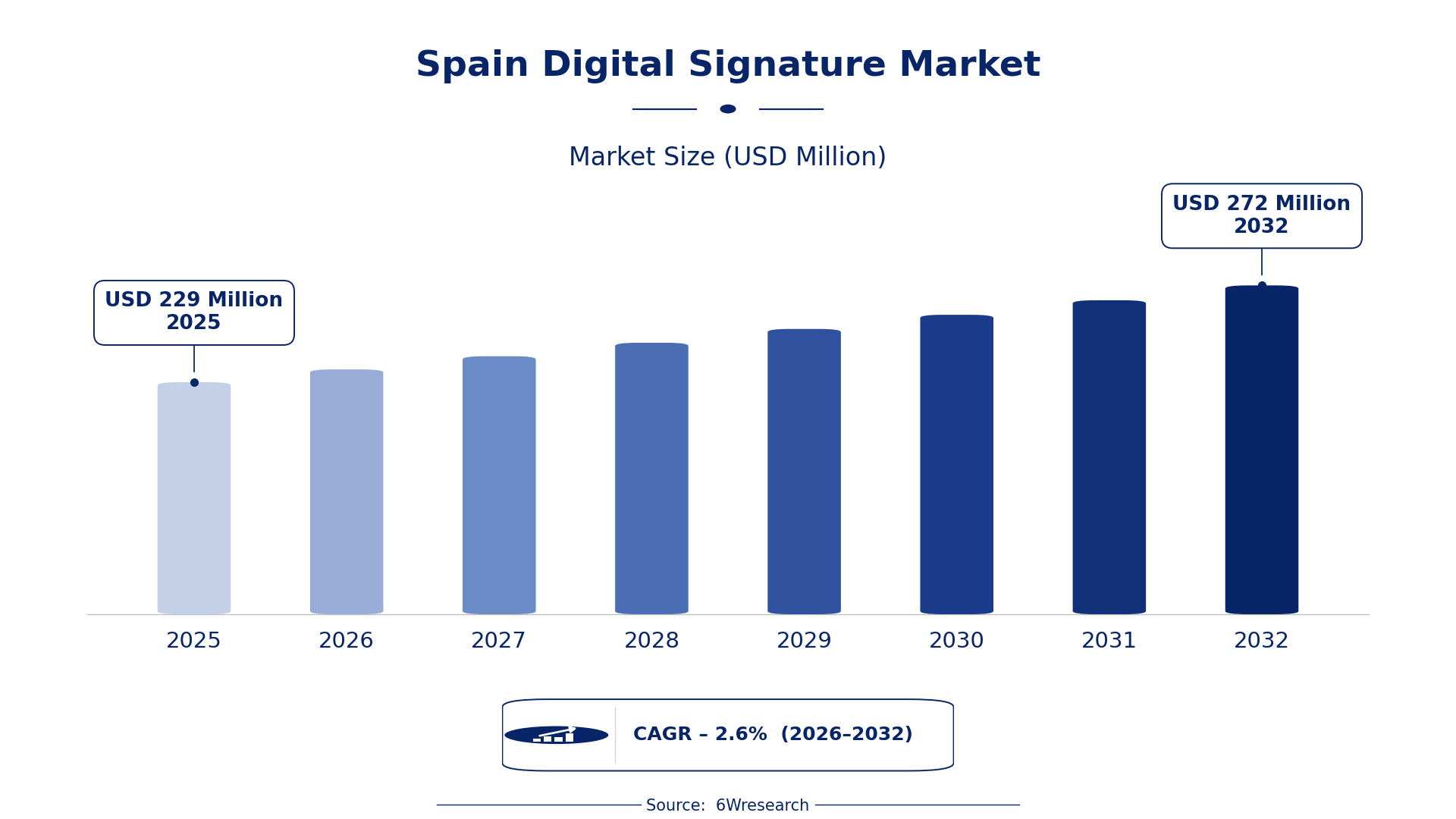
The Spain Digital Signature Market was estimated at USD 229 Million in 2025 and is projected to reach USD 272 Million by 2032, growing at a CAGR of 2.6% from 2026 to 2032.
Spain Digital Signature Market Synopsis
The Spain Digital Signature Market is experiencing robust growth as organizations increasingly implement digital signature solutions to enhance security and efficiency in document management. Recent adoption has surged, reflecting a shift in how businesses and public institutions approach electronic transactions.
Looking ahead, the market is set to benefit from regulatory backing and a broader push towards digital transformation. As sectors like finance, government, and legal services prioritize digital solutions, the landscape is ripe for innovation and investment, making it a key area for stakeholders.
Spain Digital Signature Market Year-wise Growth Rate and Key Drivers
This graph illustrates the annual growth rates of the Spain Digital Signature Market from 2021 to 2032, highlighting a steady upward trajectory and projected expansion over the forecast period.
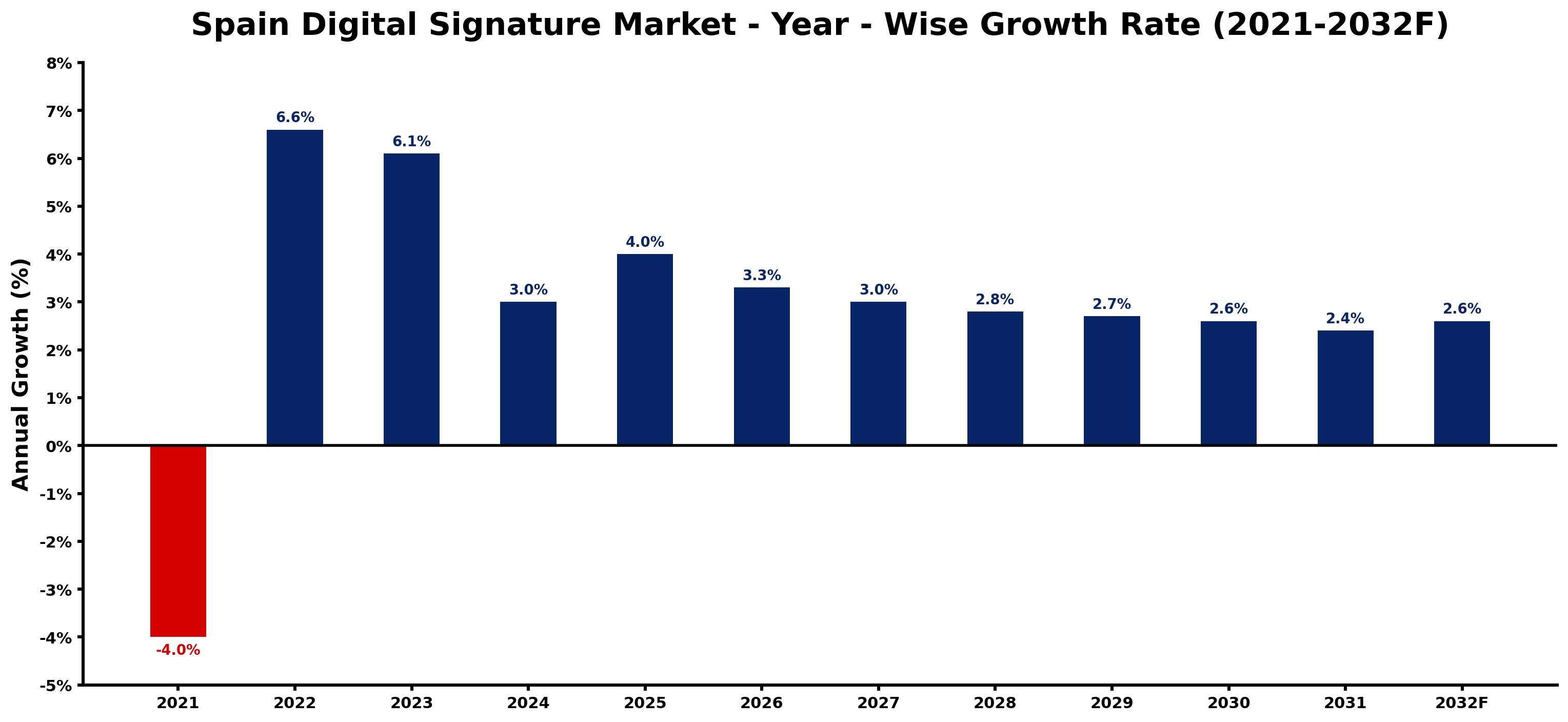
The table below presents the year‑wise growth rates along with the key drivers influencing the market
| Year | Growth Rate | Major Drivers |
| 2021 | -4.0% | Increased reluctance towards digital compliance post-COVID. |
| 2022 | 6.6% | Increase in remote work driving secure digital signings |
| 2023 | 6.1% | Spain's digital transformation initiative boosts e-signature adoption |
| 2024 | 3.0% | Regulatory updates enhancing legality of electronic signatures |
| 2025 | 4.0% | Higher demand for e-commerce fuels digital signature needs |
| 2026 | 3.3% | Rise in cybersecurity threats increases e-signature usage |
| 2027 | 3.0% | Government push for paperless transactions supports market growth |
| 2028 | 2.8% | Healthcare digitalization requiring patient consent electronically |
| 2029 | 2.7% | Growth in fintech increasing necessity for secure signing |
| 2030 | 2.6% | Legal sector adoption of e-signatures for case management |
| 2031 | 2.4% | Rise in small business digitalization fostering e-signature growth |
| 2032 | 2.6% | Banking sector reforms promoting electronic contract signings |
Note: Market size estimations and growth projections presented in this report are based on 6Wresearch's proprietary forecasting methodology, utilizing the latest available industry data, government publications, and primary research inputs.
Spain Digital Signature Market Key Takeaways
Below are some of the specific key takeaways from the market, including:
- The demand for digital signatures is fueled by the rising need for secure electronic transactions.
- Government policies play a crucial role in supporting the growth and adoption of digital signatures.
- Cybersecurity concerns are driving organizations to seek advanced digital signature technologies.
- Integration challenges with legacy systems remain a barrier for many businesses.
- Emerging technologies such as blockchain are influencing the future of digital signatures.
Evaluation of Restraints in Spain Digital Signature Market
Despite the encouraging growth trajectory, several factors hinder the Spain Digital Signature Market's progress. Ensuring the security and authenticity of digital signatures is paramount, as stakeholders must address concerns about potential fraud and identity theft. Integration with existing document management systems presents another hurdle; many organizations struggle to adopt new technologies alongside legacy systems. Compliance with stringent regulatory standards further complicates the landscape, adding layers of operational complexity and cost that can deter adoption.
Spain Digital Signature Market Trends
Several key trends are shaping the Spain Digital Signature Market. First, there is a notable shift towards cloud-based solutions, making digital signatures more accessible and scalable for businesses of all sizes. Secondly, the integration of artificial intelligence and machine learning technologies is improving the verification processes, making them faster and more reliable. Lastly, a growing emphasis on sustainability is encouraging organizations to reduce their paper usage, further driving demand for digital solutions.
Spain Digital Signature Market Opportunities
There are significant growth opportunities in the Spain Digital Signature Market, particularly within sectors embracing digital transformation. The increasing digitization of governmental processes and financial services presents a fertile ground for investment. Additionally, as more businesses prioritize cybersecurity, there is a growing market for advanced digital signature solutions that integrate secure authentication methods. This presents an opening for technology providers to innovate and deliver tailored solutions for diverse industry needs.
Government Initiatives in the Spain Digital Signature Market
Government initiatives are fundamentally shaping the Spain Digital Signature Market, driven by policies aimed at enhancing the security and legitimacy of electronic transactions. These efforts not only establish essential standards but also foster public trust in digital solutions. The Spanish government’s regulatory framework is designed to ensure compliance with electronic identification and trust services, which further reinforces the market's credibility.
- A recently completed initiative focused on updating electronic identification regulations to improve user authentication processes.
- A current program is underway, promoting the adoption of digital signatures within public administrations to streamline administrative procedures.
- A planned public-private partnership aims to enhance digital infrastructure by 2027, facilitating broader access to digital signature technologies.
- Ongoing efforts include developing cybersecurity guidelines specifically tailored for digital signatures in various sectors.
- An initiative established in 2025 aims to create awareness and training programs for businesses transitioning to digital documentation.
Future Insights of the Spain Digital Signature Market
Looking ahead to 2026-2032, the Spain Digital Signature Market is set to expand as digital transformation remains a priority across sectors. Organizations will increasingly seek efficient, secure methods for electronic transactions, driven by both regulatory encouragement and evolving consumer expectations. This demand will push technological advancements, potentially leading to more integrated and user-friendly solutions. Furthermore, as market confidence grows, so too will the innovation in security measures, ensuring that digital signatures remain a trusted choice for authenticating documents.
Spain Digital Signature Market Latest Developments
In the past year, the Spain Digital Signature Market has witnessed a wave of activity, marked by initiatives aimed at refining technologies and addressing emerging needs. Organizations are responding proactively to the demand for secure digital solutions, reflecting a commitment to innovation and service enhancement.
- A major technology vendor launched an upgraded digital signature platform in early 2025, designed to facilitate smoother integration with existing systems.
- A public sector initiative started in mid-2025 aims to digitize administrative records, encouraging the use of digital signatures across various departments.
- In Q3 2025, a leading provider unveiled a new mobile app that simplifies the signing process for users on the go.
- A collaboration between regional businesses focused on enhancing security measures for digital signatures, which began in late 2025 and is currently underway.
- Upcoming in early 2026 is a planned launch of an educational campaign to raise awareness about the benefits of digital signatures in business operations.
Spain Digital Signature Market - Key Attractiveness of the Report
- 10 Years of Market Numbers
- Historical Data Starting from 2022 to 2025
- Base Year: 2025
- Forecast Data until 2032
- Key Performance Indicators Impacting the Market
- Major Upcoming Developments and Projects
Key Highlights of the Report:
- Spain Digital Signature Market Outlook
- Market Size of Spain Digital Signature Market, 2025
- Forecast of Spain Digital Signature Market, 2032
- Historical Data and Forecast of Spain Digital Signature Revenues & Volume for the Period 2022-2032F
- Spain Digital Signature Market Trend Evolution
- Spain Digital Signature Market Drivers and Challenges
- Spain Digital Signature Price Trends
- Spain Digital Signature Porter's Five Forces
- Spain Digital Signature Industry Life Cycle
- Historical Data and Forecast of Spain Digital Signature Market Revenues & Volume By Component for the Period 2022-2032F
- Historical Data and Forecast of Spain Digital Signature Market Revenues & Volume By Solutions for the Period 2022-2032F
- Historical Data and Forecast of Spain Digital Signature Market Revenues & Volume By Services for the Period 2022-2032F
- Historical Data and Forecast of Spain Digital Signature Market Revenues & Volume By Solution for the Period 2022-2032F
- Historical Data and Forecast of Spain Digital Signature Market Revenues & Volume By Software for the Period 2022-2032F
- Historical Data and Forecast of Spain Digital Signature Market Revenues & Volume By Hardware for the Period 2022-2032F
- Historical Data and Forecast of Spain Digital Signature Market Revenues & Volume By Vertical for the Period 2022-2032F
- Historical Data and Forecast of Spain Digital Signature Market Revenues & Volume By BFSI for the Period 2022-2032F
- Historical Data and Forecast of Spain Digital Signature Market Revenues & Volume By Government for the Period 2022-2032F
- Historical Data and Forecast of Spain Digital Signature Market Revenues & Volume By Defense for the Period 2022-2032F
- Historical Data and Forecast of Spain Digital Signature Market Revenues & Volume By Legal for the Period 2022-2032F
- Historical Data and Forecast of Spain Digital Signature Market Revenues & Volume By Real Estate for the Period 2022-2032F
- Historical Data and Forecast of Spain Digital Signature Market Revenues & Volume By Organization Size for the Period 2022-2032F
- Historical Data and Forecast of Spain Digital Signature Market Revenues & Volume By Large Enterprises for the Period 2022-2032F
- Historical Data and Forecast of Spain Digital Signature Market Revenues & Volume By Small and Medium-Sized Enterprises (SMEs) for the Period 2022-2032F
- Historical Data and Forecast of Spain Digital Signature Market Revenues & Volume By Deployment Mode for the Period 2022-2032F
- Historical Data and Forecast of Spain Digital Signature Market Revenues & Volume By Cloud for the Period 2022-2032F
- Historical Data and Forecast of Spain Digital Signature Market Revenues & Volume By On-Premises for the Period 2022-2032F
- Spain Digital Signature Import Export Trade Statistics
- Market Opportunity Assessment By Component
- Market Opportunity Assessment By Solution
- Market Opportunity Assessment By Vertical
- Market Opportunity Assessment By Organization Size
- Market Opportunity Assessment By Deployment Mode
- Spain Digital Signature Top Companies Market Share
- Spain Digital Signature Competitive Benchmarking By Technical and Operational Parameters
- Spain Digital Signature Company Profiles
- Spain Digital Signature Key Strategic Recommendations






































