Spain Financial Analytics Market Size & Growth Rate (2026-2032)
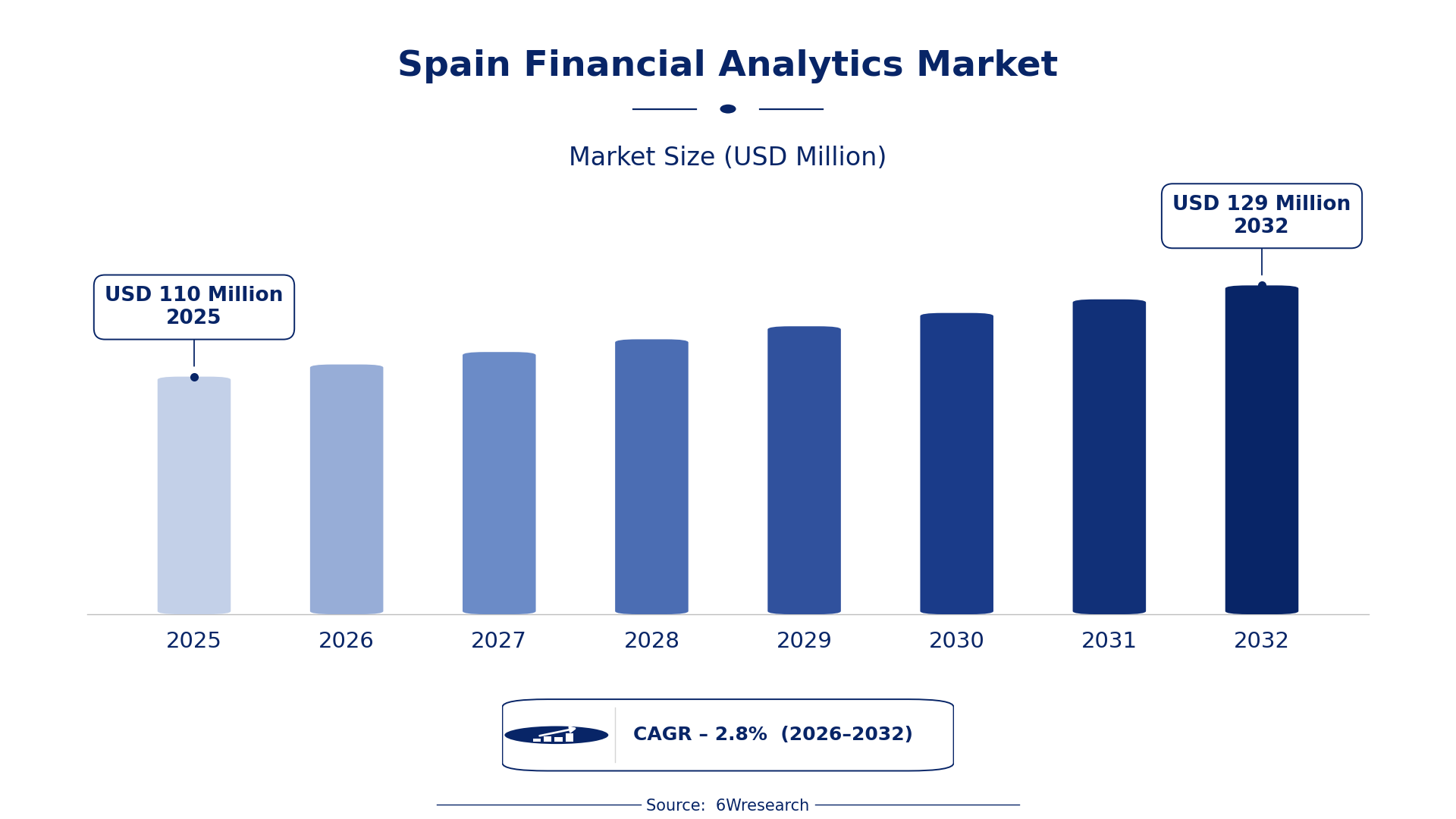
The Spain Financial Analytics Market was estimated at USD 110 Million in 2025 and is projected to reach USD 129 Million by 2032, growing at a CAGR of 2.8% from 2026 to 2032.
Spain Financial Analytics Market Synopsis
The drive towards data-driven decision-making is the most potent force shaping the Spain Financial Analytics Market today. Financial institutions are increasingly realizing that advanced analytics tools are not just optional but essential for optimizing operations, managing risks, and improving overall decision-making.
With an emphasis on real-time data analysis, predictive analytics, and performance management, businesses are making substantial investments in analytics solutions. The focus is on enhancing transparency, efficiency, and compliance within a landscape marked by strict regulatory requirements.
Spain Financial Analytics Market Year-wise Growth Rate and Key Drivers
This graph illustrates the annual growth rates of the Spain Financial Analytics Market from 2021 to 2032, highlighting a steady upward trajectory and projected expansion over the forecast period.
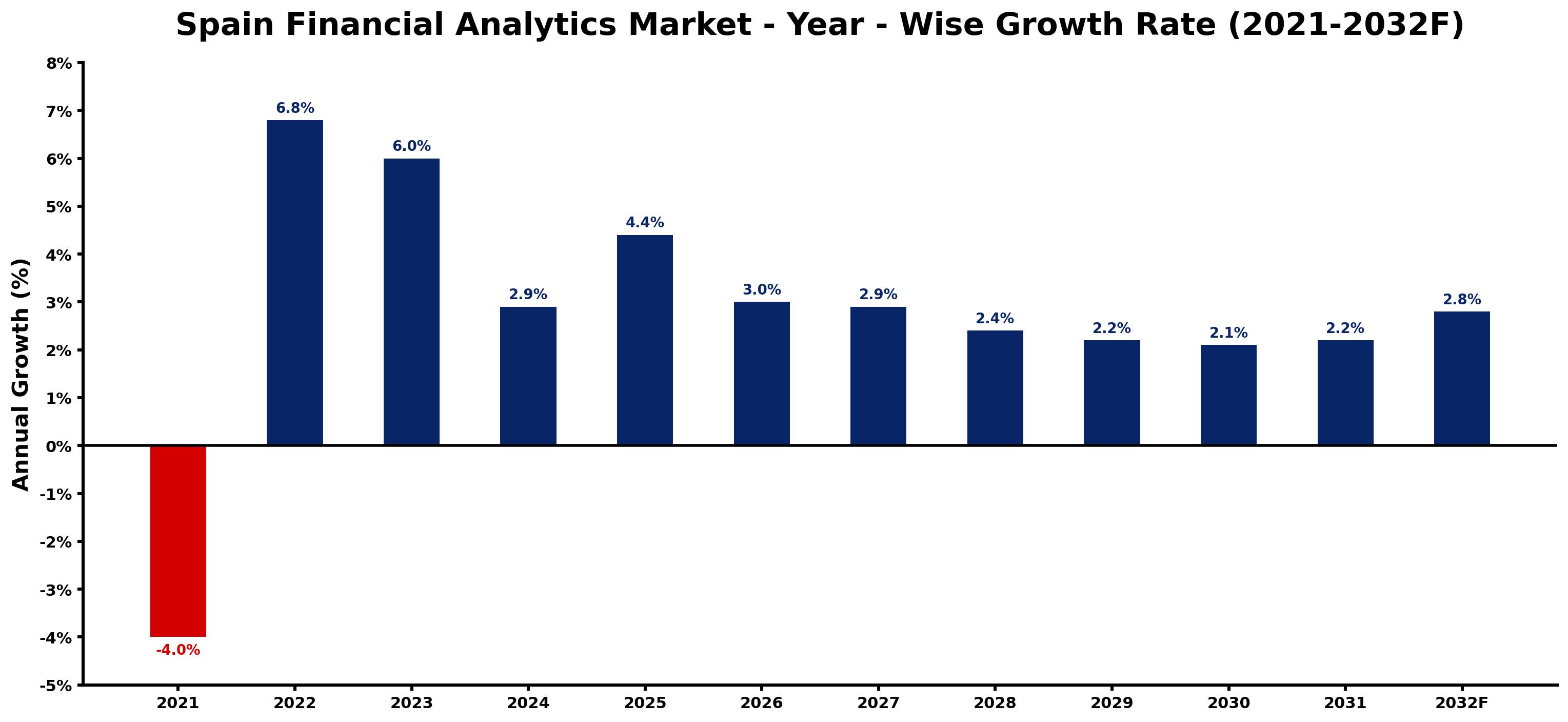
The table below presents the year‑wise growth rates along with the key drivers influencing the market
| Year | Growth Rate | Major Drivers |
| 2021 | -4.0% | COVID-19 pandemic delayed financial technology investments. |
| 2022 | 6.8% | Implementation of EU's MiFID II enhancing transparency requirements |
| 2023 | 6.0% | Increased regulatory focus on risk management analytics tools |
| 2024 | 2.9% | Growth in fintech startups necessitating advanced data solutions |
| 2025 | 4.4% | Digital transformation initiatives in Spanish banks accelerating adoption |
| 2026 | 3.0% | Government incentives for data-driven decision-making in finance |
| 2027 | 2.9% | Rise in consumer awareness of financial wellness products |
| 2028 | 2.4% | Integration of AI technologies in financial forecasting models |
| 2029 | 2.2% | Sustainability mandates driving ESG analytics in investments |
| 2030 | 2.1% | ISO certifications boosting demand for compliance analytics |
| 2031 | 2.2% | Emerging urban wealth creating demand for analytics services |
| 2032 | 2.8% | Shift towards real-time financial risk assessment solutions |
Note: Market size estimations and growth projections presented in this report are based on 6Wresearch's proprietary forecasting methodology, utilizing the latest available industry data, government publications, and primary research inputs.
Spain Financial Analytics Market Key Takeaways
Below are some of the specific key takeaways from the market, including:
- The market is driven by increasing demands for predictive analytics and data visualization tools.
- Investment in AI and machine learning technologies is on the rise, enhancing data analysis capabilities.
- Cloud-based solutions are gaining traction for their scalability and flexibility.
- Regulatory compliance requirements are pushing organizations to adopt more sophisticated analytics tools.
- Emerging fintech companies are rapidly innovating in the analytics space, creating new market opportunities.
Evaluation of Restraints in Spain Financial Analytics Market
Despite its growth potential, the Spain Financial Analytics Market faces several limitations. Stringent regulatory frameworks, particularly surrounding data privacy such as GDPR, impose significant compliance burdens on financial institutions. These regulations can hinder the speed of analytics implementation as firms must ensure data security and privacy. Additionally, integrating data from various sources remains a complex challenge, often requiring substantial investment in technology and resources. Addressing these issues will be crucial for organizations seeking to capitalize on market opportunities.
Spain Financial Analytics Market Trends
The market is witnessing a pronounced shift towards advanced technologies, particularly artificial intelligence and machine learning, to refine analytics capabilities. Companies are increasingly investing in predictive analytics to empower data-driven decision-making. on top of that, the transition to cloud-based financial analytics solutions is transforming how businesses operate, offering enhanced scalability and flexibility. As financial institutions aim for greater transparency and efficiency, the demand for integrated analytics solutions that deliver real-time insights continues to grow.
Spain Financial Analytics Market Opportunities
Investment opportunities are flourishing within the Spain Financial Analytics Market, driven by a burgeoning demand for data insights. Fintech firms specializing in risk management, fraud detection, and customer analytics are particularly well-positioned for growth. Traditional financial institutions are also ramping up their analytics capabilities to improve operational efficiency and decision-making processes. As real-time analysis and machine learning technologies advance, investors should consider exploring emerging startups and partnerships aimed at leveraging analytics for competitive advantages.
Government Initiatives in the Spain Financial Analytics Market
Government policy is playing a pivotal role in shaping the Spain Financial Analytics Market. Regulations like the General Data Protection Regulation (GDPR) set the tone for how data is handled, ensuring consumer privacy while promoting data security. The establishment of the Spanish National Securities Market Commission (CNMV) also underscores the government’s commitment to overseeing financial practices, including analytics. Current initiatives focus on fostering innovation and digital transformation, vital for the sector's growth.
- A recently completed initiative under the Digital Agenda for Spain aims to enhance digital infrastructure across the financial sector.
- Current efforts include ongoing regulatory frameworks to promote transparency and efficiency in financial reporting.
- Upcoming plans include the FinTech Action Plan, which will encourage further adoption of analytics technologies within financial institutions.
- The CNMV is enhancing its oversight capabilities, including measures to ensure compliance with evolving regulations impacting analytics practices.
- Future initiatives will focus on public-private partnerships to drive technological advancements in financial analytics.
Future Insights of the Spain Financial Analytics Market
Looking ahead to 2026-2032, the Spain Financial Analytics Market is set for steady growth. The increasing reliance on data analytics for informed decision-making, coupled with stringent regulatory requirements, will propel demand for innovative solutions. As technologies such as artificial intelligence and machine learning become more sophisticated, they will enable financial institutions to harness analytics more effectively. The focus will remain on improving operational efficiency and risk management, paving the way for a more data-centric financial environment.
Spain Financial Analytics Market Latest Developments
In the past year, the Spain Financial Analytics Market has seen noteworthy activity. Companies are not only investing in advanced analytics tools but also forming strategic partnerships to enhance their service offerings. The integration of AI and machine learning is becoming commonplace as firms seek to differentiate themselves through superior data analytics capabilities.
- A leading technology vendor launched a new predictive analytics platform in early 2025, aimed at enhancing financial forecasting for institutions.
- An initiative that began in mid-2025 and remains underway focuses on integrating analytics tools into existing financial systems across multiple banks.
- Plans are in motion for a rollout expected to begin in the second half of 2026, aimed at expanding cloud-based analytics solutions for small and medium-sized enterprises.
- Recently, a major regional operator completed a partnership agreement with a fintech startup to develop AI-driven fraud detection tools.
- Ongoing projects include enhancing data integration capabilities across various financial sectors, set to improve operational efficiency by late 2025.
Spain Financial Analytics Market - Key Attractiveness of the Report
- 10 Years of Market Numbers
- Historical Data Starting from 2022 to 2025
- Base Year: 2025
- Forecast Data until 2032
- Key Performance Indicators Impacting the Market
- Major Upcoming Developments and Projects
Key Highlights of the Report:
- Spain Financial Analytics Market Outlook
- Market Size of Spain Financial Analytics Market, 2025
- Forecast of Spain Financial Analytics Market, 2032
- Historical Data and Forecast of Spain Financial Analytics Revenues & Volume for the Period 2022-2032F
- Spain Financial Analytics Market Trend Evolution
- Spain Financial Analytics Market Drivers and Challenges
- Spain Financial Analytics Price Trends
- Spain Financial Analytics Porter's Five Forces
- Spain Financial Analytics Industry Life Cycle
- Historical Data and Forecast of Spain Financial Analytics Market Revenues & Volume By Components for the Period 2022-2032F
- Historical Data and Forecast of Spain Financial Analytics Market Revenues & Volume By Software for the Period 2022-2032F
- Historical Data and Forecast of Spain Financial Analytics Market Revenues & Volume By Services for the Period 2022-2032F
- Historical Data and Forecast of Spain Financial Analytics Market Revenues & Volume By Deployment Modes for the Period 2022-2032F
- Historical Data and Forecast of Spain Financial Analytics Market Revenues & Volume By On-premises for the Period 2022-2032F
- Historical Data and Forecast of Spain Financial Analytics Market Revenues & Volume By Cloud for the Period 2022-2032F
- Historical Data and Forecast of Spain Financial Analytics Market Revenues & Volume By Application for the Period 2022-2032F
- Historical Data and Forecast of Spain Financial Analytics Market Revenues & Volume By Wealth Management for the Period 2022-2032F
- Historical Data and Forecast of Spain Financial Analytics Market Revenues & Volume By Governance, Risk, and Compliance Management for the Period 2022-2032F
- Historical Data and Forecast of Spain Financial Analytics Market Revenues & Volume By Financial Forecasting and Budgeting for the Period 2022-2032F
- Historical Data and Forecast of Spain Financial Analytics Market Revenues & Volume By Customer Management for the Period 2022-2032F
- Historical Data and Forecast of Spain Financial Analytics Market Revenues & Volume By Transaction Monitoring for the Period 2022-2032F
- Historical Data and Forecast of Spain Financial Analytics Market Revenues & Volume By Claim Management for the Period 2022-2032F
- Historical Data and Forecast of Spain Financial Analytics Market Revenues & Volume By Fraud Detection and Prevention for the Period 2022-2032F
- Historical Data and Forecast of Spain Financial Analytics Market Revenues & Volume By Stock Management for the Period 2022-2032F
- Historical Data and Forecast of Spain Financial Analytics Market Revenues & Volume By Organization Size for the Period 2022-2032F
- Historical Data and Forecast of Spain Financial Analytics Market Revenues & Volume By Small and Medium-sized Enterprises (SMEs) for the Period 2022-2032F
- Historical Data and Forecast of Spain Financial Analytics Market Revenues & Volume By Large Enterprises for the Period 2022-2032F
- Historical Data and Forecast of Spain Financial Analytics Market Revenues & Volume By Verticals for the Period 2022-2032F
- Historical Data and Forecast of Spain Financial Analytics Market Revenues & Volume By Banking, Financial Services, and Insurance (BFSI) for the Period 2022-2032F
- Historical Data and Forecast of Spain Financial Analytics Market Revenues & Volume By Telecom and IT for the Period 2022-2032F
- Historical Data and Forecast of Spain Financial Analytics Market Revenues & Volume By Government for the Period 2022-2032F
- Historical Data and Forecast of Spain Financial Analytics Market Revenues & Volume By Energy and Utilities for the Period 2022-2032F
- Historical Data and Forecast of Spain Financial Analytics Market Revenues & Volume By Manufacturing and Automotive for the Period 2022-2032F
- Historical Data and Forecast of Spain Financial Analytics Market Revenues & Volume By Healthcare and Pharmaceutical for the Period 2022-2032F
- Historical Data and Forecast of Spain Financial Analytics Market Revenues & Volume By Retail and eCommerce for the Period 2022-2032F
- Historical Data and Forecast of Spain Financial Analytics Market Revenues & Volume By Media and Entertainment for the Period 2022-2032F
- Spain Financial Analytics Import Export Trade Statistics
- Market Opportunity Assessment By Components
- Market Opportunity Assessment By Deployment Modes
- Market Opportunity Assessment By Application
- Market Opportunity Assessment By Organization Size
- Market Opportunity Assessment By Verticals
- Spain Financial Analytics Top Companies Market Share
- Spain Financial Analytics Competitive Benchmarking By Technical and Operational Parameters
- Spain Financial Analytics Company Profiles
- Spain Financial Analytics Key Strategic Recommendations






































