Spain Food & Grocery Retail Market Size, Share & Growth Rate
The Spain Food & Grocery Retail Market was estimated at USD 421 Million in 2025 and is projected to reach USD 571 Million by 2032, growing at a CAGR of 4.4% from 2026 to 2032. This growth trajectory is largely attributed to a notable shift in consumer behavior towards convenience and health-conscious products, alongside the rising influence of e-commerce platforms. Additionally, the market is experiencing increased demand for sustainable and locally sourced options, which are significantly reshaping the retail landscape.
Spain Food & Grocery Retail Market Year-wise Growth Rate and Key Drivers
This graph highlights how the Spain Food & Grocery Retail Market has steadily grown over the years, supported by major growth factors.
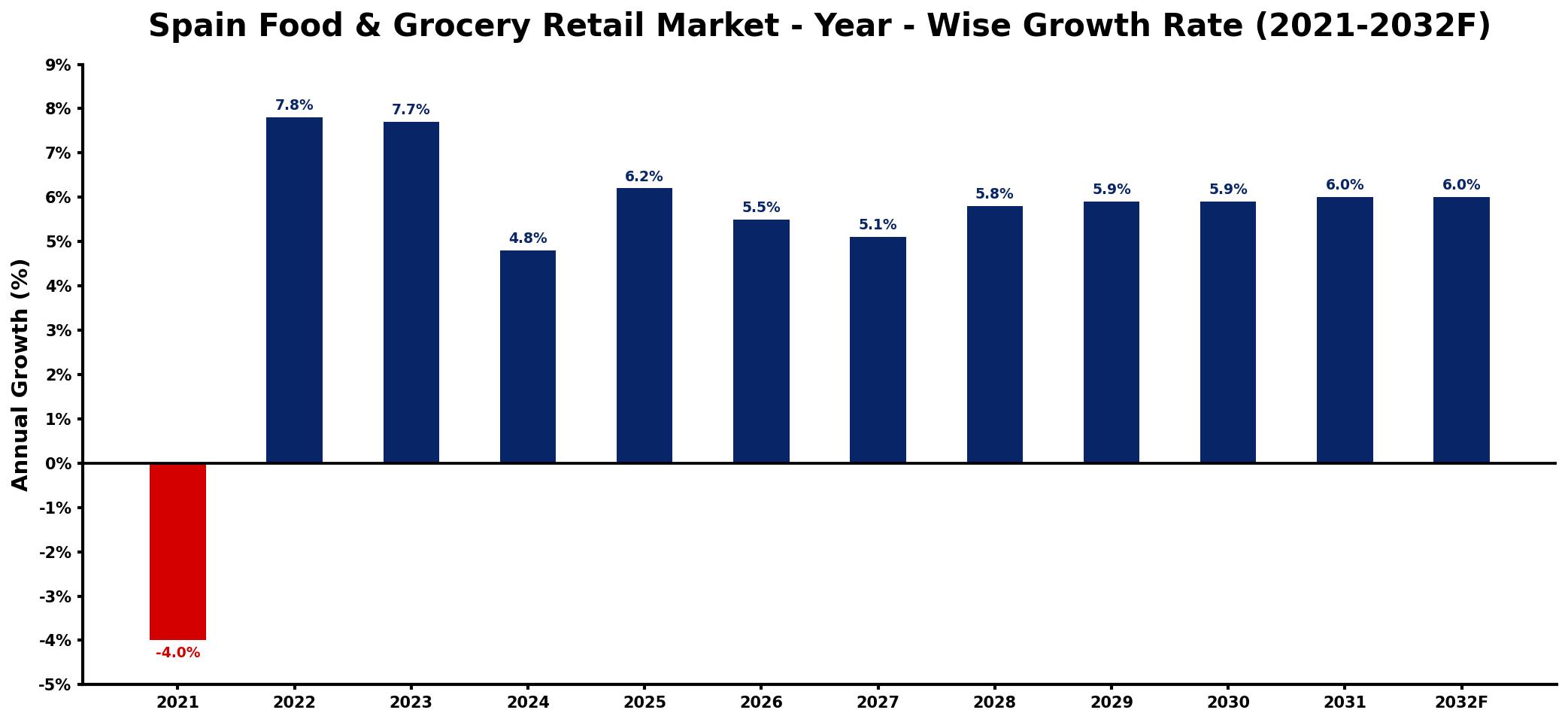
The table below presents the year‑wise growth rates along with the key drivers influencing the market
| Year | Growth Rate | Major Drivers |
| 2021 | -4.0% | decrease in consumer spending habits |
| 2022 | 7.8% | rise in online shopping trends |
| 2023 | 7.7% | increased demand for convenience products |
| 2024 | 4.8% | growth in sustainable packaging solutions |
| 2025 | 6.2% | expansion of local sourcing initiatives |
| 2026 | 5.5% | enhanced focus on health trends |
| 2027 | 5.1% | adoption of digital payment methods |
| 2028 | 5.8% | development of loyalty programs |
| 2029 | 5.9% | emphasis on premium product offerings |
| 2030 | 5.9% | investment in supply chain technology |
| 2031 | 6.0% | introduction of plant-based alternatives |
| 2032 | 6.0% | strengthening of private label brands |
Note: Market size estimations and growth projections presented in this report are based on 6Wresearch's proprietary forecasting methodology, utilizing the latest available industry data, government publications, and primary research inputs.
Spain Food & Grocery Retail Market Synopsis
In Spain, the food and grocery retail sector is witnessing a substantial rise in demand for organic products as consumers become increasingly health-conscious. This trend is further amplified by a cultural emphasis on quality and authenticity in food choices, which has paved the way for specialty stores and organic offerings to thrive.
Moreover, the rapid urbanization and changing lifestyle patterns of Spaniards are propelling the growth of convenience stores and online grocery shopping platforms. These formats are quickly adapting to meet the needs of a busy population that values speed and efficiency in their shopping experiences.
- The market is adapting to a significant shift towards online shopping, propelled by technological advancements and changing consumer preferences.
- Demand for sustainable, organic, and locally sourced products is increasing, leading retailers to diversify their product offerings.
- The competitive landscape is intense, with both traditional and online retailers striving to capture market share.
- Investment opportunities are emerging in specialized grocery stores that focus on high-quality and unique food options.
- Government regulations are ensuring food safety and promoting healthier eating habits among consumers.
Despite the promising growth outlook for the Spain Food & Grocery Retail Market, several constraints exist. The fierce competition, particularly between traditional brick-and-mortar stores and e-commerce platforms, intensifies price wars, impacting profitability. Retailers face pressure to continually adapt to evolving consumer preferences for healthier and ethically sourced products, necessitating ongoing investment in product development and marketing. Moreover, economic fluctuations and regulatory changes can affect consumer spending behaviors, adding layers of complexity to market dynamics.
Current trends within the Spain Food & Grocery Retail Market showcase a profound shift towards sustainability and transparency in sourcing practices. Consumers are not only prioritizing health-conscious choices but are also increasingly vigilant about the origins of their food. This is leading to a growing popularity of retailers who provide clear insights into their supply chains.
Furthermore, technology is reshaping the shopping experience, with innovations such as mobile apps and personalized recommendations becoming essential tools for retailers. These advancements are designed to enhance customer engagement, making shopping more intuitive and enjoyable, while fostering brand loyalty.
The evolution of the Spain Food & Grocery Retail Market is brimming with investment potential. Expanding online grocery services represents a key opportunity to tap into the growing demand for convenience. Retailers that embrace innovative technologies like automated checkout and efficient supply chain management can streamline operations and enhance customer satisfaction. Additionally, the rise in consumer interest for organic and gourmet products opens avenues for specialized grocery stores to cater to discerning shoppers seeking high-quality options.
The Spanish government actively implements policies aimed at bolstering food safety and promoting healthy eating habits across the nation. Regulatory measures include strict labeling requirements that ensure consumers are well-informed about nutritional values and allergens. Moreover, the government actively monitors food advertising, particularly targeting children, in a bid to encourage healthier choices. These initiatives serve not only to protect consumer rights but also to foster a healthier society overall.
Looking ahead to 2026-2032, the Spain Food & Grocery Retail Market is set to experience sustained growth driven by an ongoing shift toward convenience and quality. The burgeoning e-commerce sector is likely to be a pivotal factor, as online grocery shopping becomes increasingly ingrained in consumer habits. Furthermore, as sustainability remains a key consumer priority, retailers will need to align their offerings with these values to maintain competitiveness in the evolving landscape.
Recent developments in the Spain Food & Grocery Retail Market indicate a continued emphasis on digital transformation as retailers seek to enhance their online presence and streamline operations. Many are investing in advanced logistics solutions to improve delivery efficiency and customer satisfaction. Additionally, several initiatives aimed at promoting local and organic products have gained traction, reflecting a growing consumer demand for sustainable and ethically produced goods.
- 10 Years of Market Numbers
- Historical Data Starting from 2022 to 2025
- Base Year: 2025
- Forecast Data until 2032
- Key Performance Indicators Impacting the Market
- Major Upcoming Developments and Projects
Key Highlights of the Report:
- Spain Food & Grocery Retail Market Outlook
- Market Size of Spain Food & Grocery Retail Market, 2025
- Forecast of Spain Food & Grocery Retail Market, 2032
- Historical Data and Forecast of Spain Food & Grocery Retail Revenues & Volume for the Period 2022-2032F
- Spain Food & Grocery Retail Market Trend Evolution
- Spain Food & Grocery Retail Market Drivers and Challenges
- Spain Food & Grocery Retail Price Trends
- Spain Food & Grocery Retail Porter's Five Forces
- Spain Food & Grocery Retail Industry Life Cycle
- Historical Data and Forecast of Spain Food & Grocery Retail Market Revenues & Volume By Product for the Period 2022-2032F
- Historical Data and Forecast of Spain Food & Grocery Retail Market Revenues & Volume By Fresh Food for the Period 2022-2032F
- Historical Data and Forecast of Spain Food & Grocery Retail Market Revenues & Volume By Frozen Food for the Period 2022-2032F
- Historical Data and Forecast of Spain Food & Grocery Retail Market Revenues & Volume By Food Cupboard for the Period 2022-2032F
- Historical Data and Forecast of Spain Food & Grocery Retail Market Revenues & Volume By Beverages for the Period 2022-2032F
- Historical Data and Forecast of Spain Food & Grocery Retail Market Revenues & Volume By Cleaning & Household for the Period 2022-2032F
- Historical Data and Forecast of Spain Food & Grocery Retail Market Revenues & Volume By Others for the Period 2022-2032F
- Historical Data and Forecast of Spain Food & Grocery Retail Market Revenues & Volume By Distribution Channel for the Period 2022-2032F
- Historical Data and Forecast of Spain Food & Grocery Retail Market Revenues & Volume By Supermarkets & Hypermarkets for the Period 2022-2032F
- Historical Data and Forecast of Spain Food & Grocery Retail Market Revenues & Volume By Convenience Stores for the Period 2022-2032F
- Historical Data and Forecast of Spain Food & Grocery Retail Market Revenues & Volume By Departmental Stores & Clubs for the Period 2022-2032F
- Historical Data and Forecast of Spain Food & Grocery Retail Market Revenues & Volume By Online for the Period 2022-2032F
- Spain Food & Grocery Retail Import Export Trade Statistics
- Market Opportunity Assessment By Product
- Market Opportunity Assessment By Distribution Channel
- Spain Food & Grocery Retail Top Companies Market Share
- Spain Food & Grocery Retail Competitive Benchmarking By Technical and Operational Parameters
- Spain Food & Grocery Retail Company Profiles
- Spain Food & Grocery Retail Key Strategic Recommendations






































