Spain Food Processing & Handling Equipment Market Summary
The spain food processing & handling equipment market was estimated at USD 176 Million in 2025 and is projected to reach USD 209 Million by 2032, growing at a CAGR of 3.5% from 2026 to 2032.
Spain Food Processing & Handling Equipment Market Year-wise Growth Rate and Key Drivers
This graph highlights how the Spain Food Processing & Handling Equipment Market has steadily grown over the past five years, supported by major growth factors.
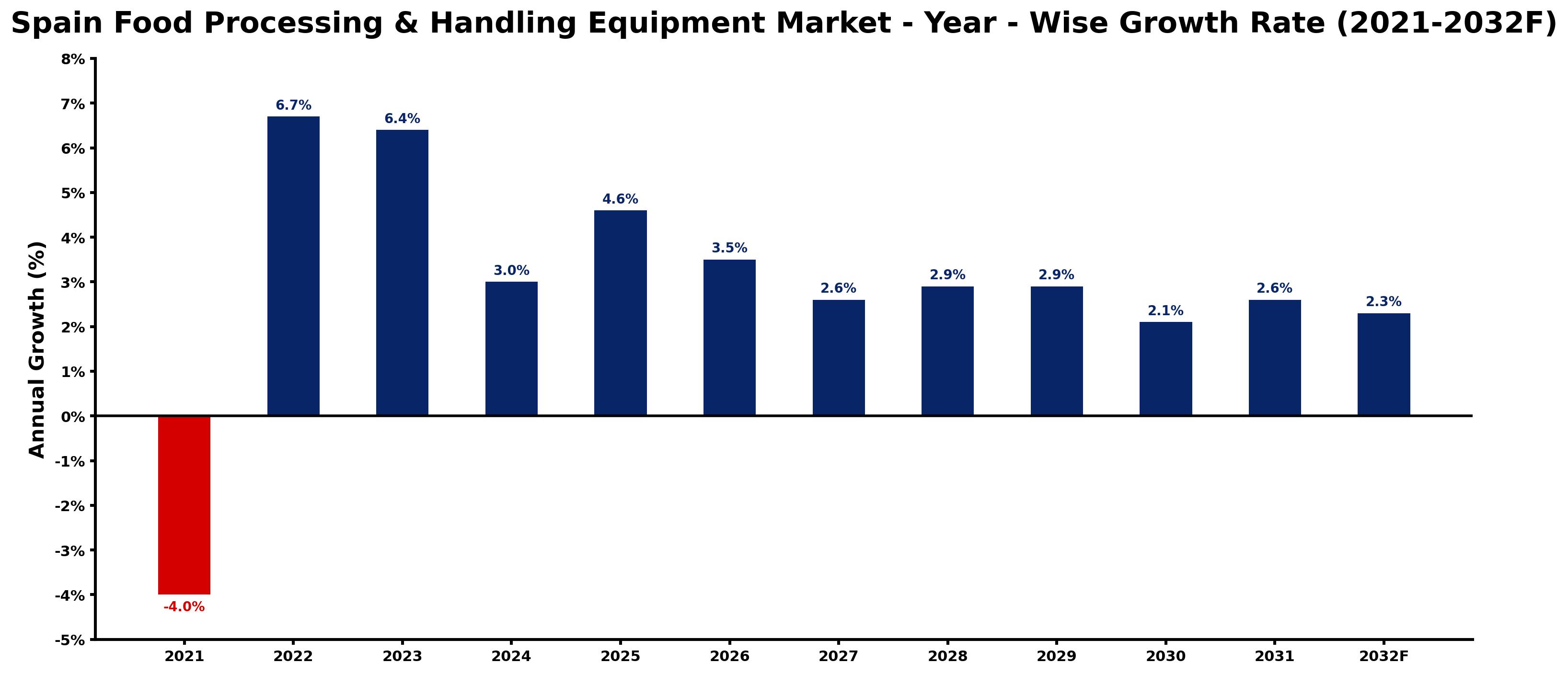
The table below presents the year wise growth rates along with the key drivers influencing the market
| Year | Growth Rate | Major Drivers |
| 2021 | -4.0% | Supply chain disruptions caused by the pandemic hindered manufacturers' ability to meet rising demand. |
| 2022 | 6.7% | Investment in sustainable processing technologies gained momentum across various food sectors. |
| 2023 | 6.4% | Retail transformation initiatives encouraged new equipment acquisitions for enhanced efficiency. |
| 2024 | 3.0% | Spain's expanding food export markets required more advanced processing capabilities. |
| 2025 | 4.6% | Consumer preference for organic products drove innovation in food handling processes. |
| 2026 | 3.5% | Emerging technologies such as IoT and AI started revolutionizing food production efficiencies. |
| 2027 | 2.6% | A shift towards local sourcing necessitated updated processing equipment for regional suppliers. |
| 2028 | 2.9% | Demand for energy-efficient machinery aligned with lower operational cost strategies in food sectors. |
| 2029 | 2.9% | Sustainability regulations prompted investments in eco-friendly food processing technologies. |
| 2030 | 2.1% | Collaboration between startups and established firms spurred innovation in food equipment solutions. |
| 2031 | 2.6% | Enhanced food safety protocols required greater investment in advanced handling equipment. |
| 2032 | 2.3% | As digital solutions matured, they reshaped food processing landscapes and operational dynamics. |
Note - Market size estimations and growth projections presented in this report are based on 6Wresearch's advanced forecasting approach, validated with industry datasets as of June 2026.
Spain Food Processing & Handling Equipment Market Synopsis
The Spain Food Processing Handling Equipment Market is projected to reach 3.5% and witness significant growth during the forecast period (2026-2032). This growth is primarily driven by an increasing demand for processed food products, advancements in processing technology, and regulatory pressures surrounding food safety. The market encompasses a variety of key segments, including industrial ovens, mixers, blenders, slicers, grinders, and packaging equipment. A noticeable trend within this market is the shift towards automation and digitization, which aims to enhance operational efficiency and minimize production costs. As consumer preferences evolve, the industry is also witnessing a rising demand for advanced and sustainable processing solutions.
Spain Food Processing & Handling Equipment Market Trends and Opportunities
The Spain Food Processing & Handling Equipment Market is marked by significant trends that indicate a growing preference for automation and the integration of technology. Several opportunities for vendors and investors are emerging from these trends:
- An increasing focus on automation: Food processing companies are increasingly adopting robotics and automated systems to enhance their operational productivity and maintain consistent product quality.
- The rise of IoT-enabled devices: Equipment integrated with Internet of Things (IoT) technology is gaining traction, as it offers real-time monitoring and controls, leading to improved operational efficiency.
- A shift towards energy-efficient solutions: Manufacturers are recognizing the need to innovate and produce equipment that not only meets stringent regulatory requirements but is also environmentally friendly, reducing energy consumption.
- Enhanced food safety protocols: As consumer awareness around food safety increases, there is a pressing demand for equipment designed to uphold high hygiene and safety standards during processing and handling.
- Adoption of flexible production systems: The need for varying production sizes and capabilities is driving investment in equipment that can adapt quickly to diverse product demands, which aids in minimizing waste and maximizing throughput.
Spain Food Processing & Handling Equipment Market Challenges and Restraints
Despite the promising landscape, several challenges persist within the Spain Food Processing & Handling Equipment Market:
- Regulatory compliance: Strict regulations regarding food safety and equipment standards can lead to increased operational costs as manufacturers invest in compliance measures.
- Rising competition: The market faces intense competition from domestic and international players, which compels companies to innovate while managing costs effectively.
- Investment in R&D: The necessity for sustainable and energy-efficient solutions requires substantial investment in research and development, which can be a financial burden for smaller entities.
- Supply chain disruptions: Recent global events, such as the COVID-19 pandemic, have highlighted vulnerabilities in supply chains, impacting production timelines and costs.
- Fluctuating consumer preferences: Evolving food trends and changing consumer demands necessitate continuous adaptation by manufacturers to remain relevant in the market.
Spain Food Processing & Handling Equipment Market Government Investment and Initiatives
Government policies play a crucial role in shaping the Spain Food Processing & Handling Equipment Market. Recent initiatives and public spending are aimed at enhancing the industry's competitiveness:
- Regulations promoting food safety: The Spanish government enforces comprehensive frameworks to ensure that food processing equipment adheres to established safety standards, thereby protecting consumer interests.
- Sustainability initiatives: Public policies encourage the adoption of eco-friendly practices, leading to investment incentives for manufacturers focusing on sustainable processing technologies.
- Support for R&D: The government is actively fostering collaboration between research institutions and the food processing sector to drive innovation and efficiency improvements.
- Labor regulations: Protective labor laws ensure that workers in the food processing industry operate under safe conditions, which contributes to a more stable workforce.
- Investment in infrastructure: The government is expected to invest in transportation and logistics infrastructure, which will enhance the overall efficiency of food distribution and processing.
Spain Food Processing & Handling Equipment Market Latest Developments (May 2025 - June 2026)
In the period from May 2025 to June 2026, the Spain Food Processing & Handling Equipment Market has observed notable developments that signal the industry's direction:
- Increased integration of automation technologies: A marked uptick in the installation of automated systems in food processing facilities has been recorded, leading to improved output and quality control.
- Rise in sustainability efforts: Companies have begun to prioritize eco-friendly practices in design and manufacturing processes, aligning with consumer demands for greener products.
- Collaboration initiatives: The period has seen increased collaboration between technology providers and food manufacturers, focusing on customized solutions that meet unique processing requirements.
- Emphasis on training programs: Recognizing the need for skill development, several industry stakeholders have introduced training programs aimed at enhancing workforce capabilities concerning advanced equipment.
- Innovation in packaging solutions: Companies are exploring new packaging technologies that extend shelf life and reduce waste, further enhancing the appeal of processed products among consumers.
Spain Food Processing & Handling Equipment Market - Key Attractiveness of the Report
- 10 Years of Market Numbers
- Historical Data Starting from 2022 to 2025
- Base Year: 2025
- Forecast Data until 2032
- Key Performance Indicators Impacting the Market
- Major Upcoming Developments and Projects
Key Highlights of the Report:
- Spain Food Processing & Handling Equipment Market Outlook
- Market Size of Spain Food Processing & Handling Equipment Market, 2025
- Forecast of Spain Food Processing & Handling Equipment Market, 2032F
- Historical Data and Forecast of Spain Food Processing & Handling Equipment Revenues & Volume for the Period 2022-2032F
- Spain Food Processing & Handling Equipment Market Trend Evolution
- Spain Food Processing & Handling Equipment Market Drivers and Challenges
- Spain Food Processing & Handling Equipment Price Trends
- Spain Food Processing & Handling Equipment Porter's Five Forces
- Spain Food Processing & Handling Equipment Industry Life Cycle
- Historical Data and Forecast of Spain Food Processing & Handling Equipment Market Revenues & Volume By Equipment Type for the Period 2022-2032F
- Historical Data and Forecast of Spain Food Processing & Handling Equipment Market Revenues & Volume By Food Processing equipment for the Period 2022-2032F
- Historical Data and Forecast of Spain Food Processing & Handling Equipment Market Revenues & Volume By Foodservice equipment for the Period 2022-2032F
- Historical Data and Forecast of Spain Food Processing & Handling Equipment Market Revenues & Volume By Food Packaging equipment for the Period 2022-2032F
- Historical Data and Forecast of Spain Food Processing & Handling Equipment Market Revenues & Volume By Application for the Period 2022-2032F
- Historical Data and Forecast of Spain Food Processing & Handling Equipment Market Revenues & Volume By Bakery & confectionery products for the Period 2022-2032F
- Historical Data and Forecast of Spain Food Processing & Handling Equipment Market Revenues & Volume By Meat & poultry products for the Period 2022-2032F
- Historical Data and Forecast of Spain Food Processing & Handling Equipment Market Revenues & Volume By Dairy products for the Period 2022-2032F
- Historical Data and Forecast of Spain Food Processing & Handling Equipment Market Revenues & Volume By Alcoholic beverages for the Period 2022-2032F
- Historical Data and Forecast of Spain Food Processing & Handling Equipment Market Revenues & Volume By Non-alcoholic beverages for the Period 2022-2032F
- Historical Data and Forecast of Spain Food Processing & Handling Equipment Market Revenues & Volume By Fish & seafood products for the Period 2022-2032F
- Historical Data and Forecast of Spain Food Processing & Handling Equipment Market Revenues & Volume By Others? for the Period 2022-2032F
- Historical Data and Forecast of Spain Food Processing & Handling Equipment Market Revenues & Volume By Form for the Period 2022-2032F
- Historical Data and Forecast of Spain Food Processing & Handling Equipment Market Revenues & Volume By Solid for the Period 2022-2032F
- Historical Data and Forecast of Spain Food Processing & Handling Equipment Market Revenues & Volume By Liquid for the Period 2022-2032F
- Historical Data and Forecast of Spain Food Processing & Handling Equipment Market Revenues & Volume By Semi-solid for the Period 2022-2032F
- Spain Food Processing & Handling Equipment Import Export Trade Statistics
- Market Opportunity Assessment By Equipment Type
- Market Opportunity Assessment By Application
- Market Opportunity Assessment By Form
- Spain Food Processing & Handling Equipment Top Companies Market Share
- Spain Food Processing & Handling Equipment Competitive Benchmarking By Technical and Operational Parameters
- Spain Food Processing & Handling Equipment Company Profiles
- Spain Food Processing & Handling Equipment Key Strategic Recommendations






































