Spain IoT Connectivity Market Size & Growth Rate (2026-2032)
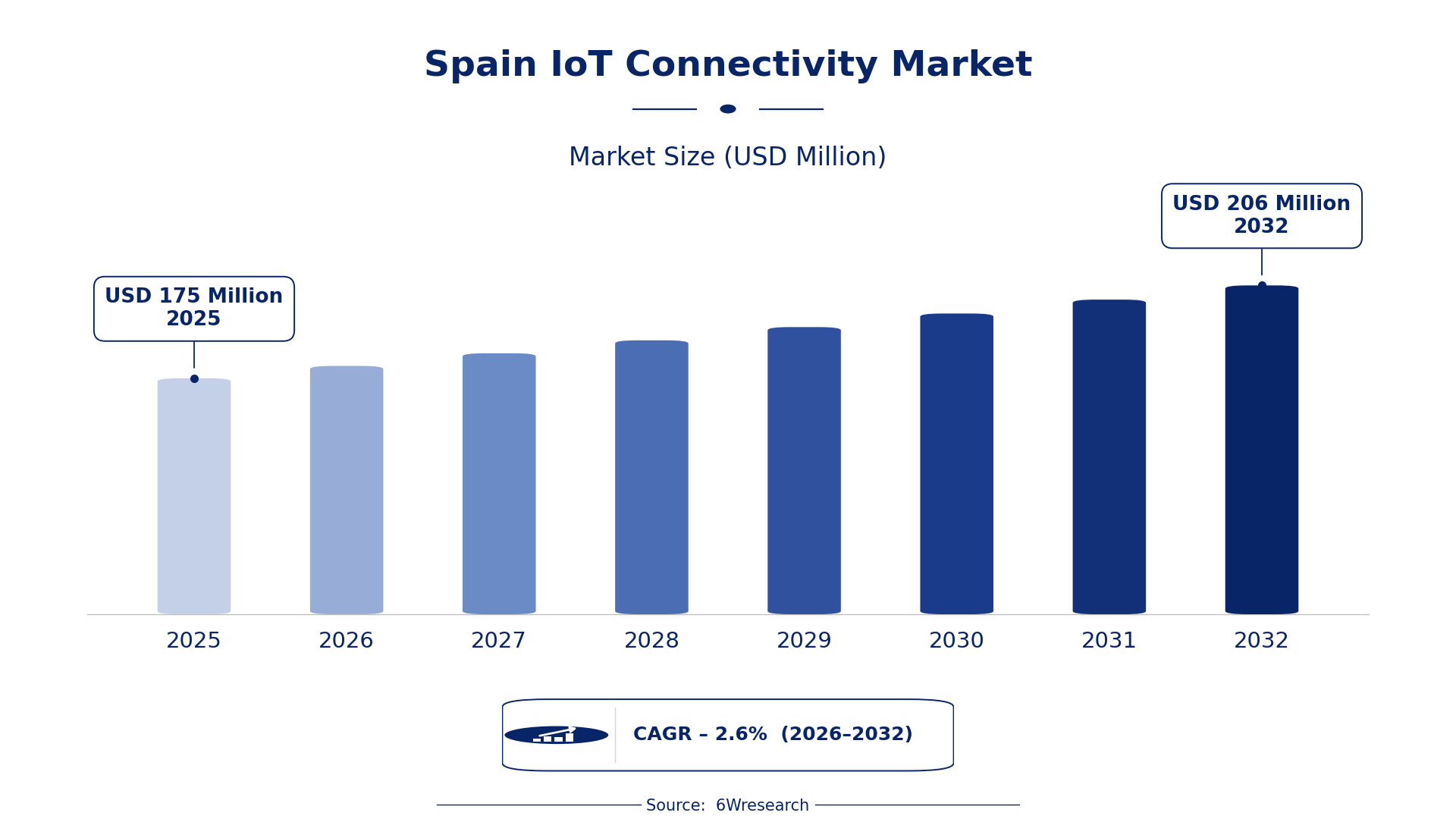
The Spain IoT Connectivity Market was estimated at USD 175 Million in 2025 and is projected to reach USD 206 Million by 2032, growing at a CAGR of 2.6% from 2026 to 2032.
Spain IoT Connectivity Market Synopsis
In Spain, the demand for IoT connectivity solutions is increasingly driven by advancements in smart technologies across various sectors. Notably, the agricultural sector is leveraging IoT for precision farming, enhancing both productivity and sustainability.
Healthcare is another domain witnessing rapid adoption of IoT connectivity, as hospitals and clinics integrate connected devices for real-time patient monitoring. This shift is expected to bolster the market as organizations strive for efficiency and improved data management.
Spain IoT Connectivity Market Year-wise Growth Rate and Key Drivers
This graph illustrates the annual growth rates of the Spain IoT Connectivity Market from 2021 to 2032, highlighting a steady upward trajectory and projected expansion over the forecast period.
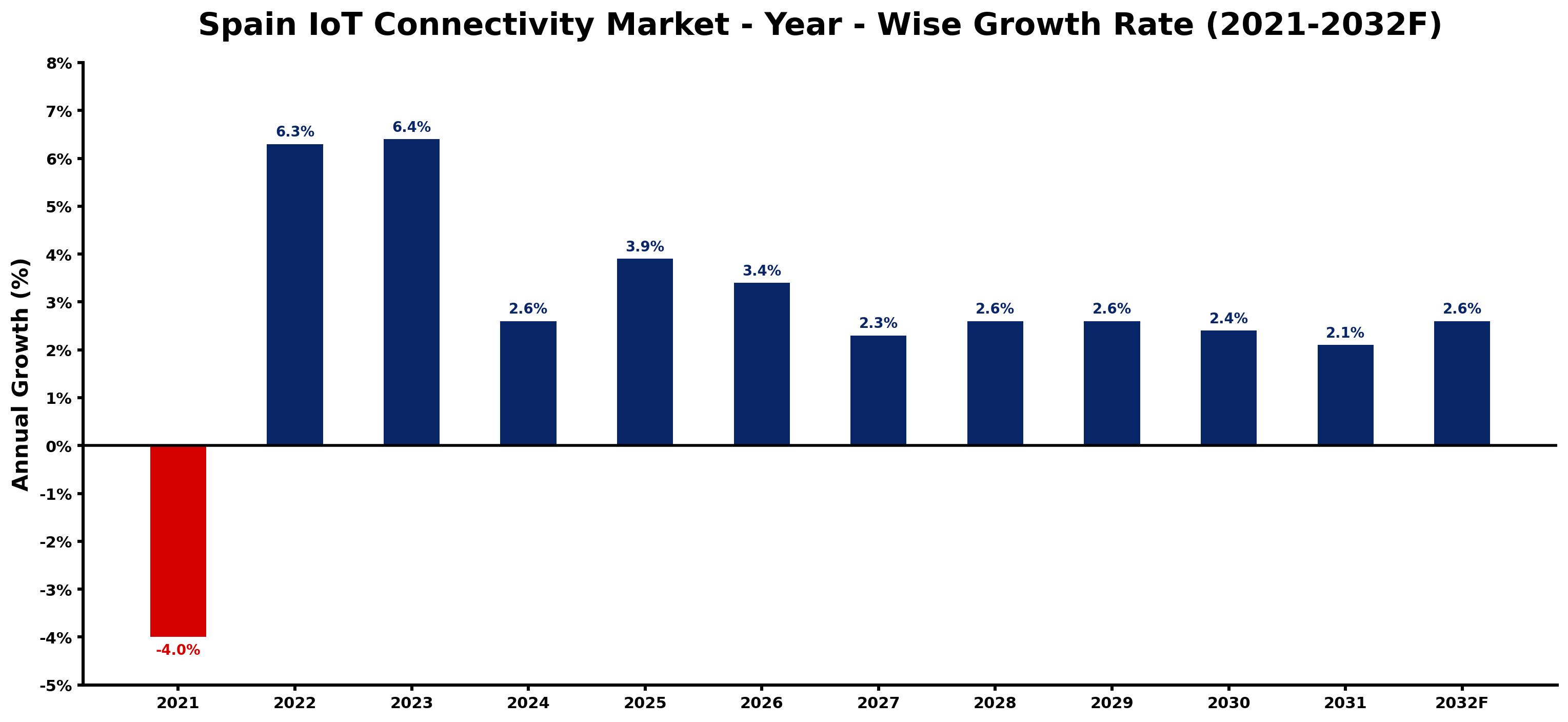
The table below presents the year‑wise growth rates along with the key drivers influencing the market
| Year | Growth Rate | Major Drivers |
| 2021 | -4.0% | Delayed 5G rollout by Spanish government authorities |
| 2022 | 6.3% | 5G rollout by Telefonica enhances IoT deployments. |
| 2023 | 6.4% | Spanish government supports IoT innovation grants. |
| 2024 | 2.6% | Urbanization increases need for connected city solutions. |
| 2025 | 3.9% | Growing agricultural IoT applications boost connectivity needs. |
| 2026 | 3.4% | Telefónica's collaborations expand IoT service offerings. |
| 2027 | 2.3% | Consumer interest in wearables fuels IoT connectivity. |
| 2028 | 2.6% | EU digital strategy promotes IoT technology adoption. |
| 2029 | 2.6% | Increased cybersecurity focus drives IoT security solutions. |
| 2030 | 2.4% | Telecom investments in IoT infrastructure rise significantly. |
| 2031 | 2.1% | Sustainable development goals encourage smart solutions adoption. |
| 2032 | 2.6% | Healthcare sector demand accelerates telemedicine IoT integration. |
Note: Market size estimations and growth projections presented in this report are based on 6Wresearch's proprietary forecasting methodology, utilizing the latest available industry data, government publications, and primary research inputs.
Spain IoT Connectivity Market Key Takeaways
Below are some of the specific key takeaways from the market, including:
- The market is increasingly driven by the rise in smart home technologies and industrial IoT applications.
- Advancements in cellular, LPWAN, and satellite technologies are expanding IoT connectivity capabilities.
- Government policies are actively promoting the deployment of advanced communication networks.
- Challenges include ensuring widespread network coverage and robust cybersecurity measures.
- Investment opportunities exist in developing infrastructure to support growing demand across various sectors.
Evaluation of Restraints in Spain IoT Connectivity Market
Despite the promising growth trajectory, the Spain IoT connectivity market faces significant hurdles. Network coverage remains inconsistent, particularly in rural areas where infrastructure is less developed. This inconsistency can hinder the reliable operation of connected devices. Additionally, as the number of IoT devices proliferates, the urgency for robust cybersecurity measures intensifies. The threat of data breaches looms larger, compelling companies to invest heavily in security solutions to safeguard sensitive information. These factors can create barriers to entry and slow the overall pace of market adoption.
Spain IoT Connectivity Market Trends
The shift towards 5G technology is a key trend shaping the Spain IoT connectivity market. The high-speed capabilities of 5G are expected to enhance the efficiency and responsiveness of connected devices, particularly in sectors requiring real-time data processing. Additionally, the growing emphasis on sustainability is driving interest in IoT solutions that improve resource management, particularly in agriculture and energy sectors. The rise of edge computing is also noteworthy, allowing data processing to occur closer to where it is generated, thus reducing latency and improving performance.
Spain IoT Connectivity Market Opportunities
Investment opportunities are abundant in Spain's IoT connectivity market. The expansion of smart city initiatives presents avenues for companies to develop and implement IoT solutions that enhance urban living. on top of that, the healthcare sector's increasing reliance on telemedicine and remote monitoring technologies is driving demand for reliable connectivity solutions. As organizations prioritize operational efficiency, there is a growing need for tailored IoT connectivity services that can cater to specific industry requirements.
Government Initiatives in the Spain IoT Connectivity Market
Government policy is playing a crucial role in shaping the IoT connectivity landscape in Spain. The administration is focused on expanding high-speed internet access, which is vital for widespread IoT adoption across both urban and rural areas. By promoting advanced communication networks, the government is facilitating an environment conducive to innovation and investment in connectivity solutions.
- A national digital infrastructure upgrade programme launched in 2023 aims to enhance connectivity across rural regions.
- Currently underway is a major initiative to implement 5G networks across metropolitan areas, expected to be completed by late 2025.
- Future plans include a public-private partnership initiative set to commence in 2026, focusing on integrating LPWAN technologies into existing infrastructure.
- Regulatory frameworks introduced in 2024 are mandating compliance with cybersecurity standards for all IoT devices deployed in the market.
Future Insights of the Spain IoT Connectivity Market
Looking ahead to 2026-2032, the Spain IoT connectivity market is set for steady growth driven by technological advancements and increasing adoption across various sectors. The push for smart cities will likely accelerate investments in IoT solutions, fostering collaborations between public and private sectors. As 5G becomes more mainstream, the capabilities of connected devices will expand, opening new avenues for innovation. Companies that prioritize security and scalability in their offerings will find themselves well-positioned to capture emerging market opportunities.
Spain IoT Connectivity Market Latest Developments
Recent activity in the Spain IoT connectivity market has been marked by significant advancements and initiatives. As companies focus on enhancing their offerings, the landscape is evolving rapidly to meet the demands of a more connected world.
- A leading telecommunications operator launched a new IoT connectivity platform in early 2025, enhancing support for smart city applications.
- In mid-2025, a major technology vendor announced a partnership with local governments to deploy IoT solutions for environmental monitoring.
- Plans are underway for a new satellite-based IoT network expected to be rolled out by late 2026, targeting remote areas with limited connectivity.
- Currently ongoing is a trial program focusing on the integration of LPWAN technologies in urban environments, aimed at reducing operational costs for businesses.
Spain IoT Connectivity Market - Key Attractiveness of the Report
- 10 Years of Market Numbers
- Historical Data Starting from 2022 to 2025
- Base Year: 2025
- Forecast Data until 2032
- Key Performance Indicators Impacting the Market
- Major Upcoming Developments and Projects
Key Highlights of the Report:
- Spain IoT Connectivity Market Outlook
- Market Size of Spain IoT Connectivity Market, 2025
- Forecast of Spain IoT Connectivity Market, 2032
- Historical Data and Forecast of Spain IoT Connectivity Revenues & Volume for the Period 2022-2032F
- Spain IoT Connectivity Market Trend Evolution
- Spain IoT Connectivity Market Drivers and Challenges
- Spain IoT Connectivity Price Trends
- Spain IoT Connectivity Porter's Five Forces
- Spain IoT Connectivity Industry Life Cycle
- Historical Data and Forecast of Spain IoT Connectivity Market Revenues & Volume By Component for the Period 2022-2032F
- Historical Data and Forecast of Spain IoT Connectivity Market Revenues & Volume By Platform for the Period 2022-2032F
- Historical Data and Forecast of Spain IoT Connectivity Market Revenues & Volume By Services for the Period 2022-2032F
- Historical Data and Forecast of Spain IoT Connectivity Market Revenues & Volume By Application Areas for the Period 2022-2032F
- Historical Data and Forecast of Spain IoT Connectivity Market Revenues & Volume By Building & Home Automation for the Period 2022-2032F
- Historical Data and Forecast of Spain IoT Connectivity Market Revenues & Volume By Smart Energy & Utility for the Period 2022-2032F
- Historical Data and Forecast of Spain IoT Connectivity Market Revenues & Volume By Smart Manufacturing for the Period 2022-2032F
- Historical Data and Forecast of Spain IoT Connectivity Market Revenues & Volume By Connected Health for the Period 2022-2032F
- Historical Data and Forecast of Spain IoT Connectivity Market Revenues & Volume By Smart Retail for the Period 2022-2032F
- Historical Data and Forecast of Spain IoT Connectivity Market Revenues & Volume By Smart Transportation for the Period 2022-2032F
- Historical Data and Forecast of Spain IoT Connectivity Market Revenues & Volume By Others (Education and Agriculture) for the Period 2022-2032F
- Historical Data and Forecast of Spain IoT Connectivity Market Revenues & Volume By Organization Size for the Period 2022-2032F
- Historical Data and Forecast of Spain IoT Connectivity Market Revenues & Volume By Large Enterprises for the Period 2022-2032F
- Historical Data and Forecast of Spain IoT Connectivity Market Revenues & Volume By SMEs for the Period 2022-2032F
- Spain IoT Connectivity Import Export Trade Statistics
- Market Opportunity Assessment By Component
- Market Opportunity Assessment By Application Areas
- Market Opportunity Assessment By Organization Size
- Spain IoT Connectivity Top Companies Market Share
- Spain IoT Connectivity Competitive Benchmarking By Technical and Operational Parameters
- Spain IoT Connectivity Company Profiles
- Spain IoT Connectivity Key Strategic Recommendations






































