Spain Mass Spectrometry Market Size, Share & Growth Rate
The Spain Mass Spectrometry Market was estimated at USD 180 Million in 2025 and is projected to reach USD 213 Million by 2032, growing at a CAGR of 2.4% from 2026 to 2032. This growth trajectory is fueled by increasing research and development investments in pharmaceuticals and biotechnology, as well as the rising adoption of mass spectrometry for food safety and environmental testing. As Spain's healthcare infrastructure improves and regulatory standards become more stringent, the demand for precise analytical techniques is expected to rise, further propelling market growth.
Spain Mass Spectrometry Market Year-wise Growth Rate and Key Drivers
This graph highlights how the Spain Mass Spectrometry Market has steadily grown over the years, supported by major growth factors.
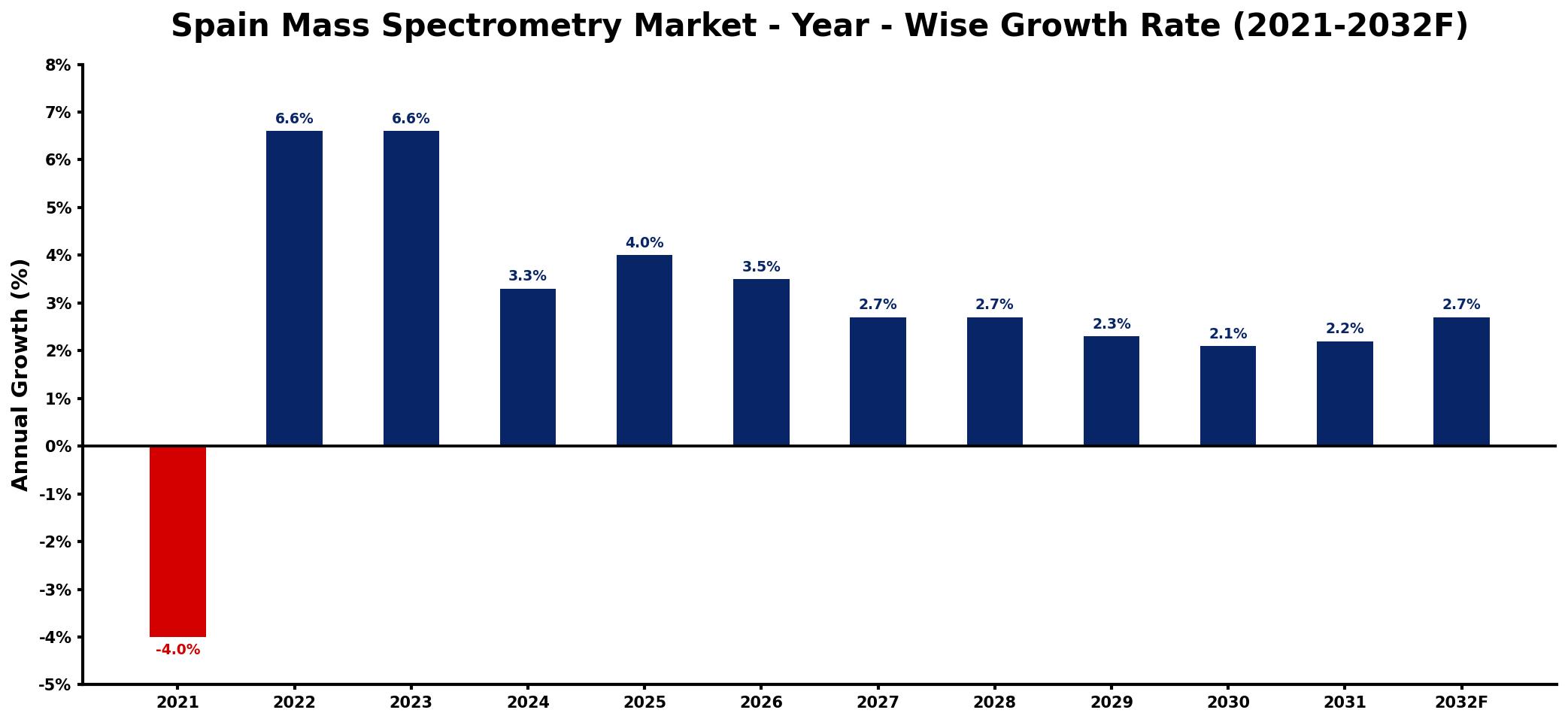
The table below presents the year‑wise growth rates along with the key drivers influencing the market
| Year | Growth Rate | Major Drivers |
| 2021 | -4.0% | Decreased investments in research facilities |
| 2022 | 6.6% | Increased funding for clinical research |
| 2023 | 6.6% | Growing demand for environmental testing |
| 2024 | 3.3% | Expansion of pharmaceutical applications |
| 2025 | 4.0% | Rising interest in proteomics research |
| 2026 | 3.5% | Advancements in analytical technologies |
| 2027 | 2.7% | Increase in food safety regulations |
| 2028 | 2.7% | Emergence of new diagnostic methods |
| 2029 | 2.3% | Growth in academic research funding |
| 2030 | 2.1% | Demand for personalized medicine solutions |
| 2031 | 2.2% | Increased adoption in biotechnology sector |
| 2032 | 2.7% | increased domestic production output |
Note: Market size estimations and growth projections presented in this report are based on 6Wresearch's proprietary forecasting methodology, utilizing the latest available industry data, government publications, and primary research inputs.
Spain Mass Spectrometry Market Synopsis
The most significant force shaping the Spain Mass Spectrometry Market is the burgeoning emphasis on advanced analytical techniques across various sectors. With a focus on pharmaceuticals and biotechnology, the country is witnessing a surge in research initiatives that leverage mass spectrometry for drug development and discovery.
Additionally, the increasing implementation of mass spectrometry in clinical diagnostics and environmental monitoring is enhancing its importance. As organizations strive for compliance with stringent safety regulations, the demand for reliable and accurate mass spectrometry systems continues to escalate, driving market expansion.
Spain Mass Spectrometry Market Key Takeaways
- The market is witnessing strong growth fueled by rising R&D investments in the pharmaceutical and biotechnology sectors.
- Advanced technologies in mass spectrometry are gaining traction for clinical diagnostics, food safety, and environmental applications.
- There is a growing focus on personalized medicine and proteomics research, contributing to market momentum.
- Innovative product developments and collaborations among industry players are shaping the competitive landscape.
- Government regulations and policies are creating a conducive environment for technological advancements in mass spectrometry.
Evaluation of Restraints in Spain Mass Spectrometry Market
The Spain Mass Spectrometry Market faces several restraints that could limit its growth. The initial capital investment for mass spectrometry equipment is notably high, which can deter smaller entities from entering the market. Furthermore, ongoing maintenance costs and the necessity for skilled personnel to manage and interpret the sophisticated data generated by these instruments add layers of complexity. Additionally, the rapid evolution of technology in this sector creates a competitive atmosphere where keeping pace with innovations becomes a challenge. Regulatory compliance also poses hurdles that can slow down market adoption in certain segments.
Spain Mass Spectrometry Market Trends
Currently, a few key trends are shaping the Spain Mass Spectrometry Market. First, the increasing sensitivity and accuracy of mass spectrometry systems are enhancing their appeal across different sectors. The integration of machine learning and artificial intelligence into analytical workflows is also emerging, leading to faster and more efficient analysis. Another notable trend is the rising emphasis on environmental testing, particularly in light of growing concerns about sustainability and public health. Moreover, the movement towards personalized medicine is steering demand for mass spectrometry applications in pharmacogenomics and biomarker discovery.
Spain Mass Spectrometry Market Opportunities
Investment opportunities in the Spain Mass Spectrometry Market are abundant, particularly within sectors such as pharmaceuticals, environmental testing, and food safety. The increasing demand for sophisticated analytical tools signifies a need for innovative solutions tailored to specific applications. Moreover, potential collaborations with academic institutions and research organizations could yield significant advancements in technology, providing investors with unique market entry points. With governmental support for R&D initiatives, there's a conducive environment for burgeoning enterprises in the mass spectrometry space.
Government Initiatives in the Spain Mass Spectrometry Market
Government initiatives in Spain are heavily focused on establishing stringent regulations aimed at maintaining high standards in mass spectrometry practices across various industries. These policies are designed to promote safety and reliability while encouraging technological advancement. Additionally, public funding for research and development activities supports innovation in mass spectrometry technologies, facilitating collaboration between industry and academia. Such initiatives help create a robust market framework that underpins further growth and acceptance of mass spectrometry solutions.
Future Insights of the Spain Mass Spectrometry Market
Looking forward to the period between 2026 and 2032, the Spain Mass Spectrometry Market is set to experience substantial growth. Demand from the pharmaceutical and biotechnology sectors will likely continue to climb, driven by ongoing innovations in drug discovery and personalized medicine. The increasing need for reliable analytical techniques in clinical diagnostics will further enhance market prospects. Furthermore, as regulatory environments evolve and public health priorities shift, mass spectrometry will play an indispensable role in ensuring quality and safety across multiple applications. The combination of technological advancements and supportive government policies heralds a positive outlook for the market.
Spain Mass Spectrometry Market Latest Developments (2025 - 2026)
Recent developments in the Spain Mass Spectrometry Market reflect a dynamic shift towards the integration of cutting-edge technologies. Many organizations are investing in improving mass spectrometry systems, enhancing analytical capabilities, and addressing specific industry needs. Additionally, collaborations between research institutions and private companies are emerging to foster innovation and streamline the development of new applications. With a focus on compliance with evolving regulatory standards, advancements in mass spectrometry tools are gaining traction, positioning the market for continued growth in the near term.
Spain Mass Spectrometry Market - Key Attractiveness of the Report
- 10 Years of Market Numbers
- Historical Data Starting from 2022 to 2025
- Base Year: 2025
- Forecast Data until 2032
- Key Performance Indicators Impacting the Market
- Major Upcoming Developments and Projects
Key Highlights of the Report:
- Spain Mass Spectrometry Market Outlook
- Market Size of Spain Mass Spectrometry Market, 2025
- Forecast of Spain Mass Spectrometry Market, 2032
- Historical Data and Forecast of Spain Mass Spectrometry Revenues & Volume for the Period 2022-2032F
- Spain Mass Spectrometry Market Trend Evolution
- Spain Mass Spectrometry Market Drivers and Challenges
- Spain Mass Spectrometry Price Trends
- Spain Mass Spectrometry Porter's Five Forces
- Spain Mass Spectrometry Industry Life Cycle
- Historical Data and Forecast of Spain Mass Spectrometry Market Revenues & Volume By Technology for the Period 2022-2032F
- Historical Data and Forecast of Spain Mass Spectrometry Market Revenues & Volume By Hybrid Mass Spectrometry for the Period 2022-2032F
- Historical Data and Forecast of Spain Mass Spectrometry Market Revenues & Volume By Single Mass Spectrometry for the Period 2022-2032F
- Historical Data and Forecast of Spain Mass Spectrometry Market Revenues & Volume By Application for the Period 2022-2032F
- Historical Data and Forecast of Spain Mass Spectrometry Market Revenues & Volume By Pharmaceutical for the Period 2022-2032F
- Historical Data and Forecast of Spain Mass Spectrometry Market Revenues & Volume By Biotechnology for the Period 2022-2032F
- Historical Data and Forecast of Spain Mass Spectrometry Market Revenues & Volume By Security for the Period 2022-2032F
- Historical Data and Forecast of Spain Mass Spectrometry Market Revenues & Volume By Industrial chemistry for the Period 2022-2032F
- Historical Data and Forecast of Spain Mass Spectrometry Market Revenues & Volume By Environmental testing for the Period 2022-2032F
- Historical Data and Forecast of Spain Mass Spectrometry Market Revenues & Volume By Food & beverage testing for the Period 2022-2032F
- Historical Data and Forecast of Spain Mass Spectrometry Market Revenues & Volume By Forensic for the Period 2022-2032F
- Historical Data and Forecast of Spain Mass Spectrometry Market Revenues & Volume By Clinical for the Period 2022-2032F
- Spain Mass Spectrometry Import Export Trade Statistics
- Market Opportunity Assessment By Technology
- Market Opportunity Assessment By Application
- Spain Mass Spectrometry Top Companies Market Share
- Spain Mass Spectrometry Competitive Benchmarking By Technical and Operational Parameters
- Spain Mass Spectrometry Company Profiles
- Spain Mass Spectrometry Key Strategic Recommendations






































