Spain Meat Packaging Market Summary
The spain meat packaging market was estimated at USD 214 Million in 2025 and is projected to reach USD 251 Million by 2032, growing at a CAGR of 2.8% from 2026 to 2032.
Spain Meat Packaging Market Year-wise Growth Rate and Key Drivers
This graph highlights how the Spain Meat Packaging Market has steadily grown over the past five years, supported by major growth factors.
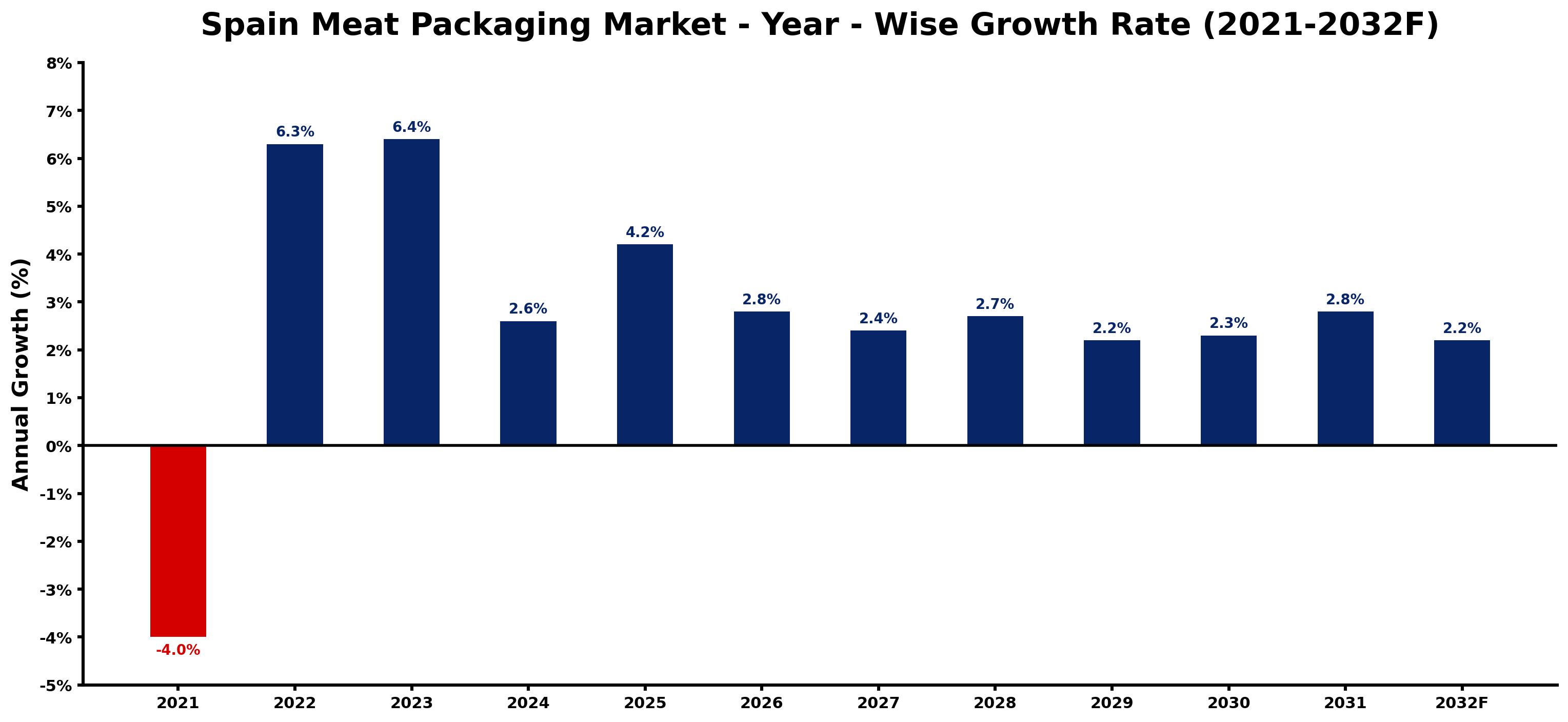
The table below presents the year wise growth rates along with the key drivers influencing the market
| Year | Growth Rate | Major Drivers |
| 2021 | -4.0% | Supply chain disruptions caused by global logistics issues limited product availability and hampered market sales. |
| 2022 | 6.3% | Increased home cooking activities drove demand for convenient meat packaging solutions. |
| 2023 | 6.4% | Health-conscious choices influenced meat packaging trends emphasizing organic and natural options. |
| 2024 | 2.6% | E-commerce platforms expanded, making packaged meat more accessible to consumers nationwide. |
| 2025 | 4.2% | Sustainability practices increasingly prioritized recyclable materials in meat packaging developments. |
| 2026 | 2.8% | Technological advancements in packaging machinery enhanced efficiency and reduced production costs. |
| 2027 | 2.4% | Local sourcing initiatives gained traction, promoting regional meat brands in packaging. |
| 2028 | 2.7% | Consumer awareness around food safety elevated standards for meat packaging quality. |
| 2029 | 2.2% | Innovations in smart packaging emerged, offering better preservation and freshness indicators. |
| 2030 | 2.3% | Increased competition among brands necessitated unique packaging designs to attract consumers. |
| 2031 | 2.8% | Changes in dietary trends led to a rise in alternative protein meat packaging options. |
| 2032 | 2.2% | Integration of artificial intelligence in logistics optimized the supply chain for meat packaging. |
Note - Market size estimations and growth projections presented in this report are based on 6Wresearch's advanced forecasting approach, validated with industry datasets as of June 2026.
Spain Meat Packaging Market Synopsis
The Spain Meat Packaging Market is projected to reach 2.8% and witness significant growth during the forecast period (2026-2032). This steady expansion is primarily driven by the increasing demand for processed meat products, evolving consumer preferences for convenience, and a heightened focus on food safety. The market encompasses a diverse array of packaging solutions that include vacuum packaging, modified atmosphere packaging, and innovations in active packaging technologies. These solutions aim to extend shelf life and maintain product integrity while responding to the growing environmental concerns surrounding packaging materials.
Spain Meat Packaging Market Growth Drivers
Several factors are influencing the growth of the Spain Meat Packaging Market. First, the rising demand for processed and ready-to-eat meat products reflects shifting consumer lifestyles that prioritize convenience. Second, the focus on food safety and hygiene standards is pushing manufacturers to adopt advanced packaging technologies that ensure product integrity. Third, there is a notable consumer shift toward sustainable packaging, with increasing preference for recyclable and biodegradable materials. Fourth, the impact of e-commerce is notable as online grocery shopping becomes more prevalent, necessitating innovative packaging solutions for meat products. Lastly, government regulations promoting hygienic practices further compel companies to enhance their packaging strategies, thereby driving market growth.
Spain Meat Packaging Market Trends and Opportunities
The Spain Meat Packaging Market is currently experiencing various trends that reflect contemporary consumer values and preferences. Firstly, sustainable and eco-friendly packaging solutions are gaining traction among consumers who are increasingly aware of environmental issues. Secondly, innovations in packaging that enhance shelf life, such as vacuum and modified atmosphere packaging, are becoming more prevalent. Thirdly, convenience-oriented features like resealable and portion-controlled packaging are being developed to cater to busy lifestyles. Fourthly, the demand for transparent labeling is rising, as consumers desire to know more about product origins and ingredients. Lastly, the integration of smart packaging technologies, which may include QR codes and sensors, presents opportunities for manufacturers to engage consumers directly and enhance transparency.
Spain Meat Packaging Market Challenges and Restraints
Despite the promising outlook, the Spain Meat Packaging Market faces several challenges. One significant hurdle is the increasing pressure to develop sustainable packaging solutions, necessitating substantial investment and innovation. As consumers prioritize environmentally-friendly options, companies must adapt to these preferences, which can be resource-intensive. Additionally, stringent regulations regarding food safety and packaging standards require ongoing compliance, increasing operational complexity for manufacturers. Moreover, competition within the market is intensifying, compelling companies to differentiate themselves through innovation while managing cost-efficiency. Lastly, fluctuations in raw material prices for packaging could impact profitability, presenting a further challenge for stakeholders in the market.
Spain Meat Packaging Market Investment Opportunities
Investment opportunities within the Spain Meat Packaging Market are emerging, particularly as a response to changing consumer demands. Companies that focus on developing eco-friendly packaging materials capable of biodegradability or recyclability are likely to capture a growing segment of the market. Moreover, investing in technologies that enhance shelf life while maintaining food safety can yield significant returns, considering the rising consumer expectations for quality products. Collaborations with meat producers for tailored packaging solutions could serve to address specific market needs, presenting a strategic avenue for investment. Advances in digital printing technologies for packaging customization also highlight prospects for gaining a competitive edge in the market. Overall, leveraging trends in sustainability and consumer convenience presents attractive investment opportunities in the Spain Meat Packaging Market.
Spain Meat Packaging Market Government Investment and Initiatives
The government policies in Spain significantly influence the meat packaging market, ensuring the safety and quality of meat products. The Ministry of Agriculture, Fisheries, and Food is responsible for establishing regulations that enforce hygiene, labeling, and packaging material standards to prevent contamination. Additionally, Spain aligns its policies with European Union directives concerning meat packaging, encompassing regulations on labeling specifications and transportation safety. The government also promotes sustainable practices within the packaging sector to minimize environmental impacts, supporting initiatives aimed at reducing single-use plastics and encouraging the adoption of recyclable materials. These regulatory frameworks aim to uphold market integrity, enhance consumer trust, and encourage sustainable practices across the industry.
Spain Meat Packaging Market Latest Developments (May 2025 - June 2026)
Recent developments within the Spain Meat Packaging Market from May 2025 to June 2026 indicate a marked shift towards sustainability and technology integration. Innovations in packaging materials that prioritize recyclability and biodegradability have gained traction, aligning with consumer demand for environmentally conscious products. Additionally, advancements in smart packaging technologies have begun to influence market dynamics, enabling enhanced product tracking and consumer engagement. The industry is also witnessing greater collaboration between meat producers and packaging companies to develop customized solutions that cater to specific needs. Moreover, regulatory changes aimed at enhancing food safety standards have prompted organizations to invest in compliance measures, ensuring that packaging meets evolving requirements.
Spain Meat Packaging Market - Key Attractiveness of the Report
- 10 Years of Market Numbers
- Historical Data Starting from 2022 to 2025
- Base Year: 2025
- Forecast Data until 2032
- Key Performance Indicators Impacting the Market
- Major Upcoming Developments and Projects
Key Highlights of the Report:
- Spain Meat Packaging Market Outlook
- Market Size of Spain Meat Packaging Market, 2025
- Forecast of Spain Meat Packaging Market, 2032F
- Historical Data and Forecast of Spain Meat Packaging Revenues & Volume for the Period 2022-2032F
- Spain Meat Packaging Market Trend Evolution
- Spain Meat Packaging Market Drivers and Challenges
- Spain Meat Packaging Price Trends
- Spain Meat Packaging Porter's Five Forces
- Spain Meat Packaging Industry Life Cycle
- Historical Data and Forecast of Spain Meat Packaging Market Revenues & Volume By Material Type for the Period 2022-2032F
- Historical Data and Forecast of Spain Meat Packaging Market Revenues & Volume By Plastic for the Period 2022-2032F
- Historical Data and Forecast of Spain Meat Packaging Market Revenues & Volume By Rigid? for the Period 2022-2032F
- Historical Data and Forecast of Spain Meat Packaging Market Revenues & Volume By Metal for the Period 2022-2032F
- Historical Data and Forecast of Spain Meat Packaging Market Revenues & Volume By Meat Type for the Period 2022-2032F
- Historical Data and Forecast of Spain Meat Packaging Market Revenues & Volume By Fresh and Frozen for the Period 2022-2032F
- Historical Data and Forecast of Spain Meat Packaging Market Revenues & Volume By Processed for the Period 2022-2032F
- Historical Data and Forecast of Spain Meat Packaging Market Revenues & Volume By Ready to Eat for the Period 2022-2032F
- Spain Meat Packaging Import Export Trade Statistics
- Market Opportunity Assessment By Material Type
- Market Opportunity Assessment By Meat Type
- Spain Meat Packaging Top Companies Market Share
- Spain Meat Packaging Competitive Benchmarking By Technical and Operational Parameters
- Spain Meat Packaging Company Profiles
- Spain Meat Packaging Key Strategic Recommendations






































