Spain Medical Gases Market Size (2020-2030)
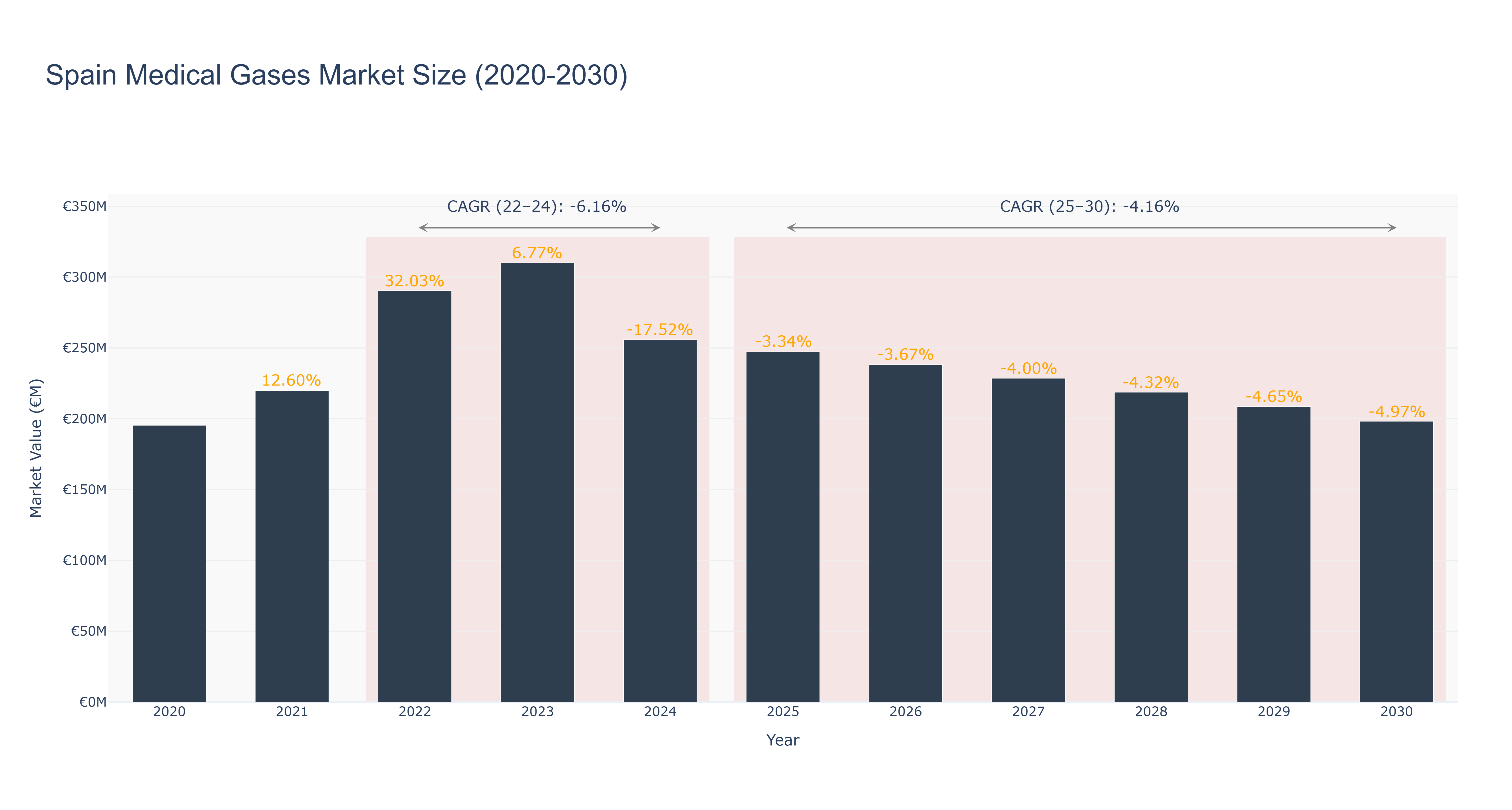
Spain Medical Gases Market has experienced a fluctuating trend in market size over the past decade. The peak market size of €310.05 million was recorded in 2023, followed by a decline to €255.74 million in 2024. The market is forecasted to continue shrinking, with a projected size of €198.21 million in 2030. The CAGR for the period 2022-24 is -6.16%, while for 2025-30 it is -4.16%. The downward trend can be attributed to various factors such as regulatory changes, increased competition, and economic uncertainties. Despite the challenging market conditions, ongoing advancements in medical gas technology and the introduction of innovative products are expected to drive growth in the future. Collaborative projects between research institutions and industry players are set to enhance the market's competitiveness and sustainability in the coming years.
Spain Medical Gases Market: Production & Trade Performance (2019-2025)
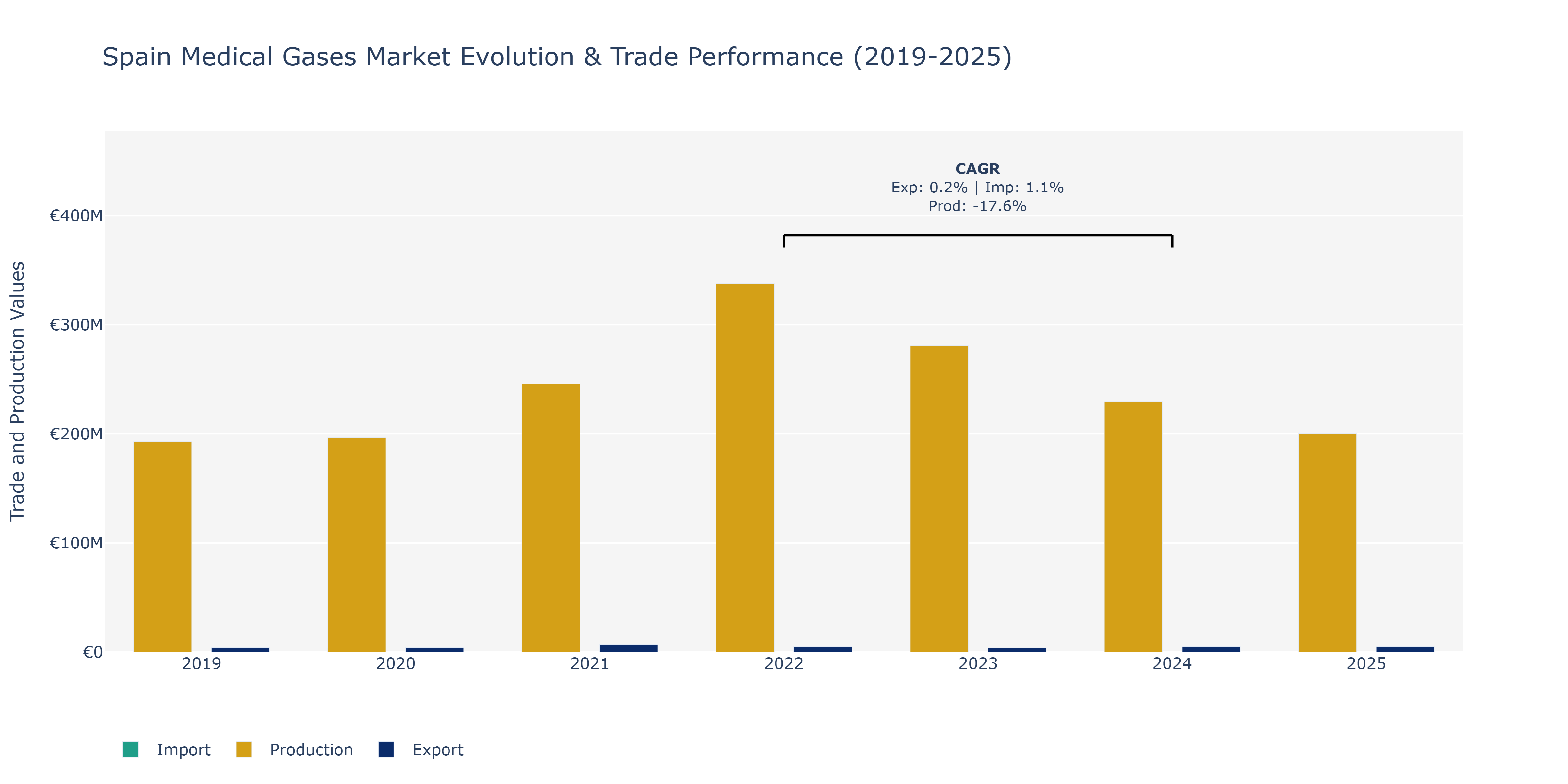
In the Spain Medical Gases Market, exports displayed fluctuating trends over the years, reaching a peak of €7.0 million in 2021, followed by a slight decrease in subsequent years. Conversely, imports saw a notable decline from €4.51 million in 2019 to €3.46 million in 2024. Production also experienced a significant drop from €245.52 million in 2021 to €200.15 million in 2025. These shifts can be attributed to various factors such as changes in domestic demand, global economic conditions impacting trade volumes, and advancements in technology affecting production efficiencies. The rise in exports in 2021 could be linked to increased international demand for medical gases, possibly driven by evolving healthcare needs or strategic market expansions by local manufacturers. The subsequent declines in exports and production may reflect market saturation, evolving regulatory environments, or shifts in consumer preferences towards alternative healthcare solutions. Such market dynamics necessitate continuous innovation and strategic partnerships to navigate evolving trends and sustain competitive advantages in the medical gases sector.
Spain Medical Gases Market Overview
The Spain medical gases market is witnessing steady growth driven by factors such as the increasing prevalence of chronic respiratory diseases, growth in the geriatric population, and advancements in healthcare infrastructure. The market is characterized by the presence of key players offering a wide range of medical gases such as oxygen, nitrogen, nitrous oxide, carbon dioxide, and hydrogen. These gases find applications in various medical procedures, including anesthesia, respiratory therapy, and diagnostics. Additionally, the rising demand for home healthcare services and the emphasis on infection control in healthcare facilities are further contributing to the market growth. With a focus on ensuring the safe and efficient delivery of medical gases, the market is expected to continue expanding, providing opportunities for innovation and market penetration.
Spain Medical Gases Market Trends
The Spain medical gases market is currently experiencing a trend towards the adoption of advanced technology for gas production and delivery systems. This includes the increasing use of portable and lightweight cylinders for easy transportation and administration of medical gases. Additionally, there is a growing emphasis on the adoption of green and sustainable practices in the production and distribution of medical gases to reduce environmental impact. The market is also seeing a rise in demand for specialty gases used in various medical procedures and therapies. Overall, the Spain medical gases market is evolving towards more efficient, innovative, and environmentally friendly solutions to meet the changing needs of healthcare facilities and patients.
Spain Medical Gases Market Challenges
In the Spain medical gases market, some key challenges include regulatory complexities related to the production, storage, and distribution of medical gases, as well as ensuring compliance with strict quality standards and safety regulations. Another challenge is the increasing competition among market players, leading to pricing pressures and the need for differentiation through innovative products or services. Additionally, the reliance on imports for certain specialized medical gases can expose the market to supply chain disruptions and volatility in pricing. Moreover, the ongoing technological advancements and evolving healthcare landscape require continuous investment in research and development to meet the changing demands of healthcare providers and patients, further adding to the complexities faced by companies operating in the Spain medical gases market.
Spain Medical Gases Market Investment Opportunities
Investment opportunities in the Spain medical gases market include the growing demand for medical gases due to an aging population and increasing incidence of chronic respiratory diseases. Companies involved in the production, distribution, and supply of medical gases stand to benefit from this trend. Additionally, advancements in technology and the development of innovative gas delivery systems present opportunities for investment in research and development. With a focus on enhancing safety, efficiency, and convenience in healthcare settings, investors can explore partnerships or acquisitions to expand their presence in the market. Furthermore, the increasing adoption of home healthcare services and the rising awareness about the benefits of medical gases for various medical procedures create a favorable environment for investment in this sector.
Spain Medical Gases Market Government Policy
In Spain, the medical gases market is regulated by the Spanish Agency of Medicines and Medical Devices (AEMPS) which sets the guidelines and requirements for the production, distribution, and use of medical gases. The government closely monitors the quality and safety standards of medical gases to ensure compliance with European Union regulations. Additionally, healthcare facilities must adhere to specific regulations regarding the storage, handling, and administration of medical gases to guarantee patient safety. The Spanish government also promotes the use of medical gases in healthcare settings through public health programs and subsidies, aiming to improve access to essential medical gases for patients across the country. Overall, government policies in Spain focus on ensuring the proper regulation and availability of medical gases to support the healthcare system and patient care.
Spain Medical Gases Market Future Outlook
The Spain medical gases market is expected to show steady growth in the coming years, driven by factors such as increasing prevalence of chronic respiratory diseases, advancements in healthcare infrastructure, and the rising demand for home healthcare services. Additionally, the growing geriatric population and the surge in surgeries and emergency care requirements are also contributing to the market expansion. Technological advancements in gas delivery systems and the increasing adoption of portable oxygen concentrators are further expected to boost market growth. However, stringent regulations related to the production and distribution of medical gases may pose challenges for market players. Overall, the Spain medical gases market is poised for growth, with opportunities for innovation and expansion in the forecast period.
Key Highlights of the Report:
- Spain Medical Gases Market Outlook
- Market Size of Spain Medical Gases Market,2025
- Forecast of Spain Medical Gases Market, 2032
- Historical Data and Forecast of Spain Medical Gases Revenues & Volume for the Period 2022-2032F
- Spain Medical Gases Market Trend Evolution
- Spain Medical Gases Market Drivers and Challenges
- Spain Medical Gases Price Trends
- Spain Medical Gases Porter's Five Forces
- Spain Medical Gases Industry Life Cycle
- Historical Data and Forecast of Spain Medical Gases Market Revenues & Volume By Technology Type for the Period 2022-2032F
- Historical Data and Forecast of Spain Medical Gases Market Revenues & Volume By Fractional Distillation for the Period 2022-2032F
- Historical Data and Forecast of Spain Medical Gases Market Revenues & Volume By Molecular Sieve for the Period 2022-2032F
- Historical Data and Forecast of Spain Medical Gases Market Revenues & Volume By Semipermeable Membrane for the Period 2022-2032F
- Historical Data and Forecast of Spain Medical Gases Market Revenues & Volume By Physical Separators for the Period 2022-2032F
- Historical Data and Forecast of Spain Medical Gases Market Revenues & Volume By Application Area for the Period 2022-2032F
- Historical Data and Forecast of Spain Medical Gases Market Revenues & Volume By Therapeutic Applications for the Period 2022-2032F
- Historical Data and Forecast of Spain Medical Gases Market Revenues & Volume By Pharmaceutical Manufacturing for the Period 2022-2032F
- Historical Data and Forecast of Spain Medical Gases Market Revenues & Volume By Diagnostic Applications for the Period 2022-2032F
- Historical Data and Forecast of Spain Medical Gases Market Revenues & Volume By Drug Discovery for the Period 2022-2032F
- Historical Data and Forecast of Spain Medical Gases Market Revenues & Volume By Quality Control for the Period 2022-2032F
- Historical Data and Forecast of Spain Medical Gases Market Revenues & Volume By End User for the Period 2022-2032F
- Historical Data and Forecast of Spain Medical Gases Market Revenues & Volume By Hospitals for the Period 2022-2032F
- Historical Data and Forecast of Spain Medical Gases Market Revenues & Volume By Home Healthcare for the Period 2022-2032F
- Historical Data and Forecast of Spain Medical Gases Market Revenues & Volume By Pharmaceutical Companies for the Period 2022-2032F
- Historical Data and Forecast of Spain Medical Gases Market Revenues & Volume By Academic Institutions for the Period 2022-2032F
- Historical Data and Forecast of Spain Medical Gases Market Revenues & Volume By Emergency Service Providers for the Period 2022-2032F
- Historical Data and Forecast of Spain Medical Gases Market Revenues & Volume By Product Type for the Period 2022-2032F
- Historical Data and Forecast of Spain Medical Gases Market Revenues & Volume By Oxygen Gases for the Period 2022-2032F
- Historical Data and Forecast of Spain Medical Gases Market Revenues & Volume By Carbon Dioxide Gases for the Period 2022-2032F
- Historical Data and Forecast of Spain Medical Gases Market Revenues & Volume By Nitrogen Gases for the Period 2022-2032F
- Historical Data and Forecast of Spain Medical Gases Market Revenues & Volume By Helium Gases for the Period 2022-2032F
- Historical Data and Forecast of Spain Medical Gases Market Revenues & Volume By Gas Mixtures for the Period 2022-2032F
- Spain Medical Gases Import Export Trade Statistics
- Market Opportunity Assessment By Technology Type
- Market Opportunity Assessment By Application Area
- Market Opportunity Assessment By End User
- Market Opportunity Assessment By Product Type
- Spain Medical Gases Top Companies Market Share
- Spain Medical Gases Competitive Benchmarking By Technical and Operational Parameters
- Spain Medical Gases Company Profiles
- Spain Medical Gases Key Strategic Recommendations






































