Saudi Arabia Medical Gases Market: Import Trend Analysis
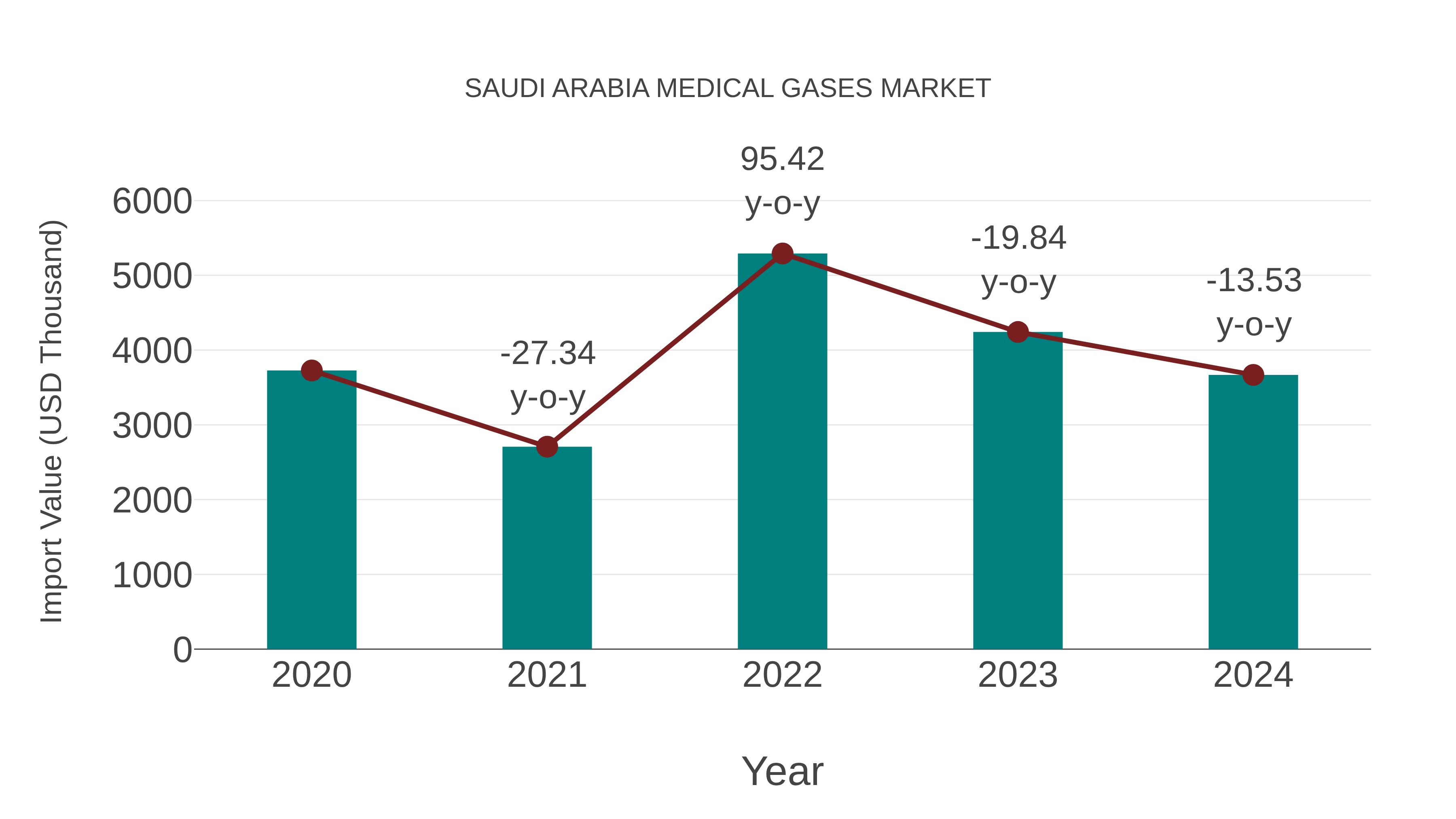
Saudi Arabia`s import trend for the medical gases market exhibited a decline from 2023 to 2024, with a growth rate of -13.53%. The compound annual growth rate (CAGR) for the period 2020-2024 stood at -0.4%. This negative momentum can be attributed to shifts in demand dynamics or regulatory changes impacting the market.
Saudi Arabia Medical Gases Market Overview
The Saudi Arabia medical gases market is witnessing steady growth due to the increasing prevalence of chronic diseases, rising geriatric population, and advancements in healthcare infrastructure. The market is primarily driven by the growing demand for medical oxygen, nitrogen, nitrous oxide, carbon dioxide, and other specialty gases for various medical applications such as respiratory therapy, anesthesia, and surgical procedures. The government`s initiatives to improve the healthcare sector and the presence of key players like Air Liquide, Linde plc, and Air Products and Chemicals, Inc. are also contributing to market growth. Additionally, the COVID-19 pandemic has further highlighted the importance of medical gases in supporting respiratory care for patients. Overall, the Saudi Arabia medical gases market is poised for continued expansion in the coming years.
Saudi Arabia Medical Gases Market Trends
The current trends in the Saudi Arabia medical gases market include a growing demand for medical oxygen due to the increased prevalence of respiratory diseases and the ongoing COVID-19 pandemic. There is also a shift towards the use of specialty gases such as nitrous oxide and helium in medical applications for anesthesia and diagnostic imaging. The market is witnessing advancements in gas delivery systems and technologies to ensure safe and efficient administration of medical gases in healthcare facilities. Additionally, there is a rising focus on ensuring the quality and purity of medical gases through strict regulatory standards and compliance measures to meet the healthcare industry`s stringent requirements for patient safety and treatment efficacy.
Saudi Arabia Medical Gases Market Challenges
In the Saudi Arabia medical gases market, challenges include regulatory compliance with stringent health and safety standards, ensuring a continuous and reliable supply chain for critical medical gases, and managing the costs associated with production, transportation, and storage of these gases. Additionally, there may be challenges related to maintaining the quality and purity of medical gases to meet the specific requirements of healthcare facilities and patients. Competition among suppliers and the need for innovative technologies to enhance efficiency and reduce environmental impact also pose challenges in this market. Overall, navigating these challenges requires industry players to stay updated on regulations, invest in infrastructure, and adopt best practices to ensure the safe and effective use of medical gases in healthcare settings.
Saudi Arabia Medical Gases Market Investment Opportunities
The Saudi Arabia medical gases market presents lucrative investment opportunities due to the increasing demand for medical gases in the healthcare sector. With the growing population and expanding healthcare infrastructure in the country, there is a rising need for medical gases such as oxygen, nitrogen, nitrous oxide, and carbon dioxide for various medical applications. Investors can consider opportunities in the manufacturing and distribution of medical gases, as well as investing in technologies for gas production and delivery systems. Additionally, partnerships with healthcare facilities and providers to supply medical gases can be a viable investment strategy. The market is expected to witness significant growth in the coming years, driven by advancements in healthcare services and the rising prevalence of chronic diseases, making it an attractive sector for investment.
Saudi Arabia Medical Gases Market Government Policy
In Saudi Arabia, the medical gases market is regulated by the Saudi Food and Drug Authority (SFDA) which oversees the registration, importation, manufacturing, and distribution of medical gases to ensure quality, safety, and efficacy. The SFDA requires all medical gas products to adhere to strict standards and regulations, including Good Manufacturing Practices (GMP) and Good Distribution Practices (GDP). Additionally, the government has implemented policies to promote local manufacturing of medical gases to reduce reliance on imports and enhance domestic production capacity. Importers and manufacturers of medical gases must obtain appropriate licenses and comply with pricing regulations to maintain fair competition in the market. Overall, government policies aim to ensure the availability of high-quality medical gases for healthcare facilities and promote the growth of the medical gases market in Saudi Arabia.
Saudi Arabia Medical Gases Market Future Outlook
The Saudi Arabia medical gases market is expected to see significant growth in the coming years due to increasing investments in healthcare infrastructure and a growing emphasis on high-quality medical services. The market is projected to be driven by factors such as the rising prevalence of chronic diseases, the expanding geriatric population, and the increasing demand for advanced medical treatments. Additionally, the implementation of favorable government initiatives and regulations aimed at enhancing the healthcare sector is anticipated to further boost market growth. Technological advancements in medical gas delivery systems, coupled with the increasing adoption of telemedicine and home healthcare services, are also expected to contribute to the expansion of the Saudi Arabia medical gases market in the future.
Key Highlights of the Report:
- Saudi Arabia Medical Gases Market Outlook
- Market Size of Saudi Arabia Medical Gases Market,2025
- Forecast of Saudi Arabia Medical Gases Market, 2032
- Historical Data and Forecast of Saudi Arabia Medical Gases Revenues & Volume for the Period 2022-2032F
- Saudi Arabia Medical Gases Market Trend Evolution
- Saudi Arabia Medical Gases Market Drivers and Challenges
- Saudi Arabia Medical Gases Price Trends
- Saudi Arabia Medical Gases Porter's Five Forces
- Saudi Arabia Medical Gases Industry Life Cycle
- Historical Data and Forecast of Saudi Arabia Medical Gases Market Revenues & Volume By Technology Type for the Period 2022-2032F
- Historical Data and Forecast of Saudi Arabia Medical Gases Market Revenues & Volume By Fractional Distillation for the Period 2022-2032F
- Historical Data and Forecast of Saudi Arabia Medical Gases Market Revenues & Volume By Molecular Sieve for the Period 2022-2032F
- Historical Data and Forecast of Saudi Arabia Medical Gases Market Revenues & Volume By Semipermeable Membrane for the Period 2022-2032F
- Historical Data and Forecast of Saudi Arabia Medical Gases Market Revenues & Volume By Physical Separators for the Period 2022-2032F
- Historical Data and Forecast of Saudi Arabia Medical Gases Market Revenues & Volume By Application Area for the Period 2022-2032F
- Historical Data and Forecast of Saudi Arabia Medical Gases Market Revenues & Volume By Therapeutic Applications for the Period 2022-2032F
- Historical Data and Forecast of Saudi Arabia Medical Gases Market Revenues & Volume By Pharmaceutical Manufacturing for the Period 2022-2032F
- Historical Data and Forecast of Saudi Arabia Medical Gases Market Revenues & Volume By Diagnostic Applications for the Period 2022-2032F
- Historical Data and Forecast of Saudi Arabia Medical Gases Market Revenues & Volume By Drug Discovery for the Period 2022-2032F
- Historical Data and Forecast of Saudi Arabia Medical Gases Market Revenues & Volume By Quality Control for the Period 2022-2032F
- Historical Data and Forecast of Saudi Arabia Medical Gases Market Revenues & Volume By End User for the Period 2022-2032F
- Historical Data and Forecast of Saudi Arabia Medical Gases Market Revenues & Volume By Hospitals for the Period 2022-2032F
- Historical Data and Forecast of Saudi Arabia Medical Gases Market Revenues & Volume By Home Healthcare for the Period 2022-2032F
- Historical Data and Forecast of Saudi Arabia Medical Gases Market Revenues & Volume By Pharmaceutical Companies for the Period 2022-2032F
- Historical Data and Forecast of Saudi Arabia Medical Gases Market Revenues & Volume By Academic Institutions for the Period 2022-2032F
- Historical Data and Forecast of Saudi Arabia Medical Gases Market Revenues & Volume By Emergency Service Providers for the Period 2022-2032F
- Historical Data and Forecast of Saudi Arabia Medical Gases Market Revenues & Volume By Product Type for the Period 2022-2032F
- Historical Data and Forecast of Saudi Arabia Medical Gases Market Revenues & Volume By Oxygen Gases for the Period 2022-2032F
- Historical Data and Forecast of Saudi Arabia Medical Gases Market Revenues & Volume By Carbon Dioxide Gases for the Period 2022-2032F
- Historical Data and Forecast of Saudi Arabia Medical Gases Market Revenues & Volume By Nitrogen Gases for the Period 2022-2032F
- Historical Data and Forecast of Saudi Arabia Medical Gases Market Revenues & Volume By Helium Gases for the Period 2022-2032F
- Historical Data and Forecast of Saudi Arabia Medical Gases Market Revenues & Volume By Gas Mixtures for the Period 2022-2032F
- Saudi Arabia Medical Gases Import Export Trade Statistics
- Market Opportunity Assessment By Technology Type
- Market Opportunity Assessment By Application Area
- Market Opportunity Assessment By End User
- Market Opportunity Assessment By Product Type
- Saudi Arabia Medical Gases Top Companies Market Share
- Saudi Arabia Medical Gases Competitive Benchmarking By Technical and Operational Parameters
- Saudi Arabia Medical Gases Company Profiles
- Saudi Arabia Medical Gases Key Strategic Recommendations






































