Spain MVNO Market Size & Growth Rate (2026-2032)
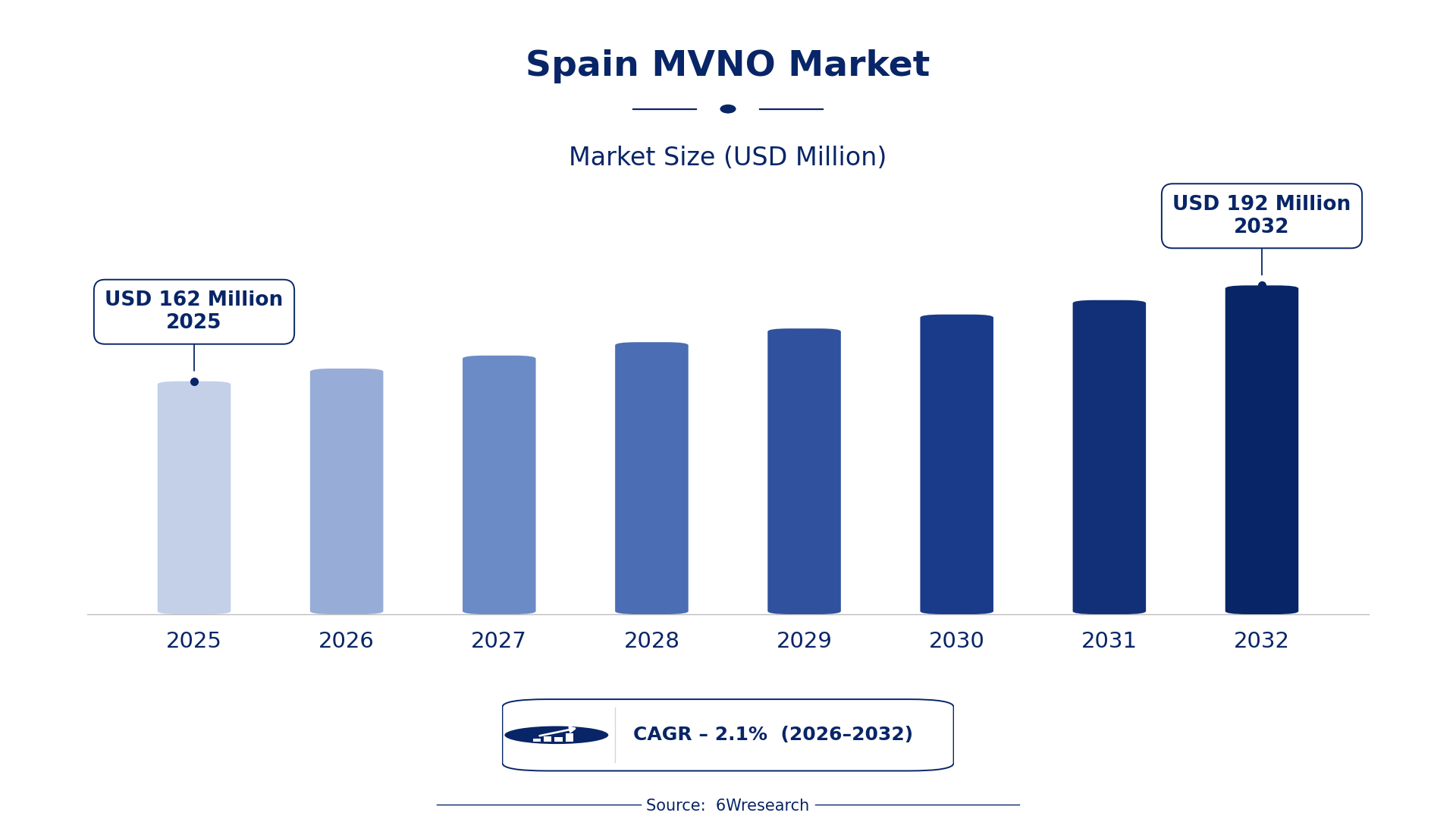
The Spain MVNO Market was estimated at USD 162 Million in 2025 and is projected to reach USD 192 Million by 2032, growing at a CAGR of 2.1% from 2026 to 2032.
Spain MVNO Market Synopsis
The demand for Mobile Virtual Network Operators (MVNOs) in Spain has surged as consumers increasingly seek affordable and flexible mobile services. Niche offerings are particularly appealing, catering to segments like budget-conscious individuals and data-heavy users. This shift signifies a departure from traditional mobile plans, emphasizing a strong desire for tailored solutions.
The competitive nature of the Spain MVNO market has led to a proliferation of operators, each vying for a share by delivering innovative services and attractive bundles. The landscape is not just about price; many MVNOs are differentiating themselves through unique value-added services, which play a critical role in capturing consumer attention.
Spain MVNO Market Year-wise Growth Rate and Key Drivers
This graph illustrates the annual growth rates of the Spain MVNO Market from 2021 to 2032, highlighting a steady upward trajectory and projected expansion over the forecast period.
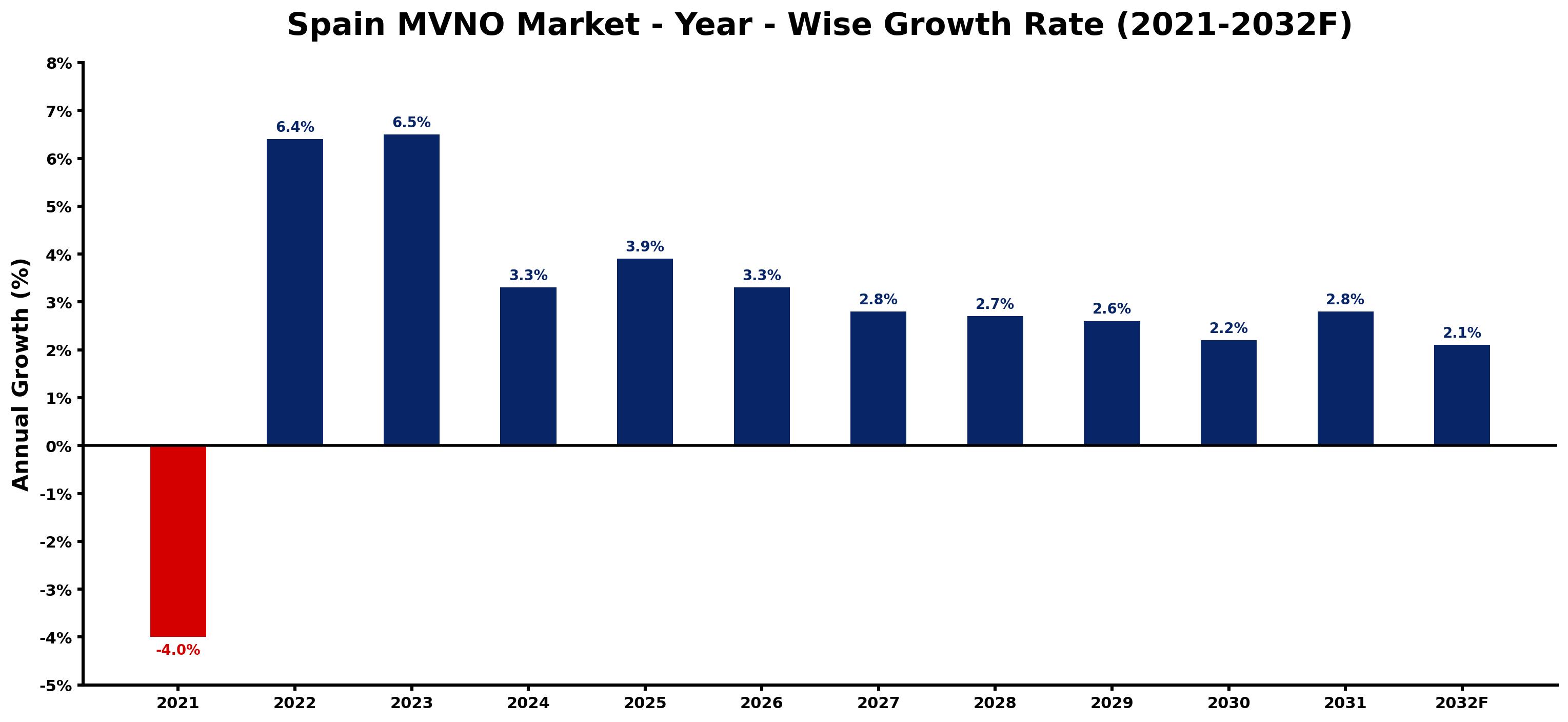
The table below presents the year‑wise growth rates along with the key drivers influencing the market
| Year | Growth Rate | Major Drivers |
| 2021 | -4.0% | Regulatory changes by CNMC reduced market competitiveness. |
| 2022 | 6.4% | Increased demand for mobile data services post-pandemic. |
| 2023 | 6.5% | 5G network expansion by Telefonica enhances MVNO competitiveness. |
| 2024 | 3.3% | Regulatory changes favoring competitive pricing from CNMC. |
| 2025 | 3.9% | Growth in digital nomad population drives mobile subscriptions. |
| 2026 | 3.3% | Rising smartphone penetration boosts data service adoption. |
| 2027 | 2.8% | Local startups offer innovative MVNO packages targeting youth. |
| 2028 | 2.7% | Partnerships with tech firms enhance service offerings. |
| 2029 | 2.6% | Affordability of MVNO plans attracts cost-conscious consumers. |
| 2030 | 2.2% | Increased mobile commerce activities spur demand for data. |
| 2031 | 2.8% | Government incentives for digital economy strengthen MVNO growth. |
| 2032 | 2.1% | Evolving consumer preferences toward flexible mobile contracts. |
Note: Market size estimations and growth projections presented in this report are based on 6Wresearch's proprietary forecasting methodology, utilizing the latest available industry data, government publications, and primary research inputs.
Spain MVNO Market Key Takeaways
Below are some of the specific key takeaways from the market, including:
- Rising smartphone penetration is driving the demand for MVNO services.
- Low-cost plans are gaining traction among budget-sensitive consumers.
- Strategic partnerships with MNOs are enhancing network quality for MVNOs.
- Regulatory support continues to shape a favorable environment for MVNO growth.
- Innovative service offerings are emerging, targeting specific demographic needs.
Evaluation of Restraints in Spain MVNO Market
Despite the growth, the Spain MVNO market faces notable challenges. Intense competition has created a pricing war that pressures margins for many operators, making profitability a complex task. Regulatory compliance can be cumbersome, especially for new entrants, and the dependency on larger MNOs for network infrastructure complicates service reliability. Distinguishing brand identity in a saturated market is essential, yet difficult for smaller players.
Spain MVNO Market Trends
Several trends are shaping the Spain MVNO market, notably the shift towards low-cost, data-centric plans. This shift caters to a growing demographic that prioritizes budget over brand loyalty. Additionally, innovative offerings, such as data-only packages or services tailored for specific age groups, are becoming more prevalent. Partnerships with major telecommunications companies are also increasing, aimed at expanding service quality and reach.
Spain MVNO Market Opportunities
Investment prospects in the Spain MVNO market are compelling. As consumers demand more personalized mobile services, operators who can deliver innovative and flexible plans are likely to capture market share from traditional MNOs. The high smartphone penetration rate indicates a ripe environment for new entrants focusing on specialized services, particularly for underserved market segments.
Government Initiatives in the Spain MVNO Market
Government policies in Spain are significantly influencing the MVNO market. The CNMC (Comisión Nacional de los Mercados y la Competencia) has implemented regulations to promote fair competition, ensuring that MVNOs have equitable access to network resources. This regulatory framework is crucial for fostering a dynamic market that encourages innovation and protects consumer interests.
- A regulatory framework introduced in 2025 mandating billing transparency for MVNOs.
- A national digital infrastructure upgrade programme now in its rollout phase, aimed at expanding network access.
- Current initiatives supporting MVNOs with access to major telecom networks at regulated wholesale prices.
- Planned public-private initiatives expected to enhance mobile service coverage by 2028.
Future Insights of the Spain MVNO Market
Looking ahead to 2026-2032, the Spain MVNO market is set for notable expansion. The increasing demand for affordable mobile services, combined with advancements in 5G technology, will present new avenues for MVNOs. Enhanced customer experiences and innovative service offerings are likely to be central to the strategies of successful operators, as they aim to carve out their niches in a competitive environment.
Spain MVNO Market Latest Developments
In the past year, the Spain MVNO market has witnessed a flurry of activity. Operators are increasingly focusing on unique offerings to differentiate themselves, while partnerships with larger telecom companies have been on the rise. These trends signal a proactive approach to meeting consumer demands and enhancing service delivery.
- A major technology vendor announced the launch of an upgraded network infrastructure project expected to enhance service quality, initiated in early 2025 and slated for completion by late 2025.
- An ongoing partnership between a regional MVNO and a prominent MNO aims to expand network coverage throughout rural areas, currently underway.
- In mid-2025, a leading MVNO launched a new data-only plan targeting young professionals, which has received positive feedback from consumers.
- Upcoming initiatives are planned for 2026 to introduce bundled service packages that include streaming services, aimed at attracting younger demographics.
Spain MVNO Market - Key Attractiveness of the Report
- 10 Years of Market Numbers
- Historical Data Starting from 2022 to 2025
- Base Year: 2025
- Forecast Data until 2032
- Key Performance Indicators Impacting the Market
- Major Upcoming Developments and Projects
Key Highlights of the Report:
- Spain MVNO Market Outlook
- Market Size of Spain MVNO Market, 2025
- Forecast of Spain MVNO Market, 2032
- Historical Data and Forecast of Spain MVNO Revenues & Volume for the Period 2022-2032F
- Spain MVNO Market Trend Evolution
- Spain MVNO Market Drivers and Challenges
- Spain MVNO Price Trends
- Spain MVNO Porter's Five Forces
- Spain MVNO Industry Life Cycle
- Historical Data and Forecast of Spain MVNO Market Revenues & Volume By Operational Model for the Period 2022-2032F
- Historical Data and Forecast of Spain MVNO Market Revenues & Volume By Reseller for the Period 2022-2032F
- Historical Data and Forecast of Spain MVNO Market Revenues & Volume By Service Operator for the Period 2022-2032F
- Historical Data and Forecast of Spain MVNO Market Revenues & Volume By Full MVNO for the Period 2022-2032F
- Historical Data and Forecast of Spain MVNO Market Revenues & Volume By Organization Size for the Period 2022-2032F
- Historical Data and Forecast of Spain MVNO Market Revenues & Volume By SMES for the Period 2022-2032F
- Historical Data and Forecast of Spain MVNO Market Revenues & Volume By Large Enterprise for the Period 2022-2032F
- Historical Data and Forecast of Spain MVNO Market Revenues & Volume By Subscriber for the Period 2022-2032F
- Historical Data and Forecast of Spain MVNO Market Revenues & Volume By Consumer for the Period 2022-2032F
- Historical Data and Forecast of Spain MVNO Market Revenues & Volume By Enterprise for the Period 2022-2032F
- Spain MVNO Import Export Trade Statistics
- Market Opportunity Assessment By Operational Model
- Market Opportunity Assessment By Organization Size
- Market Opportunity Assessment By Subscriber
- Spain MVNO Top Companies Market Share
- Spain MVNO Competitive Benchmarking By Technical and Operational Parameters
- Spain MVNO Company Profiles
- Spain MVNO Key Strategic Recommendations






































