Spain Physical Security Market Size & Growth Rate (2026-2032)
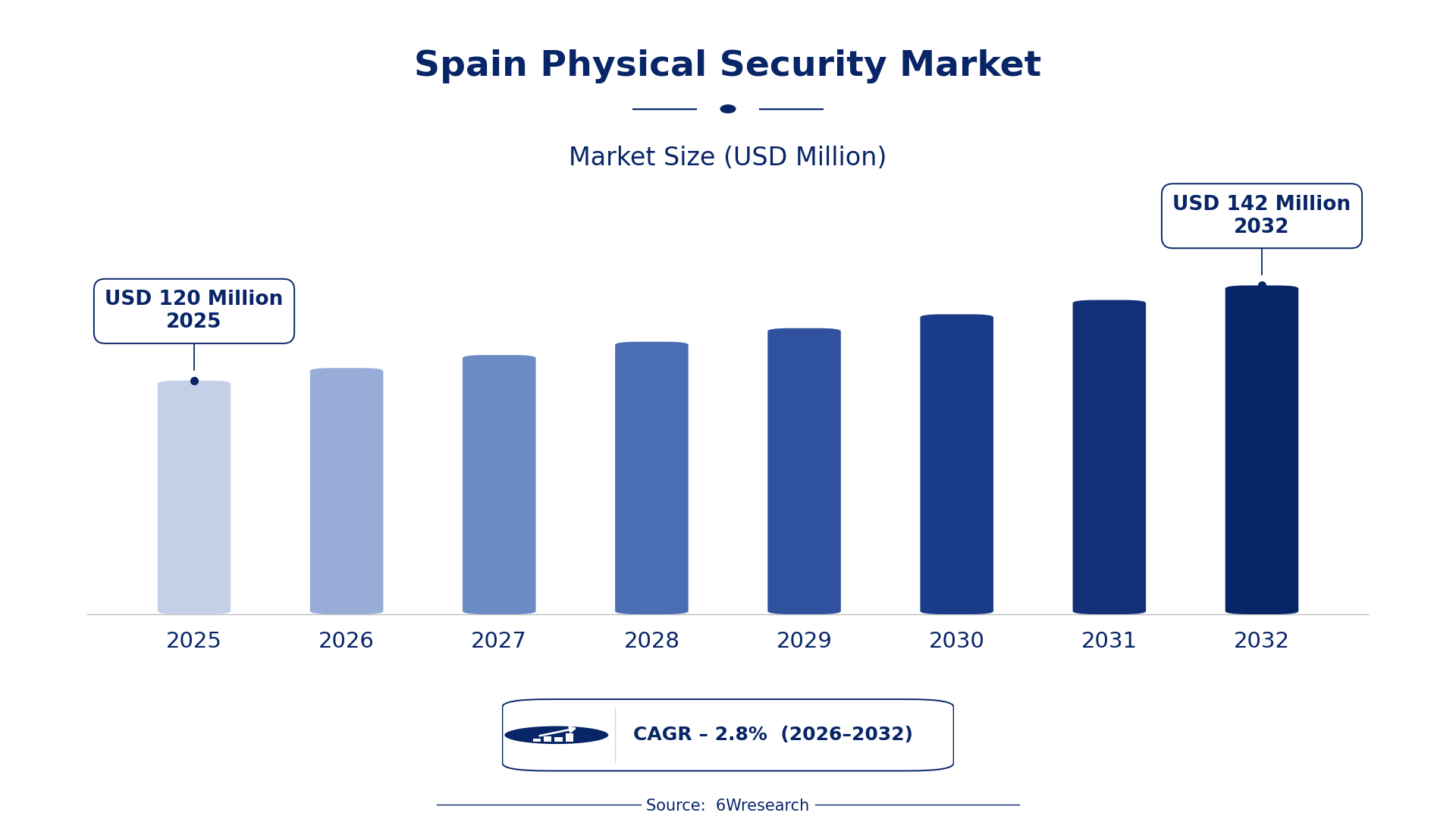
The Spain Physical Security Market was estimated at USD 120 Million in 2025 and is projected to reach USD 142 Million by 2032, growing at a CAGR of 2.8% from 2026 to 2032.
Spain Physical Security Market Synopsis
The Spain Physical Security Market is in a phase of significant evolution, as organizations increasingly prioritize safety across various sectors. With rising crime rates and potential terrorist threats, businesses and government entities are now investing heavily in advanced physical security measures. The current focus is not only on traditional security systems but also on the integration of cutting-edge technologies.
As security needs become more complex, there is a notable shift towards comprehensive solutions that integrate video surveillance, access control, and intrusion detection systems. This transformation is indicative of a broader awareness regarding the necessity of safeguarding critical infrastructure and public spaces, ultimately driving the market's growth.
Spain Physical Security Market Year-wise Growth Rate and Key Drivers
This graph illustrates the annual growth rates of the Spain Physical Security Market from 2021 to 2032, highlighting a steady upward trajectory and projected expansion over the forecast period.
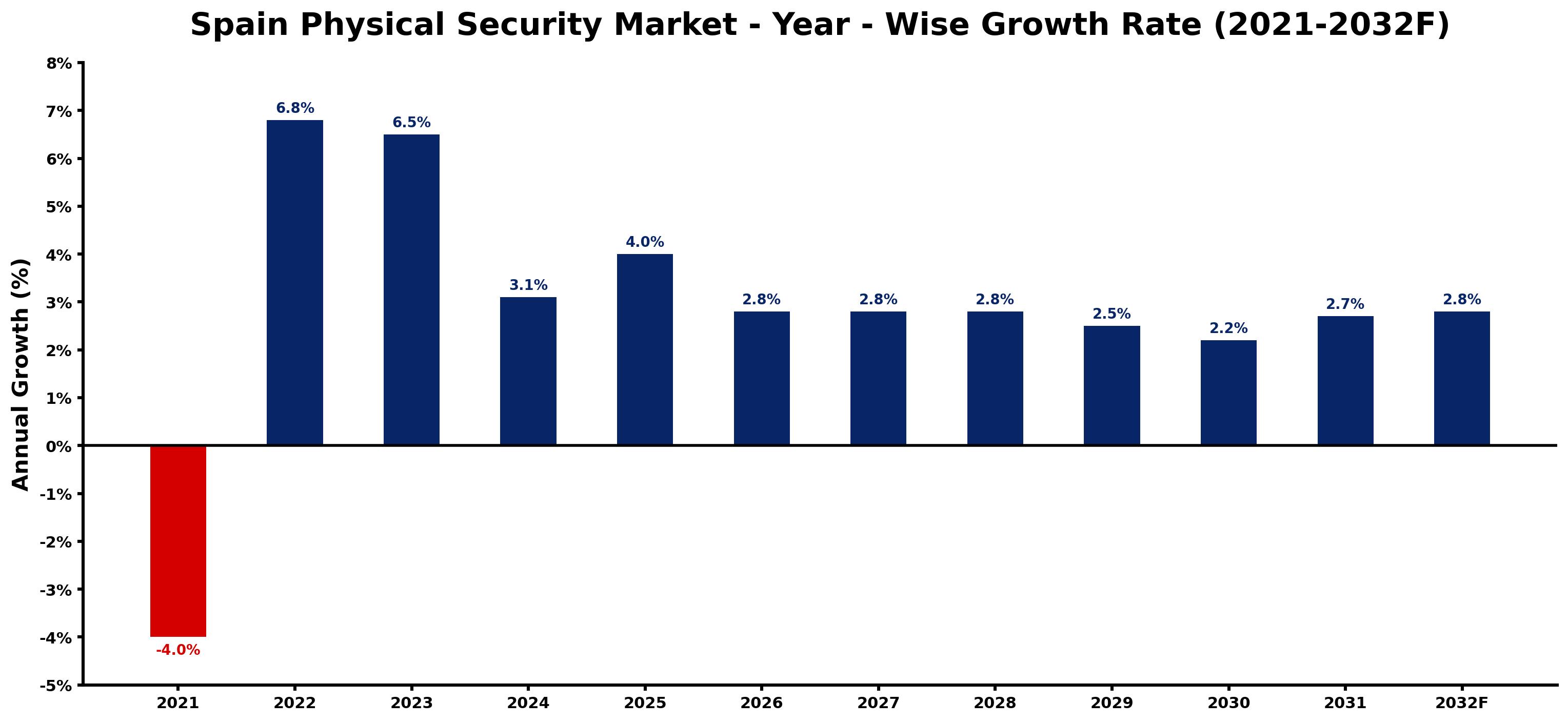
The table below presents the year‑wise growth rates along with the key drivers influencing the market
| Year | Growth Rate | Major Drivers |
| 2021 | -4.0% | Increased reliance on smart security technology disrupts traditional providers. |
| 2022 | 6.8% | Increase in government funding for public safety initiatives |
| 2023 | 6.5% | Implementation of stricter surveillance regulations by local authorities |
| 2024 | 3.1% | Heightened concerns over urban crime rates and safety |
| 2025 | 4.0% | Rising consumer interest in integrated security systems |
| 2026 | 2.8% | Growth of tourism boosting demand for venue security |
| 2027 | 2.8% | Local business investments in advanced security technologies |
| 2028 | 2.8% | Increased adoption of biometric access controls by enterprises |
| 2029 | 2.5% | Emergence of cybersecurity threats driving physical security needs |
| 2030 | 2.2% | Focus on protecting cultural heritage sites from vandalism |
| 2031 | 2.7% | Rising eco-tourism prompting enhanced site security protocols |
| 2032 | 2.8% | Demand for residential alarm systems from digital-savvy homeowners |
Note: Market size estimations and growth projections presented in this report are based on 6Wresearch's proprietary forecasting methodology, utilizing the latest available industry data, government publications, and primary research inputs.
Spain Physical Security Market Key Takeaways
Below are some of the specific key takeaways from the market, including:
- Significant growth is anticipated in the demand for integrated security solutions combining various technologies.
- Cloud-based security systems are gaining traction for their scalability and flexibility.
- Cybersecurity is increasingly becoming a vital aspect of physical security measures.
- Rising awareness of data protection regulations is influencing the adoption of compliant security technologies.
- Investment in smart city initiatives is driving demand for advanced physical security solutions.
Evaluation of Restraints in Spain Physical Security Market
Despite a growth-oriented environment, the Spain Physical Security Market grapples with notable challenges. The complexity of evolving security threats necessitates continuous upgrades in technology, which can strain budgets. Additionally, strict compliance with data protection laws demands careful navigation, often complicating security implementations. Organizations must also consider the balance between investing in high-quality solutions and managing operational costs effectively, which can limit their capacity to adapt to emerging threats.
Spain Physical Security Market Trends
The movement towards integrated security solutions is perhaps the most prominent trend in this market. As entities seek more holistic security measures, combining video surveillance, access control, and intrusion detection becomes essential. Alongside this, there's a marked rise in the adoption of artificial intelligence, which enhances threat detection capabilities, making security systems smarter and more efficient. on top of that, cloud-based solutions are becoming increasingly popular, providing organizations the flexibility they need to scale security measures without significant upfront investments.
Spain Physical Security Market Opportunities
Investment opportunities abound in the Spain Physical Security Market as the demand for advanced solutions continues to grow. The focus on video surveillance systems, along with perimeter security solutions, represents a lucrative avenue for companies. Additionally, the integration of cybersecurity measures within physical security frameworks provides a rich ground for investment. With the ongoing push towards smart city initiatives and critical infrastructure protection, partnerships with technology providers and security service firms can yield significant returns in this evolving market.
Government Initiatives in the Spain Physical Security Market
Government policies in Spain are increasingly aimed at reinforcing public safety and enhancing the security of critical infrastructure. Regulations surrounding video surveillance and access control systems are becoming stricter, emphasizing compliance with data protection laws. These initiatives are crucial as they ensure that both public and private entities maintain high standards of security while safeguarding citizen privacy.
- A recently completed initiative involved the rollout of a national cybersecurity framework to protect physical security systems from digital threats.
- Ongoing efforts include the implementation of updated guidelines for biometric security measures across government facilities.
- Upcoming regulations are set to introduce stringent compliance requirements for video surveillance systems in urban areas.
- A public-private partnership launched in 2025 aims to enhance surveillance capabilities in major transportation hubs.
- Plans are underway for a comprehensive review of access control policies to streamline their integration with existing security measures by 2026.
Future Insights of the Spain Physical Security Market
Looking ahead to 2026-2032, the Spain Physical Security Market is set for steady growth driven by increased security concerns and technological advancements. The ongoing integration of cloud-based and AI-enhanced solutions will redefine how security is managed, making it more efficient and responsive. As organizations continue to prioritize the protection of assets and individuals, the demand for integrated security frameworks will escalate, presenting opportunities for innovation and new product development.
Spain Physical Security Market Latest Developments
In recent months, the Spain Physical Security Market has seen a flurry of activity, reflecting a growing commitment to enhancing security measures across various sectors. Companies are rapidly adapting to new technologies, seeking ways to better protect critical infrastructure and address increasing security threats.
- A major technology vendor launched an upgraded video surveillance system in early 2025, featuring enhanced analytics capabilities.
- An initiative that began in mid-2025 and remains underway focuses on the integration of AI technologies into existing security frameworks for improved threat detection.
- By the end of 2025, a leading regional operator is expected to complete the installation of advanced access control systems across multiple airports.
- A rollout planned for Q2 2026 aims to expand perimeter security solutions in urban centers.
- A partnership established in late 2025 between a technology provider and a national security agency focuses on developing cybersecurity protocols for physical security systems.
Spain Physical Security Market - Key Attractiveness of the Report
- 10 Years of Market Numbers
- Historical Data Starting from 2022 to 2025
- Base Year: 2025
- Forecast Data until 2032
- Key Performance Indicators Impacting the Market
- Major Upcoming Developments and Projects
Key Highlights of the Report:
- Spain Physical Security Market Outlook
- Market Size of Spain Physical Security Market, 2025
- Forecast of Spain Physical Security Market, 2032
- Historical Data and Forecast of Spain Physical Security Revenues & Volume for the Period 2022-2032F
- Spain Physical Security Market Trend Evolution
- Spain Physical Security Market Drivers and Challenges
- Spain Physical Security Price Trends
- Spain Physical Security Porter's Five Forces
- Spain Physical Security Industry Life Cycle
- Historical Data and Forecast of Spain Physical Security Market Revenues & Volume By Component for the Period 2022-2032F
- Historical Data and Forecast of Spain Physical Security Market Revenues & Volume By Systems (PACS, PSIM, PIAM, Video Surveillance, Fire and Life Safety) for the Period 2022-2032F
- Historical Data and Forecast of Spain Physical Security Market Revenues & Volume By Services for the Period 2022-2032F
- Historical Data and Forecast of Spain Physical Security Market Revenues & Volume By Vertical for the Period 2022-2032F
- Historical Data and Forecast of Spain Physical Security Market Revenues & Volume By BFSI for the Period 2022-2032F
- Historical Data and Forecast of Spain Physical Security Market Revenues & Volume By Government for the Period 2022-2032F
- Historical Data and Forecast of Spain Physical Security Market Revenues & Volume By Retail for the Period 2022-2032F
- Historical Data and Forecast of Spain Physical Security Market Revenues & Volume By Transportation for the Period 2022-2032F
- Historical Data and Forecast of Spain Physical Security Market Revenues & Volume By Residential for the Period 2022-2032F
- Historical Data and Forecast of Spain Physical Security Market Revenues & Volume By Telecom and IT for the Period 2022-2032F
- Historical Data and Forecast of Spain Physical Security Market Revenues & Volume By Other Verticals (Healthcare, Manufacturing, Energy and Utilities, and Education). for the Period 2022-2032F
- Historical Data and Forecast of Spain Physical Security Market Revenues & Volume By Organization Size for the Period 2022-2032F
- Historical Data and Forecast of Spain Physical Security Market Revenues & Volume By SMEs for the Period 2022-2032F
- Historical Data and Forecast of Spain Physical Security Market Revenues & Volume By Large Enterprises for the Period 2022-2032F
- Spain Physical Security Import Export Trade Statistics
- Market Opportunity Assessment By Component
- Market Opportunity Assessment By Vertical
- Market Opportunity Assessment By Organization Size
- Spain Physical Security Top Companies Market Share
- Spain Physical Security Competitive Benchmarking By Technical and Operational Parameters
- Spain Physical Security Company Profiles
- Spain Physical Security Key Strategic Recommendations






































