Spain Policy Management in Telecom Market Size & Growth Rate (2026-2032)
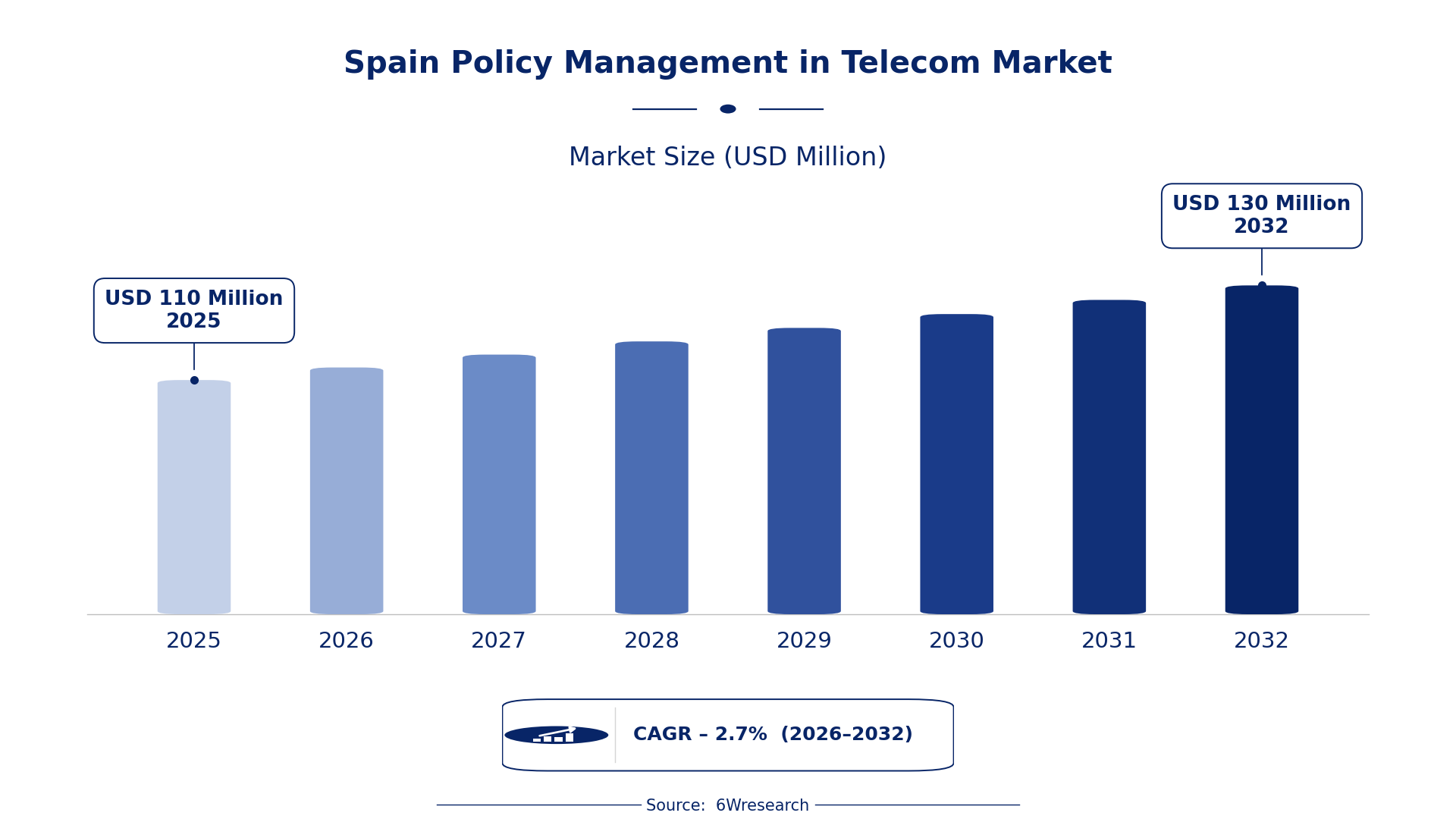
The Spain Policy Management in Telecom Market was estimated at USD 110 Million in 2025 and is projected to reach USD 130 Million by 2032, growing at a CAGR of 2.7% from 2026 to 2032.
Spain Policy Management in Telecom Market Synopsis
The primary force driving the Spain Policy Management in Telecom Market is the urgent need for telecom operators to enhance customer experience while ensuring compliance with regulatory standards. As competition heightens, service providers increasingly recognize that effective policy management solutions are crucial for optimizing service delivery.
Telecom companies are also turning to advanced policy management systems to cope with the complex demands of data management and billing accuracy. With an eye toward improving customer satisfaction and loyalty, firms in Spain are actively seeking to invest in innovative policy management solutions that can adapt to changing market needs.
Spain Policy Management in Telecom Market Year-wise Growth Rate and Key Drivers
This graph illustrates the annual growth rates of the Spain Policy Management in Telecom Market from 2021 to 2032, highlighting a steady upward trajectory and projected expansion over the forecast period.
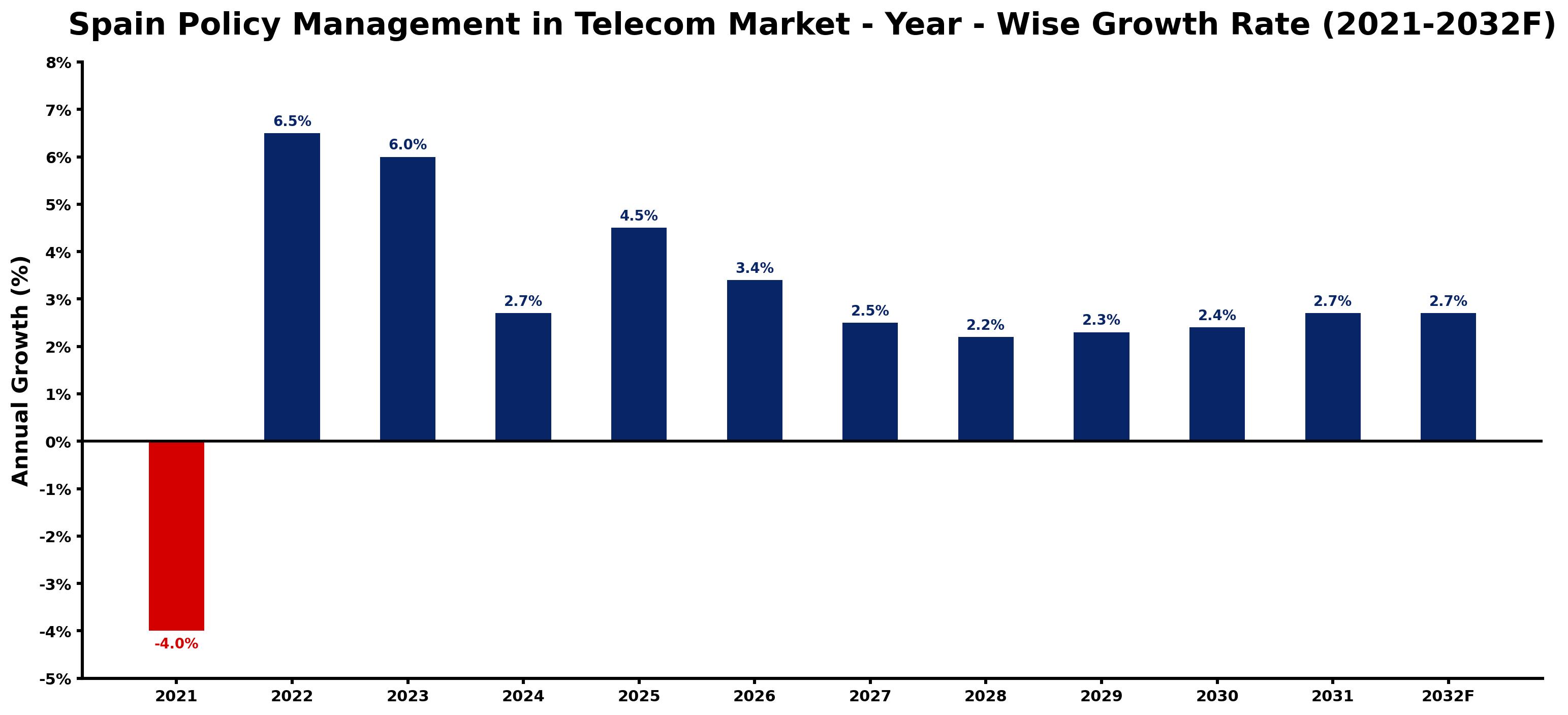
The table below presents the year‑wise growth rates along with the key drivers influencing the market
| Year | Growth Rate | Major Drivers |
| 2021 | -4.0% | Revised telecommunications regulations by CNMC deterred investments. |
| 2022 | 6.5% | Increase in 5G infrastructure rollout by telecom providers. |
| 2023 | 6.0% | Government subsidies for digital transformation in telecom sector. |
| 2024 | 2.7% | Strengthened national cybersecurity regulations impacting telecom policies. |
| 2025 | 4.5% | Growing consumer demand for improved data privacy solutions. |
| 2026 | 3.4% | Adoption of AI-driven policy management tools by operators. |
| 2027 | 2.5% | Regulatory push for enhanced mobile network security standards. |
| 2028 | 2.2% | Rising urban population demanding better telecom services. |
| 2029 | 2.3% | Increased competition fostering innovation among telecom companies. |
| 2030 | 2.4% | Emergence of new telecom startups driving policy adaptation. |
| 2031 | 2.7% | Alignment with EU digital single market initiatives underway. |
| 2032 | 2.7% | Evolving consumer preferences shaping telecom service policies. |
Note: Market size estimations and growth projections presented in this report are based on 6Wresearch's proprietary forecasting methodology, utilizing the latest available industry data, government publications, and primary research inputs.
Spain Policy Management in Telecom Market Key Takeaways
Below are some of the specific key takeaways from the market, including:
- The market is projected to grow steadily, reaching USD 130 Million by 2032.
- Increased competition among service providers is spurring demand for effective policy management solutions.
- Regulatory compliance remains a significant driving factor for market development.
- Companies are investing in advanced technologies to streamline operations and enhance customer satisfaction.
- Focus on customer loyalty will drive the adaptation of more sophisticated policy management systems.
Evaluation of Restraints in Spain Policy Management in Telecom Market
Despite the promising outlook, several factors constrain the growth of the Spain Policy Management in Telecom Market. Telecom companies are often challenged by the complexity of integrating existing systems with new policy management solutions. Furthermore, adherence to stringent regulatory frameworks necessitates substantial investment in advanced technologies, which can burden operational efficiency. The competition from traditional telecom management solutions further complicates the dynamics, forcing companies to differentiate their offerings while managing costs effectively.
Spain Policy Management in Telecom Market Trends
A noticeable trend is the shift towards data-driven decision-making in policy management. Operators are increasingly utilizing analytics to better understand customer behavior, enabling more personalized service offerings. Another emerging trend is the integration of artificial intelligence into policy management solutions, which aids in real-time data processing and improves response times for customer inquiries. Additionally, the emphasis on compliance with new regulations is driving the need for automated policy management systems that can adapt swiftly to legislative changes.
Spain Policy Management in Telecom Market Opportunities
Significant growth opportunities lie in the development of innovative policy management solutions that can seamlessly integrate with existing telecom infrastructures. Investments in customer experience enhancements, particularly through automation and AI, are crucial for operators looking to differentiate themselves. Furthermore, as digital transformation accelerates, there's a growing demand for solutions that ensure compliance with evolving regulatory frameworks, providing a fertile ground for new entrants and established players alike.
Government Initiatives in the Spain Policy Management in Telecom Market
The Spanish government plays a crucial role in shaping the telecommunications environment, directly influencing the policy management market. Regulatory frameworks are designed to promote competition and protect consumer interests, which in turn drives the demand for effective policy management solutions. The current government focus on enhancing digital infrastructure and ensuring compliance with new regulations makes this an essential time for policy management adaptations.
- A regulatory framework introduced in 2025 mandating billing transparency aims to improve consumer trust.
- A national digital infrastructure upgrade programme is currently underway to expand access and improve service quality.
- Ongoing initiatives focus on enhancing cybersecurity measures within the telecommunications sector.
- A planned public-private initiative is expected to bolster telecom infrastructure access by 2028, paving the way for improved service delivery.
Future Insights of the Spain Policy Management in Telecom Market
Looking ahead to 2026-2032, the Spain Policy Management in Telecom Market is expected to evolve in response to ongoing technological advancements and regulatory changes. Operators will likely continue investing in automated systems that offer greater operational efficiency while meeting compliance requirements. Additionally, customer-centric strategies that emphasize personalization and service quality will be at the forefront of market developments, driving operators to adopt more sophisticated policy management tools.
Spain Policy Management in Telecom Market Latest Developments
In recent months, the Spain Policy Management in Telecom Market has witnessed a wave of activity, characterized by strategic investments and new technology implementations. Telecom operators are focusing on enhancing customer experiences through innovative policy management solutions, showcasing a clear shift towards data-driven approaches.
- A major technology vendor launched a new automated policy management system in early 2025 aimed at streamlining billing processes.
- An initiative began in mid-2025 to upgrade customer service channels with AI-driven solutions, improving response times.
- Ongoing trials of a comprehensive analytics platform are set to enhance data-driven decision-making among telecom providers.
- A rollout expected to begin in the second half of 2026 will focus on implementing regulatory compliance tools across service providers.
Spain Policy Management in Telecom Market - Key Attractiveness of the Report
- 10 Years of Market Numbers
- Historical Data Starting from 2022 to 2025
- Base Year: 2025
- Forecast Data until 2032
- Key Performance Indicators Impacting the Market
- Major Upcoming Developments and Projects
Key Highlights of the Report:
- Spain Policy Management in Telecom Market Outlook
- Market Size of Spain Policy Management in Telecom Market, 2025
- Forecast of Spain Policy Management in Telecom Market, 2032
- Historical Data and Forecast of Spain Policy Management in Telecom Revenues & Volume for the Period 2022-2032F
- Spain Policy Management in Telecom Market Trend Evolution
- Spain Policy Management in Telecom Market Drivers and Challenges
- Spain Policy Management in Telecom Price Trends
- Spain Policy Management in Telecom Porter's Five Forces
- Spain Policy Management in Telecom Industry Life Cycle
- Historical Data and Forecast of Spain Policy Management in Telecom Market Revenues & Volume By Network for the Period 2022-2032F
- Historical Data and Forecast of Spain Policy Management in Telecom Market Revenues & Volume By Fixed for the Period 2022-2032F
- Historical Data and Forecast of Spain Policy Management in Telecom Market Revenues & Volume By Wireless for the Period 2022-2032F
- Historical Data and Forecast of Spain Policy Management in Telecom Market Revenues & Volume By Component for the Period 2022-2032F
- Historical Data and Forecast of Spain Policy Management in Telecom Market Revenues & Volume By Solutions for the Period 2022-2032F
- Historical Data and Forecast of Spain Policy Management in Telecom Market Revenues & Volume By Services for the Period 2022-2032F
- Historical Data and Forecast of Spain Policy Management in Telecom Market Revenues & Volume By Deployment for the Period 2022-2032F
- Historical Data and Forecast of Spain Policy Management in Telecom Market Revenues & Volume By Cloud for the Period 2022-2032F
- Historical Data and Forecast of Spain Policy Management in Telecom Market Revenues & Volume By On-Premises for the Period 2022-2032F
- Spain Policy Management in Telecom Import Export Trade Statistics
- Market Opportunity Assessment By Network
- Market Opportunity Assessment By Component
- Market Opportunity Assessment By Deployment
- Spain Policy Management in Telecom Top Companies Market Share
- Spain Policy Management in Telecom Competitive Benchmarking By Technical and Operational Parameters
- Spain Policy Management in Telecom Company Profiles
- Spain Policy Management in Telecom Key Strategic Recommendations






































