Spain Predictive Maintenance Market Size & Growth Rate (2026-2032)
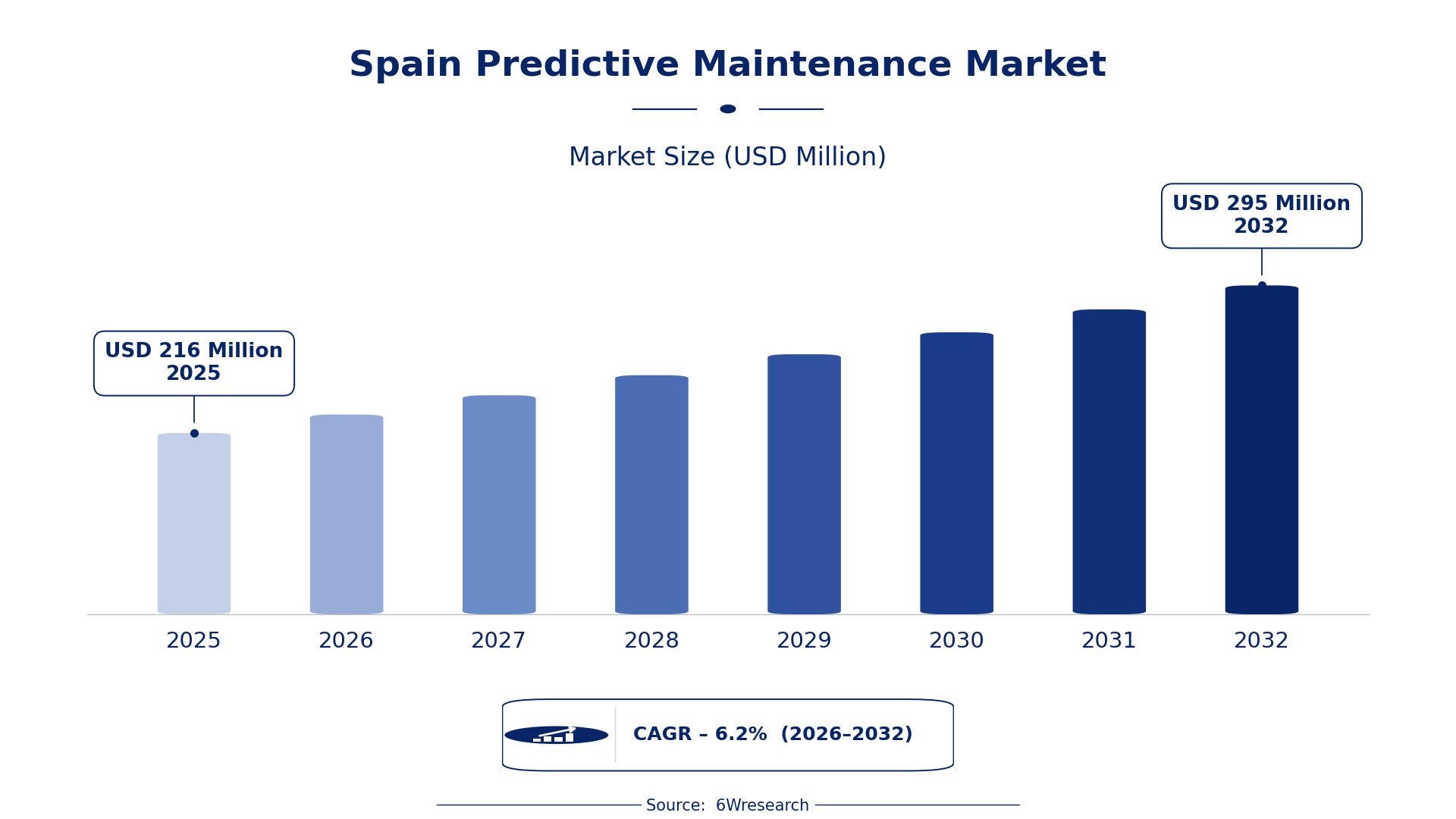
The Spain Predictive Maintenance Market was estimated at USD 216 Million in 2025 and is projected to reach USD 295 Million by 2032, growing at a CAGR of 6.2% from 2026 to 2032.
Spain Predictive Maintenance Market Synopsis
The Spain Predictive Maintenance Market is witnessing a notable surge as industries increasingly adopt innovative technologies. The demand for predictive maintenance is being propelled by the need to enhance operational efficiencies, minimize downtime, and optimize maintenance schedules across sectors like manufacturing, energy, and transportation.
Companies are investing heavily in predictive maintenance solutions that utilize advanced analytics, IoT, and AI to facilitate proactive strategies. This shift not only improves asset reliability but also significantly reduces maintenance costs, positioning predictive maintenance as a critical component in Spain's industrial transformation.
Spain Predictive Maintenance Market Year-wise Growth Rate and Key Drivers
This graph illustrates the annual growth rates of the Spain Predictive Maintenance Market from 2021 to 2032, highlighting a steady upward trajectory and projected expansion over the forecast period.
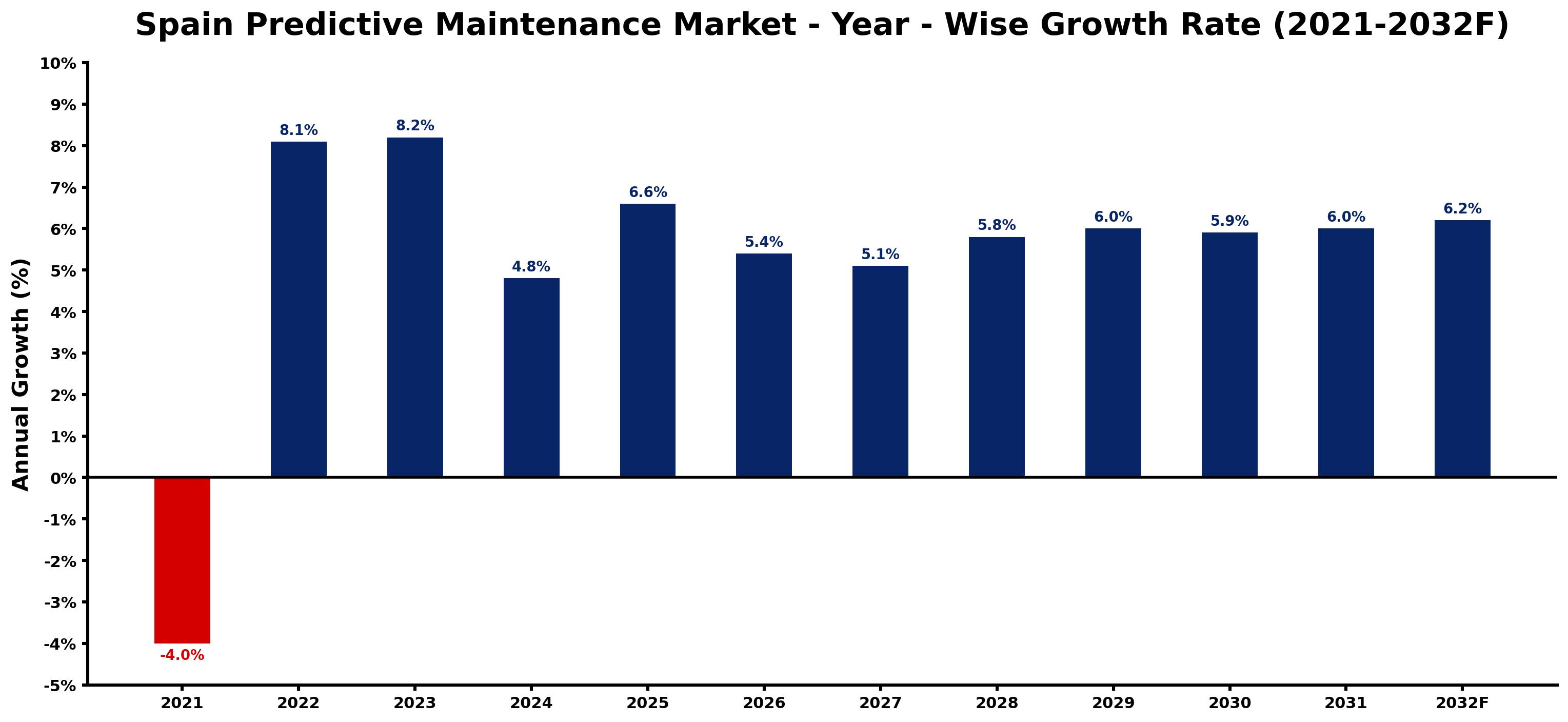
The table below presents the year‑wise growth rates along with the key drivers influencing the market
| Year | Growth Rate | Major Drivers |
| 2021 | -4.0% | Delayed industrial investment due to Covid-19 uncertainty. |
| 2022 | 8.1% | Increased EU funding for Industry 4.0 initiatives |
| 2023 | 8.2% | Growth of SMEs adopting predictive analytics tools |
| 2024 | 4.8% | Spanish government promoting digital transformation in manufacturing |
| 2025 | 6.6% | Investment in IoT technology for predictive maintenance solutions |
| 2026 | 5.4% | Automotive sector's shift towards data-driven maintenance strategies |
| 2027 | 5.1% | Rising focus on cost reduction in industrial operations |
| 2028 | 5.8% | Enhanced cybersecurity regulations encouraging data reliability |
| 2029 | 6.0% | Post-pandemic recovery boosting operational efficiency interest |
| 2030 | 5.9% | Development of localized software solutions for maintenance needs |
| 2031 | 6.0% | Emergence of industry partnerships enhancing technology accessibility |
| 2032 | 6.2% | Increased training programs for predictive maintenance expertise |
Note: Market size estimations and growth projections presented in this report are based on 6Wresearch's proprietary forecasting methodology, utilizing the latest available industry data, government publications, and primary research inputs.
Spain Predictive Maintenance Market Key Takeaways
Below are some of the specific key takeaways from the market, including:
- The market is increasingly driven by the adoption of Industry 4.0 technologies.
- Investment in predictive maintenance software and services is on the rise.
- Cloud-based platforms and condition monitoring techniques are gaining traction.
- Government initiatives are fostering digital transformation across sectors.
- Companies are seeking tailored solutions for specific industry needs.
Evaluation of Restraints in Spain Predictive Maintenance Market
Despite the growth potential, the Spain Predictive Maintenance Market faces several real challenges. The initial investment required for advanced technologies and data analytics tools can be substantial, creating a barrier for many companies, particularly SMEs. on top of that, integrating these modern solutions with legacy systems often complicates implementation. A skilled labor shortage in predictive maintenance techniques exacerbates these issues, making it difficult for organizations to effectively deploy and manage such programs. Additionally, concerns around data security and privacy continue to loom large, as businesses must balance leveraging operational data while protecting sensitive information.
Spain Predictive Maintenance Market Trends
Several key trends are shaping the Spain Predictive Maintenance Market. The transition towards cloud-based predictive maintenance platforms is notable, enabling real-time data access and analytics. Additionally, condition-based monitoring techniques are increasingly being adopted, allowing companies to monitor equipment health dynamically. The focus on extending the lifespan of machinery and enhancing overall equipment efficiency is driving demand for tailored predictive maintenance solutions. As industries embrace digital transformation, the convergence of IoT, AI, and advanced analytics is expected to redefine maintenance strategies in the coming years.
Spain Predictive Maintenance Market Opportunities
The market presents a wealth of investment opportunities. With the ongoing adoption of Industry 4.0 technologies, there is a growing need for advanced predictive maintenance solutions, particularly in the manufacturing sector. Companies looking to innovate can explore developing specialized software, sensor technologies, and IoT devices designed for the Spanish market. on top of that, the demand for consulting services and training programs to facilitate the effective implementation of predictive maintenance strategies offers another avenue for growth. Collaborations and strategic partnerships will also be vital for companies looking to capture a share of this expanding market segment.
Government Initiatives in the Spain Predictive Maintenance Market
The Spanish government is actively promoting the adoption of predictive maintenance technologies as part of its broader strategy to enhance industrial efficiency. Public policy initiatives focus on incentivizing companies to invest in these technologies, funding research and development, and fostering awareness of predictive maintenance benefits. By establishing standards and regulations, the government aims to facilitate widespread adoption and improve asset management across industries.
- A recently completed initiative provided funding for R&D projects aimed at developing predictive maintenance solutions tailored for the energy sector.
- A current program is underway to offer financial incentives for companies adopting predictive maintenance technologies, improving operational efficiencies.
- Upcoming regulations are expected to mandate transparency in predictive maintenance practices, ensuring quality and reliability in services.
- A planned public-private partnership is set to launch in 2026, focusing on advancing digital infrastructure for predictive maintenance systems.
- Ongoing awareness campaigns are educating businesses about the financial and operational benefits of predictive maintenance.
Future Insights of the Spain Predictive Maintenance Market
Looking ahead to 2026-2032, the Spain Predictive Maintenance Market is on track for substantial growth driven by technological advancements and the urgent need for operational efficiencies. The shift from reactive to predictive maintenance strategies will become increasingly evident as more organizations recognize the long-term benefits. This evolution will be fueled by ongoing digital transformation initiatives and a growing emphasis on sustainability, making predictive maintenance an integral part of Spain's industrial future.
Spain Predictive Maintenance Market Latest Developments
In the past year, the Spain Predictive Maintenance Market has seen a flurry of activity aimed at enhancing technological capabilities and expanding service offerings. Companies are stepping up their investments in R&D to develop innovative solutions tailored to the specific needs of various sectors.
- A major technology vendor launched a new predictive maintenance software platform in Q1 2025, designed to integrate seamlessly with existing industrial systems.
- An ongoing initiative, started in mid-2025, focuses on implementing IoT sensors across manufacturing plants to gather real-time data for predictive analytics.
- In early 2025, a consortium of industry leaders announced a partnership to develop advanced predictive maintenance algorithms utilizing AI and machine learning.
- A rollout expected to begin in late 2025 aims to enhance training programs for professionals in predictive maintenance, addressing the skills gap in the industry.
- Plans are underway for a new cloud-based predictive maintenance solution to be introduced in Q3 2026, catering specifically to the transportation sector.
Spain Predictive Maintenance Market - Key Attractiveness of the Report
- 10 Years of Market Numbers
- Historical Data Starting from 2022 to 2025
- Base Year: 2025
- Forecast Data until 2032
- Key Performance Indicators Impacting the Market
- Major Upcoming Developments and Projects
The Spanish government is implementing various initiatives, including funding for R&D and financial incentives for companies adopting predictive maintenance technologies, aimed at promoting efficiency and reducing operational costs.
Key Highlights of the Report:
- Spain Predictive Maintenance Market Outlook
- Market Size of Spain Predictive Maintenance Market, 2025
- Forecast of Spain Predictive Maintenance Market, 2032
- Historical Data and Forecast of Spain Predictive Maintenance Revenues & Volume for the Period 2022-2032F
- Spain Predictive Maintenance Market Trend Evolution
- Spain Predictive Maintenance Market Drivers and Challenges
- Spain Predictive Maintenance Price Trends
- Spain Predictive Maintenance Porter's Five Forces
- Spain Predictive Maintenance Industry Life Cycle
- Historical Data and Forecast of Spain Predictive Maintenance Market Revenues & Volume By Component for the Period 2022-2032F
- Historical Data and Forecast of Spain Predictive Maintenance Market Revenues & Volume By Solutions for the Period 2022-2032F
- Historical Data and Forecast of Spain Predictive Maintenance Market Revenues & Volume By Services for the Period 2022-2032F
- Historical Data and Forecast of Spain Predictive Maintenance Market Revenues & Volume By Organization Size for the Period 2022-2032F
- Historical Data and Forecast of Spain Predictive Maintenance Market Revenues & Volume By Large Enterprises for the Period 2022-2032F
- Historical Data and Forecast of Spain Predictive Maintenance Market Revenues & Volume By SME for the Period 2022-2032F
- Historical Data and Forecast of Spain Predictive Maintenance Market Revenues & Volume By Deployment Mode for the Period 2022-2032F
- Historical Data and Forecast of Spain Predictive Maintenance Market Revenues & Volume By On-premises for the Period 2022-2032F
- Historical Data and Forecast of Spain Predictive Maintenance Market Revenues & Volume By Cloud for the Period 2022-2032F
- Historical Data and Forecast of Spain Predictive Maintenance Market Revenues & Volume By Vertical for the Period 2022-2032F
- Historical Data and Forecast of Spain Predictive Maintenance Market Revenues & Volume By Government and Defense for the Period 2022-2032F
- Historical Data and Forecast of Spain Predictive Maintenance Market Revenues & Volume By Manufacturing for the Period 2022-2032F
- Historical Data and Forecast of Spain Predictive Maintenance Market Revenues & Volume By Energy and Utilities for the Period 2022-2032F
- Historical Data and Forecast of Spain Predictive Maintenance Market Revenues & Volume By Transportation and Logistics for the Period 2022-2032F
- Historical Data and Forecast of Spain Predictive Maintenance Market Revenues & Volume By Healthcare and Life Sciences for the Period 2022-2032F
- Spain Predictive Maintenance Import Export Trade Statistics
- Market Opportunity Assessment By Component
- Market Opportunity Assessment By Organization Size
- Market Opportunity Assessment By Deployment Mode
- Market Opportunity Assessment By Vertical
- Spain Predictive Maintenance Top Companies Market Share
- Spain Predictive Maintenance Competitive Benchmarking By Technical and Operational Parameters
- Spain Predictive Maintenance Company Profiles
- Spain Predictive Maintenance Key Strategic Recommendations






































