Spain RegTech Market Size & Growth Rate (2026-2032)
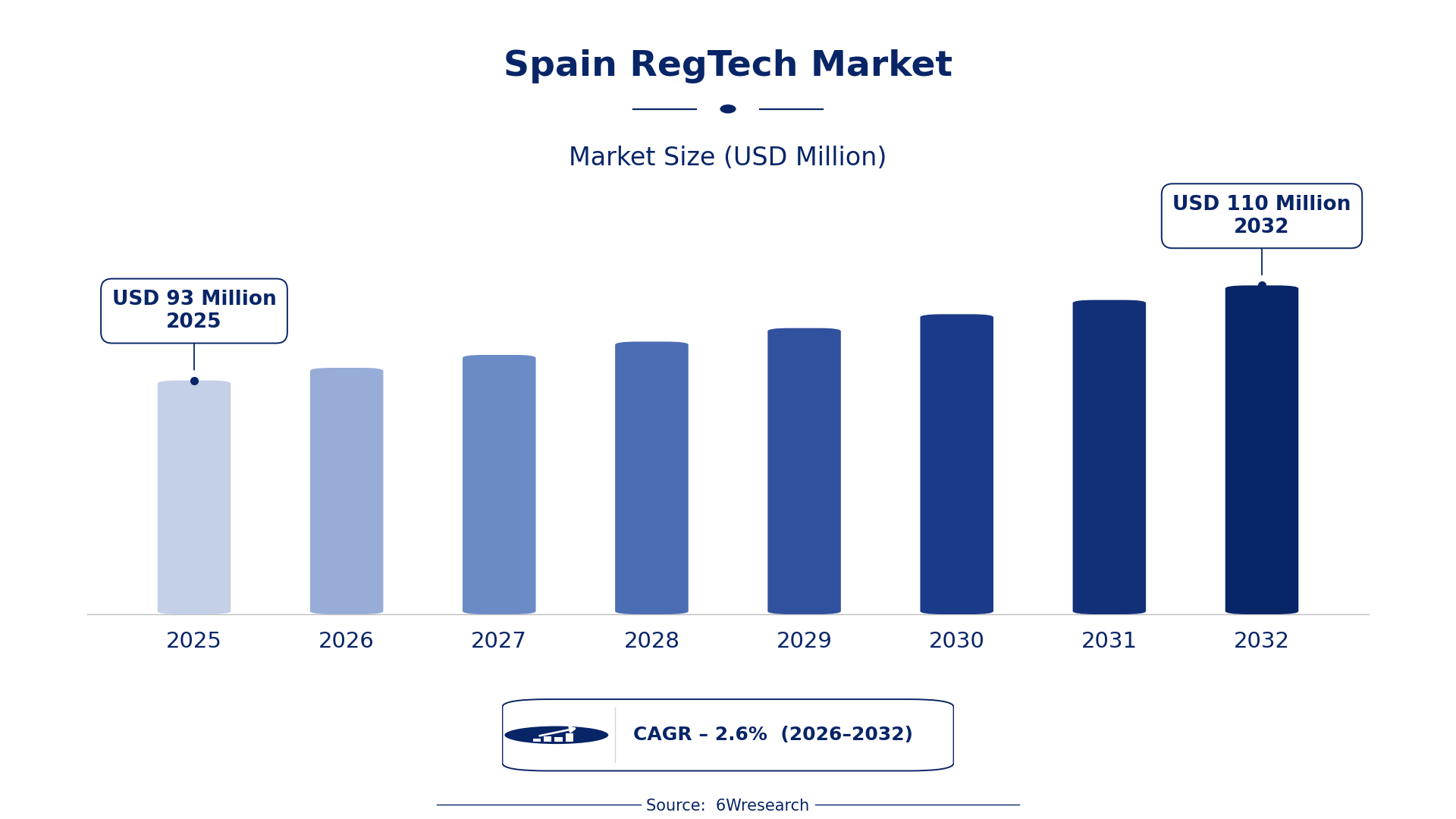
The Spain RegTech Market was estimated at USD 93 Million in 2025 and is projected to reach USD 110 Million by 2032, growing at a CAGR of 2.6% from 2026 to 2032.
Spain RegTech Market Synopsis
The growing complexity of regulatory requirements is the strongest force shaping the Spain RegTech market today. Financial institutions in Spain are increasingly turning to RegTech solutions to enhance compliance, improve risk management, and minimize costs.
As organizations face mounting pressures to comply with evolving regulations, the demand for innovative technologies is escalating. This trend is driving the adoption of solutions ranging from identity verification to anti-money laundering tools, ensuring that Spanish firms remain competitive and compliant.
Spain RegTech Market Year-wise Growth Rate and Key Drivers
This graph illustrates the annual growth rates of the Spain RegTech Market from 2021 to 2032, highlighting a steady upward trajectory and projected expansion over the forecast period.
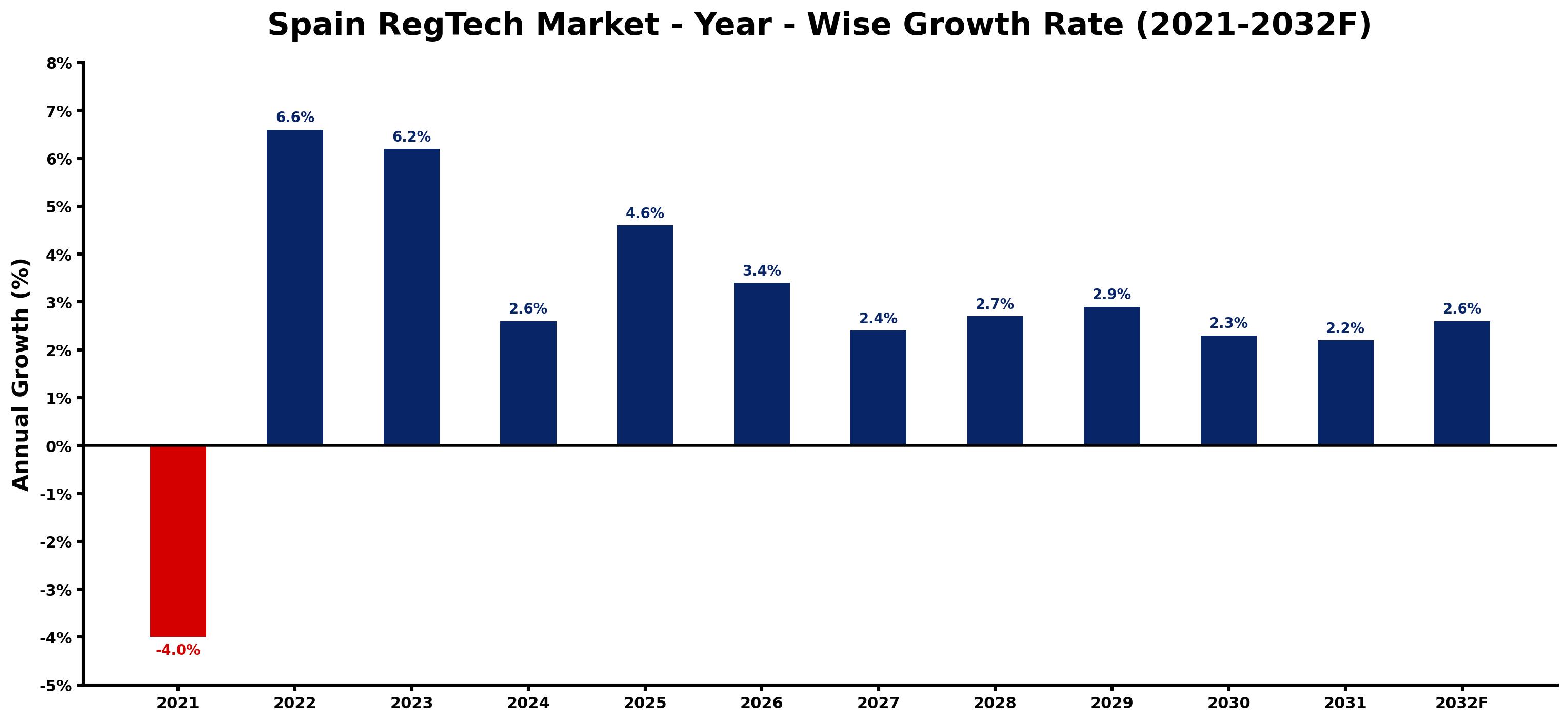
The table below presents the year‑wise growth rates along with the key drivers influencing the market
| Year | Growth Rate | Major Drivers |
| 2021 | -4.0% | Periodic delays in compliance updates by CNMV |
| 2022 | 6.6% | Implementation of PSD2 fostering innovation in financial services. |
| 2023 | 6.2% | Increased KYC regulations enhancing compliance technology demand. |
| 2024 | 2.6% | Enhanced cybersecurity laws driving adoption of RegTech solutions. |
| 2025 | 4.6% | EU sustainable finance initiatives promoting transparency tools. |
| 2026 | 3.4% | Rise in fintech startups requiring regulatory compliance support. |
| 2027 | 2.4% | Government support for digital asset regulation initiatives. |
| 2028 | 2.7% | Local demand for data protection compliance solutions. |
| 2029 | 2.9% | Adoption of AI technologies in financial supervision processes. |
| 2030 | 2.3% | Focus on anti-money laundering regulations boosting technology needs. |
| 2031 | 2.2% | Spanish digitalization strategy encouraging compliance automation. |
| 2032 | 2.6% | Increased risk management requirements in financial institutions. |
Note: Market size estimations and growth projections presented in this report are based on 6Wresearch's proprietary forecasting methodology, utilizing the latest available industry data, government publications, and primary research inputs.
Spain RegTech Market Key Takeaways
Below are some of the specific key takeaways from the market, including:
- The market is currently driven by stringent regulatory requirements in the financial sector.
- Advanced technologies such as AI and machine learning are becoming integral to compliance solutions.
- Cloud-based solutions are gaining traction for their scalability and cost-effectiveness.
- Data privacy and cybersecurity concerns are prompting increased investments in RegTech.
- Organizations are leaning towards integrated platforms for comprehensive compliance management.
Evaluation of Restraints in Spain RegTech Market
The Spain RegTech market faces real constraints primarily due to the intricate and shifting regulatory landscape. As regulations evolve, RegTech solutions must continuously adapt to meet compliance standards, which can be a resource-intensive endeavor. on top of that, different industries in Spain often operate under diverse regulatory frameworks, complicating the development of universal solutions. Collaboration between regulators, financial institutions, and RegTech providers remains a challenge, hampering the effective implementation of these technologies. Additionally, data security and privacy issues are top concerns as companies manage sensitive information, necessitating robust security measures that can add to operational complexity.
Spain RegTech Market Trends
Recent trends indicate a significant shift towards automation in compliance processes, driven by the adoption of AI and machine learning technologies. Organizations are increasingly investing in cloud-based solutions that offer flexibility and cost savings, enhancing the scalability of compliance operations. There’s also a noticeable focus on integrated RegTech platforms that address multiple compliance needs in a cohesive manner. As data privacy regulations tighten, firms are prioritizing cybersecurity measures to safeguard sensitive information against breaches.
Spain RegTech Market Opportunities
The Spain RegTech market presents numerous avenues for growth and investment. Companies that specialize in anti-money laundering (AML) and know your customer (KYC) processes are well-positioned to capitalize on the increasing demand for compliance solutions. The push for digital transformation by the Spanish government further enhances market opportunities, encouraging firms to adopt innovative technologies. Investment in data privacy solutions and cybersecurity measures also holds potential, as organizations seek to navigate regulatory challenges effectively.
Government Initiatives in the Spain RegTech Market
Government policy in Spain is actively shaping the RegTech market, focusing on enhancing regulatory compliance and fostering innovation. The Spanish government is committed to supporting digital transformation initiatives that streamline compliance processes, thereby reducing burdens on financial institutions. This regulatory posture is crucial as it encourages the adoption of advanced technologies within the sector.
- A national initiative launched in 2025 aimed to promote the adoption of RegTech solutions across various financial services.
- Currently ongoing is a program to develop a centralized compliance platform intended to standardize reporting and oversight in the financial sector.
- Planned for 2027 is a regulatory framework designed to integrate emerging technologies like blockchain into compliance processes.
- Recent updates to the General Data Protection Regulation (GDPR) guidelines have reinforced data protection measures for RegTech solutions.
- A public-private partnership initiated in early 2026 seeks to enhance collaboration between regulators and technology providers.
Future Insights of the Spain RegTech Market
Looking ahead to 2026-2032, the Spain RegTech market is set for substantial growth as businesses increasingly invest in technologies that facilitate regulatory compliance. The ongoing rise in regulations across various sectors will drive demand for solutions that provide automation and analytics capabilities. Anticipate an increase in partnerships between RegTech firms and financial institutions, as both parties recognize the value of collaboration in meeting compliance challenges. Advancements in AI, machine learning, and blockchain technologies will continue to spur innovation, enabling firms to adapt proactively to changing regulatory requirements.
Spain RegTech Market Latest Developments
Recent developments in the Spain RegTech market reflect a vigorous push toward innovation and enhanced compliance solutions. Over the past year, organizations have made strides in adopting new technologies that bolster their regulatory frameworks and improve operational efficiencies.
- A major technology vendor completed the rollout of a new AML compliance tool in Q2 2025, enhancing detection and reporting capabilities for financial institutions.
- An ongoing initiative that began in early 2025 aims to integrate AI-driven analytics into existing compliance systems to streamline processes.
- A leading regional operator is expected to launch a comprehensive RegTech platform by mid-2026, targeting multiple compliance functions.
- A collaboration initiated in late 2025 between a prominent financial institution and a RegTech startup focuses on developing identity verification solutions to enhance customer onboarding.
- A planned upgrade of the national regulatory reporting framework is set to begin in late 2026, aiming to improve efficiency and accuracy in compliance submissions.
Spain RegTech Market - Key Attractiveness of the Report
- 10 Years of Market Numbers
- Historical Data Starting from 2022 to 2025
- Base Year: 2025
- Forecast Data until 2032
- Key Performance Indicators Impacting the Market
- Major Upcoming Developments and Projects
Key Highlights of the Report:
- Spain RegTech Market Outlook
- Market Size of Spain RegTech Market, 2025
- Forecast of Spain RegTech Market, 2032
- Historical Data and Forecast of Spain RegTech Revenues & Volume for the Period 2022-2032F
- Spain RegTech Market Trend Evolution
- Spain RegTech Market Drivers and Challenges
- Spain RegTech Price Trends
- Spain RegTech Porter's Five Forces
- Spain RegTech Industry Life Cycle
- Historical Data and Forecast of Spain RegTech Market Revenues & Volume By Component for the Period 2022-2032F
- Historical Data and Forecast of Spain RegTech Market Revenues & Volume By Solutions for the Period 2022-2032F
- Historical Data and Forecast of Spain RegTech Market Revenues & Volume By Services for the Period 2022-2032F
- Historical Data and Forecast of Spain RegTech Market Revenues & Volume By Application for the Period 2022-2032F
- Historical Data and Forecast of Spain RegTech Market Revenues & Volume By Risk & Compliance Management for the Period 2022-2032F
- Historical Data and Forecast of Spain RegTech Market Revenues & Volume By Identity Management for the Period 2022-2032F
- Historical Data and Forecast of Spain RegTech Market Revenues & Volume By Regulatory Reporting for the Period 2022-2032F
- Historical Data and Forecast of Spain RegTech Market Revenues & Volume By AML and Fraud Management for the Period 2022-2032F
- Historical Data and Forecast of Spain RegTech Market Revenues & Volume By Regulatory Intelligence for the Period 2022-2032F
- Historical Data and Forecast of Spain RegTech Market Revenues & Volume By Organization Size for the Period 2022-2032F
- Historical Data and Forecast of Spain RegTech Market Revenues & Volume By SMEs for the Period 2022-2032F
- Historical Data and Forecast of Spain RegTech Market Revenues & Volume By Large Enterprises for the Period 2022-2032F
- Historical Data and Forecast of Spain RegTech Market Revenues & Volume By Deployment Mode for the Period 2022-2032F
- Historical Data and Forecast of Spain RegTech Market Revenues & Volume By On-Premises for the Period 2022-2032F
- Historical Data and Forecast of Spain RegTech Market Revenues & Volume By Cloud for the Period 2022-2032F
- Historical Data and Forecast of Spain RegTech Market Revenues & Volume By Vertical for the Period 2022-2032F
- Historical Data and Forecast of Spain RegTech Market Revenues & Volume By Banking for the Period 2022-2032F
- Historical Data and Forecast of Spain RegTech Market Revenues & Volume By Insurance for the Period 2022-2032F
- Historical Data and Forecast of Spain RegTech Market Revenues & Volume By Non-Financial for the Period 2022-2032F
- Spain RegTech Import Export Trade Statistics
- Market Opportunity Assessment By Component
- Market Opportunity Assessment By Application
- Market Opportunity Assessment By Organization Size
- Market Opportunity Assessment By Deployment Mode
- Market Opportunity Assessment By Vertical
- Spain RegTech Top Companies Market Share
- Spain RegTech Competitive Benchmarking By Technical and Operational Parameters
- Spain RegTech Company Profiles
- Spain RegTech Key Strategic Recommendations






































