Spain Retail And Wholesale Market Size, Share & Growth Rate
The Spain Retail And Wholesale Market was estimated at USD 428 Million in 2025 and is projected to reach USD 582 Million by 2032, growing at a CAGR of 4.5% from 2026 to 2032. This upward trajectory is driven by rising disposable incomes, changing consumer preferences towards online shopping, and a growing demand for quality products. As e-commerce continues to evolve, it is reshaping traditional retail dynamics and enhancing consumer engagement across various platforms.
Spain Retail And Wholesale Market Year-wise Growth Rate and Key Drivers
This graph highlights how the Spain Retail And Wholesale Market has steadily grown over the years, supported by major growth factors.
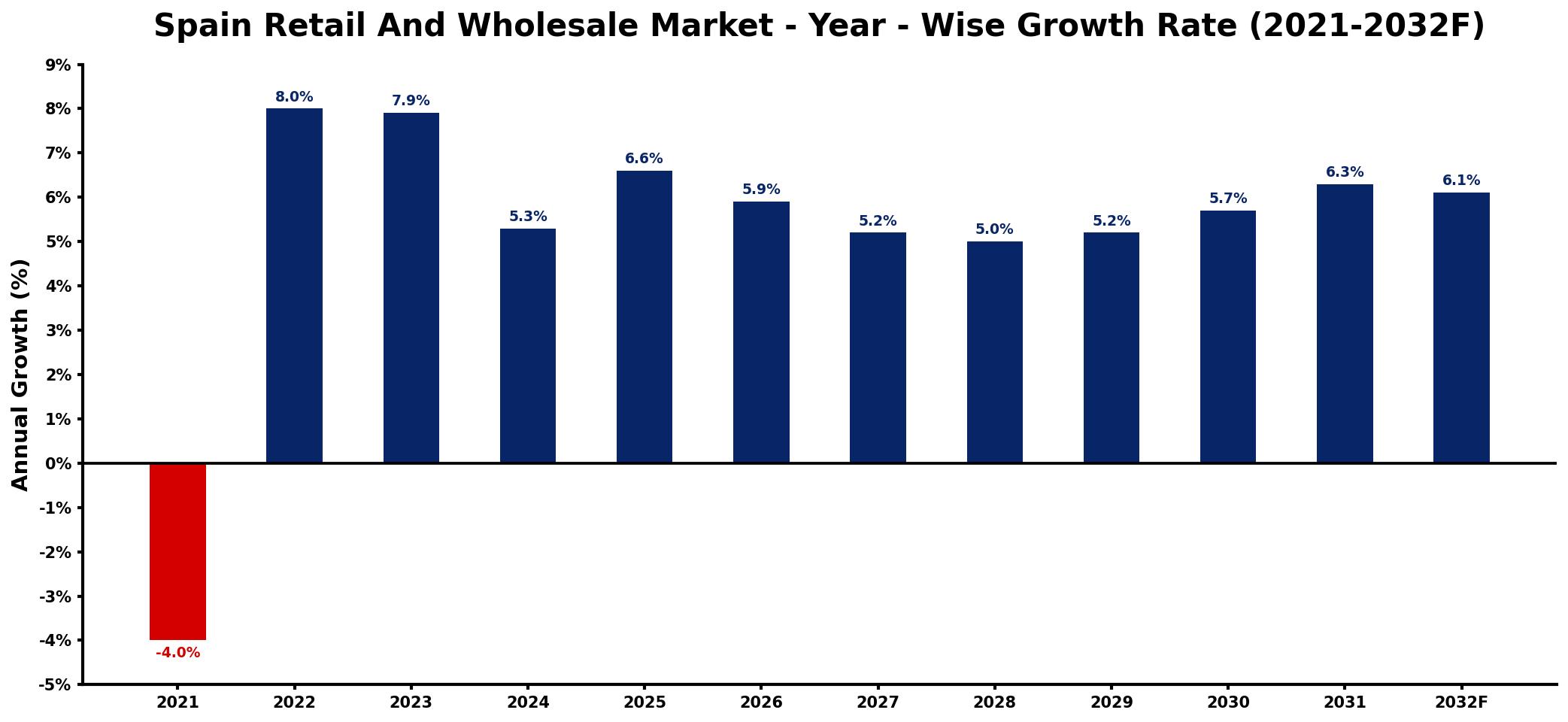
The table below presents the year‑wise growth rates along with the key drivers influencing the market
| Year | Growth Rate | Major Drivers |
| 2021 | -4.0% | decreased consumer spending patterns |
| 2022 | 8.0% | increased online shopping adoption |
| 2023 | 7.9% | rising disposable income levels |
| 2024 | 5.3% | expansion of e-commerce platforms |
| 2025 | 6.6% | growth in sustainable products |
| 2026 | 5.9% | enhanced customer experience initiatives |
| 2027 | 5.2% | investment in supply chain technology |
| 2028 | 5.0% | increase in urban population density |
| 2029 | 5.2% | growing demand for personalized services |
| 2030 | 5.7% | increased capital investment inflows |
| 2031 | 6.3% | rising interest in local sourcing |
| 2032 | 6.1% | enhanced digital marketing strategies |
Note: Market size estimations and growth projections presented in this report are based on 6Wresearch's proprietary forecasting methodology, utilizing the latest available industry data, government publications, and primary research inputs.
Spain Retail And Wholesale Market Synopsis
The primary force shaping the Spain Retail And Wholesale Market today is the rapid advancement of digitalization, which is compelling retailers to enhance their online presence and improve customer experience. Consumers increasingly prefer the convenience of online shopping, prompting businesses to adopt omnichannel strategies that seamlessly blend digital and physical shopping experiences.
Additionally, the Spanish retail landscape is marked by a significant emphasis on sustainability. As consumers demonstrate a growing preference for eco-friendly products and transparent supply chains, retailers are responding by incorporating ethical practices into their operations. This shift not only aligns with consumer values but also positions businesses to meet emerging market demands.
Spain Retail And Wholesale Market Key Takeaways
- The market is expected to witness a steady growth rate, reaching USD 582 Million by 2032.
- Digital transformation and the rise of e-commerce are redefining consumer purchasing habits.
- Sustainability is increasingly influencing product offerings and business practices in the sector.
- Omnichannel retailing is becoming essential for businesses to thrive in a competitive environment.
- Investment opportunities exist across various sectors, including fashion and eco-friendly products.
Evaluation of Restraints in Spain Retail And Wholesale Market
Despite its promising growth, the Spain Retail And Wholesale Market faces several limitations that could inhibit expansion. Intense competition exists both from established brick-and-mortar entities and from agile e-commerce platforms, making market penetration challenging for new entrants. Additionally, fluctuating economic conditions and shifts in consumer spending patterns complicate inventory management and pricing strategies for retailers. The need to adhere to strict regulatory frameworks and evolving consumer expectations around sustainability further complicates operational dynamics, necessitating adaptability and innovation.
Spain Retail And Wholesale Market Trends
Key trends currently shaping the Spain Retail And Wholesale Market include an accelerated shift towards e-commerce, emphasizing the importance of a robust digital presence. Businesses are investing in technology to enhance online shopping experiences, employing data analytics and artificial intelligence for personalized customer engagement. The omnichannel approach is now vital, as consumers seek seamless interactions between physical stores and online platforms. Additionally, the increasing demand for sustainable products is prompting companies to revamp their supply chains for better transparency and eco-friendliness.
Spain Retail And Wholesale Market Opportunities
The market presents various opportunities for investment, particularly in sectors that align with evolving consumer preferences. The growing trend of eco-conscious consumption opens avenues for retailers focused on sustainable products. Furthermore, the expansion of e-commerce offers significant potential for investment in online retail platforms and logistics services. With Spain's robust tourism sector, there is also room for retail ventures catering specifically to international travelers seeking unique products.
Government Initiatives in the Spain Retail And Wholesale Market
Government policies in Spain play a crucial role in regulating the retail and wholesale market to ensure fair competition and consumer protection. The Retail Trade Act establishes fundamental rules governing the operation of retail businesses, including opening hours and sales practices. The General Law for the Defense of Consumers and Users safeguards consumer rights, emphasizing transparency and fairness in transactions. Additionally, tax policies affecting VAT rates and corporate taxation have a direct impact on retail operations, further shaping the business landscape.
Future Insights of the Spain Retail And Wholesale Market
Looking ahead to 2026-2032, the future of the Spain Retail And Wholesale Market appears optimistic. The combination of rising disposable incomes, population growth, and the ongoing digital shift is expected to propel market expansion. Businesses that leverage advanced technologies for enhanced consumer experiences and invest in sustainable practices will likely find themselves ahead of the curve. Nonetheless, adaptability to changing regulations and consumer preferences will be essential for long-term success in this dynamic market.
Spain Retail And Wholesale Market Latest Developments (2025 - 2026)
Recent developments in the Spain Retail And Wholesale Market indicate a heightened focus on digital transformation and sustainability initiatives. Companies are increasingly prioritizing contactless payment solutions and integrating advanced analytics to cater to consumer preferences effectively. Furthermore, the emphasis on enhancing omnichannel retail experiences has gained traction, with many retailers investing in technology to better connect their online and offline offerings.
Spain Retail And Wholesale Market - Key Attractiveness of the Report
- 10 Years of Market Numbers
- Historical Data Starting from 2022 to 2025
- Base Year: 2025
- Forecast Data until 2032
- Key Performance Indicators Impacting the Market
- Major Upcoming Developments and Projects
Key Highlights of the Report:
- Spain Retail And Wholesale Market Outlook
- Market Size of Spain Retail And Wholesale Market, 2025
- Forecast of Spain Retail And Wholesale Market, 2032
- Historical Data and Forecast of Spain Retail And Wholesale Revenues & Volume for the Period 2022-2032F
- Spain Retail And Wholesale Market Trend Evolution
- Spain Retail And Wholesale Market Drivers and Challenges
- Spain Retail And Wholesale Price Trends
- Spain Retail And Wholesale Porter's Five Forces
- Spain Retail And Wholesale Industry Life Cycle
- Historical Data and Forecast of Spain Retail And Wholesale Market Revenues & Volume By Type for the Period 2022-2032F
- Historical Data and Forecast of Spain Retail And Wholesale Market Revenues & Volume By Retail for the Period 2022-2032F
- Historical Data and Forecast of Spain Retail And Wholesale Market Revenues & Volume By Wholesale for the Period 2022-2032F
- Historical Data and Forecast of Spain Retail And Wholesale Market Revenues & Volume By Ownership for the Period 2022-2032F
- Historical Data and Forecast of Spain Retail And Wholesale Market Revenues & Volume By Retail Chain/Wholesale Chain for the Period 2022-2032F
- Historical Data and Forecast of Spain Retail And Wholesale Market Revenues & Volume By Independent Retailer/Independent Wholesalers for the Period 2022-2032F
- Historical Data and Forecast of Spain Retail And Wholesale Market Revenues & Volume By Price Range for the Period 2022-2032F
- Historical Data and Forecast of Spain Retail And Wholesale Market Revenues & Volume By Premium for the Period 2022-2032F
- Historical Data and Forecast of Spain Retail And Wholesale Market Revenues & Volume By Mid-Range for the Period 2022-2032F
- Historical Data and Forecast of Spain Retail And Wholesale Market Revenues & Volume By Economy for the Period 2022-2032F
- Historical Data and Forecast of Spain Retail And Wholesale Market Revenues & Volume By Distribution Channel for the Period 2022-2032F
- Historical Data and Forecast of Spain Retail And Wholesale Market Revenues & Volume By Supermarkets/Hypermarkets for the Period 2022-2032F
- Historical Data and Forecast of Spain Retail And Wholesale Market Revenues & Volume By Convenience Stores for the Period 2022-2032F
- Historical Data and Forecast of Spain Retail And Wholesale Market Revenues & Volume By Department Stores for the Period 2022-2032F
- Historical Data and Forecast of Spain Retail And Wholesale Market Revenues & Volume By Specialty Stores for the Period 2022-2032F
- Spain Retail And Wholesale Import Export Trade Statistics
- Market Opportunity Assessment By Type
- Market Opportunity Assessment By Ownership
- Market Opportunity Assessment By Price Range
- Market Opportunity Assessment By Distribution Channel
- Spain Retail And Wholesale Top Companies Market Share
- Spain Retail And Wholesale Competitive Benchmarking By Technical and Operational Parameters
- Spain Retail And Wholesale Company Profiles
- Spain Retail And Wholesale Key Strategic Recommendations






































