Spain Retail Market Size, Share & Growth Rate
The Spain Retail Market was estimated at USD 210 Million in 2025 and is projected to reach USD 285 Million by 2032, growing at a CAGR of 4.5% from 2026 to 2032. This growth trajectory is fueled by a robust economy, increasing disposable incomes, and a shift towards digital shopping experiences among consumers. As Spanish shoppers embrace the convenience of e-commerce, retailers are responding by enhancing their online platforms and omnichannel strategies, positioning themselves for sustained success.
Spain Retail Market Year-wise Growth Rate and Key Drivers
This graph highlights how the Spain Retail Market has steadily grown over the years, supported by major growth factors.
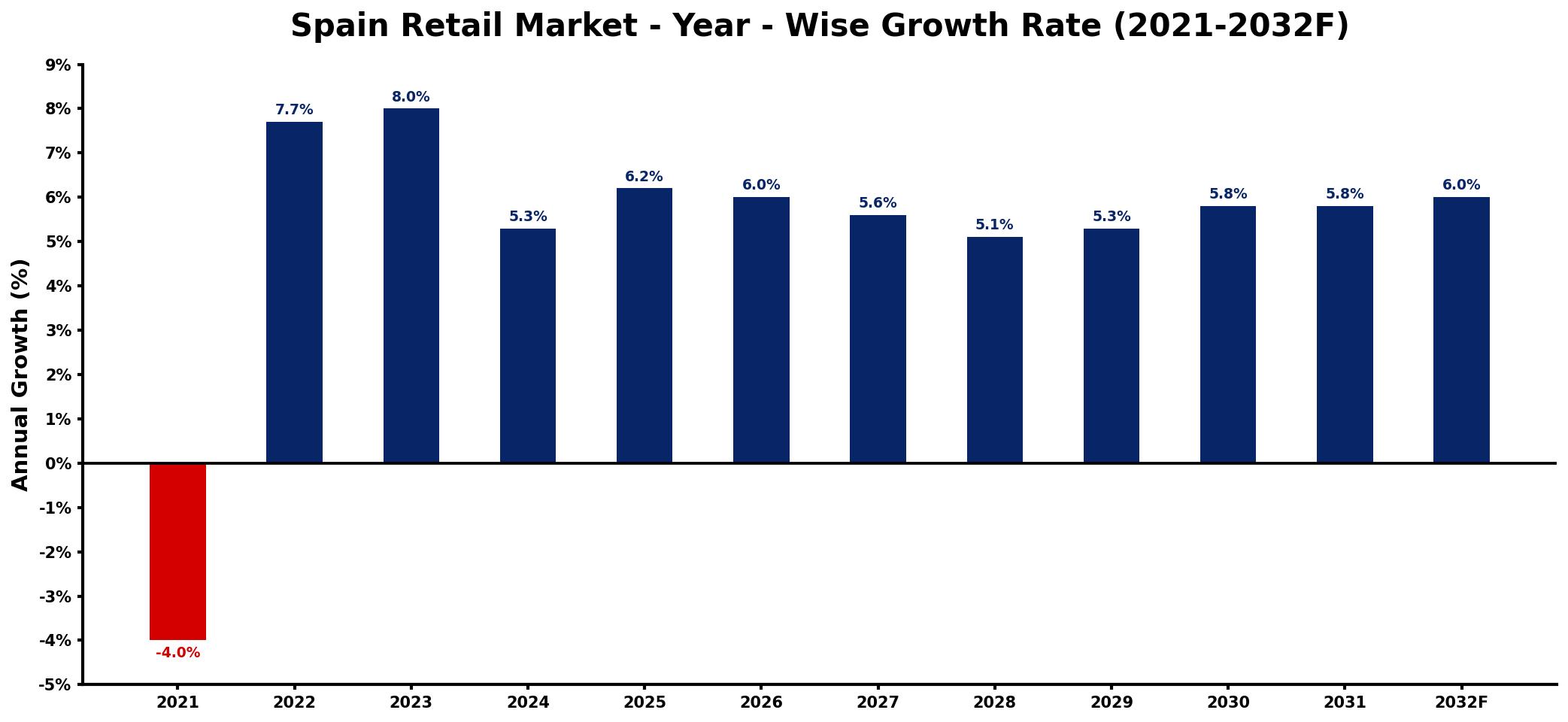
The table below presents the year‑wise growth rates along with the key drivers influencing the market
| Year | Growth Rate | Major Drivers |
| 2021 | -4.0% | consumer confidence significantly declined |
| 2022 | 7.7% | e-commerce adoption rapidly increased |
| 2023 | 8.0% | local brands gained market share |
| 2024 | 5.3% | sustainable products became popular |
| 2025 | 6.2% | digital payment options expanded |
| 2026 | 6.0% | personalized shopping experiences improved |
| 2027 | 5.6% | in-store technology innovations emerged |
| 2028 | 5.1% | omni-channel strategies enhanced engagement |
| 2029 | 5.3% | subscription models attracted consumers |
| 2030 | 5.8% | health and wellness trends grew |
| 2031 | 5.8% | social media marketing flourished |
| 2032 | 6.0% | supply chain efficiencies optimized |
Note: Market size estimations and growth projections presented in this report are based on 6Wresearch's proprietary forecasting methodology, utilizing the latest available industry data, government publications, and primary research inputs.
Spain Retail Market Synopsis
The increasing preference for quality products is evident in the Spanish retail landscape, where consumers prioritize personalized service and sustainable offerings. This demand has prompted retailers to adopt innovative practices, blending traditional shopping experiences with modern technology to cater to evolving customer needs.
Furthermore, as tourism continues to rebound, the retail sector is poised to benefit from an influx of international visitors seeking unique products. This dynamic presents both opportunities and challenges, compelling retailers to differentiate themselves in a competitive marketplace.
Spain Retail Market Key Takeaways
- The market is characterized by a blend of traditional and online retail, driving competition.
- Consumers increasingly seek sustainable and ethically produced products.
- Investment in technology and omnichannel strategies is essential for retailers to thrive.
- Tourism plays a vital role in retail demand, particularly in urban centers.
- Regulatory policies promote fair practices while ensuring a competitive environment.
Evaluation of Restraints in Spain Retail Market
While the Spain Retail Market showcases considerable potential, several restraints must be navigated. Intense competition, particularly from both established retail chains and online newcomers, has led to price wars that can erode margins. Furthermore, economic fluctuations and consumer confidence levels pose ongoing challenges, impacting retailers ability to forecast demand. Strict labor laws and complex regulations can also limit operational flexibility, compelling businesses to invest resources in compliance rather than growth initiatives.
Spain Retail Market Trends
The trend towards online shopping is reshaping the Spain Retail Market, as consumers appreciate the convenience and selection available through e-commerce platforms. Retailers are increasingly leveraging data analytics to provide personalized experiences, enhancing customer loyalty. Additionally, the growing emphasis on sustainability is pushing brands to develop eco-friendly products, aligning with consumers ethical preferences. Lastly, experiential retail is gaining traction, with physical stores transforming into venues for immersive shopping experiences that engage customers on multiple levels.
Spain Retail Market Opportunities
Investors in the Spain Retail Market can find promising opportunities, particularly within the expanding e-commerce sector. Companies focused on logistics and technology solutions that enhance online shopping experiences are well-positioned for growth. Moreover, niche markets such as luxury goods, sustainable products, and experiential retail concepts hold significant potential for investors aiming to tap into evolving consumer preferences. Prime physical retail spaces in major urban centers and tourist areas also present advantageous investment opportunities.
Government Initiatives in the Spain Retail Market
The Spanish government implements a range of policies aimed at fostering a competitive retail environment while protecting small businesses. Regulations on store opening hours are designed to balance consumer accessibility with the needs of local retailers. Consumer protection laws uphold standards in advertising and product quality, ensuring fair practices in the market. Additionally, government support through grants and subsidies encourages innovation and entrepreneurship, ultimately benefiting the retail landscape.
Future Insights of the Spain Retail Market
Looking ahead to 2026-2032, the Spain Retail Market is set to experience a transformation driven by technological advancements and shifting consumer expectations. The continued rise of e-commerce will prompt retailers to innovate their digital strategies and explore novel ways to engage customers. Sustainability will remain a core focus, influencing product offerings and marketing strategies. As consumer habits evolve, the ability to adapt swiftly will be crucial for retailers aiming to capture market share in this dynamic environment.
Spain Retail Market Latest Developments (2025 - 2026)
Recent developments in the Spain Retail Market highlight a significant shift toward enhanced digital capabilities among retailers. Many companies are launching or upgrading their e-commerce platforms to better meet the increasing demand for online shopping. In addition, the focus on sustainability has led several brands to introduce eco-friendly product lines and engage in transparent sourcing practices. Experiential retail is also on the rise, with stores designing immersive environments to attract customers, particularly in high-traffic tourist areas.
Spain Retail Market - Key Attractiveness of the Report
- 10 Years of Market Numbers
- Historical Data Starting from 2022 to 2025
- Base Year: 2025
- Forecast Data until 2032
- Key Performance Indicators Impacting the Market
- Major Upcoming Developments and Projects
Key Highlights of the Report:
- Spain Retail Market Outlook
- Market Size of Spain Retail Market, 2025
- Forecast of Spain Retail Market, 2032
- Historical Data and Forecast of Spain Retail Revenues & Volume for the Period 2022-2032F
- Spain Retail Market Trend Evolution
- Spain Retail Market Drivers and Challenges
- Spain Retail Price Trends
- Spain Retail Porter's Five Forces
- Spain Retail Industry Life Cycle
- Historical Data and Forecast of Spain Retail Market Revenues & Volume By Product for the Period 2022-2032F
- Historical Data and Forecast of Spain Retail Market Revenues & Volume By Food and Beverages for the Period 2022-2032F
- Historical Data and Forecast of Spain Retail Market Revenues & Volume By Personal and Household Care for the Period 2022-2032F
- Historical Data and Forecast of Spain Retail Market Revenues & Volume By Apparel for the Period 2022-2032F
- Historical Data and Forecast of Spain Retail Market Revenues & Volume By Footwear and Accessories for the Period 2022-2032F
- Historical Data and Forecast of Spain Retail Market Revenues & Volume By Furniture for the Period 2022-2032F
- Historical Data and Forecast of Spain Retail Market Revenues & Volume By Toys for the Period 2022-2032F
- Historical Data and Forecast of Spain Retail Market Revenues & Volume By Electronic and Household Appliances for the Period 2022-2032F
- Historical Data and Forecast of Spain Food and Beverages Retail Market Revenues & Volume By Other Products for the Period 2022-2032F
- Historical Data and Forecast of Spain Retail Market Revenues & Volume By Distribution Channel for the Period 2022-2032F
- Historical Data and Forecast of Spain Retail Market Revenues & Volume By Supermarkets/Hypermarkets for the Period 2022-2032F
- Historical Data and Forecast of Spain Retail Market Revenues & Volume By Convenience Stores for the Period 2022-2032F
- Historical Data and Forecast of Spain Retail Market Revenues & Volume By Department Stores for the Period 2022-2032F
- Historical Data and Forecast of Spain Retail Market Revenues & Volume By Specialty Stores for the Period 2022-2032F
- Historical Data and Forecast of Spain Retail Market Revenues & Volume By Online for the Period 2022-2032F
- Historical Data and Forecast of Spain Retail Market Revenues & Volume By Other Distribution Channels for the Period 2022-2032F
- Spain Retail Import Export Trade Statistics
- Market Opportunity Assessment By Product
- Market Opportunity Assessment By Distribution Channel
- Spain Retail Top Companies Market Share
- Spain Retail Competitive Benchmarking By Technical and Operational Parameters
- Spain Retail Company Profiles
- Spain Retail Key Strategic Recommendations






































