Spain Seafood Processing Market Size, Share & Growth Rate
The Spain Seafood Processing Market was estimated at USD 95 Million in 2025 and is projected to reach USD 112 Million by 2032, growing at a CAGR of 2.4% from 2026 to 2032. This growth is primarily driven by the increasing consumer preference for high-quality and sustainable seafood options, as well as advancements in processing technology that enhance product quality and efficiency. Additionally, the robust reputation of Spain's fishing industry and its diverse seafood offerings play a pivotal role in this promising trajectory.
Spain Seafood Processing Market Year-wise Growth Rate and Key Drivers
This graph highlights how the Spain Seafood Processing Market has steadily grown over the years, supported by major growth factors.
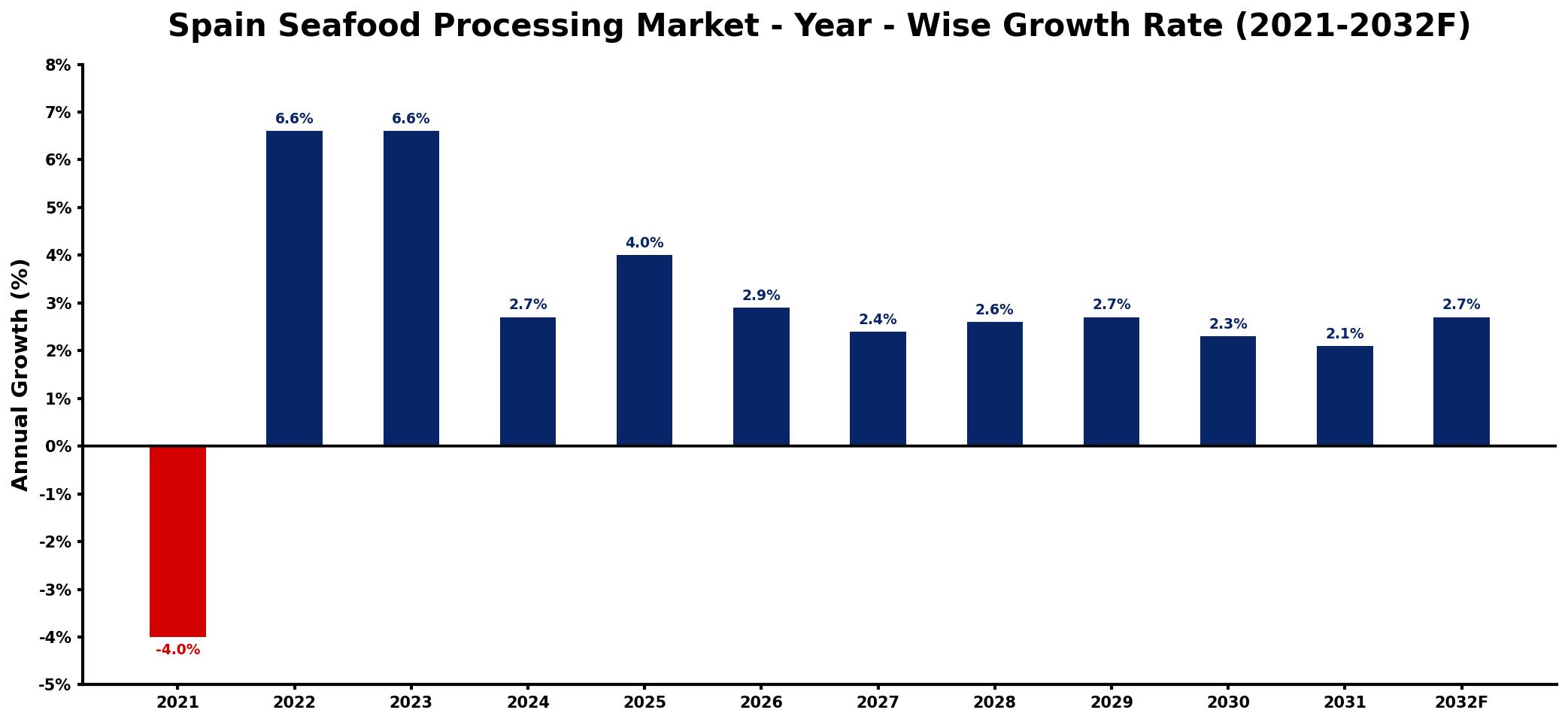
The table below presents the year‑wise growth rates along with the key drivers influencing the market
| Year | Growth Rate | Major Drivers |
| 2021 | -4.0% | Shifts in consumer preferences observed |
| 2022 | 6.6% | Increased investment in technology |
| 2023 | 6.6% | Growing demand for sustainable options |
| 2024 | 2.7% | Expansion of export markets anticipated |
| 2025 | 4.0% | Rising health consciousness among consumers |
| 2026 | 2.9% | Innovations in food preservation techniques |
| 2027 | 2.4% | Strengthening supply chain efficiencies noted |
| 2028 | 2.6% | Emergence of new culinary trends |
| 2029 | 2.7% | Increased collaboration with retailers |
| 2030 | 2.3% | growing downstream application demand |
| 2031 | 2.1% | Growing popularity of convenience products |
| 2032 | 2.7% | Enhanced focus on quality assurance |
Note: Market size estimations and growth projections presented in this report are based on 6Wresearch's proprietary forecasting methodology, utilizing the latest available industry data, government publications, and primary research inputs.
Spain Seafood Processing Market Synopsis
Spain stands out for its commitment to traditional seafood processing methods, which resonate deeply with consumers seeking authentic culinary experiences. The emphasis on quality is further reflected in Spain's diverse seafood products, including an array of fish, shellfish, and cephalopods, positioning the market as a significant player in the European seafood sector.
As consumer demand for healthy and sustainable food options surges, the Spain Seafood Processing Market adapts by focusing on environmentally-friendly practices and eco-label certifications. This alignment with consumer values not only fosters brand loyalty but also strengthens the competitive advantage of Spanish processors in both local and international markets.
Spain Seafood Processing Market Key Takeaways
- The market is leveraging traditional methods while integrating modern technology to enhance processing efficiency.
- Consumer demand for sustainable seafood is driving processors to adopt eco-friendly practices and certifications.
- Value-added seafood products are increasingly popular, catering to evolving consumer preferences for convenience and health.
- The industry's growth is supported by Spain's robust fishing sector and a diverse product range.
- Investment in R&D is crucial for innovation in product offerings and packaging solutions.
Evaluation of Restraints in Spain Seafood Processing Market
Despite the positive outlook, the Spain Seafood Processing Market faces significant challenges that could hinder growth. Fluctuating seafood prices caused by climate change and overfishing can squeeze profit margins for processors. Additionally, strict regulations pertaining to food safety and sustainability demand substantial investment in technology and infrastructure. Competition from other European seafood processing nations remains fierce, necessitating continuous innovation. Lastly, labor shortages in skilled positions could impede productivity and expansion, emphasizing the need for strategic workforce planning in the industry.
Spain Seafood Processing Market Trends
Current trends indicate a marked shift towards sustainable practices within the Spain Seafood Processing Market. Consumers increasingly favor products that are ethically sourced, prompting processors to adopt green technologies and eco-friendly certifications. Another trend is the rising demand for value-added seafood products, such as ready-to-eat meals, which cater to busy lifestyles. Additionally, advancements in processing technologies enhance efficiency and quality control, driving overall improvements within the sector.
Spain Seafood Processing Market Opportunities
The market offers exciting investment opportunities, particularly in modernizing processing facilities. By upgrading equipment and technologies, companies can improve efficiency and product quality. Another area ripe for investment is sustainable fishing practices, ensuring a stable supply of raw materials. Expanding product lines to include innovative packaging solutions will also allow processors to tap into the growing demand for convenience-focused seafood offerings, thereby capturing a larger share of the market.
Government Initiatives in the Spain Seafood Processing Market
The Spain Seafood Processing Market is supported by various government policies aimed at fostering sustainability and quality. The European Union's Common Fisheries Policy (CFP) plays a crucial role in regulating fishing activities, preventing overfishing, and protecting marine resources. On the national level, the Ministry of Agriculture, Fisheries, and Food enforces hygiene and safety standards for seafood processing. Furthermore, the government provides subsidies and grants to encourage innovation and maintain competitiveness, balancing economic growth with environmental conservation.
Future Insights of the Spain Seafood Processing Market
Looking ahead, the Spain Seafood Processing Market is expected to continue on a positive growth trajectory through 2026-2032. Driven by heightened consumer demand for seafood products, ongoing technological advancements, and an increasing focus on sustainability, the market is primed for expansion. Innovations in packaging and preservation methods will be crucial in ensuring product quality and freshness. Moreover, as seafood solidifies its place as a preferred healthy food option, new product differentiation strategies will emerge, catering to evolving consumer preferences.
Spain Seafood Processing Market Latest Developments (2025 - 2026)
Recent developments within the Spain Seafood Processing Market indicate a shift toward more sophisticated processing technologies. The focus has been on enhancing product quality through innovative preservation methods and improved supply chain logistics. Additionally, there has been increased collaboration among stakeholders to promote sustainable practices and transparency in sourcing. These efforts aim to boost consumer confidence in seafood products and align with growing demand for ethically sourced options.
Spain Seafood Processing Market - Key Attractiveness of the Report
- 10 Years of Market Numbers
- Historical Data Starting from 2022 to 2025
- Base Year: 2025
- Forecast Data until 2032
- Key Performance Indicators Impacting the Market
- Major Upcoming Developments and Projects
Key Highlights of the Report:
- Spain Seafood Processing Market Outlook
- Market Size of Spain Seafood Processing Market, 2025
- Forecast of Spain Seafood Processing Market, 2032
- Historical Data and Forecast of Spain Seafood Processing Revenues & Volume for the Period 2022-2032F
- Spain Seafood Processing Market Trend Evolution
- Spain Seafood Processing Market Drivers and Challenges
- Spain Seafood Processing Price Trends
- Spain Seafood Processing Porter's Five Forces
- Spain Seafood Processing Industry Life Cycle
- Historical Data and Forecast of Spain Seafood Processing Market Revenues & Volume By Equipment Type for the Period 2022-2032F
- Historical Data and Forecast of Spain Seafood Processing Market Revenues & Volume By Gutting Equipment for the Period 2022-2032F
- Historical Data and Forecast of Spain Seafood Processing Market Revenues & Volume By Sealing Equipment for the Period 2022-2032F
- Historical Data and Forecast of Spain Seafood Processing Market Revenues & Volume By Filleting Equipment for the Period 2022-2032F
- Historical Data and Forecast of Spain Seafood Processing Market Revenues & Volume By Deboning Equipment for the Period 2022-2032F
- Historical Data and Forecast of Spain Seafood Processing Market Revenues & Volume By other Equipment for the Period 2022-2032F
- Historical Data and Forecast of Spain Seafood Processing Market Revenues & Volume By Category for the Period 2022-2032F
- Historical Data and Forecast of Spain Seafood Processing Market Revenues & Volume By Single-Function Equipment for the Period 2022-2032F
- Historical Data and Forecast of Spain Seafood Processing Market Revenues & Volume By Multi-Function Equipment for the Period 2022-2032F
- Historical Data and Forecast of Spain Seafood Processing Market Revenues & Volume By Seafood Type for the Period 2022-2032F
- Historical Data and Forecast of Spain Seafood Processing Market Revenues & Volume By Fish for the Period 2022-2032F
- Historical Data and Forecast of Spain Seafood Processing Market Revenues & Volume By Crustaceans for the Period 2022-2032F
- Historical Data and Forecast of Spain Seafood Processing Market Revenues & Volume By Mollusks for the Period 2022-2032F
- Historical Data and Forecast of Spain Seafood Processing Market Revenues & Volume By others for the Period 2022-2032F
- Spain Seafood Processing Import Export Trade Statistics
- Market Opportunity Assessment By Equipment Type
- Market Opportunity Assessment By Category
- Market Opportunity Assessment By Seafood Type
- Spain Seafood Processing Top Companies Market Share
- Spain Seafood Processing Competitive Benchmarking By Technical and Operational Parameters
- Spain Seafood Processing Company Profiles
- Spain Seafood Processing Key Strategic Recommendations






































