Spain Smart Building Market Size, Share & Growth Rate
The Spain Smart Building Market was estimated at USD 355 Million in 2025 and is projected to reach USD 464 Million by 2032, growing at a CAGR of 3.9% from 2026 to 2032. This growth is propelled by an increasing demand for energy-efficient solutions and a stronger emphasis on sustainable building practices. As regulations tighten around energy consumption and sustainability, the adoption of smart technologies is becoming a necessity for modern infrastructures.
Spain Smart Building Market Year-wise Growth Rate and Key Drivers
This graph highlights how the Spain Smart Building Market has steadily grown over the years, supported by major growth factors.
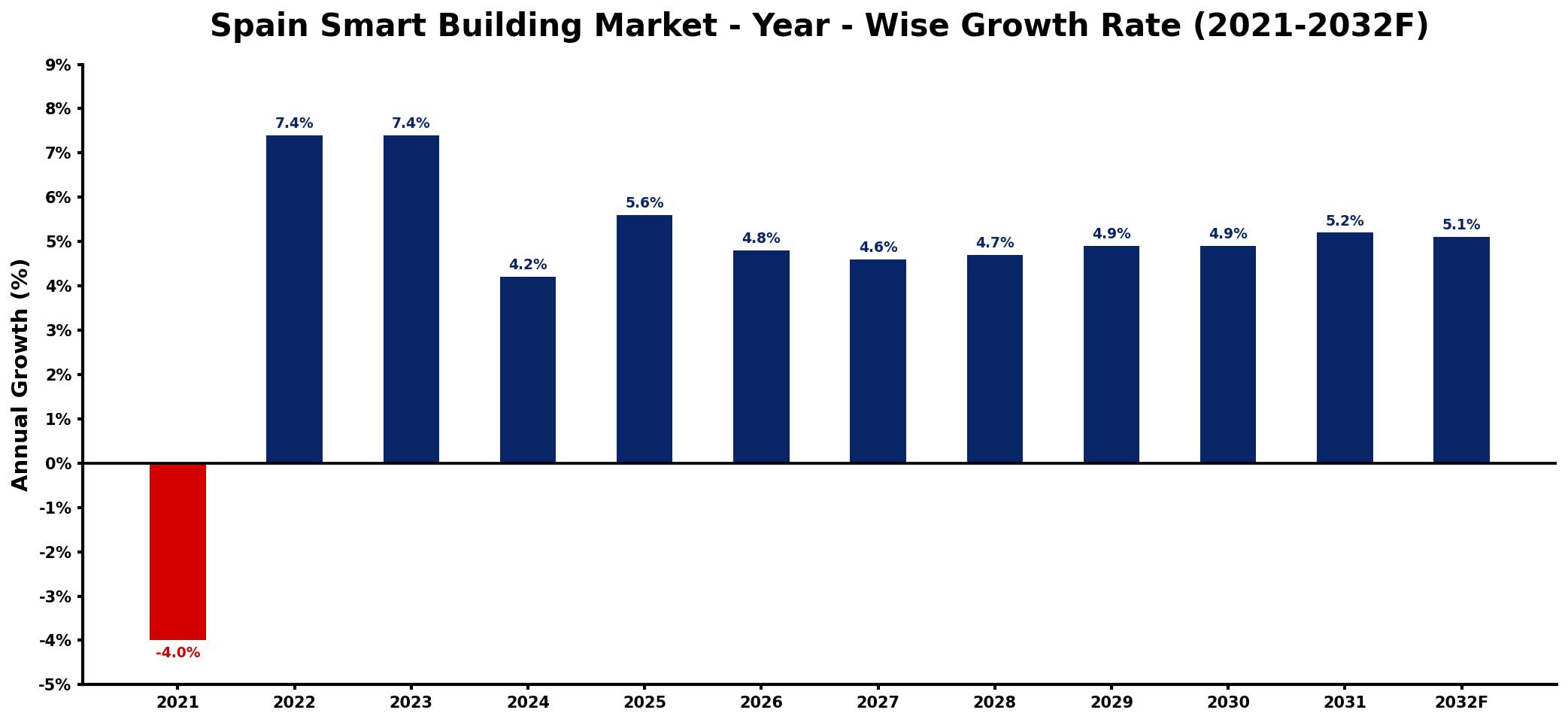
The table below presents the year‑wise growth rates along with the key drivers influencing the market
| Year | Growth Rate | Major Drivers |
| 2021 | -4.0% | decreased investment in infrastructure projects |
| 2022 | 7.4% | rising demand for energy efficiency |
| 2023 | 7.4% | increased focus on sustainability initiatives |
| 2024 | 4.2% | growing adoption of IoT technologies |
| 2025 | 5.6% | expansion of renewable energy sources |
| 2026 | 4.8% | enhanced regulations for energy management |
| 2027 | 4.6% | increased corporate sustainability commitments |
| 2028 | 4.7% | growing integration of AI solutions |
| 2029 | 4.9% | improved processing technologies adoption |
| 2030 | 4.9% | rising interest in automation solutions |
| 2031 | 5.2% | strengthened focus on user experience |
| 2032 | 5.1% | increased collaboration among stakeholders |
Note: Market size estimations and growth projections presented in this report are based on 6Wresearch's proprietary forecasting methodology, utilizing the latest available industry data, government publications, and primary research inputs.
Spain Smart Building Market Synopsis
Spain is witnessing a significant shift towards integrating smart building technologies that not only enhance energy efficiency but also elevate occupant comfort. The demand for solutions such as IoT devices and advanced building management systems is driving innovation in both new constructions and retrofitting of existing buildings. Additionally, the growing interest in smart home solutions is shaping consumer expectations in residential and commercial spaces.
As the market evolves, government regulations promoting green initiatives further contribute to this growth trend. These mandates underscore the necessity for sustainable practices in the built environment, compelling stakeholders to invest in smart technologies that enable improved operational efficiencies and reduced carbon footprints.
Spain Smart Building Market Key Takeaways
- The integration of smart technologies is essential for optimizing building performance and energy efficiency.
- Government incentives are accelerating the adoption of smart building solutions across sectors.
- Consumer demand for smart home technologies is influencing developments in the market.
- Real-time data monitoring through IoT devices is becoming a critical aspect of building management.
- There is a growing emphasis on sustainable practices within the construction industry to meet regulatory requirements.
Evaluation of Restraints in Spain Smart Building Market
Despite the positive growth trajectory, several factors pose challenges to the Spain Smart Building Market. High initial costs associated with the implementation of smart technologies often deter investment from smaller enterprises and older building owners. Additionally, the lack of standardized regulations and interoperability among various systems can create friction in the transition towards smarter buildings. There is also a notable skills gap in the workforce, hindering the effective design, installation, and maintenance of advanced smart building systems.
Spain Smart Building Market Trends
The Spain Smart Building Market is characterized by several notable trends. One significant trend is the increasing utilization of IoT devices for real-time data analytics, enabling enhanced decision-making and operational efficiency. Additionally, building management systems are evolving towards more centralized control systems, which streamline operations and reduce energy waste. The growth of smart home solutions, particularly in the residential sector, also highlights the demand for interconnected technologies that cater to modern consumer preferences.
Spain Smart Building Market Opportunities
Investment opportunities abound in the Spain Smart Building Market, particularly in sectors such as energy management and automation solutions. As the emphasis on sustainability continues to rise, there is a burgeoning demand for technologies that can significantly enhance resource efficiency while improving occupant comfort. Furthermore, the ongoing development of smart cities initiatives in Spain offers a fertile ground for investments in integrated building systems that promote urban sustainability and resilience.
Government Initiatives in the Spain Smart Building Market
The Spanish government is actively promoting smart building technologies through various policies aimed at enhancing energy efficiency and sustainability. Initiatives include tax incentives for energy-efficient renovations and funding for innovative research and development projects. Additionally, the government is working alongside industry stakeholders to establish standards and regulations that facilitate the adoption of smart building solutions, thereby accelerating the shift towards more intelligent and eco-friendly infrastructures.
Future Insights of the Spain Smart Building Market
Looking ahead to the years 2026-2032, the Spain Smart Building Market is expected to experience significant advancements driven by technological innovation and regulatory support. With an increasing focus on sustainability and operational efficiency, the integration of advanced technologies such as AI and machine learning will play a vital role in enhancing building performance and occupant experience. As awareness grows around the economic and environmental benefits of smart buildings, adoption rates are likely to escalate, positioning this market for robust growth.
Spain Smart Building Market Latest Developments (2025 - 2026)
Recent developments in the Spain Smart Building Market indicate a continued push towards the adoption of smart technologies across various sectors. There has been an increase in partnerships between technology providers and real estate developers focused on enhancing building automation and sustainability. Additionally, many projects are exploring innovative smart home solutions, showcasing the growing consumer interest in connected living. The market landscape is evolving rapidly as stakeholders seek to capitalize on the benefits of intelligent building systems.
Spain Smart Building Market - Key Attractiveness of the Report
- 10 Years of Market Numbers
- Historical Data Starting from 2022 to 2025
- Base Year: 2025
- Forecast Data until 2032
- Key Performance Indicators Impacting the Market
- Major Upcoming Developments and Projects
Key Highlights of the Report:
- Spain Smart Building Market Outlook
- Market Size of Spain Smart Building Market, 2025
- Forecast of Spain Smart Building Market, 2032
- Historical Data and Forecast of Spain Smart Building Revenues & Volume for the Period 2022-2032F
- Spain Smart Building Market Trend Evolution
- Spain Smart Building Market Drivers and Challenges
- Spain Smart Building Price Trends
- Spain Smart Building Porter's Five Forces
- Spain Smart Building Industry Life Cycle
- Historical Data and Forecast of Spain Smart Building Market Revenues & Volume By Component for the Period 2022-2032F
- Historical Data and Forecast of Spain Smart Building Market Revenues & Volume By Solution for the Period 2022-2032F
- Historical Data and Forecast of Spain Smart Building Market Revenues & Volume By Services for the Period 2022-2032F
- Historical Data and Forecast of Spain Smart Building Market Revenues & Volume By Application for the Period 2022-2032F
- Historical Data and Forecast of Spain Smart Building Market Revenues & Volume By Residential for the Period 2022-2032F
- Historical Data and Forecast of Spain Smart Building Market Revenues & Volume By Commercial for the Period 2022-2032F
- Spain Smart Building Import Export Trade Statistics
- Market Opportunity Assessment By Component
- Market Opportunity Assessment By Application
- Spain Smart Building Top Companies Market Share
- Spain Smart Building Competitive Benchmarking By Technical and Operational Parameters
- Spain Smart Building Company Profiles
- Spain Smart Building Key Strategic Recommendations






































