Spain Time and Attendance Software Market Size, Share & Growth Rate
The Spain Time and Attendance Software Market was estimated at USD 148 Million in 2025 and is projected to reach USD 174 Million by 2032, growing at a CAGR of 2.3% from 2026 to 2032. This upward trajectory is fueled by an increasing shift towards automated workforce management tools, particularly as businesses adapt to new working models. The rise in remote work and the necessity for stringent compliance with labor regulations further amplify the demand for reliable time and attendance solutions.
Spain Time and Attendance Software Market Year-wise Growth Rate and Key Drivers
This graph highlights how the Spain Time and Attendance Software Market has steadily grown over the years, supported by major growth factors.
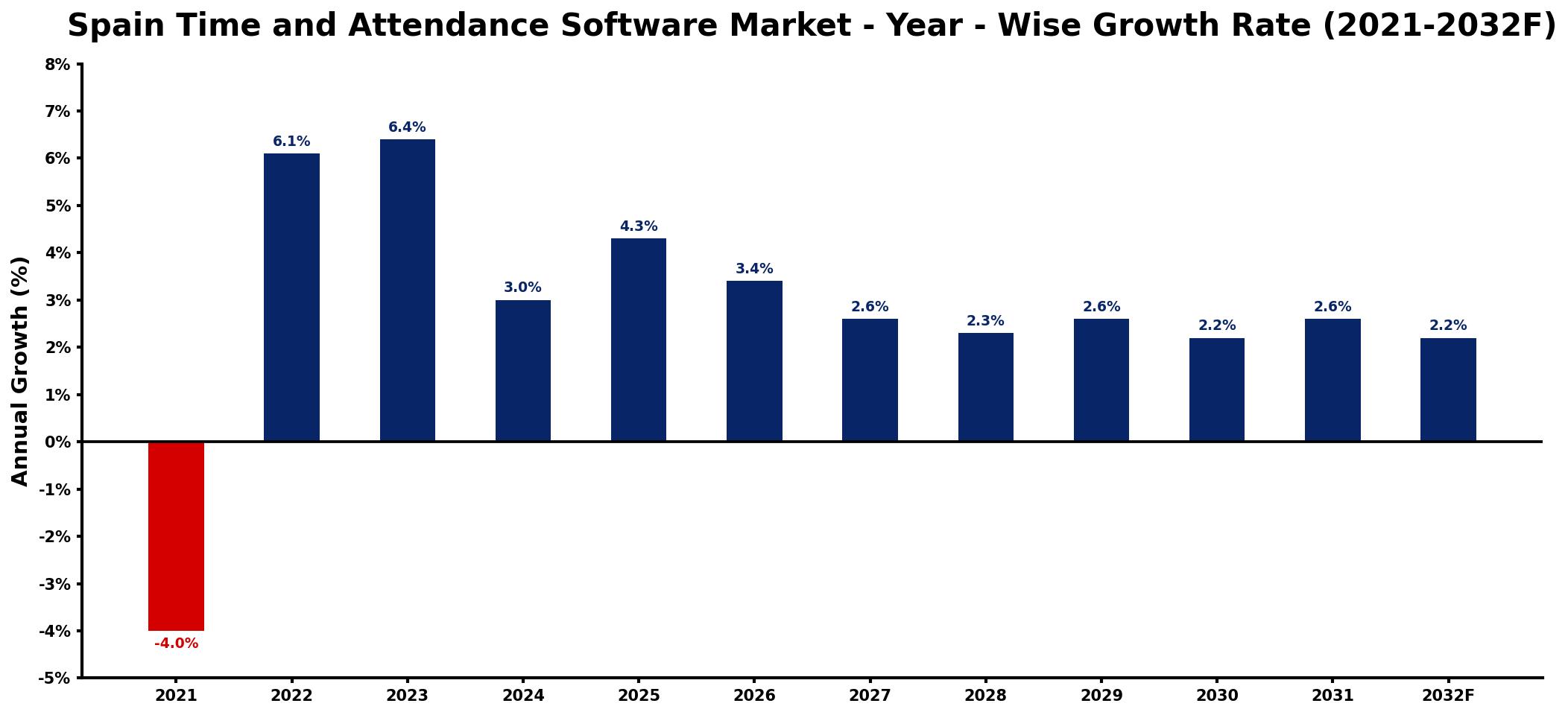
The table below presents the year‑wise growth rates along with the key drivers influencing the market
| Year | Growth Rate | Major Drivers |
| 2021 | -4.0% | decreased corporate investment in technology |
| 2022 | 6.1% | rising demand for workforce management |
| 2023 | 6.4% | increased adoption of cloud solutions |
| 2024 | 3.0% | growing emphasis on data analytics |
| 2025 | 4.3% | expansion of remote working practices |
| 2026 | 3.4% | surge in employee engagement initiatives |
| 2027 | 2.6% | enhanced regulatory compliance requirements |
| 2028 | 2.3% | emphasis on operational efficiency strategies |
| 2029 | 2.6% | integration with HR management systems |
| 2030 | 2.2% | increased focus on employee well-being |
| 2031 | 2.6% | growth in mobile application usage |
| 2032 | 2.2% | advancements in artificial intelligence technologies |
Note: Market size estimations and growth projections presented in this report are based on 6Wresearch's proprietary forecasting methodology, utilizing the latest available industry data, government publications, and primary research inputs.
Spain Time and Attendance Software Market Synopsis
In recent years, the Spain Time and Attendance Software Market has gained significant momentum, driven by the urgent need for efficiency in workforce management. Organizations across diverse sectors are keenly investing in technology that not only simplifies employee tracking but also ensures regulatory compliance.
Looking ahead, the market is on the brink of transformative growth. The continuous development of cloud-based solutions, mobile applications, and biometric technologies is reshaping how businesses manage time and attendance. This evolution aligns seamlessly with the growing trend of remote work, creating a fertile environment for innovative solutions.
Spain Time and Attendance Software Market Key Takeaways
- The market is driven by the increasing adoption of automated workforce management solutions.
- Cloud-based systems are gaining popularity due to their flexibility and scalability.
- Biometric technologies and mobile applications are enhancing the efficiency of time tracking.
- SMEs are increasingly investing in time and attendance software to improve productivity.
- Compliance with GDPR and labor laws is essential for software developers in this space.
Evaluation of Restraints in Spain Time and Attendance Software Market
Despite its robust growth, the Spain Time and Attendance Software Market faces notable challenges. Intense competition from both domestic and international vendors can dilute market share and pressure prices. Additionally, businesses often require tailored solutions that address unique industry requirements, making customization a significant yet complex demand. Furthermore, the integration of advanced technologies like artificial intelligence introduces technical hurdles and necessitates ongoing investment in secure infrastructure to comply with data protection regulations, which can deter smaller entities from entering the market.
Spain Time and Attendance Software Market Trends
Current trends in the Spain Time and Attendance Software Market include a pronounced shift towards cloud-based solutions, as organizations seek scalability and flexibility. Integration with existing HR and payroll systems is becoming a priority, enabling businesses to streamline their operations and improve data accuracy. The adoption of mobile applications for real-time monitoring and biometric systems for enhanced security is also on the rise, catering to the evolving needs of remote and hybrid work environments.
Spain Time and Attendance Software Market Opportunities
The market presents numerous investment opportunities as organizations increasingly embrace automation and digital tools for workforce management. There is a burgeoning demand for innovative solutions that enhance efficiency and comply with labor regulations. Investment in established players or emerging startups with cutting-edge offerings can be particularly beneficial, especially as businesses continue to prioritize remote work capabilities and flexible scheduling solutions.
Government Initiatives in the Spain Time and Attendance Software Market
Government policies in Spain significantly influence the Time and Attendance Software Market, particularly concerning data protection and labor regulations. The General Data Protection Regulation (GDPR) mandates strict adherence to data privacy standards, impacting how time tracking systems are developed. Additionally, labor laws are in place to protect employee rights, ensuring proper compensation for hours worked, which can shape market dynamics and necessitate compliance among software providers.
Future Insights of the Spain Time and Attendance Software Market
The Spain Time and Attendance Software Market is poised for steady growth through 2032. As advanced technologies become more entrenched in workplace practices, the demand for innovative solutions will continue to rise. Companies are likely to focus on features such as real-time analytics and enhanced reporting capabilities to optimize workforce management. The emphasis on compliance with labor laws and data security will also drive demand for sophisticated software solutions that align with evolving regulatory frameworks.
Spain Time and Attendance Software Market Latest Developments (2025 - 2026)
Recent industry developments indicate a strong movement towards enhancing user experience through intuitive interfaces and personalized features in time and attendance software. Many providers are exploring partnerships with technology firms to integrate artificial intelligence capabilities, providing organizations with predictive analytics for better workforce planning. As market competition heats up, a significant focus on improving customer support and service offerings is also emerging to retain client loyalty and satisfaction.
Spain Time and Attendance Software Market - Key Attractiveness of the Report
- 10 Years of Market Numbers
- Historical Data Starting from 2022 to 2025
- Base Year: 2025
- Forecast Data until 2032
- Key Performance Indicators Impacting the Market
- Major Upcoming Developments and Projects
Key Highlights of the Report:
- Spain Time and Attendance Software Market Outlook
- Market Size of Spain Time and Attendance Software Market, 2025
- Forecast of Spain Time and Attendance Software Market, 2032
- Historical Data and Forecast of Spain Time and Attendance Software Revenues & Volume for the Period 2022-2032F
- Spain Time and Attendance Software Market Trend Evolution
- Spain Time and Attendance Software Market Drivers and Challenges
- Spain Time and Attendance Software Price Trends
- Spain Time and Attendance Software Porter's Five Forces
- Spain Time and Attendance Software Industry Life Cycle
- Historical Data and Forecast of Spain Time and Attendance Software Market Revenues & Volume By Component for the Period 2022-2032F
- Historical Data and Forecast of Spain Time and Attendance Software Market Revenues & Volume By Software for the Period 2022-2032F
- Historical Data and Forecast of Spain Time and Attendance Software Market Revenues & Volume By Services for the Period 2022-2032F
- Historical Data and Forecast of Spain Time and Attendance Software Market Revenues & Volume By Deployment Mode for the Period 2022-2032F
- Historical Data and Forecast of Spain Time and Attendance Software Market Revenues & Volume By On-premise for the Period 2022-2032F
- Historical Data and Forecast of Spain Time and Attendance Software Market Revenues & Volume By Cloud for the Period 2022-2032F
- Historical Data and Forecast of Spain Time and Attendance Software Market Revenues & Volume By Hybrid for the Period 2022-2032F
- Historical Data and Forecast of Spain Time and Attendance Software Market Revenues & Volume By Organization Size for the Period 2022-2032F
- Historical Data and Forecast of Spain Time and Attendance Software Market Revenues & Volume By Large Enterprises for the Period 2022-2032F
- Historical Data and Forecast of Spain Time and Attendance Software Market Revenues & Volume By SMES for the Period 2022-2032F
- Historical Data and Forecast of Spain Time and Attendance Software Market Revenues & Volume By Industry Vertical for the Period 2022-2032F
- Historical Data and Forecast of Spain Time and Attendance Software Market Revenues & Volume By BFSI for the Period 2022-2032F
- Historical Data and Forecast of Spain Time and Attendance Software Market Revenues & Volume By Manufacturing for the Period 2022-2032F
- Historical Data and Forecast of Spain Time and Attendance Software Market Revenues & Volume By Healthcare for the Period 2022-2032F
- Historical Data and Forecast of Spain Time and Attendance Software Market Revenues & Volume By Government for the Period 2022-2032F
- Historical Data and Forecast of Spain Time and Attendance Software Market Revenues & Volume By Retail & E-commerce for the Period 2022-2032F
- Historical Data and Forecast of Spain Time and Attendance Software Market Revenues & Volume By IT & Telecom for the Period 2022-2032F
- Historical Data and Forecast of Spain Time and Attendance Software Market Revenues & Volume By Education for the Period 2022-2032F
- Historical Data and Forecast of Spain Time and Attendance Software Market Revenues & Volume By Others for the Period 2022-2032F
- Spain Time and Attendance Software Import Export Trade Statistics
- Market Opportunity Assessment By Component
- Market Opportunity Assessment By Deployment Mode
- Market Opportunity Assessment By Organization Size
- Market Opportunity Assessment By Industry Vertical
- Spain Time and Attendance Software Top Companies Market Share
- Spain Time and Attendance Software Competitive Benchmarking By Technical and Operational Parameters
- Spain Time and Attendance Software Company Profiles
- Spain Time and Attendance Software Key Strategic Recommendations






































