Spain Workforce Management Market Size & Growth Rate (2026-2032)
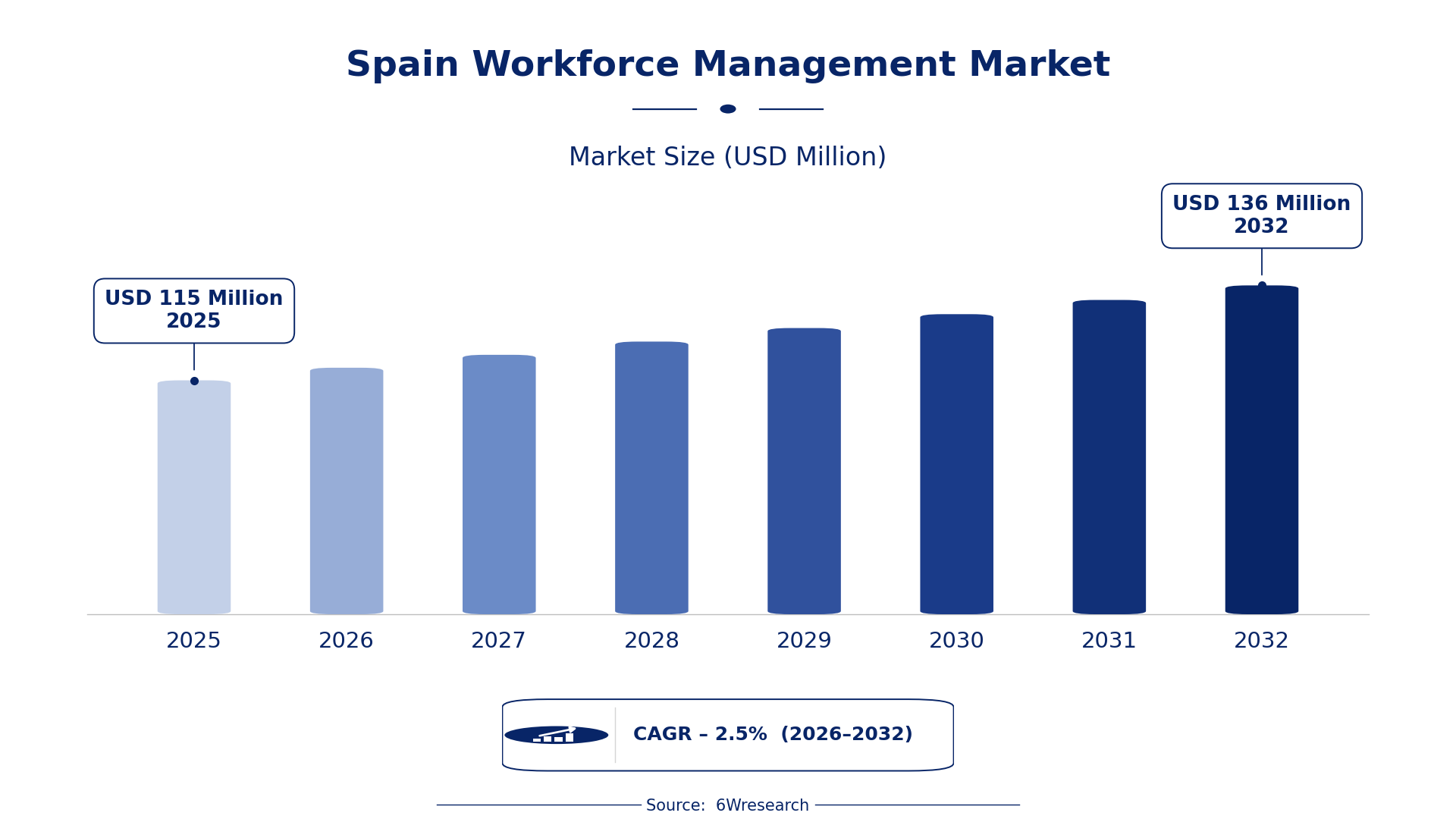
The Spain Workforce Management Market was estimated at USD 115 Million in 2025 and is projected to reach USD 136 Million by 2032, growing at a CAGR of 2.5% from 2026 to 2032.
Spain Workforce Management Market Synopsis
In Spain, organizations are increasingly recognizing the importance of effective workforce management solutions to enhance productivity and streamline labor resources. Companies are turning to advanced tools for scheduling, attendance tracking, and performance evaluation, enabling them to maintain a competitive edge in a challenging market.
This market is evolving rapidly as businesses seek data-driven insights to make informed human resource decisions. The ongoing demand for comprehensive workforce management systems signifies a shift toward prioritizing employee engagement and resource optimization, which are crucial for achieving operational efficiency.
Spain Workforce Management Market Year-wise Growth Rate and Key Drivers
This graph illustrates the annual growth rates of the Spain Workforce Management Market from 2021 to 2032, highlighting a steady upward trajectory and projected expansion over the forecast period.
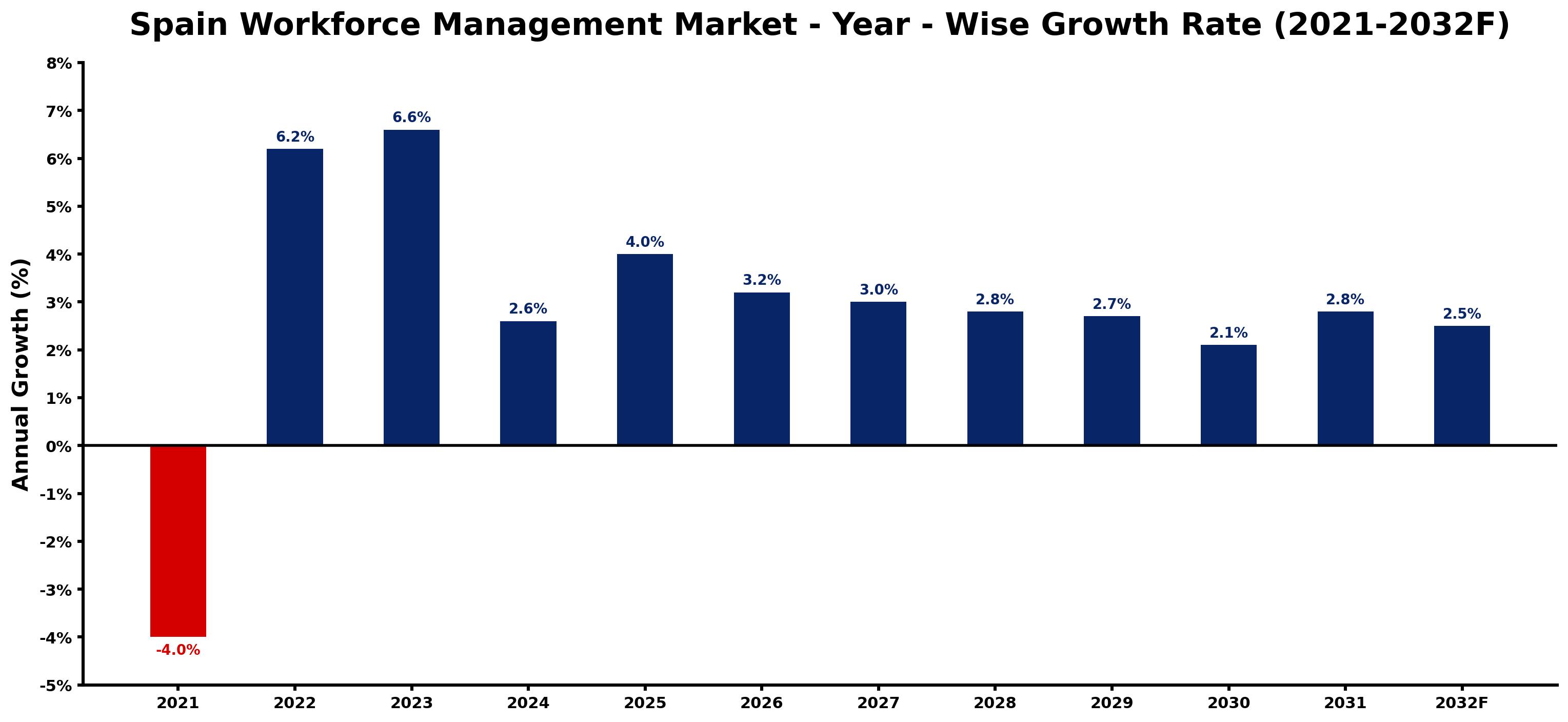
The table below presents the year‑wise growth rates along with the key drivers influencing the market
| Year | Growth Rate | Major Drivers |
| 2021 | -4.0% | Teleworking policy by the Spanish government reduced demand. |
| 2022 | 6.2% | Increased adoption of digital HR solutions in companies. |
| 2023 | 6.6% | Growing remote work policies by Spanish government initiatives. |
| 2024 | 2.6% | Demand for real-time employee scheduling software surges. |
| 2025 | 4.0% | Focus on upskilling initiatives for tech in Spain. |
| 2026 | 3.2% | Elevated labor force participation among older workers. |
| 2027 | 3.0% | Rise of analytics-driven decision-making in workforce planning. |
| 2028 | 2.8% | Increase in gig economy platforms impacting workforce dynamics. |
| 2029 | 2.7% | Strengthening employer branding to attract top talent. |
| 2030 | 2.1% | Shift towards employee well-being programs by businesses. |
| 2031 | 2.8% | Integration of AI tools for performance management systems. |
| 2032 | 2.5% | Growing emphasis on diversity and inclusion in hiring. |
Note: Market size estimations and growth projections presented in this report are based on 6Wresearch's proprietary forecasting methodology, utilizing the latest available industry data, government publications, and primary research inputs.
Spain Workforce Management Market Key Takeaways
Below are some of the specific key takeaways from the market, including:
- The market is driven by the need for enhanced employee productivity and resource optimization.
- Data-driven decision-making is becoming a critical component of human resource management.
- Integration of advanced technologies like AI is reshaping workforce management practices.
- Privacy and data security concerns present challenges for the adoption of new solutions.
- Government policies are fostering the growth of workforce management technologies in Spain.
Evaluation of Restraints in Spain Workforce Management Market
The Spain Workforce Management Market faces notable constraints that hinder its full potential. One primary limitation is the high cost associated with integrating advanced technologies such as artificial intelligence and analytics. This financial barrier particularly affects small and medium-sized enterprises, which may struggle to implement these solutions effectively. Additionally, there is a palpable resistance among employees towards automation and digital tools, which complicates the adoption process. Concerns regarding privacy and data security are also significant, especially given the stringent European regulations that govern employee data protection.
Spain Workforce Management Market Trends
Several trends are shaping the Spain Workforce Management Market. The increasing adoption of AI technologies is enabling organizations to automate mundane tasks, allowing HR teams to focus on strategic initiatives. on top of that, the demand for mobile workforce management applications is on the rise, driven by the need for flexibility and remote work solutions. There's also a growing emphasis on analytics, with companies leveraging data to enhance employee performance and retention rates.
Spain Workforce Management Market Opportunities
Significant opportunities lie within the Spain Workforce Management Market as organizations look to enhance their operational efficiencies. The growing focus on employee engagement creates a fertile ground for solutions that cater to performance management and employee satisfaction. on top of that, the push towards digital transformation offers a chance for vendors to innovate and provide tailored solutions that address the specific needs of various sectors. As the market matures, companies that can deliver scalable and secure workforce management solutions will find considerable success.
Government Initiatives in the Spain Workforce Management Market
Government policies are instrumental in shaping the direction of the Spain Workforce Management Market. The Spanish government is committed to enhancing labor market efficiency through various initiatives aimed at promoting advanced workforce management solutions. These policies not only prioritize employee engagement but also ensure compliance with labor laws and data protection regulations, fostering a secure environment for both employers and employees.
- A national initiative launched in 2024 aimed at supporting the adoption of digital tools in human resources, enhancing productivity across various sectors.
- Current efforts focus on a comprehensive review of labor laws to facilitate smoother integration of workforce management technologies.
- Planned public-private partnerships expected to roll out by 2026 will focus on developing training programs for workforce management solutions.
- A regulatory framework introduced in 2025 mandates transparency in employee data management practices.
- Recent funding programs have been initiated to support small businesses in implementing workforce management technologies effectively.
Future Insights of the Spain Workforce Management Market
Looking ahead to 2026-2032, the Spain Workforce Management Market is set to experience steady growth driven by the increasing necessity for data-driven human resource practices. As businesses continue to embrace technology, we can expect advancements in AI and analytics to significantly influence how organizations manage their workforce. The demand for solutions that enhance flexibility and employee engagement will further shape market dynamics, leading to innovative offerings that address emerging challenges in labor management.
Spain Workforce Management Market Latest Developments
Over the past year, the Spain Workforce Management Market has witnessed a flurry of activities reflecting the sector's commitment to innovation and efficiency. Companies are increasingly launching initiatives aimed at enhancing their workforce management capabilities, which speaks volumes about the industry's growth trajectory.
- A major technology vendor launched a new workforce analytics platform in early 2025, designed to provide real-time insights into employee performance metrics.
- An ongoing initiative that began in mid-2025 focuses on integrating AI solutions into existing workforce management systems, aiming to streamline operations.
- A partnership between regional businesses and tech providers is expected to enhance workforce management training programs by late 2026.
- A public sector program initiated in 2024 aims to establish data protection guidelines specifically for workforce management software providers.
- Upcoming regulations anticipated in 2026 will mandate enhanced employee consent protocols for data collection in workforce management applications.
Spain Workforce Management Market - Key Attractiveness of the Report
- 10 Years of Market Numbers
- Historical Data Starting from 2022 to 2025
- Base Year: 2025
- Forecast Data until 2032
- Key Performance Indicators Impacting the Market
- Major Upcoming Developments and Projects
Key Highlights of the Report:
- Spain Workforce Management Market Outlook
- Market Size of Spain Workforce Management Market, 2025
- Forecast of Spain Workforce Management Market, 2032
- Historical Data and Forecast of Spain Workforce Management Revenues & Volume for the Period 2022-2032F
- Spain Workforce Management Market Trend Evolution
- Spain Workforce Management Market Drivers and Challenges
- Spain Workforce Management Price Trends
- Spain Workforce Management Porter's Five Forces
- Spain Workforce Management Industry Life Cycle
- Historical Data and Forecast of Spain Workforce Management Market Revenues & Volume By Solution for the Period 2022-2032F
- Historical Data and Forecast of Spain Workforce Management Market Revenues & Volume By Time and Attendance Management for the Period 2022-2032F
- Historical Data and Forecast of Spain Workforce Management Market Revenues & Volume By Leave and Absence Management for the Period 2022-2032F
- Historical Data and Forecast of Spain Workforce Management Market Revenues & Volume By Workforce Scheduling for the Period 2022-2032F
- Historical Data and Forecast of Spain Workforce Management Market Revenues & Volume By Workforce Analytics for the Period 2022-2032F
- Historical Data and Forecast of Spain Workforce Management Market Revenues & Volume By Others for the Period 2022-2032F
- Historical Data and Forecast of Spain Workforce Management Market Revenues & Volume By Component for the Period 2022-2032F
- Historical Data and Forecast of Spain Workforce Management Market Revenues & Volume By Solutions for the Period 2022-2032F
- Historical Data and Forecast of Spain Workforce Management Market Revenues & Volume By Services for the Period 2022-2032F
- Historical Data and Forecast of Spain Workforce Management Market Revenues & Volume By Service for the Period 2022-2032F
- Historical Data and Forecast of Spain Workforce Management Market Revenues & Volume By Consulting for the Period 2022-2032F
- Historical Data and Forecast of Spain Workforce Management Market Revenues & Volume By Implementation for the Period 2022-2032F
- Historical Data and Forecast of Spain Workforce Management Market Revenues & Volume By Training, Support and Maintenance for the Period 2022-2032F
- Historical Data and Forecast of Spain Workforce Management Market Revenues & Volume By Deployment Type for the Period 2022-2032F
- Historical Data and Forecast of Spain Workforce Management Market Revenues & Volume By On-Premises for the Period 2022-2032F
- Historical Data and Forecast of Spain Workforce Management Market Revenues & Volume By Cloud for the Period 2022-2032F
- Historical Data and Forecast of Spain Workforce Management Market Revenues & Volume By Organization Size for the Period 2022-2032F
- Historical Data and Forecast of Spain Workforce Management Market Revenues & Volume By Large Enterprises for the Period 2022-2032F
- Historical Data and Forecast of Spain Workforce Management Market Revenues & Volume By Small and Medium-sized Enterprises (SMEs) for the Period 2022-2032F
- Historical Data and Forecast of Spain Workforce Management Market Revenues & Volume By Vertical for the Period 2022-2032F
- Historical Data and Forecast of Spain Workforce Management Market Revenues & Volume By Banking, Financial Services and Insurance (BFSI) for the Period 2022-2032F
- Historical Data and Forecast of Spain Workforce Management Market Revenues & Volume By Telecom for the Period 2022-2032F
- Historical Data and Forecast of Spain Workforce Management Market Revenues & Volume By Government for the Period 2022-2032F
- Historical Data and Forecast of Spain Workforce Management Market Revenues & Volume By Consumer Goods and Retail for the Period 2022-2032F
- Historical Data and Forecast of Spain Workforce Management Market Revenues & Volume By Manufacturing for the Period 2022-2032F
- Historical Data and Forecast of Spain Workforce Management Market Revenues & Volume By Energy and Utilities for the Period 2022-2032F
- Historical Data and Forecast of Spain Workforce Management Market Revenues & Volume By Transportation and Logistics for the Period 2022-2032F
- Historical Data and Forecast of Spain Workforce Management Market Revenues & Volume By Healthcare and Life Sciences for the Period 2022-2032F
- Spain Workforce Management Import Export Trade Statistics
- Market Opportunity Assessment By Solution
- Market Opportunity Assessment By Component
- Market Opportunity Assessment By Service
- Market Opportunity Assessment By Deployment Type
- Market Opportunity Assessment By Organization Size
- Market Opportunity Assessment By Vertical
- Spain Workforce Management Top Companies Market Share
- Spain Workforce Management Competitive Benchmarking By Technical and Operational Parameters
- Spain Workforce Management Company Profiles
- Spain Workforce Management Key Strategic Recommendations






































