Sri Lanka Agriculture Market Size, Share & Growth Rate
The Sri Lanka Agriculture Market was estimated at USD 231 Million in 2025 and is projected to reach USD 311 Million by 2032, growing at a CAGR of 4.3% from 2026 to 2032. This growth trajectory is driven by the rising demand for organic produce, ongoing government support for sustainable agricultural practices, and an increasing focus on technology adoption among farmers. As the sector modernizes, opportunities for investment and innovation are also expanding, positioning Sri Lanka as a pivotal player in the regional agricultural landscape.
Sri Lanka Agriculture Market Year-wise Growth Rate and Key Drivers
This graph highlights how the Sri Lanka Agriculture Market has steadily grown over the years, supported by major growth factors.
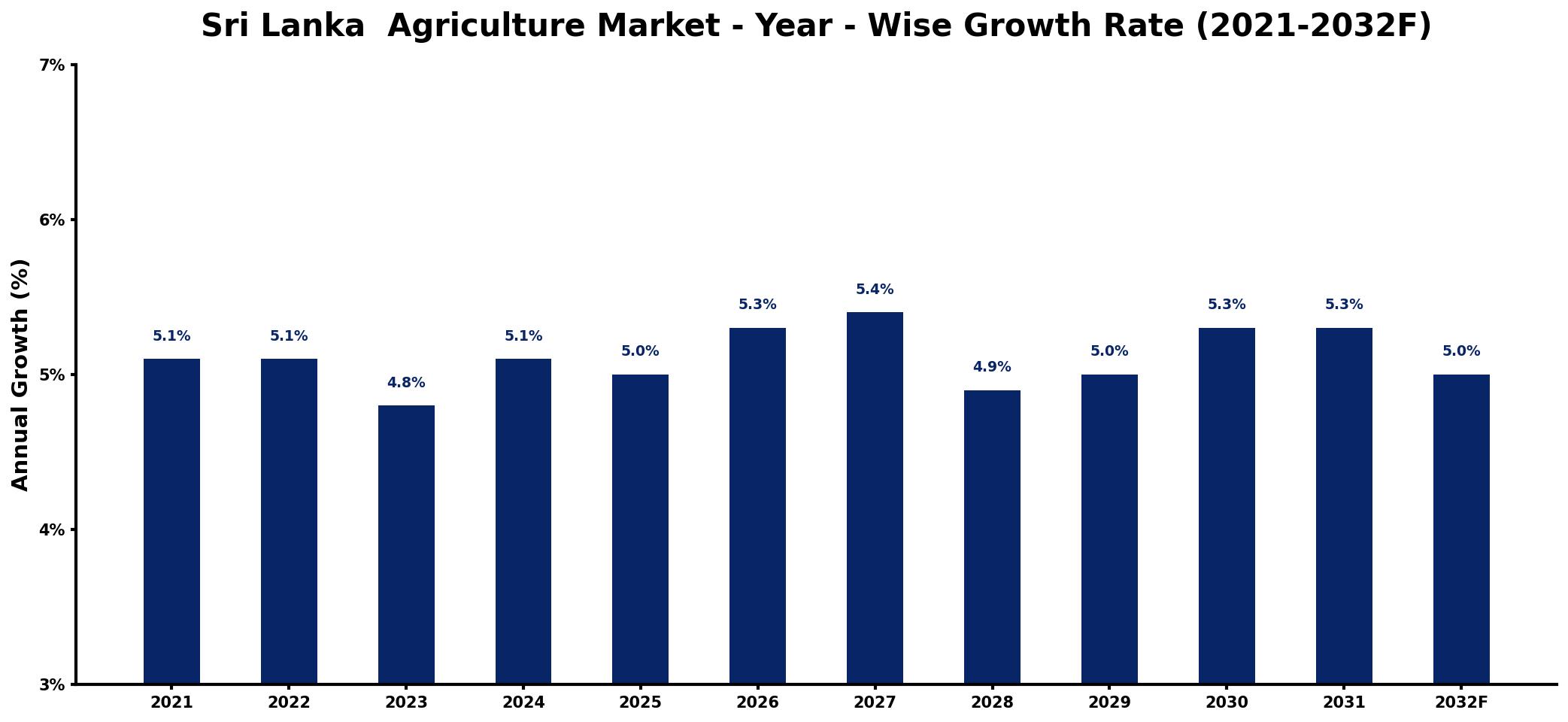
The table below presents the year‑wise growth rates along with the key drivers influencing the market
| Year | Growth Rate | Major Drivers |
| 2021 | 5.1% | Increased investment in technology |
| 2022 | 5.1% | Rising consumer demand for organic |
| 2023 | 4.8% | Expansion of export markets |
| 2024 | 5.1% | Growth in sustainable practices |
| 2025 | 5.0% | Diversification of crop production |
| 2026 | 5.3% | Advancements in irrigation systems |
| 2027 | 5.4% | Emergence of agritech startups |
| 2028 | 4.9% | Strengthening of supply chain networks |
| 2029 | 5.0% | Increased government support initiatives |
| 2030 | 5.3% | Growing interest in local sourcing |
| 2031 | 5.3% | Enhanced research and development |
| 2032 | 5.0% | Development of climate-resilient crops |
Note: Market size estimations and growth projections presented in this report are based on 6Wresearch's proprietary forecasting methodology, utilizing the latest available industry data, government publications, and primary research inputs.
Sri Lanka Agriculture Market Synopsis
Sri Lanka's agricultural landscape is marked by a rich tapestry of crops, most notably rice, tea, rubber, and coconut. These staples are not only vital for domestic consumption but also contribute significantly to export revenues, showcasing the sector's essential role in the national economy.
Smallholder farmers are the backbone of this industry, yet they grapple with challenges such as climate change and limited access to modern agricultural technologies. The governments efforts towards sustainable practices are gradually reshaping the sector, aiming to bolster productivity and foster market access for these crucial stakeholders.
Sri Lanka Agriculture Market Key Takeaways
- The agriculture sector contributes significantly to Sri Lankas economy, with tea and rubber as major export commodities.
- Investment in organic farming is increasing due to growing consumer demand for chemical-free products.
- Technological advancements, including precision agriculture, are being adopted to enhance efficiency.
- Government initiatives are focused on promoting sustainability and providing financial assistance to farmers.
- Diversification in crop and livestock production is emerging as a strategy to combat climate change impacts.
Evaluation of Restraints in Sri Lanka Agriculture Market
Despite its promising potential, the Sri Lanka Agriculture Market faces significant restraints. Limited access to modern technologies and agricultural techniques hampers productivity. Additionally, inadequate infrastructure and water scarcity complicate the landscape, making it difficult for farmers to thrive. Smallholders often deal with high production costs and lack adequate financing options, which exacerbates issues related to land fragmentation and outdated farming practices. To overcome these limitations, a multifaceted approach from government and private sectors is essential.
Sri Lanka Agriculture Market Trends
Emerging trends in the Sri Lanka Agriculture Market indicate a strong shift towards sustainability and technology integration. There is a marked increase in organic farming practices, driven by consumer preferences for healthier, chemical-free food options. Furthermore, the integration of digital tools and precision agriculture is enabling farmers to make data-driven decisions, improving their productivity. Additionally, diversification strategies are gaining traction, allowing farmers to withstand market fluctuations and climate variations more effectively.
Sri Lanka Agriculture Market Opportunities
Investment opportunities in the Sri Lanka Agriculture Market are vast. The cultivation of high-value crops like spices and organic produce presents lucrative prospects for both local and international investors. Additionally, advancements in the agro-processing sector allow for value addition to agricultural products, which can significantly enhance profitability. Infrastructure development, particularly in irrigation and cold storage, is crucial for bolstering the supply chain and ensuring product freshness, creating further avenues for investment.
Government Initiatives in the Sri Lanka Agriculture Market
The Sri Lankan government has rolled out a comprehensive set of policies aimed at revitalizing the agriculture sector. These include subsidies for essential inputs such as seeds and fertilizers, initiatives to promote organic farming, and financial assistance programs for smallholder farmers. Agricultural extension services have also been established to provide much-needed technical support. Furthermore, the government is working to enhance market access through the development of agricultural value chains and price stabilization programs.
Future Insights of the Sri Lanka Agriculture Market
Looking ahead to 2026-2032, the Sri Lanka Agriculture Market is poised for growth driven by modernization and a focus on sustainability. The government is expected to continue investing in infrastructure and farmer education, facilitating improvements in productivity. As organic and specialty crops gain traction, there will be an increasing need for diversification within the agricultural landscape. Despite ongoing challenges like climate change and access to financing, a proactive approach from stakeholders can ensure a resilient and competitive agricultural future.
Sri Lanka Agriculture Market Latest Developments (2025 - 2026)
Recent developments in the Sri Lankan agriculture sector highlight a growing interest in eco-friendly farming practices, with several farmer cooperatives adopting organic methods. Technological innovation is gaining momentum, as more farmers integrate digital solutions to track yields and optimize resource usage. Additionally, public and private sector collaborations are emerging to enhance irrigation systems, addressing water scarcity challenges, which remains a pivotal concern in sustaining agricultural output.
Sri Lanka Agriculture Market - Key Attractiveness of the Report
- 10 Years of Market Numbers
- Historical Data Starting from 2022 to 2025
- Base Year: 2025
- Forecast Data until 2032
- Key Performance Indicators Impacting the Market
- Major Upcoming Developments and Projects
Key Highlights of the Report:
- Sri Lanka Agriculture Market Outlook
- Market Size of Sri Lanka Agriculture Market, 2025
- Forecast of Sri Lanka Agriculture Market, 2032
- Historical Data and Forecast of Sri Lanka Agriculture Revenues & Volume for the Period 2022-2032F
- Sri Lanka Agriculture Market Trend Evolution
- Sri Lanka Agriculture Market Drivers and Challenges
- Sri Lanka Agriculture Price Trends
- Sri Lanka Agriculture Porter's Five Forces
- Sri Lanka Agriculture Industry Life Cycle
- Historical Data and Forecast of Sri Lanka Agriculture Market Revenues & Volume By Type for the Period 2022-2032F
- Historical Data and Forecast of Sri Lanka Agriculture Market Revenues & Volume By Animal Produce for the Period 2022-2032F
- Historical Data and Forecast of Sri Lanka Agriculture Market Revenues & Volume By Crop Production for the Period 2022-2032F
- Historical Data and Forecast of Sri Lanka Agriculture Market Revenues & Volume By Distribution Channel for the Period 2022-2032F
- Historical Data and Forecast of Sri Lanka Agriculture Market Revenues & Volume By Supermarkets/Hypermarkets for the Period 2022-2032F
- Historical Data and Forecast of Sri Lanka Agriculture Market Revenues & Volume By Convenience Stores for the Period 2022-2032F
- Historical Data and Forecast of Sri Lanka Agriculture Market Revenues & Volume By E-Commerce for the Period 2022-2032F
- Historical Data and Forecast of Sri Lanka Agriculture Market Revenues & Volume By Others for the Period 2022-2032F
- Historical Data and Forecast of Sri Lanka Agriculture Market Revenues & Volume By Nature for the Period 2022-2032F
- Historical Data and Forecast of Sri Lanka Agriculture Market Revenues & Volume By Organic for the Period 2022-2032F
- Historical Data and Forecast of Sri Lanka Agriculture Market Revenues & Volume By Conventional for the Period 2022-2032F
- Sri Lanka Agriculture Import Export Trade Statistics
- Market Opportunity Assessment By Type
- Market Opportunity Assessment By Distribution Channel
- Market Opportunity Assessment By Nature
- Sri Lanka Agriculture Top Companies Market Share
- Sri Lanka Agriculture Competitive Benchmarking By Technical and Operational Parameters
- Sri Lanka Agriculture Company Profiles
- Sri Lanka Agriculture Key Strategic Recommendations






































