Sri Lanka AI in IoT Market Size & Growth Rate (2026-2032)
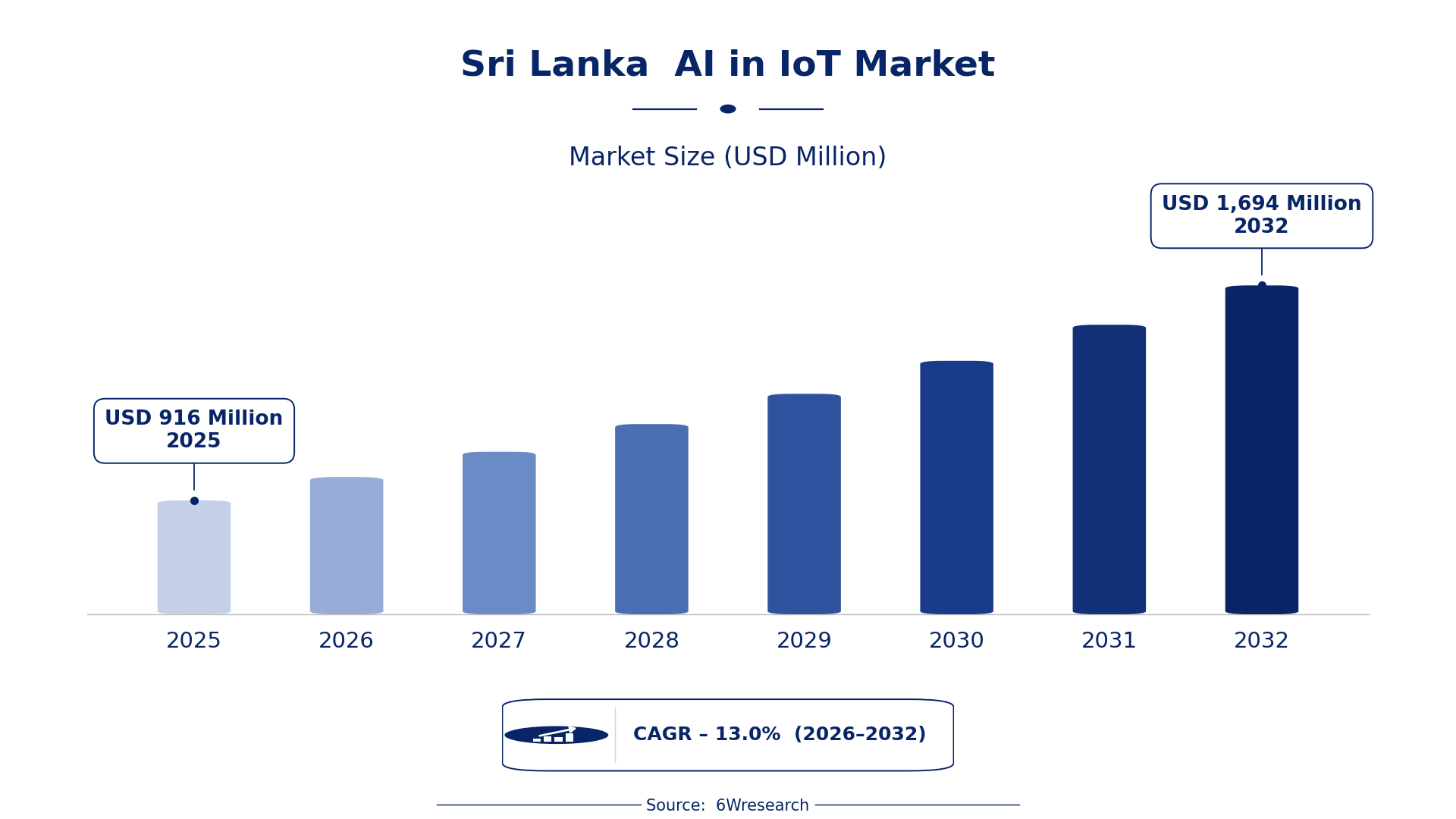
The Sri Lanka AI in IoT Market was estimated at USD 916 Million in 2025 and is projected to reach USD 1694 Million by 2032, growing at a CAGR of 13.0% from 2026 to 2032.
Sri Lanka AI in IoT Market Synopsis
The Sri Lanka AI in IoT market is currently experiencing notable momentum, driven by the rapid integration of IoT devices across diverse industries such as healthcare, manufacturing, and agriculture. This growth is not merely a fleeting trend; it reflects a broader movement towards digital transformation that is reshaping how businesses operate.
Looking ahead, the market is set to expand further, buoyed by advancements in AI technologies that enhance the functionality of IoT systems. As organizations increasingly seek data-driven insights and operational efficiencies, the convergence of these technologies is expected to open new avenues for innovation and service delivery.
Sri Lanka AI in IoT Market Year-wise Growth Rate and Key Drivers
This graph illustrates the annual growth rates of the Sri Lanka AI in IoT Market from 2021 to 2032, highlighting a steady upward trajectory and projected expansion over the forecast period.
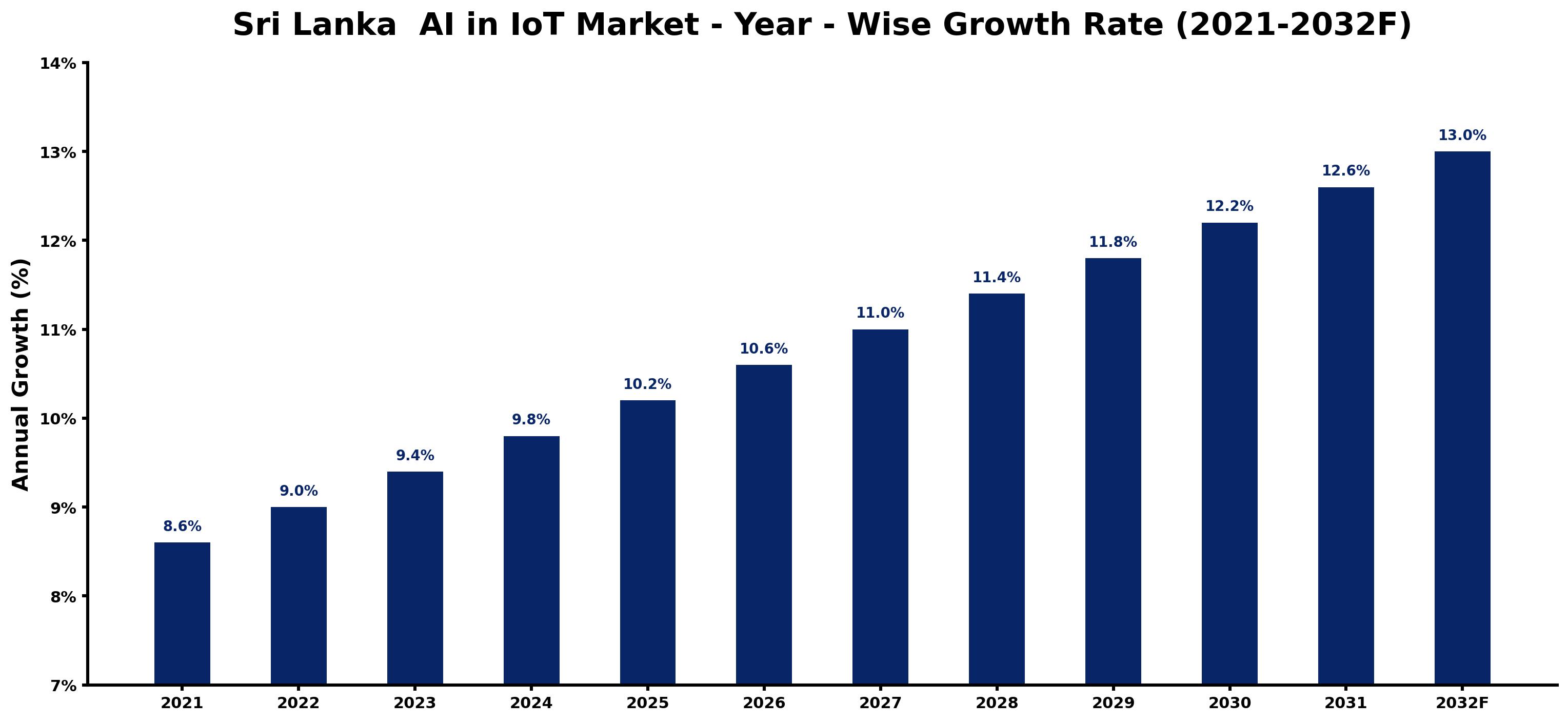
The table below presents the year‑wise growth rates along with the key drivers influencing the market
| Year | Growth Rate | Major Drivers |
| 2021 | 8.6% | Government initiative promoting AI research in universities. |
| 2022 | 9.0% | Increased local startups focusing on IoT solutions development. |
| 2023 | 9.4% | Launch of Smart Cities program by Urban Development Authority. |
| 2024 | 9.8% | Investment subsidies for AI and IoT tech innovations. |
| 2025 | 10.2% | Growing mobile penetration influencing IoT applications adoption. |
| 2026 | 10.6% | Partnerships between telecoms and tech firms boosting IoT deployment. |
| 2027 | 11.0% | Strengthening data protection regulations enhancing cybersecurity in IoT. |
| 2028 | 11.4% | Rising interest in sustainable energy solutions via IoT. |
| 2029 | 11.8% | Surge in e-commerce driving demand for smart logistics. |
| 2030 | 12.2% | Increased government funding for IoT research initiatives. |
| 2031 | 12.6% | Emergence of AI-driven smart transport solutions for urban mobility. |
| 2032 | 13.0% | Collaboration with international tech firms accelerating IoT advancements. |
Note: Market size estimations and growth projections presented in this report are based on 6Wresearch's proprietary forecasting methodology, utilizing the latest available industry data, government publications, and primary research inputs.
Sri Lanka AI in IoT Market Key Takeaways
Below are some of the specific key takeaways from the market, including:
- The integration of AI with IoT is enhancing decision-making processes across various sectors.
- Government initiatives are fostering a conducive environment for the adoption of AI and IoT technologies.
- Investment opportunities are emerging in predictive maintenance and personalized services.
- Data security concerns remain a critical challenge for market players.
- Startups are playing a vital role in driving innovation within the AI in IoT space.
Evaluation of Restraints in Sri Lanka AI in IoT Market
Several key factors are hindering the growth of the Sri Lanka AI in IoT market. A primary concern is the shortage of skilled professionals who can adeptly handle both AI and IoT technologies. This talent gap limits companies' ability to implement and manage advanced solutions effectively. on top of that, data privacy and security issues pose significant challenges, as the integration of AI and IoT often involves handling sensitive information, increasing the risk of cyber threats. These barriers need to be addressed to unlock the market's full potential.
Sri Lanka AI in IoT Market Trends
The current trends in the Sri Lanka AI in IoT market highlight a strong inclination towards smart technologies. Businesses are increasingly adopting AI algorithms to boost the capabilities of IoT devices, facilitating predictive maintenance and real-time data analytics. This trend is particularly pronounced in sectors like healthcare, agriculture, and transportation, where efficiency and cost reduction are paramount. Additionally, advancements in edge computing and machine learning are shaping the future, promoting further innovation in AI-enabled IoT applications.
Sri Lanka AI in IoT Market Opportunities
The Sri Lanka AI in IoT market presents substantial investment opportunities, particularly in healthcare and smart city initiatives. As IoT adoption accelerates, the demand for AI-powered solutions that analyze data for actionable insights is growing. Investors should focus on developing technologies for remote monitoring, asset tracking, and personalized healthcare services. Collaborations with local businesses can enhance market presence and foster innovation tailored to local needs, driving long-term growth.
Government Initiatives in the Sri Lanka AI in IoT Market
The Sri Lankan government is actively promoting the growth of the AI and IoT sectors through various strategic initiatives. These efforts aim to create a supportive regulatory environment while prioritizing digital transformation across industries. Public policy plays a crucial role in facilitating the deployment of AI and IoT technologies, ensuring data protection, and fostering collaboration among stakeholders. Such initiatives are essential for positioning Sri Lanka as a competitive player in the global AI in IoT market.
- A national digital infrastructure upgrade programme launched in early 2025 aims to enhance connectivity and support IoT deployment.
- Current initiatives include a public-private partnership focused on developing AI training programs to bridge the skills gap in the workforce.
- A regulatory framework introduced in 2025 mandates data protection measures, ensuring security in IoT applications.
- Upcoming plans include a comprehensive strategy expected to roll out by 2027, promoting AI integration across public services.
- The government is currently working on establishing innovation hubs to encourage startups in the AI and IoT sectors.
Future Insights of the Sri Lanka AI in IoT Market
Looking towards 2026-2032, the Sri Lanka AI in IoT market is set for substantial growth. The continuous evolution of AI technologies and their integration with IoT systems will drive operational efficiencies and improve customer experiences across sectors. With the government's commitment to digital transformation and the increasing interest from businesses, we anticipate significant advancements in sectors like healthcare, agriculture, and smart cities, making this market an attractive arena for investment and innovation.
Sri Lanka AI in IoT Market Latest Developments
In the past year, the Sri Lanka AI in IoT market has seen a flurry of activity as companies ramp up efforts to innovate and implement new technologies. The focus has been on creating AI-driven solutions that enhance the functionality of IoT devices. These developments indicate a strong commitment to harnessing technology for improved efficiency and service delivery.
- A major technology vendor announced the rollout of an AI-based predictive maintenance system in Q2 2025, aimed at the manufacturing sector.
- A leading regional operator is currently deploying an IoT network that integrates AI analytics for smart agriculture, set to enhance yield predictions by mid-2026.
- In early 2025, a new partnership was formed between local tech startups to develop AI solutions tailored for the healthcare industry.
- Another initiative, which began in late 2025, focuses on upgrading existing IoT infrastructure to support advanced AI capabilities across urban areas.
- An upcoming project planned for 2027 will introduce AI technologies to optimize traffic management in major cities, enhancing urban mobility.
Sri Lanka AI in IoT Market - Key Attractiveness of the Report
- 10 Years of Market Numbers
- Historical Data Starting from 2022 to 2025
- Base Year: 2025
- Forecast Data until 2032
- Key Performance Indicators Impacting the Market
- Major Upcoming Developments and Projects
Key Highlights of the Report:
- Sri Lanka AI in IoT Market Outlook
- Market Size of Sri Lanka AI in IoT Market, 2025
- Forecast of Sri Lanka AI in IoT Market, 2032
- Historical Data and Forecast of Sri Lanka AI in IoT Revenues & Volume for the Period 2022-2032F
- Sri Lanka AI in IoT Market Trend Evolution
- Sri Lanka AI in IoT Market Drivers and Challenges
- Sri Lanka AI in IoT Price Trends
- Sri Lanka AI in IoT Porter's Five Forces
- Sri Lanka AI in IoT Industry Life Cycle
- Historical Data and Forecast of Sri Lanka AI in IoT Market Revenues & Volume By Component for the Period 2022-2032F
- Historical Data and Forecast of Sri Lanka AI in IoT Market Revenues & Volume By Platforms for the Period 2022-2032F
- Historical Data and Forecast of Sri Lanka AI in IoT Market Revenues & Volume By Software Solutions for the Period 2022-2032F
- Historical Data and Forecast of Sri Lanka AI in IoT Market Revenues & Volume By Services for the Period 2022-2032F
- Historical Data and Forecast of Sri Lanka AI in IoT Market Revenues & Volume By Vertical for the Period 2022-2032F
- Historical Data and Forecast of Sri Lanka AI in IoT Market Revenues & Volume By Manufacturing for the Period 2022-2032F
- Historical Data and Forecast of Sri Lanka AI in IoT Market Revenues & Volume By Energy and Utilities for the Period 2022-2032F
- Historical Data and Forecast of Sri Lanka AI in IoT Market Revenues & Volume By Transportation and Mobility for the Period 2022-2032F
- Historical Data and Forecast of Sri Lanka AI in IoT Market Revenues & Volume By BFSI for the Period 2022-2032F
- Historical Data and Forecast of Sri Lanka AI in IoT Market Revenues & Volume By Government and Defense for the Period 2022-2032F
- Historical Data and Forecast of Sri Lanka AI in IoT Market Revenues & Volume By Retail for the Period 2022-2032F
- Historical Data and Forecast of Sri Lanka AI in IoT Market Revenues & Volume By Healthcare and Life Sciences for the Period 2022-2032F
- Historical Data and Forecast of Sri Lanka AI in IoT Market Revenues & Volume By Telecom for the Period 2022-2032F
- Historical Data and Forecast of Sri Lanka AI in IoT Market Revenues & Volume By Technology for the Period 2022-2032F
- Historical Data and Forecast of Sri Lanka AI in IoT Market Revenues & Volume By ML and Deep Learning for the Period 2022-2032F
- Historical Data and Forecast of Sri Lanka AI in IoT Market Revenues & Volume By NLP for the Period 2022-2032F
- Sri Lanka AI in IoT Import Export Trade Statistics
- Market Opportunity Assessment By Component
- Market Opportunity Assessment By Vertical
- Market Opportunity Assessment By Technology
- Sri Lanka AI in IoT Top Companies Market Share
- Sri Lanka AI in IoT Competitive Benchmarking By Technical and Operational Parameters
- Sri Lanka AI in IoT Company Profiles
- Sri Lanka AI in IoT Key Strategic Recommendations






































