Sri Lanka Aircraft Cabin Interior Market Size, Share & Growth Rate
The Sri Lanka Aircraft Cabin Interior Market was estimated at USD 762 Million in 2025 and is projected to reach USD 1263 Million by 2032, growing at a CAGR of 7.5% from 2026 to 2032. This growth trajectory is primarily driven by the increasing demand for air travel in the region, alongside airlines' ongoing modernization efforts. With a heightened focus on enhancing passenger comfort and the adoption of innovative technologies, the market is poised for significant advancements.
Sri Lanka Aircraft Cabin Interior Market Year-wise Growth Rate and Key Drivers
This graph highlights how the Sri Lanka Aircraft Cabin Interior Market has steadily grown over the years, supported by major growth factors.
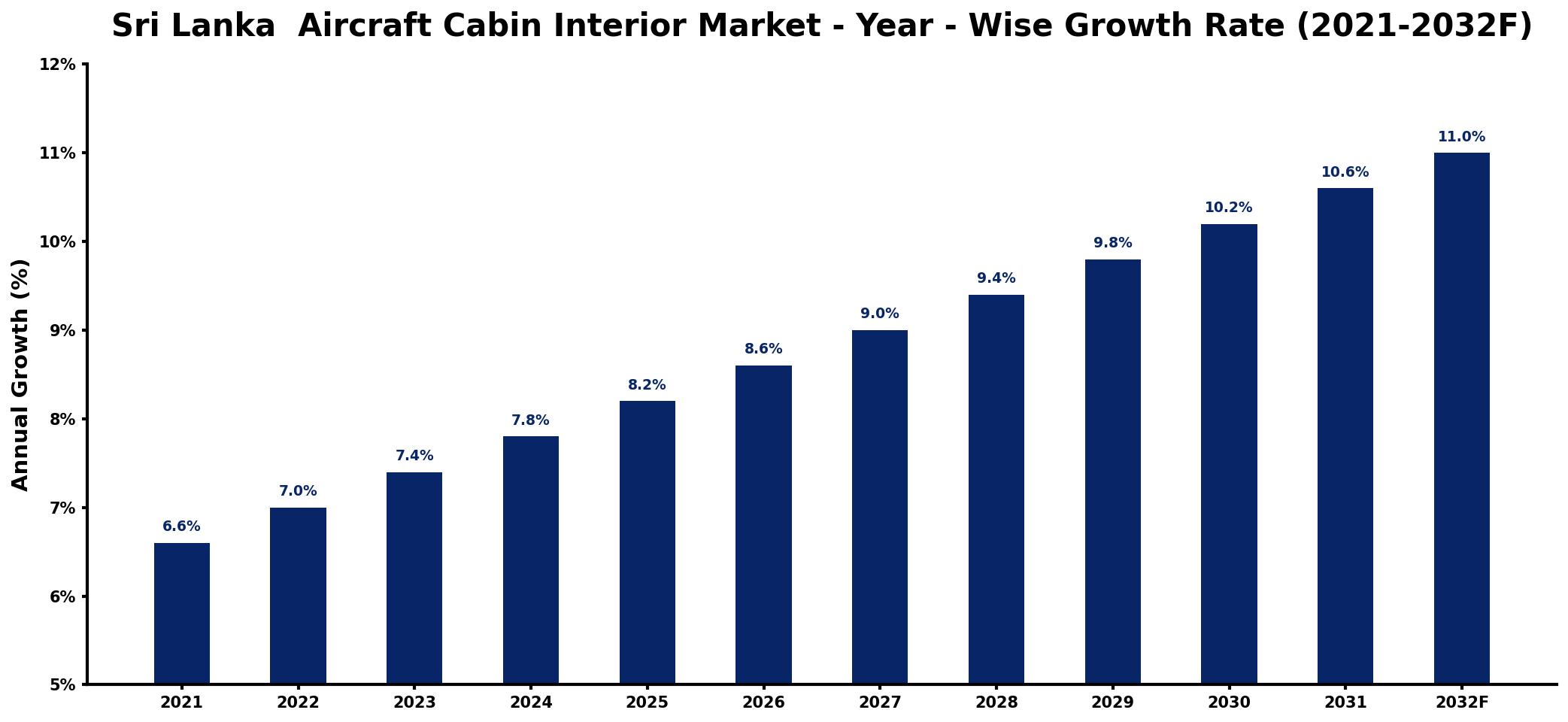
The table below presents the year‑wise growth rates along with the key drivers influencing the market
| Year | Growth Rate | Major Drivers |
| 2021 | 6.6% | Rising passenger travel demand |
| 2022 | 7.0% | Increased airline fleet expansion |
| 2023 | 7.4% | Growing focus on sustainability |
| 2024 | 7.8% | Technological advancements in materials |
| 2025 | 8.2% | Strengthening global tourism recovery |
| 2026 | 8.6% | Investment in modernization projects |
| 2027 | 9.0% | Enhanced passenger experience expectations |
| 2028 | 9.4% | Emerging markets driving growth |
| 2029 | 9.8% | Higher emphasis on safety standards |
| 2030 | 10.2% | Integration of smart technologies |
| 2031 | 10.6% | Demand for luxury travel options |
| 2032 | 11.0% | Improved regulatory support initiatives |
Note: Market size estimations and growth projections presented in this report are based on 6Wresearch's proprietary forecasting methodology, utilizing the latest available industry data, government publications, and primary research inputs.
Sri Lanka Aircraft Cabin Interior Market Synopsis
A major force shaping the Sri Lanka Aircraft Cabin Interior Market is the rising demand for lightweight materials aimed at improving fuel efficiency. Airlines are now prioritizing sustainable cabin solutions that not only reduce operational costs but also enhance the overall passenger experience.
Additionally, the integration of advanced technologies in cabin interiors is transforming the way airlines approach passenger comfort and engagement. There is a notable shift towards customizable in-flight experiences, featuring premium seating and high-quality entertainment systems that cater to the evolving preferences of travelers.
Sri Lanka Aircraft Cabin Interior Market Key Takeaways
- The market is set to grow significantly, propelled by increased air travel demand and airline modernization.
- Sustainable practices are becoming essential, with a strong focus on eco-friendly materials in cabin interiors.
- Technological advancements are enhancing in-flight experiences, driving demand for connectivity solutions and entertainment options.
- Infrastructure investments in the aviation sector are expected to spur further opportunities in cabin interior solutions.
- Collaboration between manufacturers and airlines can lead to tailored solutions that meet specific needs.
Evaluation of Restraints in Sri Lanka Aircraft Cabin Interior Market
Despite the positive outlook, several factors are constraining growth in the Sri Lanka Aircraft Cabin Interior Market. One key restraint is the limited domestic manufacturing capabilities for cabin components, which results in a reliance on imports. This dependency can lead to fluctuations in costs due to exchange rate volatility. Moreover, regulatory compliance with international safety and quality standards can pose challenges for local manufacturers, who may lack the necessary technical expertise. Overall, these limitations necessitate strategic adaptations by companies operating within the market to maintain competitiveness.
Sri Lanka Aircraft Cabin Interior Market Trends
A notable trend in the Sri Lanka Aircraft Cabin Interior Market is the increasing adoption of lightweight materials that enhance aircraft performance and reduce fuel consumption. This focus on efficiency is complemented by airlines efforts to provide superior passenger comfort, leading to a rise in premium seating options and advanced in-flight entertainment systems. Additionally, the COVID-19 pandemic has amplified the demand for hygiene-conscious designs, resulting in the implementation of antimicrobial surfaces and touchless technologies in cabin interiors.
Sri Lanka Aircraft Cabin Interior Market Opportunities
Investing in the Sri Lanka Aircraft Cabin Interior Market offers substantial opportunities for growth, particularly in the domains of innovative seating solutions and cutting-edge entertainment systems. Airlines are eager to enhance passenger experiences, which creates a fertile ground for companies that can deliver bespoke and high-quality cabin interior products. Furthermore, focusing on research and development to incorporate lightweight and sustainable materials can significantly contribute to market positioning, while strategic partnerships with airlines for customized solutions can boost profitability.
Government Initiatives in the Sri Lanka Aircraft Cabin Interior Market
While there are no specific policies targeting the Aircraft Cabin Interior Market directly, the Sri Lankan government is committed to promoting the overall aviation sector. Efforts include improving aviation infrastructure, enhancing safety regulations, and encouraging foreign investment, which indirectly supports the growth of cabin interior solutions. Such initiatives aim to create a conducive environment for airlines, paving the way for expanded fleet operations and modernization projects that benefit the cabin interior market.
Future Insights of the Sri Lanka Aircraft Cabin Interior Market
Looking ahead to the 2026-2032 period, the Sri Lanka Aircraft Cabin Interior Market is expected to continue on its growth trajectory, driven by rising disposable incomes and changing consumer expectations. Airlines will likely place increased emphasis on innovative, technology-driven cabin interiors that prioritize passenger comfort and engagement. However, potential fluctuations in fuel prices and regulatory hurdles may present challenges. Companies that can navigate these dynamics effectively will position themselves favorably in the evolving market landscape.
Sri Lanka Aircraft Cabin Interior Market Latest Developments (2025 - 2026)
Recent developments in the Sri Lanka Aircraft Cabin Interior Market reflect a growing emphasis on innovative solutions and sustainability. Several manufacturers have started to explore the integration of eco-friendly materials in cabin designs to cater to the increasing consumer demand for environmentally conscious options. Additionally, airlines are piloting new concepts that incorporate advanced technology to enhance the passenger experience, signaling a trend towards modernization in cabin interiors.
Sri Lanka Aircraft Cabin Interior Market - Key Attractiveness of the Report
- 10 Years of Market Numbers
- Historical Data Starting from 2022 to 2025
- Base Year: 2025
- Forecast Data until 2032
- Key Performance Indicators Impacting the Market
- Major Upcoming Developments and Projects
Key Highlights of the Report:
- Sri Lanka Aircraft Cabin Interior Market Outlook
- Market Size of Sri Lanka Aircraft Cabin Interior Market, 2025
- Forecast of Sri Lanka Aircraft Cabin Interior Market, 2032
- Historical Data and Forecast of Sri Lanka Aircraft Cabin Interior Revenues & Volume for the Period 2022-2032F
- Sri Lanka Aircraft Cabin Interior Market Trend Evolution
- Sri Lanka Aircraft Cabin Interior Market Drivers and Challenges
- Sri Lanka Aircraft Cabin Interior Price Trends
- Sri Lanka Aircraft Cabin Interior Porter's Five Forces
- Sri Lanka Aircraft Cabin Interior Industry Life Cycle
- Historical Data and Forecast of Sri Lanka Aircraft Cabin Interior Market Revenues & Volume By Type for the Period 2022-2032F
- Historical Data and Forecast of Sri Lanka Aircraft Cabin Interior Market Revenues & Volume By Seats for the Period 2022-2032F
- Historical Data and Forecast of Sri Lanka Aircraft Cabin Interior Market Revenues & Volume By Cabin Lightening for the Period 2022-2032F
- Historical Data and Forecast of Sri Lanka Aircraft Cabin Interior Market Revenues & Volume By Windows and Windshields for the Period 2022-2032F
- Historical Data and Forecast of Sri Lanka Aircraft Cabin Interior Market Revenues & Volume By Galley and Lavatory for the Period 2022-2032F
- Historical Data and Forecast of Sri Lanka Aircraft Cabin Interior Market Revenues & Volume By In-Flight Entertainment & Connectivity for the Period 2022-2032F
- Historical Data and Forecast of Sri Lanka Aircraft Cabin Interior Market Revenues & Volume By Others for the Period 2022-2032F
- Historical Data and Forecast of Sri Lanka Aircraft Cabin Interior Market Revenues & Volume By Class for the Period 2022-2032F
- Historical Data and Forecast of Sri Lanka Aircraft Cabin Interior Market Revenues & Volume By First Class for the Period 2022-2032F
- Historical Data and Forecast of Sri Lanka Aircraft Cabin Interior Market Revenues & Volume By Business Class for the Period 2022-2032F
- Historical Data and Forecast of Sri Lanka Aircraft Cabin Interior Market Revenues & Volume By Premium Economy Class for the Period 2022-2032F
- Historical Data and Forecast of Sri Lanka Aircraft Cabin Interior Market Revenues & Volume By Economy Class for the Period 2022-2032F
- Historical Data and Forecast of Sri Lanka Aircraft Cabin Interior Market Revenues & Volume By Aircraft Type for the Period 2022-2032F
- Historical Data and Forecast of Sri Lanka Aircraft Cabin Interior Market Revenues & Volume By Narrow Body Aircraft for the Period 2022-2032F
- Historical Data and Forecast of Sri Lanka Aircraft Cabin Interior Market Revenues & Volume By Wide-Body Aircraft for the Period 2022-2032F
- Historical Data and Forecast of Sri Lanka Aircraft Cabin Interior Market Revenues & Volume By Business Jets for the Period 2022-2032F
- Historical Data and Forecast of Sri Lanka Aircraft Cabin Interior Market Revenues & Volume By Regional Transport Aircraft for the Period 2022-2032F
- Historical Data and Forecast of Sri Lanka Aircraft Cabin Interior Market Revenues & Volume By End User for the Period 2022-2032F
- Historical Data and Forecast of Sri Lanka Aircraft Cabin Interior Market Revenues & Volume By OEM for the Period 2022-2032F
- Historical Data and Forecast of Sri Lanka Aircraft Cabin Interior Market Revenues & Volume By Aftermarket for the Period 2022-2032F
- Sri Lanka Aircraft Cabin Interior Import Export Trade Statistics
- Market Opportunity Assessment By Type
- Market Opportunity Assessment By Class
- Market Opportunity Assessment By Aircraft Type
- Market Opportunity Assessment By End User
- Sri Lanka Aircraft Cabin Interior Top Companies Market Share
- Sri Lanka Aircraft Cabin Interior Competitive Benchmarking By Technical and Operational Parameters
- Sri Lanka Aircraft Cabin Interior Company Profiles
- Sri Lanka Aircraft Cabin Interior Key Strategic Recommendations






































