Sri Lanka Apparel Accessories Market Size, Share & Growth Rate
The Sri Lanka Apparel Accessories Market was estimated at USD 253 Million in 2025 and is projected to reach USD 340 Million by 2032, growing at a CAGR of 4.3% from 2026 to 2032. This growth is being propelled by a rising consumer appetite for stylish accessories that align with contemporary fashion trends. Furthermore, an increasing awareness of sustainability among Sri Lankan consumers is driving the market towards ethically sourced and environmentally friendly products.
Sri Lanka Apparel Accessories Market Year-wise Growth Rate and Key Drivers
This graph highlights how the Sri Lanka Apparel Accessories Market has steadily grown over the years, supported by major growth factors.
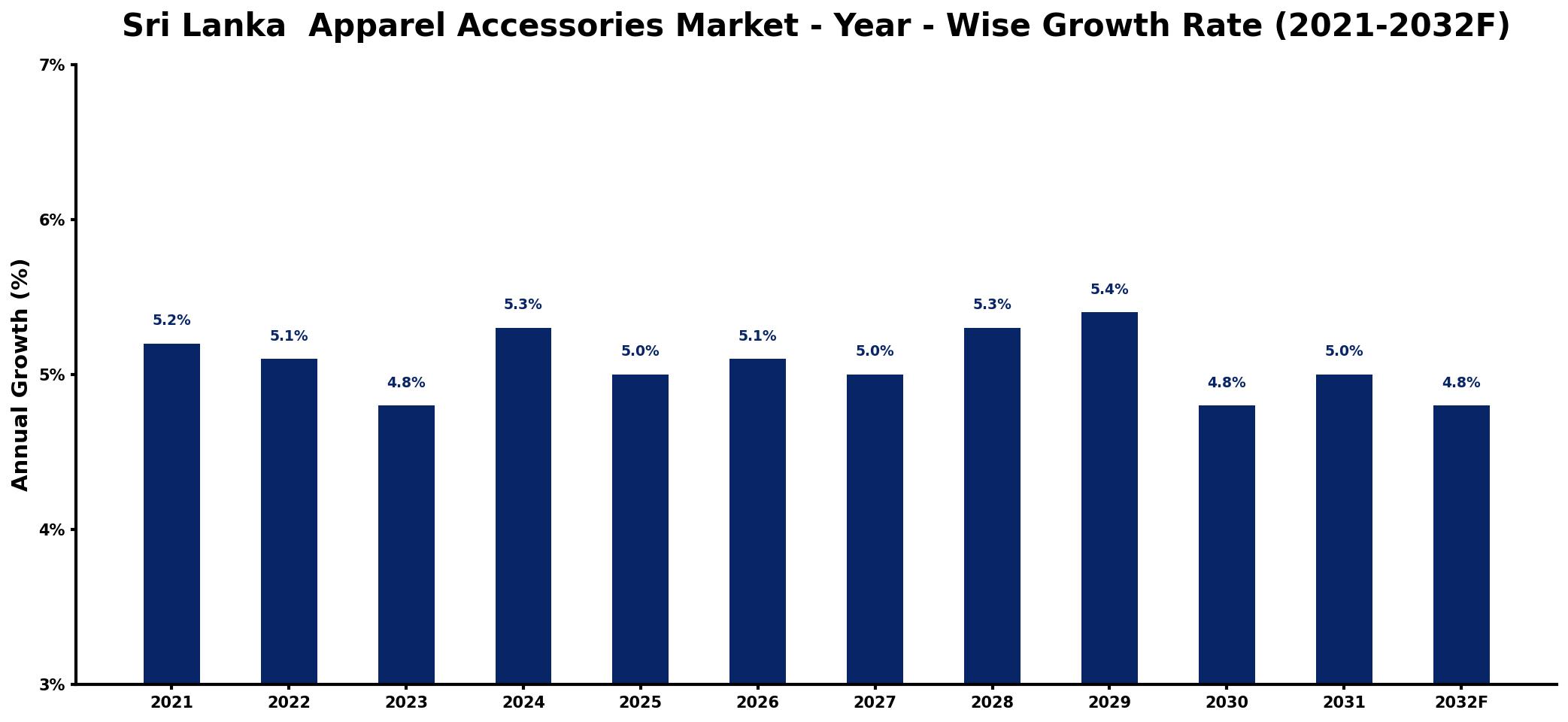
The table below presents the year‑wise growth rates along with the key drivers influencing the market
| Year | Growth Rate | Major Drivers |
| 2021 | 5.2% | Rising consumer spending power |
| 2022 | 5.1% | Increased online shopping trends |
| 2023 | 4.8% | Expansion of retail distribution |
| 2024 | 5.3% | Growing fashion influencer impact |
| 2025 | 5.0% | Emergence of sustainable brands |
| 2026 | 5.1% | Enhanced supply chain efficiency |
| 2027 | 5.0% | Boost in local manufacturing capacity |
| 2028 | 5.3% | Rising demand for customization |
| 2029 | 5.4% | Growth of eco-friendly practices |
| 2030 | 4.8% | Shift towards minimalism aesthetic |
| 2031 | 5.0% | Increased focus on brand loyalty |
| 2032 | 4.8% | Enhanced digital marketing strategies |
Note: Market size estimations and growth projections presented in this report are based on 6Wresearch's proprietary forecasting methodology, utilizing the latest available industry data, government publications, and primary research inputs.
Sri Lanka Apparel Accessories Market Synopsis
Sustainability stands as the strongest force shaping the Sri Lanka Apparel Accessories Market today. As consumers become increasingly conscientious about their purchasing decisions, the demand for eco-friendly materials and ethically produced items is surging. Local manufacturers are responding to this shift by incorporating sustainable practices into their production processes, ensuring that they cater to a growing market segment that values both style and responsibility.
Additionally, the versatility of accessories is influencing market dynamics. Shoppers are gravitating towards multi-functional items that can seamlessly transition between various outfits and occasions. This trend underscores a broader demand for products that not only elevate fashion but also offer practicality, further energizing the market landscape.
Sri Lanka Apparel Accessories Market Key Takeaways
- The market is expected to grow from USD 253 Million in 2025 to USD 340 Million by 2032.
- Consumer demand is shifting towards sustainable and ethically produced accessories.
- Versatile products that serve multiple purposes are gaining traction among consumers.
- Intense competition from neighboring countries presents ongoing challenges.
- Government policies are actively supporting growth in the apparel accessories sector.
Evaluation of Restraints in Sri Lanka Apparel Accessories Market
The Sri Lanka Apparel Accessories Market faces several real restraints that could limit its growth potential. Intense competition from established players in India and Bangladesh often results in price wars, as these countries can produce similar items at lower costs. Moreover, fluctuations in raw material prices create uncertainty, impacting production expenses for local manufacturers. Limited access to advanced technology and a skilled workforce in specific areas further complicate growth, as businesses strive to innovate while maintaining quality. Compliance with international standards adds an additional layer of complexity for manufacturers aiming to expand into global markets.
Sri Lanka Apparel Accessories Market Trends
The trend towards sustainability is at the forefront of the Sri Lanka Apparel Accessories Market, as consumers increasingly prefer products made from organic cotton, recycled materials, and other eco-friendly sources. This is complemented by a growing interest in versatile accessories, prompting brands to develop items that can be styled in multiple ways. Moreover, the digital transformation of retail, notably through e-commerce and social media, is enabling brands to reach broader audiences while showcasing their commitment to sustainability and innovation.
Sri Lanka Apparel Accessories Market Opportunities
The Sri Lanka Apparel Accessories Market presents myriad investment opportunities, particularly in the realm of sustainable production. Investors can tap into the supply chain by providing eco-friendly raw materials, such as organic fabrics and recycled components. Moreover, fostering collaborations with local designers could pave the way for innovative product lines that reflect both local craftsmanship and global trends. As e-commerce platforms continue to rise, opportunities for online retailing and targeted marketing campaigns are abundant, making it an appealing area for strategic investment.
Government Initiatives in the Sri Lanka Apparel Accessories Market
The Sri Lankan government is actively fostering the growth of the apparel accessories market through various supportive policies. This includes offering tax incentives and duty-free access to promote investment in the sector. Additionally, there are ongoing improvements in industrial infrastructure, particularly in regions where manufacturing is concentrated. The government is also placing emphasis on compliance with international labor and environmental standards, thereby enhancing the industry's global competitiveness and reputation.
Future Insights of the Sri Lanka Apparel Accessories Market
Looking ahead to the period from 2026 to 2032, the Sri Lanka Apparel Accessories Market is expected to continue its upward trajectory. Factors such as rising disposable incomes, evolving fashion preferences, and an enhanced focus on personal style will drive growth. The market's established reputation for quality manufacturing positions it well to cater to both local and international customers. E-commerce advancements are also anticipated to reshape shopping behaviors, further boosting sales as consumers seek unique, stylish accessories that align with their values.
Sri Lanka Apparel Accessories Market Latest Developments (2025 - 2026)
Recent developments in the Sri Lanka Apparel Accessories Market have highlighted a concerted shift towards sustainable practices among manufacturers. Many companies are investing in technology that allows for better resource management and waste reduction, aligning with global trends towards environmental responsibility. There is also a growing trend of collaborations between local artisans and international brands, leading to innovative product offerings that blend local craftsmanship with global appeal.
Sri Lanka Apparel Accessories Market - Key Attractiveness of the Report
- 10 Years of Market Numbers
- Historical Data Starting from 2022 to 2025
- Base Year: 2025
- Forecast Data until 2032
- Key Performance Indicators Impacting the Market
- Major Upcoming Developments and Projects
Key Highlights of the Report:
- Sri Lanka Apparel Accessories Market Outlook
- Market Size of Sri Lanka Apparel Accessories Market, 2025
- Forecast of Sri Lanka Apparel Accessories Market, 2032
- Historical Data and Forecast of Sri Lanka Apparel Accessories Revenues & Volume for the Period 2022-2032F
- Sri Lanka Apparel Accessories Market Trend Evolution
- Sri Lanka Apparel Accessories Market Drivers and Challenges
- Sri Lanka Apparel Accessories Price Trends
- Sri Lanka Apparel Accessories Porter's Five Forces
- Sri Lanka Apparel Accessories Industry Life Cycle
- Historical Data and Forecast of Sri Lanka Apparel Accessories Market Revenues & Volume By Product for the Period 2022-2032F
- Historical Data and Forecast of Sri Lanka Apparel Accessories Market Revenues & Volume By Belts for the Period 2022-2032F
- Historical Data and Forecast of Sri Lanka Apparel Accessories Market Revenues & Volume By Handbags for the Period 2022-2032F
- Historical Data and Forecast of Sri Lanka Apparel Accessories Market Revenues & Volume By Scarves for the Period 2022-2032F
- Historical Data and Forecast of Sri Lanka Apparel Accessories Market Revenues & Volume By Eye wear for the Period 2022-2032F
- Historical Data and Forecast of Sri Lanka Apparel Accessories Market Revenues & Volume By Jewelry for the Period 2022-2032F
- Historical Data and Forecast of Sri Lanka Apparel Accessories Market Revenues & Volume By Neckties for the Period 2022-2032F
- Historical Data and Forecast of Sri Lanka Apparel Accessories Market Revenues & Volume By Gloves for the Period 2022-2032F
- Historical Data and Forecast of Sri Lanka Belts Apparel Accessories Market Revenues & Volume By Others for the Period 2022-2032F
- Historical Data and Forecast of Sri Lanka Apparel Accessories Market Revenues & Volume By Demographic for the Period 2022-2032F
- Historical Data and Forecast of Sri Lanka Apparel Accessories Market Revenues & Volume By Men for the Period 2022-2032F
- Historical Data and Forecast of Sri Lanka Apparel Accessories Market Revenues & Volume By Women for the Period 2022-2032F
- Historical Data and Forecast of Sri Lanka Apparel Accessories Market Revenues & Volume By Children for the Period 2022-2032F
- Historical Data and Forecast of Sri Lanka Apparel Accessories Market Revenues & Volume By Price for the Period 2022-2032F
- Historical Data and Forecast of Sri Lanka Apparel Accessories Market Revenues & Volume By Economical Apparel Accessories for the Period 2022-2032F
- Historical Data and Forecast of Sri Lanka Apparel Accessories Market Revenues & Volume By Mid-range Apparel Accessories for the Period 2022-2032F
- Historical Data and Forecast of Sri Lanka Apparel Accessories Market Revenues & Volume By Premium Apparel Accessories for the Period 2022-2032F
- Historical Data and Forecast of Sri Lanka Apparel Accessories Market Revenues & Volume By Super-premium Apparel Accessories for the Period 2022-2032F
- Historical Data and Forecast of Sri Lanka Apparel Accessories Market Revenues & Volume By Sales Channel for the Period 2022-2032F
- Historical Data and Forecast of Sri Lanka Apparel Accessories Market Revenues & Volume By Apparel Accessories Sold through Modern Trade for the Period 2022-2032F
- Historical Data and Forecast of Sri Lanka Apparel Accessories Market Revenues & Volume By Apparel Accessories Sold at Franchise Outlets for the Period 2022-2032F
- Historical Data and Forecast of Sri Lanka Apparel Accessories Market Revenues & Volume By Apparel Accessories Sold at Specialty Stores for the Period 2022-2032F
- Historical Data and Forecast of Sri Lanka Apparel Accessories Market Revenues & Volume By Others for the Period 2022-2032F
- Sri Lanka Apparel Accessories Import Export Trade Statistics
- Market Opportunity Assessment By Product
- Market Opportunity Assessment By Demographic
- Market Opportunity Assessment By Price
- Market Opportunity Assessment By Sales Channel
- Sri Lanka Apparel Accessories Top Companies Market Share
- Sri Lanka Apparel Accessories Competitive Benchmarking By Technical and Operational Parameters
- Sri Lanka Apparel Accessories Company Profiles
- Sri Lanka Apparel Accessories Key Strategic Recommendations






































