Sri Lanka Apparel & Textile Machinery Market Summary
The sri lanka apparel & textile machinery market was estimated at USD 202 Million in 2025 and is projected to reach USD 277 Million by 2032, growing at a CAGR of 5.3% from 2026 to 2032.
Sri Lanka Apparel & Textile Machinery Market Year-wise Growth Rate and Key Drivers
This graph highlights how the Sri Lanka Apparel & Textile Machinery Market has steadily grown over the past five years, supported by major growth factors.
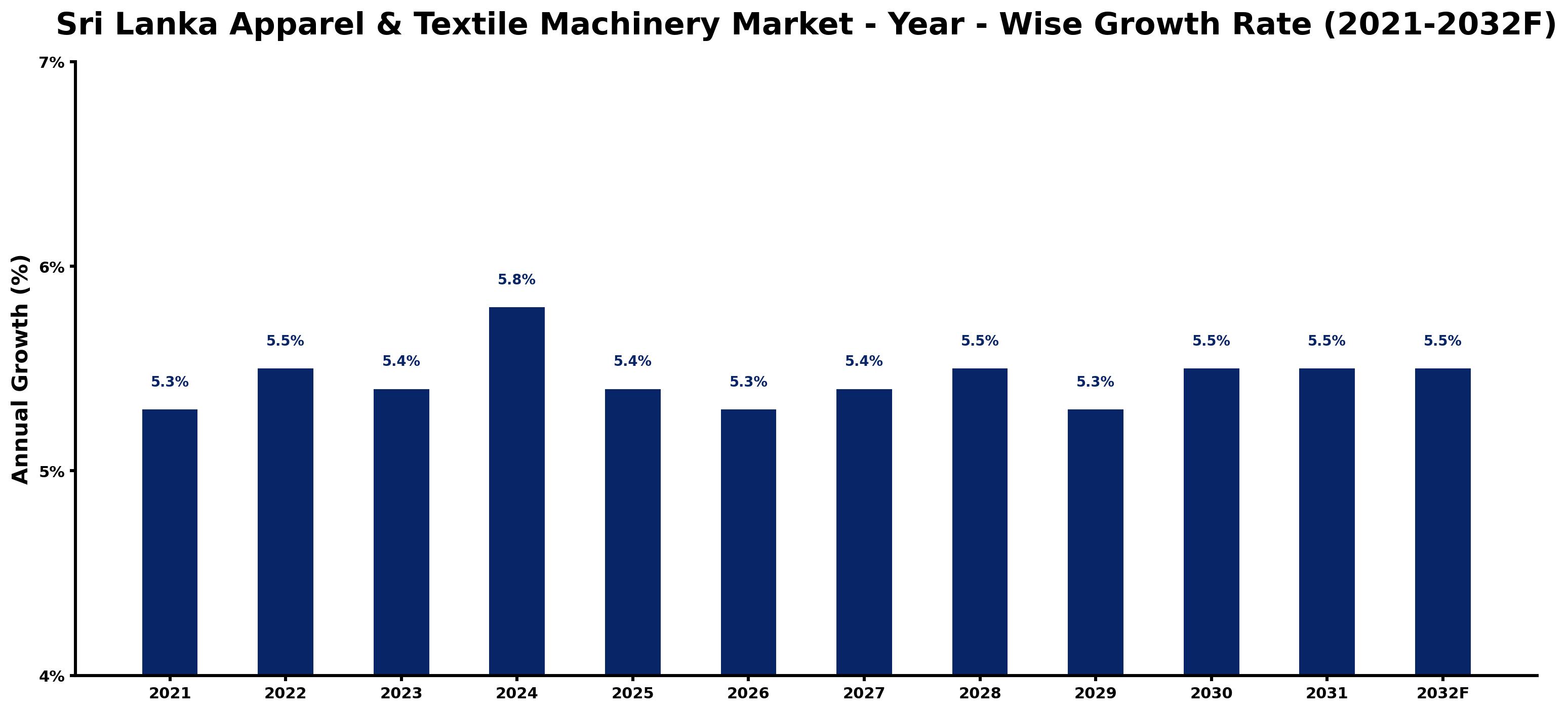
The table below presents the year wise growth rates along with the key drivers influencing the market
| Year | Growth Rate | Major Drivers |
| 2021 | 5.3% | Post-lockdown retail projects resumed, boosting demand for apparel manufacturing machinery. |
| 2022 | 5.5% | Investment in eco-friendly textiles encouraged machinery upgrades to enhance production efficiency. |
| 2023 | 5.4% | Shifts towards digitalization prompted manufacturers to adopt advanced textile technologies. |
| 2024 | 5.8% | Local brands gained traction, increasing the need for versatile textile machinery solutions. |
| 2025 | 5.4% | International collaborations flourished, diversifying technology access within the apparel sector. |
| 2026 | 5.3% | Emerging fashion trends necessitated quick response capabilities in textile manufacturing processes. |
| 2027 | 5.4% | Skill development programs improved workforce competency, driving machinery investment decisions. |
| 2028 | 5.5% | Sustainability trends pressured manufacturers to innovate on energy-efficient equipment configurations. |
| 2029 | 5.3% | Supply chain disruptions highlighted the importance of flexible and adaptive machinery investments. |
| 2030 | 5.5% | Technological integration across production lines became essential for maintaining competitive advantages. |
| 2031 | 5.5% | Increasing global textile trade created opportunities for local machinery manufacturers to expand. |
| 2032 | 5.5% | Digital platforms facilitated data-driven decision-making, transforming operations in the textile machinery sector. |
Note - Market size estimations and growth projections presented in this report are based on 6Wresearch's advanced forecasting approach, validated with industry datasets as of June 2026.
Key Highlights of the Report:
- Sri Lanka Apparel & Textile Machinery Market Overview
- Sri Lanka Apparel & Textile Machinery Market Outlook
- Market Size of Sri Lanka Apparel & Textile Machinery Market, 2025
- Forecast of Sri Lanka Apparel & Textile Machinery Market, 2032F
- Historical Data and Forecast of Sri Lanka Apparel & Textile Machinery Revenues & Volume for the Period 2022-2032F
- Sri Lanka Apparel & Textile Machinery Market Trend Evolution
- Sri Lanka Apparel & Textile Machinery Market Drivers and Challenges
- Sri Lanka Apparel & Textile Machinery Price Trends
- Sri Lanka Apparel & Textile Machinery Porter's Five Forces
- Sri Lanka Apparel & Textile Machinery Industry Life Cycle
- Historical Data and Forecast of Sri Lanka Apparel & Textile Machinery Market Revenues & Volume By Machine Types for the Period 2022-2032F
- Historical Data and Forecast of Sri Lanka Apparel & Textile Machinery Market Revenues & Volume By Spinning Machine for the Period 2022-2032F
- Historical Data and Forecast of Sri Lanka Apparel & Textile Machinery Market Revenues & Volume By Weaving Machine for the Period 2022-2032F
- Historical Data and Forecast of Sri Lanka Apparel & Textile Machinery Market Revenues & Volume By Knitting Machine for the Period 2022-2032F
- Historical Data and Forecast of Sri Lanka Apparel & Textile Machinery Market Revenues & Volume By Texturing Machine for the Period 2022-2032F
- Historical Data and Forecast of Sri Lanka Apparel & Textile Machinery Market Revenues & Volume By Applications for the Period 2022-2032F
- Historical Data and Forecast of Sri Lanka Apparel & Textile Machinery Market Revenues & Volume By Textile Industry for the Period 2022-2032F
- Historical Data and Forecast of Sri Lanka Apparel & Textile Machinery Market Revenues & Volume By Clothing Industry for the Period 2022-2032F
- Historical Data and Forecast of Sri Lanka Apparel & Textile Machinery Market Revenues & Volume By Raw Material Types for the Period 2022-2032F
- Historical Data and Forecast of Sri Lanka Apparel & Textile Machinery Market Revenues & Volume By Wool for the Period 2022-2032F
- Historical Data and Forecast of Sri Lanka Apparel & Textile Machinery Market Revenues & Volume By Cotton for the Period 2022-2032F
- Historical Data and Forecast of Sri Lanka Apparel & Textile Machinery Market Revenues & Volume By Cellulosic for the Period 2022-2032F
- Historical Data and Forecast of Sri Lanka Apparel & Textile Machinery Market Revenues & Volume By Polypropylene for the Period 2022-2032F
- Historical Data and Forecast of Sri Lanka Apparel & Textile Machinery Market Revenues & Volume By Acrylic for the Period 2022-2032F
- Historical Data and Forecast of Sri Lanka Apparel & Textile Machinery Market Revenues & Volume By Others for the Period 2022-2032F
- Sri Lanka Apparel & Textile Machinery Import Export Trade Statistics
- Market Opportunity Assessment By Machine Types
- Market Opportunity Assessment By Applications
- Market Opportunity Assessment By Raw Material Types
- Sri Lanka Apparel & Textile Machinery Top Companies Market Share
- Sri Lanka Apparel & Textile Machinery Competitive Benchmarking By Technical and Operational Parameters
- Sri Lanka Apparel & Textile Machinery Company Profiles
- Sri Lanka Apparel & Textile Machinery Key Strategic Recommendations






































