Sri Lanka Ascorbic Acid Market Size, Share & Growth Rate
The Sri Lanka Ascorbic Acid Market was estimated at USD 416 Million in 2025 and is projected to reach USD 548 Million by 2032, growing at a CAGR of 4.0% from 2026 to 2032. This positive trajectory is driven by heightened consumer awareness regarding the health benefits of Vitamin C, alongside its extensive applications across food and beverage, pharmaceutical, and cosmetic sectors. The rising emphasis on preventive healthcare and immunity-boosting products further bolsters the market's growth potential.
Sri Lanka Ascorbic Acid Market Year-wise Growth Rate and Key Drivers
This graph highlights how the Sri Lanka Ascorbic Acid Market has steadily grown over the years, supported by major growth factors.
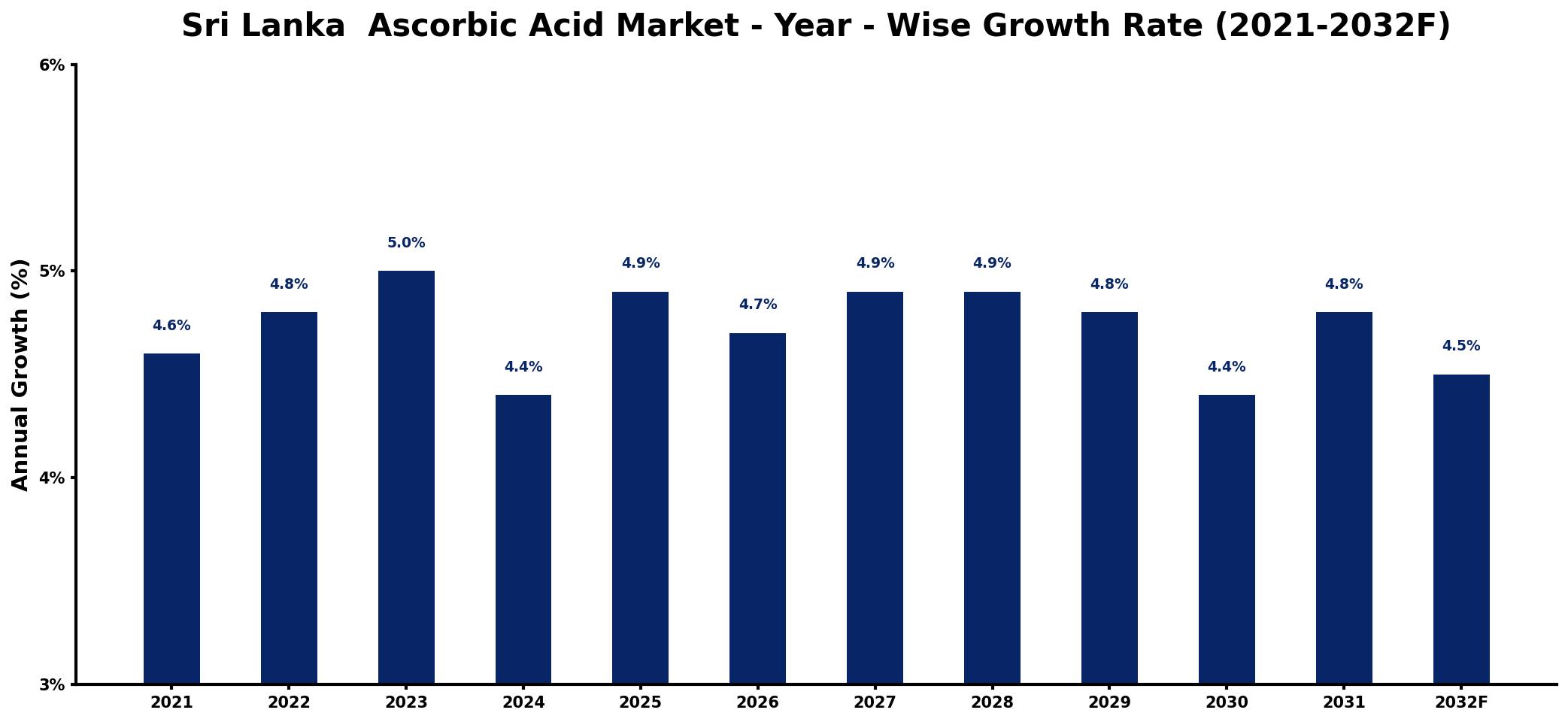
The table below presents the year‑wise growth rates along with the key drivers influencing the market
| Year | Growth Rate | Major Drivers |
| 2021 | 4.6% | Rising health awareness among consumers |
| 2022 | 4.8% | Increased demand for nutritional supplements |
| 2023 | 5.0% | Growing popularity of functional foods |
| 2024 | 4.4% | Expansion of beverage industry innovations |
| 2025 | 4.9% | Surge in organic product consumption |
| 2026 | 4.7% | Investment in food fortification initiatives |
| 2027 | 4.9% | Rising trend of preventive healthcare |
| 2028 | 4.9% | Growth in natural ingredient sourcing |
| 2029 | 4.8% | Increase in online retail channels |
| 2030 | 4.4% | increased pharmaceutical industry usage |
| 2031 | 4.8% | Boost in dietary supplement regulations |
| 2032 | 4.5% | increased domestic production output |
Note: Market size estimations and growth projections presented in this report are based on 6Wresearch's proprietary forecasting methodology, utilizing the latest available industry data, government publications, and primary research inputs.
Sri Lanka Ascorbic Acid Market Synopsis
At present, the most significant force shaping the Sri Lanka Ascorbic Acid market is the escalating consumer awareness surrounding the advantages of Vitamin C. As a result, demand for ascorbic acid is surging, especially among health-conscious individuals looking to bolster their immunity.
In addition to health benefits, a notable trend toward natural and organic products is influencing manufacturers to innovate and develop ascorbic acid derived from natural sources. This shift is not only meeting consumer demands but also aligning with the growing preference for clean label products across various industries.
Sri Lanka Ascorbic Acid Market Key Takeaways
- The Sri Lankan Ascorbic Acid market is witnessing steady growth due to rising health awareness.
- Food and beverage, pharmaceuticals, and cosmetics are the primary sectors driving demand.
- Market participants are focusing on natural and organic sources of ascorbic acid.
- Investment in innovative formulations and local partnerships presents significant opportunities.
- Regulatory oversight ensures quality and safety of ascorbic acid products in the market.
Evaluation of Restraints in Sri Lanka Ascorbic Acid Market
Despite the promising growth trajectory, the Sri Lanka Ascorbic Acid market faces several notable constraints. Fluctuating raw material prices can destabilize cost structures, complicating pricing strategies for local manufacturers reliant on imports. Additionally, navigating complex import regulations and stringent quality standards adds to operational hurdles for companies aiming to expand. The competitive landscape is further intensified by the presence of low-cost producers in neighboring countries, which may put local manufacturers under pricing pressure.
Sri Lanka Ascorbic Acid Market Trends
Current trends within the Sri Lanka Ascorbic Acid market showcase a growing consumer preference for health-oriented products, particularly those promoting immunity. Additionally, the incorporation of ascorbic acid into various product categories, from beverages to personal care, is on the rise. Innovations focusing on naturally sourced Vitamin C are emerging as a significant trend, driven by a consumer shift towards organic and environmentally friendly products.
Sri Lanka Ascorbic Acid Market Opportunities
Investment opportunities abound in the Sri Lanka Ascorbic Acid market. The increasing consumer focus on health and wellness presents a lucrative avenue for developing ascorbic acid supplements. Companies can explore establishing manufacturing facilities or distribution networks to enhance supply chain resilience. Collaborating with local firms for sourcing and marketing initiatives can also yield significant returns. Furthermore, prioritizing research and development for innovative applications of ascorbic acid could provide companies with a competitive advantage.
Government Initiatives in the Sri Lanka Ascorbic Acid Market
The Sri Lankan government plays a critical role in regulating the Ascorbic Acid market through various initiatives. Import tariffs are implemented to safeguard local manufacturers, promoting domestic production. Regulatory authorities are vigilant about quality and safety standards, ensuring that imported ascorbic acid products meet stringent consumer protection criteria. Additionally, there are government-led programs that encourage research and development in the pharmaceutical and food industries, which is expected to boost demand for ascorbic acid.
Future Insights of the Sri Lanka Ascorbic Acid Market
Looking ahead to 2026-2032, the Sri Lanka Ascorbic Acid market is set for continued growth, driven by rising awareness of the benefits of Vitamin C across diverse industries. The anticipated growth in health-consciousness among consumers will likely propel demand for ascorbic acid-infused products. Innovations focusing on natural ingredients will align with evolving consumer preferences, promoting market expansion. Nevertheless, stakeholders must remain cognizant of price fluctuations and regulatory challenges that could impede progress.
Sri Lanka Ascorbic Acid Market Latest Developments (2025 - 2026)
Recent industry developments reflect a heightened focus on the health and wellness sectors. Manufacturers are introducing new formulations that cater to the increasing consumer demand for natural and organic products. There is also a noticeable trend toward increased partnerships and collaborations among local firms, aimed at enhancing distribution networks and boosting product visibility in the competitive landscape.
Sri Lanka Ascorbic Acid Market - Key Attractiveness of the Report
- 10 Years of Market Numbers
- Historical Data Starting from 2022 to 2025
- Base Year: 2025
- Forecast Data until 2032
- Key Performance Indicators Impacting the Market
- Major Upcoming Developments and Projects
Key Highlights of the Report:
- Sri Lanka Ascorbic Acid Market Outlook
- Market Size of Sri Lanka Ascorbic Acid Market, 2025
- Forecast of Sri Lanka Ascorbic Acid Market, 2032
- Historical Data and Forecast of Sri Lanka Ascorbic Acid Revenues & Volume for the Period 2022-2032F
- Sri Lanka Ascorbic Acid Market Trend Evolution
- Sri Lanka Ascorbic Acid Market Drivers and Challenges
- Sri Lanka Ascorbic Acid Price Trends
- Sri Lanka Ascorbic Acid Porter's Five Forces
- Sri Lanka Ascorbic Acid Industry Life Cycle
- Historical Data and Forecast of Sri Lanka Ascorbic Acid Market Revenues & Volume By Grade for the Period 2022-2032F
- Historical Data and Forecast of Sri Lanka Ascorbic Acid Market Revenues & Volume By Food & Pharmaceutical for the Period 2022-2032F
- Historical Data and Forecast of Sri Lanka Ascorbic Acid Market Revenues & Volume By Industrial for the Period 2022-2032F
- Historical Data and Forecast of Sri Lanka Ascorbic Acid Market Revenues & Volume By Application for the Period 2022-2032F
- Historical Data and Forecast of Sri Lanka Ascorbic Acid Market Revenues & Volume By Food & Beverages for the Period 2022-2032F
- Historical Data and Forecast of Sri Lanka Ascorbic Acid Market Revenues & Volume By Pharmaceutical for the Period 2022-2032F
- Historical Data and Forecast of Sri Lanka Ascorbic Acid Market Revenues & Volume By Cosmetics for the Period 2022-2032F
- Historical Data and Forecast of Sri Lanka Ascorbic Acid Market Revenues & Volume By Chemicals for the Period 2022-2032F
- Historical Data and Forecast of Sri Lanka Ascorbic Acid Market Revenues & Volume By Agriculture for the Period 2022-2032F
- Historical Data and Forecast of Sri Lanka Ascorbic Acid Market Revenues & Volume By Others for the Period 2022-2032F
- Sri Lanka Ascorbic Acid Import Export Trade Statistics
- Market Opportunity Assessment By Grade
- Market Opportunity Assessment By Application
- Sri Lanka Ascorbic Acid Top Companies Market Share
- Sri Lanka Ascorbic Acid Competitive Benchmarking By Technical and Operational Parameters
- Sri Lanka Ascorbic Acid Company Profiles
- Sri Lanka Ascorbic Acid Key Strategic Recommendations






































