Sri Lanka Auto Parts And Accessories Market Size, Share & Growth Rate
The Sri Lanka Auto Parts And Accessories Market was estimated at USD 300 Million in 2025 and is projected to reach USD 431 Million by 2032, growing at a CAGR of 5.3% from 2026 to 2032. This robust growth trajectory is primarily fueled by a notable increase in vehicle ownership, driven by a burgeoning middle-class population and urbanization. As disposable incomes rise, consumers are investing more in vehicle maintenance and customization, which is further catalyzing demand for a diverse range of auto parts and accessories.
Sri Lanka Auto Parts And Accessories Market Year-wise Growth Rate and Key Drivers
This graph highlights how the Sri Lanka Auto Parts And Accessories Market has steadily grown over the years, supported by major growth factors.
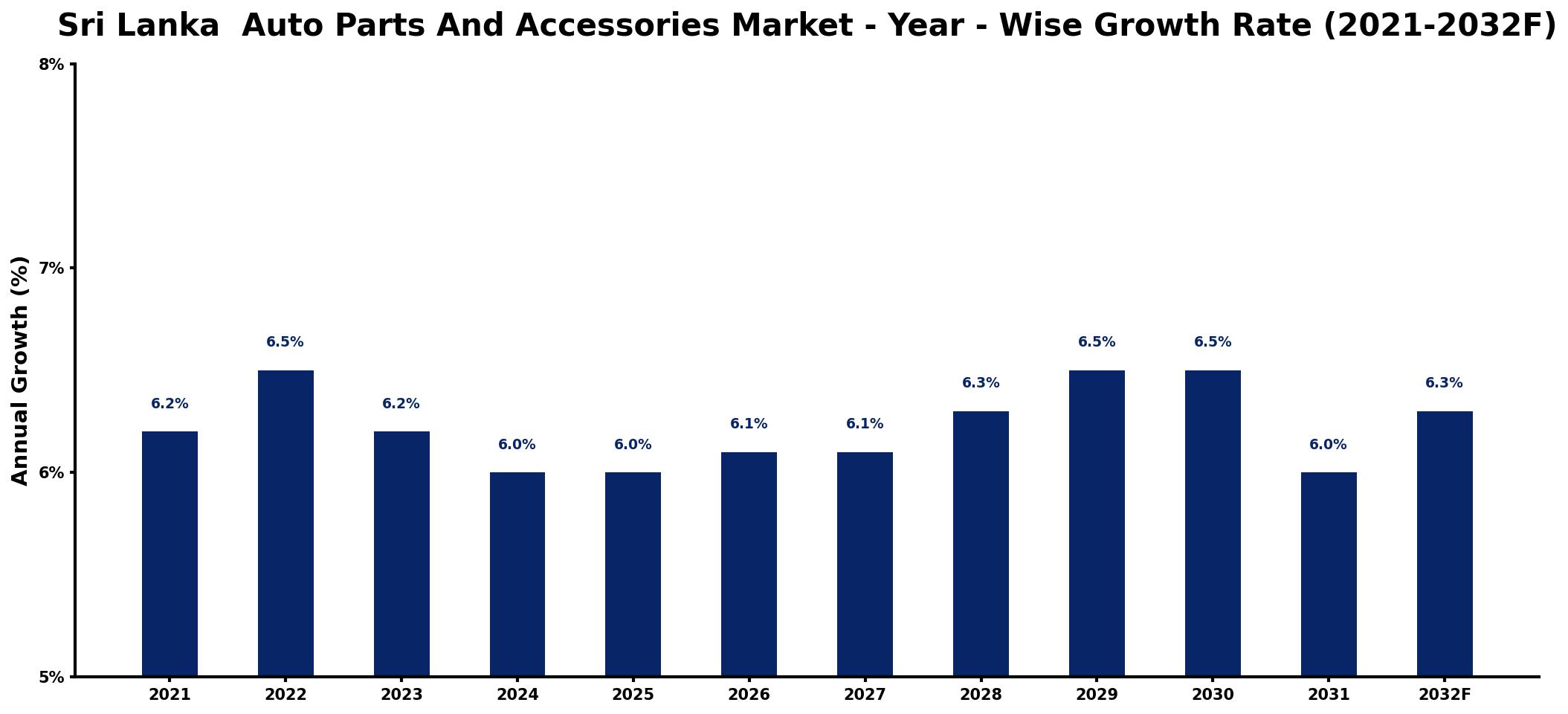
The table below presents the year‑wise growth rates along with the key drivers influencing the market
| Year | Growth Rate | Major Drivers |
| 2021 | 6.2% | Increase in vehicle ownership rates |
| 2022 | 6.5% | Growth in e-commerce platforms |
| 2023 | 6.2% | Rise in domestic manufacturing capacity |
| 2024 | 6.0% | Expansion of logistics infrastructure |
| 2025 | 6.0% | Investment in renewable energy vehicles |
| 2026 | 6.1% | Development of smart transportation solutions |
| 2027 | 6.1% | rising demand from electronics |
| 2028 | 6.3% | increased overall sector activity |
| 2029 | 6.5% | expanding healthcare application demand |
| 2030 | 6.5% | expanding industrial usage applications |
| 2031 | 6.0% | increased domestic production output |
| 2032 | 6.3% | increased capital investment inflows |
Note: Market size estimations and growth projections presented in this report are based on 6Wresearch's proprietary forecasting methodology, utilizing the latest available industry data, government publications, and primary research inputs.
Sri Lanka Auto Parts And Accessories Market Synopsis
A significant aspect of the Sri Lanka auto parts and accessories market is the growing consumer preference for high-quality aftermarket products. This is evidenced by an increasing number of consumers seeking reliable and durable components for their vehicles, especially as the local automotive industry expands.
Moreover, local manufacturers are ramping up production capabilities to meet demand. This burgeoning local supply, combined with government support, is helping to foster a competitive marketplace where a wide variety of products, including innovative and eco-friendly options, are readily available to consumers.
Sri Lanka Auto Parts And Accessories Market Key Takeaways
- The market is expected to expand significantly due to rising vehicle ownership and a growing automotive sector.
- Increasing demand for high-quality aftermarket parts is shaping competitive dynamics within the industry.
- Technological advancements and eco-friendly innovations are becoming crucial for market players.
- Government policies aimed at boosting local manufacturing are creating a favorable environment for investment.
- Customization trends are influencing consumer buying behaviors, leading to increased sales of aftermarket accessories.
Evaluation of Restraints in Sri Lanka Auto Parts And Accessories Market
Despite the positive growth outlook, the Sri Lanka auto parts and accessories market faces certain limitations. One major issue is the lack of standardized regulations, which allows counterfeit products to infiltrate the market. This can compromise product quality and safety, thus diminishing consumer trust. Additionally, the competitive landscape, characterized by numerous small and medium-sized enterprises, can pose challenges for new entrants trying to carve out a market niche. Limited access to modern technology and financial resources further complicates the situation, hindering innovation and scalability.
Sri Lanka Auto Parts And Accessories Market Trends
Current trends in the Sri Lanka auto parts and accessories market highlight a shift towards sustainability and advanced technology. Consumers are increasingly interested in eco-friendly components, such as those associated with electric and hybrid vehicles. Furthermore, the integration of connected technologies like telematics and smart sensors is gaining traction, reflecting a growing demand for enhanced vehicle performance and functionality. The customization trend continues to thrive, with consumers seeking unique aftermarket accessories to personalize their vehicles.
Sri Lanka Auto Parts And Accessories Market Opportunities
Investment opportunities in the Sri Lanka auto parts and accessories market are substantial, given the country's expanding automotive landscape. With an increasing vehicle count, there is a pressing need for high-quality components across various categories. Manufacturers and suppliers can explore avenues in engine parts, electrical systems, and specialty accessories. Furthermore, innovation in technology and sustainable solutions can open new doors for growth, particularly in the emerging electric vehicle segment. Establishing local partnerships and expanding distribution networks are also critical strategies for investors seeking to tap into this lucrative market.
Government Initiatives in the Sri Lanka Auto Parts And Accessories Market
The Sri Lankan government has introduced several initiatives to foster growth in the auto parts and accessories market. Key policies focus on promoting local manufacturing by imposing tariffs on imported auto parts to encourage domestic production. Additionally, subsidies and financial incentives are provided to local manufacturers, thereby enhancing the competitive landscape. The government is also working on establishing regulatory frameworks that set quality and safety standards for auto parts, ensuring a secure environment for consumers and fostering trust in locally produced goods.
Future Insights of the Sri Lanka Auto Parts And Accessories Market
Looking ahead to the 2026-2032 period, the Sri Lanka auto parts and accessories market is well-positioned for growth. Key drivers include continued urbanization, rising disposable incomes, and a growing emphasis on vehicle personalization. The government's ongoing infrastructure projects are likely to enhance logistics and distribution capabilities, further stimulating market expansion. However, staying ahead in an increasingly competitive landscape will require ongoing technological innovation and adaptation to shifting consumer preferences.
Sri Lanka Auto Parts And Accessories Market Latest Developments (2025 - 2026)
In recent months, the Sri Lanka auto parts and accessories market has seen an uptick in investments aimed at enhancing production capabilities. Local manufacturers are increasingly adopting advanced technologies to improve efficiency and product quality. There has also been a notable increase in partnerships between local suppliers and international firms, aimed at introducing innovative products and technologies to meet evolving consumer demands. Additionally, the trend towards eco-friendly materials is becoming more prevalent, as companies aim to align with global sustainability objectives.
Sri Lanka Auto Parts And Accessories Market - Key Attractiveness of the Report
- 10 Years of Market Numbers
- Historical Data Starting from 2022 to 2025
- Base Year: 2025
- Forecast Data until 2032
- Key Performance Indicators Impacting the Market
- Major Upcoming Developments and Projects
Key Highlights of the Report:
- Sri Lanka Auto Parts And Accessories Market Outlook
- Market Size of Sri Lanka Auto Parts And Accessories Market, 2025
- Forecast of Sri Lanka Auto Parts And Accessories Market, 2032
- Historical Data and Forecast of Sri Lanka Auto Parts And Accessories Revenues & Volume for the Period 2022-2032F
- Sri Lanka Auto Parts And Accessories Market Trend Evolution
- Sri Lanka Auto Parts And Accessories Market Drivers and Challenges
- Sri Lanka Auto Parts And Accessories Price Trends
- Sri Lanka Auto Parts And Accessories Porter's Five Forces
- Sri Lanka Auto Parts And Accessories Industry Life Cycle
- Historical Data and Forecast of Sri Lanka Auto Parts And Accessories Market Revenues & Volume By Product for the Period 2022-2032F
- Historical Data and Forecast of Sri Lanka Auto Parts And Accessories Market Revenues & Volume By Driveline & Powertrain for the Period 2022-2032F
- Historical Data and Forecast of Sri Lanka Auto Parts And Accessories Market Revenues & Volume By Interiors & Exteriors for the Period 2022-2032F
- Historical Data and Forecast of Sri Lanka Auto Parts And Accessories Market Revenues & Volume By Electronics for the Period 2022-2032F
- Historical Data and Forecast of Sri Lanka Auto Parts And Accessories Market Revenues & Volume By Bodies & Chassis for the Period 2022-2032F
- Historical Data and Forecast of Sri Lanka Auto Parts And Accessories Market Revenues & Volume By Wheel & Tires for the Period 2022-2032F
- Historical Data and Forecast of Sri Lanka Auto Parts And Accessories Market Revenues & Volume By Others for the Period 2022-2032F
- Historical Data and Forecast of Sri Lanka Auto Parts And Accessories Market Revenues & Volume By Application for the Period 2022-2032F
- Historical Data and Forecast of Sri Lanka Auto Parts And Accessories Market Revenues & Volume By OEMs for the Period 2022-2032F
- Historical Data and Forecast of Sri Lanka Auto Parts And Accessories Market Revenues & Volume By Aftermarket for the Period 2022-2032F
- Sri Lanka Auto Parts And Accessories Import Export Trade Statistics
- Market Opportunity Assessment By Product
- Market Opportunity Assessment By Application
- Sri Lanka Auto Parts And Accessories Top Companies Market Share
- Sri Lanka Auto Parts And Accessories Competitive Benchmarking By Technical and Operational Parameters
- Sri Lanka Auto Parts And Accessories Company Profiles
- Sri Lanka Auto Parts And Accessories Key Strategic Recommendations






































