Sri Lanka Aviation Test Equipment Market Size, Share & Growth Rate
The Sri Lanka Aviation Test Equipment Market was estimated at USD 1307 Million in 2025 and is projected to reach USD 1874 Million by 2032, growing at a CAGR of 5.3% from 2026 to 2032. This growth trajectory is largely driven by the ongoing expansion of the aviation sector in Sri Lanka, characterized by increased air traffic and airport upgrades. Furthermore, the rising emphasis on stringent safety regulations and the need for efficient maintenance solutions are propelling the demand for a wide array of testing equipment in the region.
Sri Lanka Aviation Test Equipment Market Year-wise Growth Rate and Key Drivers
This graph highlights how the Sri Lanka Aviation Test Equipment Market has steadily grown over the years, supported by major growth factors.
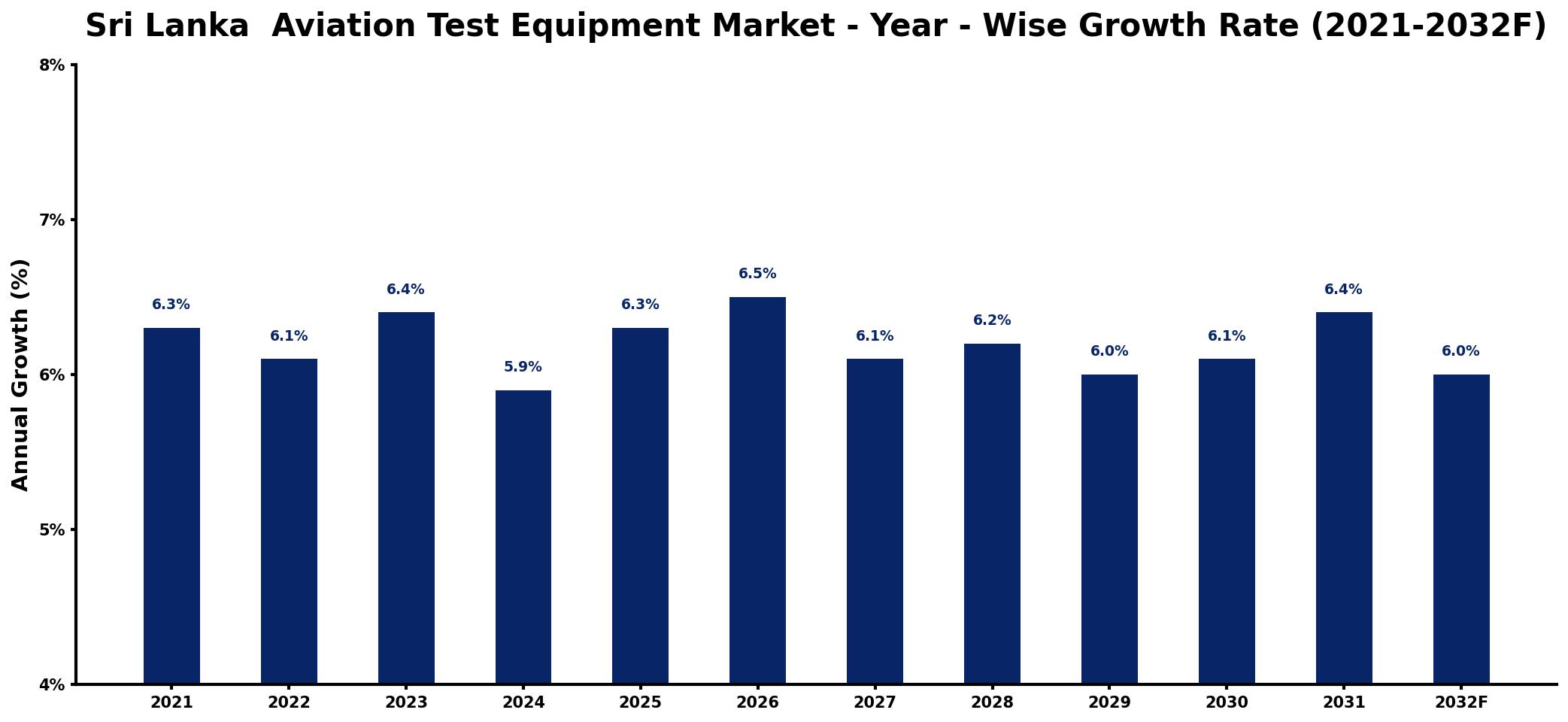
The table below presents the year‑wise growth rates along with the key drivers influencing the market
| Year | Growth Rate | Major Drivers |
| 2021 | 6.3% | increased government defense spending |
| 2022 | 6.1% | growing commercial flight operations |
| 2023 | 6.4% | rising demand for pilot training |
| 2024 | 5.9% | expansion of regional airline networks |
| 2025 | 6.3% | increased focus on safety standards |
| 2026 | 6.5% | development of new training facilities |
| 2027 | 6.1% | surge in military modernization efforts |
| 2028 | 6.2% | growing interest in UAV technology |
| 2029 | 6.0% | enhanced research and development funding |
| 2030 | 6.1% | increased private sector investments |
| 2031 | 6.4% | improved processing technologies adoption |
| 2032 | 6.0% | increased domestic production output |
Note: Market size estimations and growth projections presented in this report are based on 6Wresearch's proprietary forecasting methodology, utilizing the latest available industry data, government publications, and primary research inputs.
Sri Lanka Aviation Test Equipment Market Synopsis
Currently, the Sri Lanka Aviation Test Equipment Market is experiencing a significant transformation, fueled by advancements in technology and a growing emphasis on operational efficiency. The market comprises diverse testing equipment essential for aircraft maintenance, repair, and operational performance, catering to airlines, maintenance organizations, and aviation training centers.
As the aviation landscape evolves, the demand for sophisticated testing solutions continues to rise, particularly for automated and integrated systems. This shift is fostering greater collaboration between domestic players and international manufacturers, leading to enhanced product offerings that meet local requirements.
Sri Lanka Aviation Test Equipment Market Key Takeaways
- The market is witnessing robust growth due to increasing air travel and infrastructure development.
- Technological advancements, particularly in automation and digital monitoring, are shaping the market landscape.
- There is a rising demand for specialized equipment to ensure compliance with rigorous safety standards.
- Collaboration with international firms is enhancing the quality and diversity of available testing equipment.
- Investment opportunities abound as the sector seeks to modernize and expand its operational capabilities.
Evaluation of Restraints in Sri Lanka Aviation Test Equipment Market
Despite the promising growth trajectory, the Sri Lanka Aviation Test Equipment Market faces several challenges that could restrain its progress. The limited availability of cutting-edge testing solutions stems from the country's relatively small market size, which often necessitates importing equipment. This reliance on foreign imports can lead to higher costs and potential delays in the acquisition of essential tools. Furthermore, the market's growth is hindered by a shortage of skilled technicians trained to operate sophisticated testing equipment, necessitating investment in local training programs to develop expertise. Lastly, navigating the complex regulatory environment presents an added layer of difficulty for firms aiming to meet compliance standards.
Sri Lanka Aviation Test Equipment Market Trends
The Sri Lanka Aviation Test Equipment Market is currently witnessing a notable trend towards the adoption of advanced and automated testing technologies. As airlines focus on optimizing maintenance protocols and enhancing safety, there is an increasing demand for sophisticated equipment capable of precise diagnostics and real-time system analysis. Additionally, the integration of digital technologies such as IoT and artificial intelligence is becoming prevalent, allowing for predictive maintenance capabilities that minimize downtime and operational costs. Manufacturers are also prioritizing the development of portable, user-friendly solutions, broadening their appeal across various segments of the market.
Sri Lanka Aviation Test Equipment Market Opportunities
The Sri Lanka Aviation Test Equipment Market offers substantial investment opportunities as the aviation sector continues to expand. With increasing passenger numbers and the modernization of airport infrastructure, there is a pressing need for advanced testing equipment that ensures safety and efficiency in aircraft operations. Potential investors should focus on emerging technologies such as avionics test sets, engine test stands, and ground support equipment, which are essential for addressing the dynamic demands of the aviation industry. Collaborating with local aviation enterprises and government entities can further enhance market penetration and drive growth in this promising sector.
Government Initiatives in the Sri Lanka Aviation Test Equipment Market
The Sri Lankan government has implemented several policies aimed at fostering the growth of the Aviation Test Equipment Market. These initiatives include infrastructure modernization efforts, enhancing airport facilities, and promoting investments in aviation technology. Additionally, the government has prioritized the establishment of safety and security regulations within the aviation sector. By facilitating partnerships with international aviation firms, the government seeks to drive innovation and competitiveness in the market, ultimately fostering a conducive environment for long-term growth and sustainability in the Sri Lanka Aviation Test Equipment landscape.
Future Insights of the Sri Lanka Aviation Test Equipment Market
The outlook for the Sri Lanka Aviation Test Equipment Market is notably optimistic, with steady growth anticipated through 2032. Key factors such as sustained investments in the aviation sector, modernization of existing airports, and an expanding airline fleet will significantly contribute to the demand for advanced testing equipment. Moreover, the implementation of rigorous safety regulations and heightened focus on aircraft performance will further bolster market growth. As technology continues to advance, the industry is expected to gravitate towards more automated and sophisticated testing solutions, positioning the market for a robust expansion.
Sri Lanka Aviation Test Equipment Market Latest Developments (2025 - 2026)
In recent months, the Sri Lanka Aviation Test Equipment Market has seen a surge in activity as various stakeholders focus on enhancing product offerings and capabilities. Manufacturers are increasingly investing in R&D to develop cutting-edge testing solutions that meet evolving industry standards. Additionally, collaboration between local firms and international companies is fostering knowledge transfer and technology sharing, further enriching the market landscape. As the aviation sector prepares for future growth, the emphasis on adopting advanced testing methodologies and equipment remains a pivotal direction.
Sri Lanka Aviation Test Equipment Market - Key Attractiveness of the Report
- 10 Years of Market Numbers
- Historical Data Starting from 2022 to 2025
- Base Year: 2025
- Forecast Data until 2032
- Key Performance Indicators Impacting the Market
- Major Upcoming Developments and Projects
Key Highlights of the Report:
- Sri Lanka Aviation Test Equipment Market Outlook
- Market Size of Sri Lanka Aviation Test Equipment Market, 2025
- Forecast of Sri Lanka Aviation Test Equipment Market, 2032
- Historical Data and Forecast of Sri Lanka Aviation Test Equipment Revenues & Volume for the Period 2022-2032F
- Sri Lanka Aviation Test Equipment Market Trend Evolution
- Sri Lanka Aviation Test Equipment Market Drivers and Challenges
- Sri Lanka Aviation Test Equipment Price Trends
- Sri Lanka Aviation Test Equipment Porter's Five Forces
- Sri Lanka Aviation Test Equipment Industry Life Cycle
- Historical Data and Forecast of Sri Lanka Aviation Test Equipment Market Revenues & Volume By Product for the Period 2022-2032F
- Historical Data and Forecast of Sri Lanka Aviation Test Equipment Market Revenues & Volume By Electrical Aviation Test Equipment for the Period 2022-2032F
- Historical Data and Forecast of Sri Lanka Aviation Test Equipment Market Revenues & Volume By Hydraulic Aviation Test Equipment for the Period 2022-2032F
- Historical Data and Forecast of Sri Lanka Aviation Test Equipment Market Revenues & Volume By Power Aviation Test Equipment for the Period 2022-2032F
- Historical Data and Forecast of Sri Lanka Aviation Test Equipment Market Revenues & Volume By Pneumatic Aviation Test Equipment for the Period 2022-2032F
- Historical Data and Forecast of Sri Lanka Aviation Test Equipment Market Revenues & Volume By End User for the Period 2022-2032F
- Historical Data and Forecast of Sri Lanka Aviation Test Equipment Market Revenues & Volume By Commercial for the Period 2022-2032F
- Historical Data and Forecast of Sri Lanka Aviation Test Equipment Market Revenues & Volume By Defense/Military Sector for the Period 2022-2032F
- Sri Lanka Aviation Test Equipment Import Export Trade Statistics
- Market Opportunity Assessment By Product
- Market Opportunity Assessment By End User
- Sri Lanka Aviation Test Equipment Top Companies Market Share
- Sri Lanka Aviation Test Equipment Competitive Benchmarking By Technical and Operational Parameters
- Sri Lanka Aviation Test Equipment Company Profiles
- Sri Lanka Aviation Test Equipment Key Strategic Recommendations






































