Sri Lanka Ballast Water Treatment Market Size, Share & Growth Rate
The Sri Lanka Ballast Water Treatment Market was estimated at USD 321 Million in 2025 and is projected to reach USD 436 Million by 2032, growing at a CAGR of 4.5% from 2026 to 2032. This growth trajectory is significantly driven by stringent international regulations aimed at safeguarding the marine environment, particularly the implementation of the International Maritime Organizations (IMO) Ballast Water Management Convention. Additionally, the rise in maritime trade and the ongoing expansion of port infrastructure further boost the demand for effective ballast water treatment solutions.
Sri Lanka Ballast Water Treatment Market Year-wise Growth Rate and Key Drivers
This graph highlights how the Sri Lanka Ballast Water Treatment Market has steadily grown over the years, supported by major growth factors.
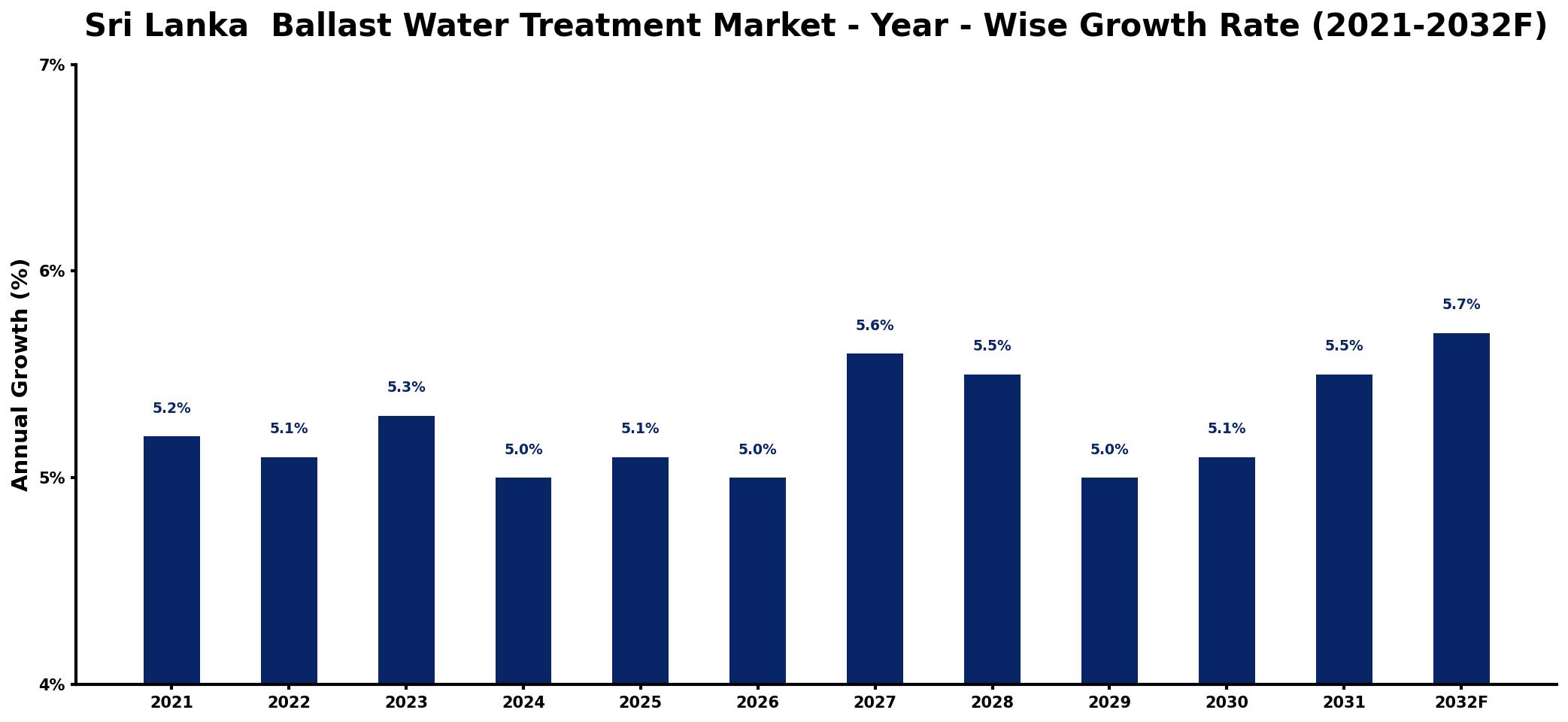
The table below presents the year‑wise growth rates along with the key drivers influencing the market
| Year | Growth Rate | Major Drivers |
| 2021 | 5.2% | Increased maritime environmental regulations |
| 2022 | 5.1% | Growing shipping industry investments |
| 2023 | 5.3% | Rising demand for compliance solutions |
| 2024 | 5.0% | Expansion of port infrastructure projects |
| 2025 | 5.1% | Enhanced focus on sustainability initiatives |
| 2026 | 5.0% | Development of innovative technologies |
| 2027 | 5.6% | Increase in international shipping activities |
| 2028 | 5.5% | Strengthening of global trade partnerships |
| 2029 | 5.0% | Emergence of new shipping routes |
| 2030 | 5.1% | Growing awareness of ecological impact |
| 2031 | 5.5% | Increased funding for green technologies |
| 2032 | 5.7% | Rising adoption of regulatory standards |
Note: Market size estimations and growth projections presented in this report are based on 6Wresearch's proprietary forecasting methodology, utilizing the latest available industry data, government publications, and primary research inputs.
Sri Lanka Ballast Water Treatment Market Synopsis
The most influential factor currently shaping the Sri Lanka Ballast Water Treatment Market is the increased focus on compliance with global environmental standards. As local maritime operators strive to adhere to these regulations, the necessity for innovative ballast water treatment systems becomes paramount. This compliance not only helps in preventing invasive aquatic species but also aligns with Sri Lanka's commitment to preserving its rich marine biodiversity.
Moreover, the expansion of Sri Lanka's maritime trade is pushing vessel operators to invest in advanced ballast water treatment technologies. With government support and the backing of international maritime bodies, the market is poised for sustained growth, reflecting a broader commitment to environmental stewardship in shipping practices.
Sri Lanka Ballast Water Treatment Market Key Takeaways
- The market is primarily driven by the enforcement of international regulations aimed at preventing invasive species through ballast water.
- Increased maritime trade volume and enhanced port infrastructure are pivotal in expanding market opportunities.
- Compliance challenges due to technological and financial constraints persist among local operators.
- Government initiatives play a crucial role in supporting investment and compliance efforts in the sector.
- Future growth prospects indicate a steady demand for innovative and efficient ballast water treatment systems.
Evaluation of Restraints in Sri Lanka Ballast Water Treatment Market
Despite a favorable growth outlook, the Sri Lanka Ballast Water Treatment Market faces several limitations. The stringent international regulations, while necessary for environmental protection, impose significant capital requirements on local maritime operators. Many struggle to afford the advanced treatment technologies needed to comply with the IMO standards. Furthermore, there is a notable shortage of technical expertise in operating and maintaining these systems, which can hinder effective implementation. Inconsistent enforcement of regulations across different ports also creates a fragmented compliance landscape, further complicating adherence efforts.
Sri Lanka Ballast Water Treatment Market Trends
Currently, there is a growing trend towards the adoption of more efficient, automated ballast water treatment systems that reduce operational costs and enhance compliance capabilities. Technological advancements are enabling the development of compact, energy-efficient solutions, which are particularly appealing to smaller operators. Additionally, there is an increasing emphasis on sustainable practices within the maritime industry, with stakeholders advocating for the integration of eco-friendly technologies in ballast water management.
Sri Lanka Ballast Water Treatment Market Opportunities
Significant growth opportunities lie in the collaboration between local businesses and international technology providers, particularly in enhancing the capacity for ballast water treatment. Investment in research and development can yield innovative solutions that cater to the unique challenges faced by Sri Lankan maritime operators. Furthermore, increased governmental support through subsidies and infrastructure development presents avenues for expansion, positioning the market favorably in the regional context of maritime trade.
Government Initiatives in the Sri Lanka Ballast Water Treatment Market
The Sri Lankan government is actively committed to preserving its marine ecosystem, as demonstrated through its robust ballast water treatment policies. Compliance with the IMO's Ballast Water Management Convention is mandatory for all maritime operators. The government also offers technical assistance and financial subsidies for the installation of necessary treatment systems. Furthermore, regular inspections by port authorities ensure that compliance measures are upheld, fostering a culture of accountability within the industry.
Future Insights of the Sri Lanka Ballast Water Treatment Market
Looking ahead to 2026-2032, the Sri Lanka Ballast Water Treatment Market is set to experience continued growth driven by regulatory compliance and technological advancements. As the global focus on environmental sustainability intensifies, local operators will increasingly seek innovative treatment solutions to meet stringent standards. This trend is likely to open doors for new entrants, fostering a competitive landscape that promotes efficiency and effectiveness in ballast water management.
Sri Lanka Ballast Water Treatment Market Latest Developments (2025 - 2026)
Recent developments in the Sri Lanka Ballast Water Treatment Market indicate a shift towards greater technological integration, with a focus on automation and real-time monitoring systems. Various stakeholders are emphasizing collaborative projects aimed at enhancing treatment capacity and regulatory compliance. Furthermore, public forums and workshops are being conducted to raise awareness among maritime operators about the benefits of investing in advanced ballast water treatment technologies, aligning operational practices with environmental stewardship.
Sri Lanka Ballast Water Treatment Market - Key Attractiveness of the Report
- 10 Years of Market Numbers
- Historical Data Starting from 2022 to 2025
- Base Year: 2025
- Forecast Data until 2032
- Key Performance Indicators Impacting the Market
- Major Upcoming Developments and Projects
Key Highlights of the Report:
- Sri Lanka Ballast Water Treatment Market Outlook
- Market Size of Sri Lanka Ballast Water Treatment Market, 2025
- Forecast of Sri Lanka Ballast Water Treatment Market, 2032
- Historical Data and Forecast of Sri Lanka Ballast Water Treatment Revenues & Volume for the Period 2022-2032F
- Sri Lanka Ballast Water Treatment Market Trend Evolution
- Sri Lanka Ballast Water Treatment Market Drivers and Challenges
- Sri Lanka Ballast Water Treatment Price Trends
- Sri Lanka Ballast Water Treatment Porter's Five Forces
- Sri Lanka Ballast Water Treatment Industry Life Cycle
- Historical Data and Forecast of Sri Lanka Ballast Water Treatment Market Revenues & Volume By Technology for the Period 2022-2032F
- Historical Data and Forecast of Sri Lanka Ballast Water Treatment Market Revenues & Volume By Physical Disinfection for the Period 2022-2032F
- Historical Data and Forecast of Sri Lanka Ballast Water Treatment Market Revenues & Volume By Mechanical Method for the Period 2022-2032F
- Historical Data and Forecast of Sri Lanka Ballast Water Treatment Market Revenues & Volume By Chemical Method for the Period 2022-2032F
- Historical Data and Forecast of Sri Lanka Ballast Water Treatment Market Revenues & Volume By Service for the Period 2022-2032F
- Historical Data and Forecast of Sri Lanka Ballast Water Treatment Market Revenues & Volume By Installation & Calibration for the Period 2022-2032F
- Historical Data and Forecast of Sri Lanka Ballast Water Treatment Market Revenues & Volume By Performance Measurement for the Period 2022-2032F
- Historical Data and Forecast of Sri Lanka Ballast Water Treatment Market Revenues & Volume By Recommissioning for the Period 2022-2032F
- Sri Lanka Ballast Water Treatment Import Export Trade Statistics
- Market Opportunity Assessment By Technology
- Market Opportunity Assessment By Service
- Sri Lanka Ballast Water Treatment Top Companies Market Share
- Sri Lanka Ballast Water Treatment Competitive Benchmarking By Technical and Operational Parameters
- Sri Lanka Ballast Water Treatment Company Profiles
- Sri Lanka Ballast Water Treatment Key Strategic Recommendations






































