Sri Lanka Bottle Filling Machine Market Size, Share & Growth Rate
The Sri Lanka Bottle Filling Machine Market was estimated at USD 184 Million in 2025 and is projected to reach USD 251 Million by 2032, growing at a CAGR of 4.5% from 2026 to 2032. This growth trajectory is fueled by a burgeoning food and beverage sector, an increase in packaged consumer goods, and heightened regulatory demands for quality and safety. As industries modernize their production processes, the appetite for technologically advanced and automated filling solutions is expected to rise, further propelling market dynamics.
Sri Lanka Bottle Filling Machine Market Year-wise Growth Rate and Key Drivers
This graph highlights how the Sri Lanka Bottle Filling Machine Market has steadily grown over the years, supported by major growth factors.
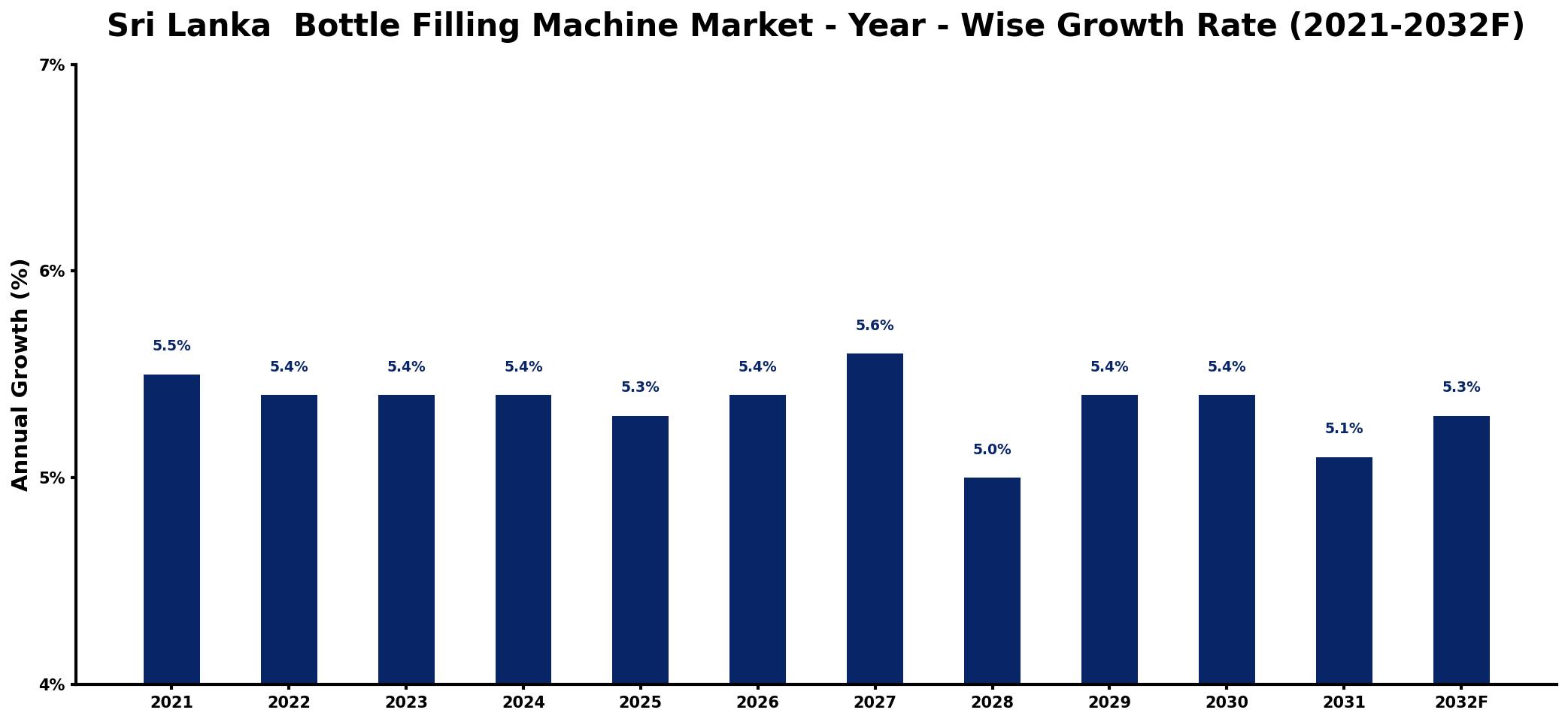
The table below presents the year‑wise growth rates along with the key drivers influencing the market
| Year | Growth Rate | Major Drivers |
| 2021 | 5.5% | Rising consumer beverage demand |
| 2022 | 5.4% | Increased investment in automation |
| 2023 | 5.4% | Growth in eco-friendly packaging |
| 2024 | 5.4% | Expansion of beverage manufacturing facilities |
| 2025 | 5.3% | Technological advancements in production |
| 2026 | 5.4% | Higher export opportunities emerging |
| 2027 | 5.6% | Surge in health-conscious products |
| 2028 | 5.0% | Emerging trends in flavored beverages |
| 2029 | 5.4% | Increased focus on sustainability initiatives |
| 2030 | 5.4% | Rising popularity of craft beverages |
| 2031 | 5.1% | increased overall sector activity |
| 2032 | 5.3% | Enhanced regulatory support for industry |
Note: Market size estimations and growth projections presented in this report are based on 6Wresearch's proprietary forecasting methodology, utilizing the latest available industry data, government publications, and primary research inputs.
Sri Lanka Bottle Filling Machine Market Synopsis
In recent years, Sri Lanka has observed a noticeable surge in the demand for bottle filling machines, particularly in the beverage sector, where consumer preferences are shifting towards convenient packaged options. This demand is not solely driven by consumer behavior; it also reflects broader economic growth, leading to increased disposable income levels among Sri Lankans.
Additionally, the pharmaceutical and personal care industries are expanding rapidly, contributing to the increased requirement for precision filling equipment. The increasing emphasis on hygiene and safety standards has further spurred manufacturers to invest in advanced technologies that enhance operational efficiency and product quality.
Sri Lanka Bottle Filling Machine Market Key Takeaways
- Technological advancements are driving market evolution, emphasizing automation and efficiency.
- The food and beverage sector remains a primary driver of demand for bottle filling solutions.
- Adoption of eco-friendly and energy-efficient machines is gaining traction among manufacturers.
- Government regulations are shaping production practices and quality assurance standards.
- Investment opportunities are emerging in local manufacturing and after-sales service sectors.
Evaluation of Restraints in Sri Lanka Bottle Filling Machine Market
Despite the positive growth outlook, the Sri Lanka Bottle Filling Machine Market faces notable restraints. The initial capital required for acquiring advanced filling machinery can be daunting for small and medium enterprises, potentially stifling their ability to modernize. Moreover, a shortage of skilled technicians capable of operating and maintaining these sophisticated machines can hinder operational efficiency. Additionally, inconsistencies in regulatory standards may lead to compliance challenges, affecting manufacturers' market positioning. Fluctuating raw material costs and currency exchange issues further compound these challenges, necessitating agile management strategies.
Sri Lanka Bottle Filling Machine Market Trends
The market is currently characterized by a strong trend towards high-speed, automated bottle filling machines that can significantly reduce labor costs while enhancing productivity. Additionally, manufacturers are increasingly adopting sustainable practices, leading to a preference for energy-efficient machines. The integration of advanced technologies, such as IoT and digital monitoring, is allowing for improved process accuracy and real-time data analytics, thus elevating operational standards. Furthermore, there's a growing emphasis on versatility, with machines designed to accommodate a wide range of bottle sizes and materials.
Sri Lanka Bottle Filling Machine Market Opportunities
A wealth of investment opportunities exists within the Sri Lanka Bottle Filling Machine Market. The escalating demand for bottled products in the food and beverage industry creates an urgent need for efficient and high-quality filling solutions. Investors can capitalize on this by developing innovative machinery tailored to these market demands. Furthermore, the rise in local production due to government initiatives to reduce import dependency offers strategic advantages for establishing manufacturing facilities. Additionally, providing comprehensive maintenance and after-sales services presents a lucrative avenue for enhancing customer loyalty and securing long-term revenue streams.
Government Initiatives in the Sri Lanka Bottle Filling Machine Market
The Sri Lankan government is actively promoting regulations to ensure consumer safety and product quality within the bottle filling machine market. These regulations include stringent quality control standards and certification requirements for manufacturers, ensuring compliance with industry benchmarks. Import restrictions and tariffs have also been implemented to foster local manufacturing capabilities, thereby reducing reliance on foreign products. Environmental regulations encouraging the adoption of eco-friendly machinery further align with global sustainability initiatives, shaping a competitive landscape for industry stakeholders.
Future Insights of the Sri Lanka Bottle Filling Machine Market
Looking ahead to 2026-2032, the Sri Lanka Bottle Filling Machine Market is poised for robust growth. The confluence of rising consumer demand for packaged goods and advancements in technology is expected to drive innovation in filling machinery. As disposable incomes rise and consumer preferences shift towards convenience and quality, the market will likely witness increased investments in automation and sustainable solutions. Manufacturers who adapt to these trends by focusing on cost-effective and energy-efficient products will likely secure a competitive advantage, reinforcing the market's growth trajectory.
Sri Lanka Bottle Filling Machine Market Latest Developments (2025 - 2026)
Recent developments in the Sri Lanka Bottle Filling Machine Market reflect a strategic focus on innovation and quality enhancement. Industry stakeholders are increasingly investing in advanced technologies to improve operational efficiencies, driven by the demand for faster production rates. There's a noticeable uptick in partnerships aimed at developing eco-friendly machinery, as market players look to align with global sustainability trends. Additionally, an emphasis on local manufacturing capabilities has emerged, encouraging businesses to establish production facilities that cater to domestic and regional markets.
Sri Lanka Bottle Filling Machine Market - Key Attractiveness of the Report
- 10 Years of Market Numbers
- Historical Data Starting from 2022 to 2025
- Base Year: 2025
- Forecast Data until 2032
- Key Performance Indicators Impacting the Market
- Major Upcoming Developments and Projects
Key Highlights of the Report:
- Sri Lanka Bottle Filling Machine Market Outlook
- Market Size of Sri Lanka Bottle Filling Machine Market, 2025
- Forecast of Sri Lanka Bottle Filling Machine Market, 2032
- Historical Data and Forecast of Sri Lanka Bottle Filling Machine Revenues & Volume for the Period 2022-2032F
- Sri Lanka Bottle Filling Machine Market Trend Evolution
- Sri Lanka Bottle Filling Machine Market Drivers and Challenges
- Sri Lanka Bottle Filling Machine Price Trends
- Sri Lanka Bottle Filling Machine Porter's Five Forces
- Sri Lanka Bottle Filling Machine Industry Life Cycle
- Historical Data and Forecast of Sri Lanka Bottle Filling Machine Market Revenues & Volume By Bottle Type for the Period 2022-2032F
- Historical Data and Forecast of Sri Lanka Bottle Filling Machine Market Revenues & Volume By PET Bottles for the Period 2022-2032F
- Historical Data and Forecast of Sri Lanka Bottle Filling Machine Market Revenues & Volume By Glass Bottles for the Period 2022-2032F
- Historical Data and Forecast of Sri Lanka Bottle Filling Machine Market Revenues & Volume By Others for the Period 2022-2032F
- Historical Data and Forecast of Sri Lanka Bottle Filling Machine Market Revenues & Volume By Application for the Period 2022-2032F
- Historical Data and Forecast of Sri Lanka Bottle Filling Machine Market Revenues & Volume By Food Products for the Period 2022-2032F
- Historical Data and Forecast of Sri Lanka Bottle Filling Machine Market Revenues & Volume By Beverages for the Period 2022-2032F
- Historical Data and Forecast of Sri Lanka Bottle Filling Machine Market Revenues & Volume By Chemicals & Pharmaceuticals for the Period 2022-2032F
- Historical Data and Forecast of Sri Lanka Bottle Filling Machine Market Revenues & Volume By Cosmetics for the Period 2022-2032F
- Sri Lanka Bottle Filling Machine Import Export Trade Statistics
- Market Opportunity Assessment By Bottle Type
- Market Opportunity Assessment By Application
- Sri Lanka Bottle Filling Machine Top Companies Market Share
- Sri Lanka Bottle Filling Machine Competitive Benchmarking By Technical and Operational Parameters
- Sri Lanka Bottle Filling Machine Company Profiles
- Sri Lanka Bottle Filling Machine Key Strategic Recommendations






































